Page 272 of 419

256
4-3. Do-it-yourself maintenance
Do-it-yourself service precautions
Do-it-yourself maintenancePa r t s a n d t o o l s
Battery condition
( P. 2 7 3 )
•Warm water
• Baking soda
•Grease
• Conventional wrench
(for terminal clamp bolts)
Blade type fuses
( P. 2 9 8 )
• Fuse with same amperage rating as original
Brake fluid level
(P. 2 7 0 )
• FMVSS No.116 DOT 3 or SAE J1703 brake
fluid
•Rag or paper towel
• Funnel (used only for adding brake fluid)
Cartridge type fuses
(P. 3 0 9 )
• Genuine Lexus fuse or equivalent with same
amperage rating as original
Engine coolant level
(P. 2 6 8 )
• “Toyota Super Long Life Coolant” or similar
high quality ethylene glycol based non-silicate,
non-amine, non-nitrate and non-borate coolant
with long-life hybrid organic acid technology.
“Toyota Super Long Life Coolant” is pre-mixed
with 50% coolant and 50% de-ionized water
(vehicles sold in the U.S.A.), 55% coolant 45%
de-ionized water (vehicles sold in Canada).
• Funnel (used only for adding coolant)
Engine oil level
( P. 2 6 3 )
• “Toyota Genuine Motor Oil” or equivalent
•Rag or paper towel
• Funnel (used only for adding oil)
If you perform maintenance yourself, be sure to follow the correct procedure
given in these sections.
Page 273 of 419
257
4-3. Do-it-yourself maintenance
4
Maintenance and care
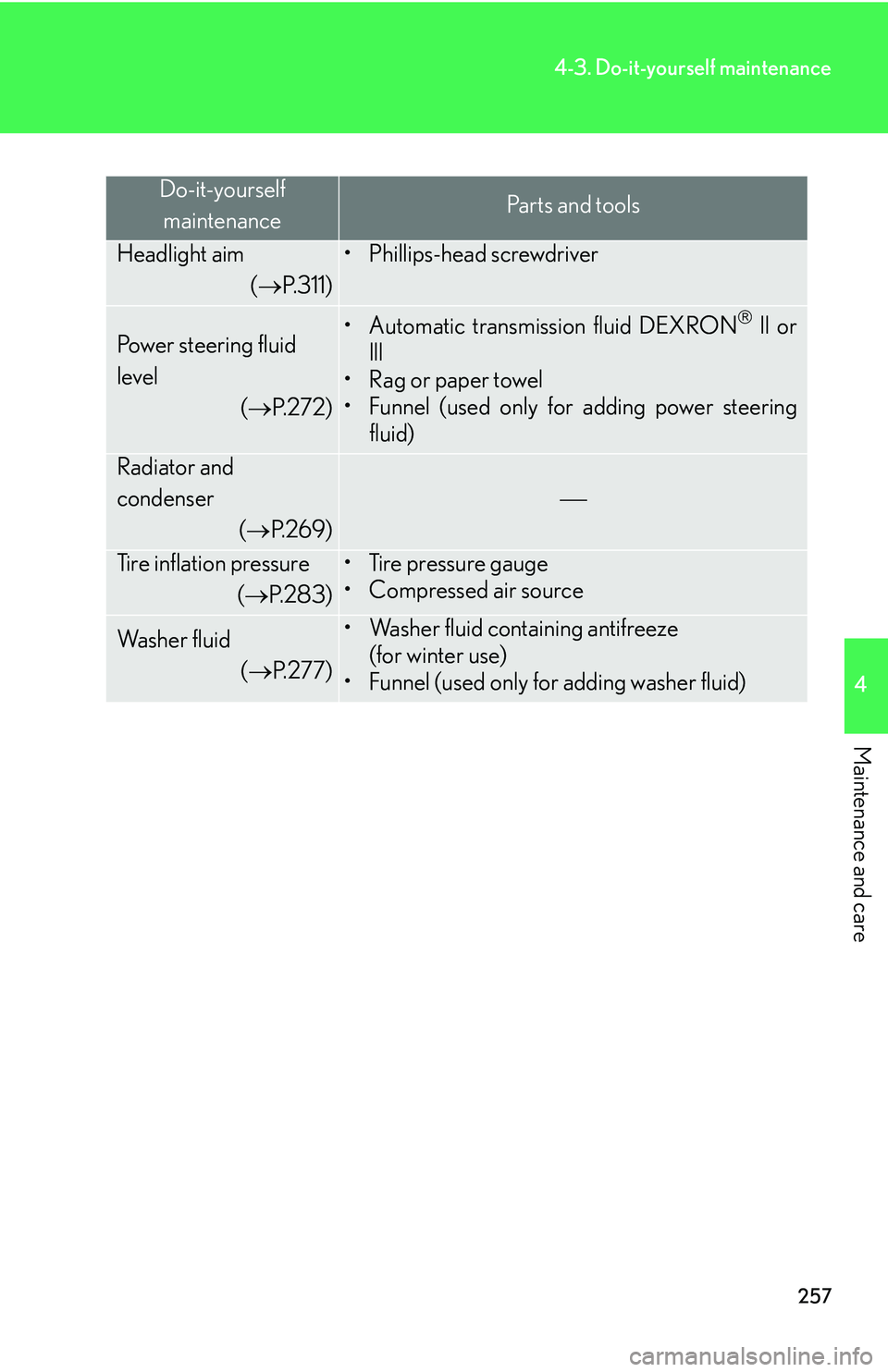
Do-it-yourself maintenancePa r t s a n d t o o l s
Headlight aim
( P.311)
• Phillips-head screwdriver
Power steering fluid
level
(P. 2 7 2 )
• Automatic transmission fluid DEXRON ll or
lll
• Rag or paper towel
• Funnel (used only for adding power steering fluid)
Radiator and
condenser
(P. 2 6 9 )
Tire inflation pressure
(P. 2 8 3 )
• Tire pressure gauge
• Compressed air source
Wa s h e r f l u i d
(P. 2 7 7 )
• Washer fluid containing antifreeze
(for winter use)
• Funnel (used only for adding washer fluid)
Page 288 of 419

272
4-3. Do-it-yourself maintenance
Power steering fluid
■Fluid level
The fluid level should be within the
appropriate range.
Full line when cold
Add fluid if at or below line
when cold.
Full line when hot
Add fluid if at or below line
when hot.
Hot : If the vehicle has been driven around 50 mph (80 km/h) for 20 min -
utes (slightly longer in frigid te mper
atures), the fluid is hot (140F -
175
F or 60C - 80C).
Cold : If the engine has not been run for about
five hours, the fluid is cold.
(about room temperature, 50
F - 85F or 10C - 30C).
■ Checking the fluid level
Make sure to check the fluid type and prepare the necessary items before
checking.
Clean all dirt off the reservoir.
Remove the reservoir cap by tu rning it counter
clockwise and
wipe the dipstick clean.
Reinstall the reservoir cap.
Remove the reservoir cap again and look at the fluid le
vel.
1
2
3
4
Fluid typeAutomatic transmission fluid DEXRON II or III
ItemsRag or paper towel and funnel (only for adding fluid)
Page 335 of 419
5When trouble arises
319
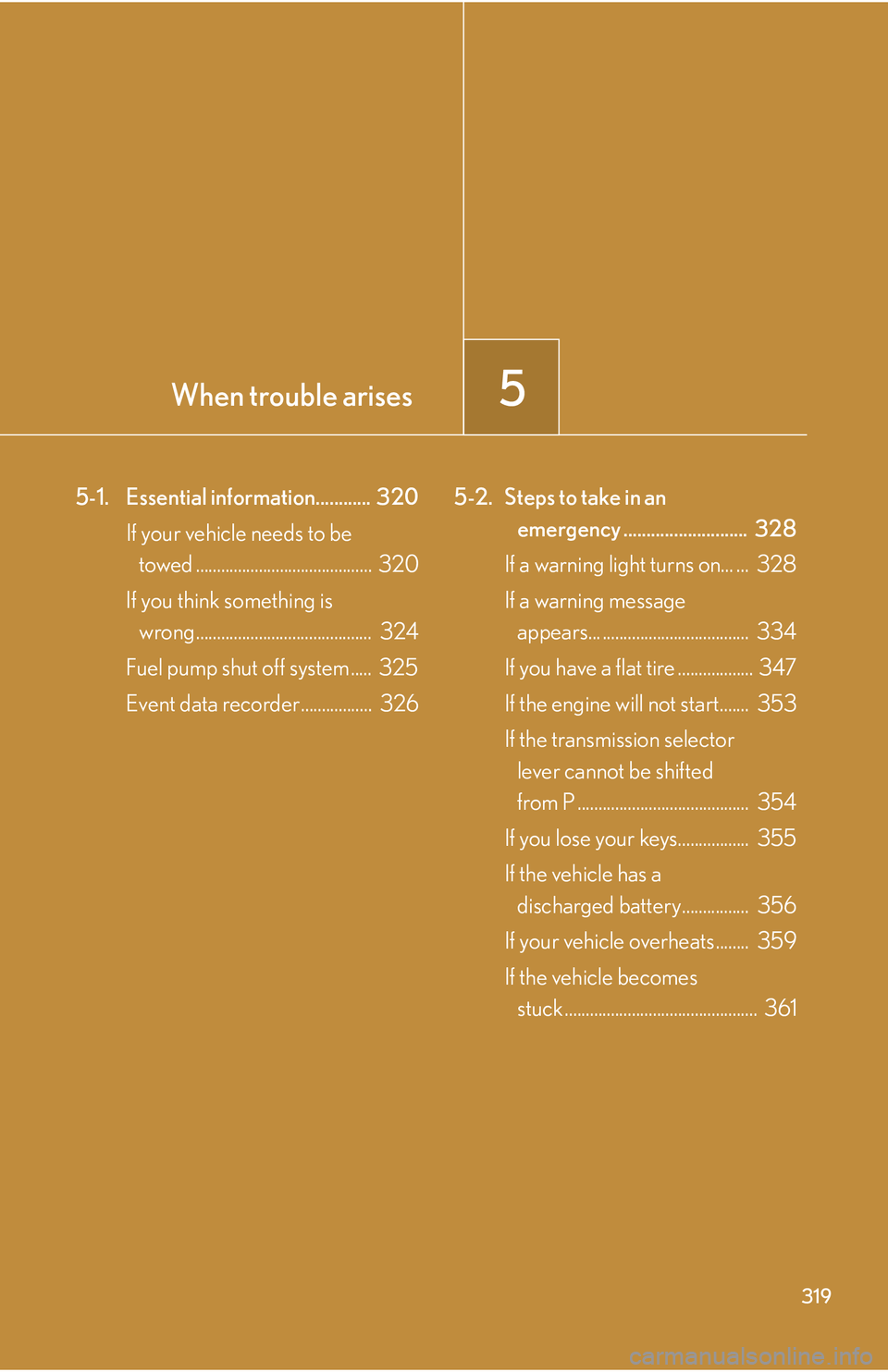
5-1. Essential information............ 320If your vehicle needs to be
towed .......................................... 320
If you think something is
wrong.......................................... 324
Fuel pump shut off system ..... 325
Event data recorder................. 326 5-2. Steps to take in an
emergency ........................... 328
If a warning light turns on... ... 328
If a warning message
appears... ................................... 334
If you have a flat tire .................. 347
If the engine will not star
t....... 353
If the transmission selector
lever cannot be shifted
from P ......................................... 354
If you lose your keys................. 355
If the vehicle has a
discharged battery................ 356
If your vehicle overheats........ 359
If the vehicle becomes
stuck .............................................. 361
Page 336 of 419
320
5-1. Essential information
If your vehicle needs to be towed
Never tow your vehicle with a sling
type truck.
We recommend having your vehicle
t
owed with a wheel lift type truck or
flat bed truck by your Lexus dealer
or a commercial tow truck service.
Use a safety chain system for all towing, and abide by the state/provincial and
loca
l laws.
If towing from the rear, the vehicle’s fr
ont wheels and axles on the ground
must be in good condition. ( P.322)
If they are damaged, use a to wing dolly
or flat bed truck.
■Before towing
In the following cases, there may be a problem with your transmission. Con -
tact your Lexus dealer before towing.
• The engine is running, but the vehicle will not move.
• The vehicle makes an abnormal sound.
Page 337 of 419

5
When trouble arises
321
5-1. Essential information
Emergency towing
If a tow truck is not available in an emergency, your vehicle may be tem-
porarily towed by a cable or chain secur
ed to the emergency towing eye-
let(s). This should only attempted on har
d, surfaced roads for short
distance at low speeds.
A driver must be in the vehicle to steer and oper
ate the brakes. The vehi-
cle's wheels, drive train, axles, steer ing and br
akes must be in good con-
dition.
Towing eyelet
1
■Emergency towing proceduresRelease the parking brake.
Put the transmission in “N”.
The ignition switch must be in ACC (eng
ine off) or ON (engine running).
CAUTION
■Caution while towing
●Use extreme caution when towing the vehi cle. Avoid sudden starts or erratic
driving maneuvers which place excessive stress on the emergency towing eyelets
and the cable or chain.
●If the engine is not running, the power assi st for the brakes and steering will not
function, making steering and braking more difficult.
STEP1
STEP2
STEP3
Page 338 of 419
322
5-1. Essential information
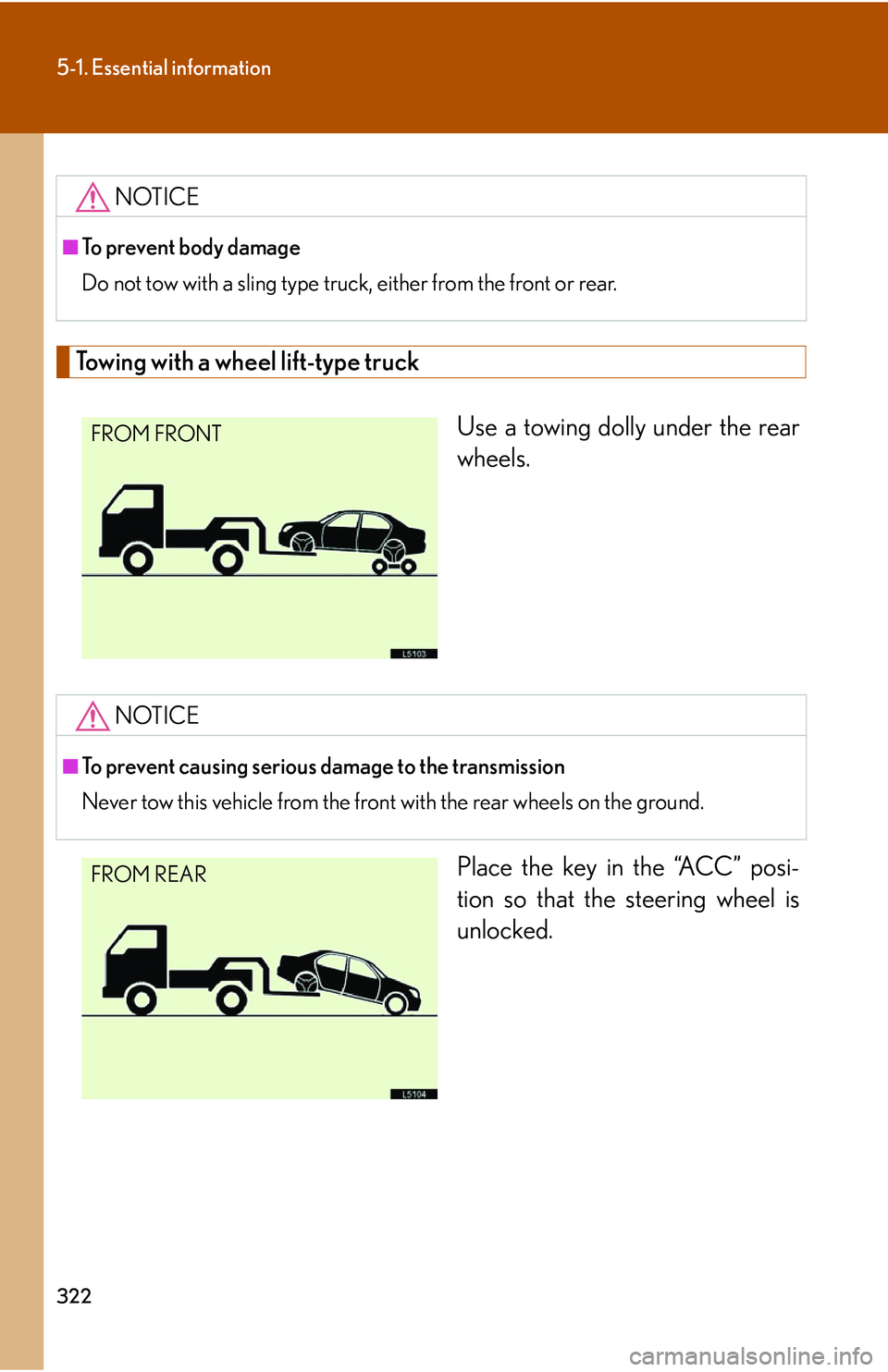
Towing with a wheel lift-type truck
Use a towing dolly under the rear
wheels.
Place the key in the “ACC” posi-
tion so that the steering wheel is
unlock
ed.
NOTICE
■To prevent body damage
Do not tow with a sling type truck, either from the front or rear.
FROM FRONT
NOTICE
■To prevent causing serious damage to the transmission
Never tow this vehicle from the front with the rear wheels on the ground.
FROM REAR
Page 339 of 419
5
When trouble arises
323
5-1. Essential information
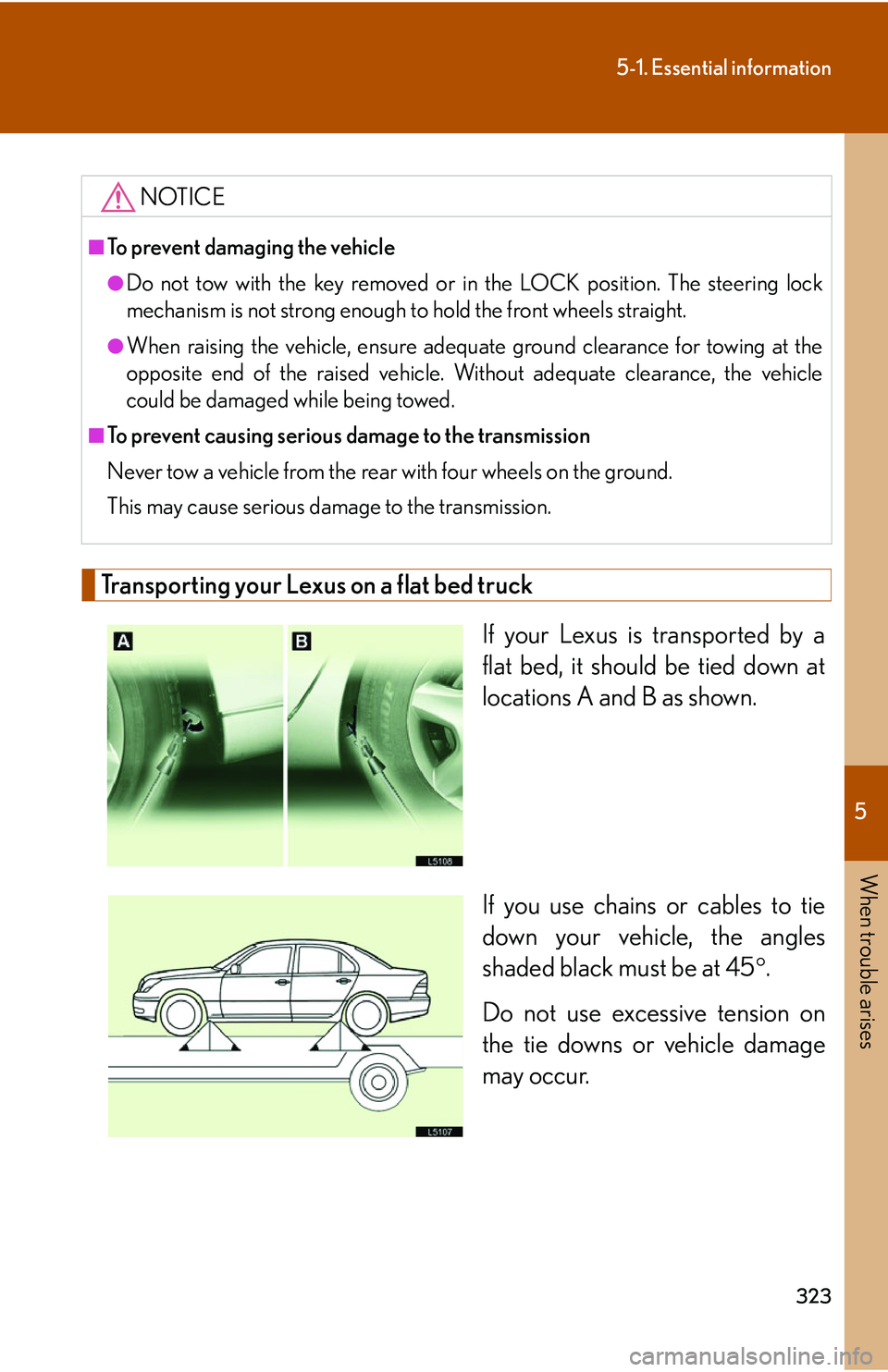
Transporting your Lexus on a flat bed truck
If your Lexus is transported by a
flat bed, it should be tied down at
locations A and B as shown.
If you use chains or cables to tie
do
wn your vehicle, the angles
shaded black must be at 45 .
Do not use excessive tension on
the tie do
wns or vehicle damage
may occur.
NOTICE
■To prevent damaging the vehicle
●Do not tow with the key removed or in the LOCK position. The steering lock
mechanism is not strong enough to hold the front wheels straight.
●When raising the vehicle, ensure adequate ground clearance for towing at the
opposite end of the raised vehicle. Wi thout adequate clearance, the vehicle
could be damaged while being towed.
■To prevent causing serious damage to the transmission
Never tow a vehicle from the rear with four wheels on the ground.
This may cause serious dama g
e to the transmission.