2006 KIA Sportage lock
[x] Cancel search: lockPage 233 of 354
521
Driving tips
1
2
3
4
5
6
7
8
9
Approaching a hill
When you approach a hill, you need
to decide if it’s one of those hills
that’s just too steep to climb,
descend, or cross. Steepness can be
difficult to judge. On a very small hill,
for example, there may be a smooth,
constant incline with only a small
change in elevation where you can
easily see all the way to the top. On
a large hill, the incline may get steep-
er as you near the top, but you may
not see this because the crest of the
hill is hidden by bushes, grass, or
shrubs.Here are some other things to con-
sider as you approach a hill:
Is there a constant incline, or does
the hill get sharply steeper in
places?
Is there good traction on the hill- side, or will the surface cause tire
slipping?
Is there a straight path up or down the hill so you won’t have to make
turning maneuvers?
Are there obstructions on the hill that can block your path (boulders,
trees, logs or ruts)?
What’s beyond the hill? Is there a cliff, an embankment, a drop-off, or
a fence? Get out of the vehicle and
walk the hill if you are unsure. It’s
the smart way to find out. Is the hill simply too rough? Steep
hills often have ruts, gullies,
troughs, and exposed rocks
because they are more susceptible
to the effects of erosion.
How have weather conditions affected the terrain? Is there likely
to be mud, snow or ice on the hill?
What time of day is it? Are temper- atures dropping so that wet sur-
faces will start to freeze?
KM CAN (ENG) 5 new.qxd 7/29/05 9:38 AM Page 21
Page 235 of 354
523
Driving tips
1
2
3
4
5
6
7
8
9
Stalling while driving uphill
What should I do if my vehicle stalls,
or is about to stall, and I can’t make
it up the hill?
If your vehicle stalls, or is about to
stall while driving uphill, there are
some things you should do, and
there are some things you must not
do. First, here’s what you should do:
Push the brake pedal to stop thevehicle and keep it from rolling
backwards. Also, apply the parking
brake.
If your engine is still running, shift the transaxle into reverse, release
the parking brake, and slowly back
down the hill in reverse. If your engine has stopped run-
ning, you’ll need to restart it. With
the brake pedal depressed and the
parking brake still applied, shift a
manual transaxle to N (Neutral), or
an automatic transaxle to P (Park)
and restart the engine. Then, shift
to reverse, release the parking
brake, and slowly back down the
hill in reverse.
As you are backing down the hill, put your left hand on the steering
wheel at the 12 o’clock position.
This way, you’ll be able to tell if
your wheels are straight or turned
to the left or right as you back
down. Here are some things you must not
do if you stall, or are about to stall,
when going up a hill.
Never attempt to prevent a stall by
depressing the clutch or shifting to
N (Neutral) to “rev-up” the engine
and regain forward momentum.
This won’t work. Your vehicle will
roll backwards very quickly and
you could go out of control or roll
over.
Instead, apply the brake to stop the
vehicle. Then apply the parking
brake. Shift into reverse, release the
parking brake, and slowly back
down.
KM CAN (ENG) 5 new.qxd 7/29/05 9:38 AM Page 23
Page 238 of 354
Driving tips26
5
1
2
3
4
5
6
7
8
9
Avoid turns that take you across the
incline of the hill. A hill that’s not too
steep to drive down may be too
steep to drive across. You could roll
over if you don’t drive straight down.
Never go downhill with the clutch
pedal depressed. This is called “free-
wheeling.” Your brakes will have to do
all the work and could overheat and
fade. If your wheels lock up during down-
hill braking, you may feel the vehicle
starting to slide sideways. To regain
your direction, just ease off the
brakes and steer to keep the front of
the vehicle pointing straight downhill.
CAUTION -
Downhill
Before beginning to go down-
hill, it is critical that you ensure
that no cargo can shift forward
while you are heading downhill.
Such shifting could either
endanger you and your occu-
pants, or interfere with your
ability to control the vehicle.
WARNING
- Braking
Heavy braking when going
down a hill can cause your
brakes to overheat and fade.
This could cause loss of control
and a serious accident. Apply
the brakes lightly when
descending a hill and use a low
gear to keep vehicle speed
under control.
CAUTION -
Wheel locking
Avoid braking so hard that you
lock the wheels when going
downhill. If your front wheels
are locked, you can’t steer your
vehicle.
KM CAN (ENG) 5 new.qxd 7/29/05 9:38 AM Page 26
Page 260 of 354
Driving tips48
5
1
2
3
4
5
6
7
8
9
6. Return to the vehicle and firmly
press and release the pro-
grammed HomeLink button up to
three times. The rolling code
equipped device should now rec-
ognize the HomeLink signal and
activate when the HomeLink but-
ton is pressed. The remaining two
buttons may now be programmed
if this has not previously been
done. Refer to the “Programming”
portion of this text.
Operating HomeLink To operate, simply press the pro-
grammed HomeLink button.
Activation will now occur for the
trained product (garage door, securi-
ty system, entry door lock, estate
gate, or home or office lighting). For
convenience, the hand-held trans-
mitter of the device may also be used
at any time. The HomeLink Wireless
Controls System (once programmed)
or the original hand-held transmitter
may be used to activate the device
(e.g. garage door, entry door lock,
etc.). In the event that there are still
programming difficulties, contact
HomeLink at 1-800-355-3515 or on
the internet at www.homelink.com.
Erasing programmed
HomeLink buttonsTo erase the three programmed but-
tons (individual buttons cannot be
erased):
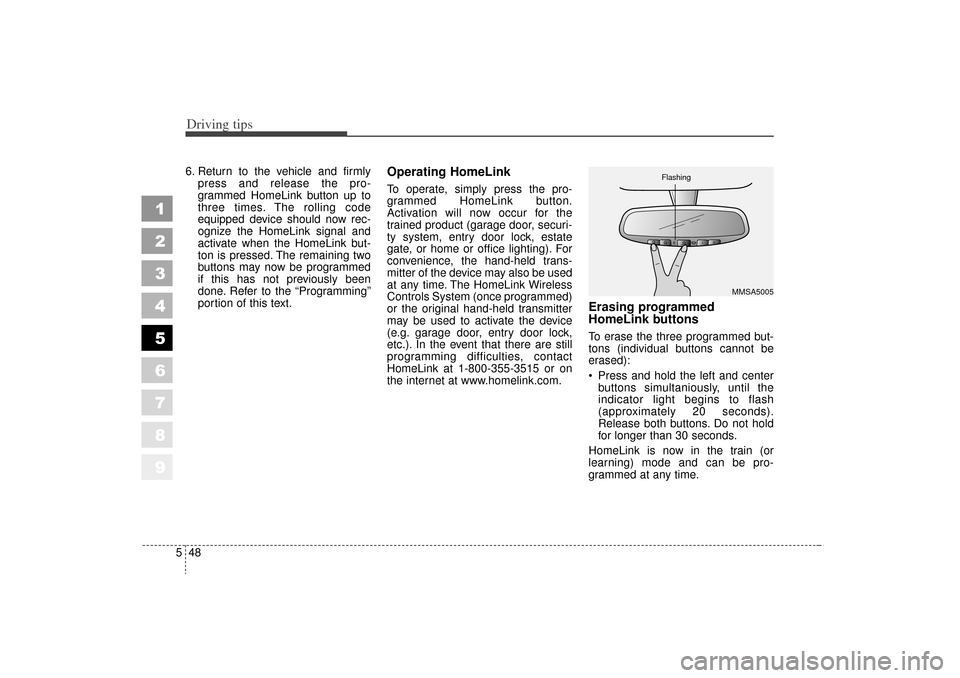
Press and hold the left and center
buttons simultaniously, until the
indicator light begins to flash
(approximately 20 seconds).
Release both buttons. Do not hold
for longer than 30 seconds.
HomeLink is now in the train (or
learning) mode and can be pro-
grammed at any time.
MMSA5005
Flashing
KM CAN (ENG) 5 new.qxd 7/29/05 9:39 AM Page 48
Page 272 of 354
In case of an emergency86Fuse replacement ✽
✽NOTICEDo not use a screwdriver or any
other metal object to remove fuses
because it may cause a short circuit
and damage the system.
Driver’s side panel1. Turn the ignition switch and all
other switches off.
2. Open the left side trim of the dri- ver’s instrument panel. Do not
remove the trim from the panel
completely.
3. Pull the suspected fuse straight out. Use the removal tool provided
in the fuse panel.
4. Check the removed fuse; replace it if it is blown.
Spare fuses are provided in the
fuse panel. 5. Push in a new fuse of the same
rating, and make sure it fits tightly
in the clips.
If it fits loosely, consult an Authorized
Kia Dealer.
If you do not have a spare, use a
fuse of the same rating from a circuit
you may not need for operating the
vehicle, such as the cigar lighter
fuse.
If the headlights or other electrical
components do not work and the
fuses are OK, check the fuse block in
the engine compartment. If a fuse is
blown, it must be replaced.
1
2
3
4
5
6
7
8
9
1KMB4003
1KMA4004
WARNING
- Fuse replace- ment
Never replace a fuse with any- thing but another fuse of the
same rating.
A higher capacity fuse could cause damage possibly a fire.
Never install a wire instead of the proper fuse - even as a
temporary repair. It may cause
extensive wiring damage and
possibly a fire.
KM CAN (ENG) 6 new.qxd 7/29/05 9:40 AM Page 8
Page 275 of 354
611
In case of an emergency
1
2
3
4
5
6
7
8
9
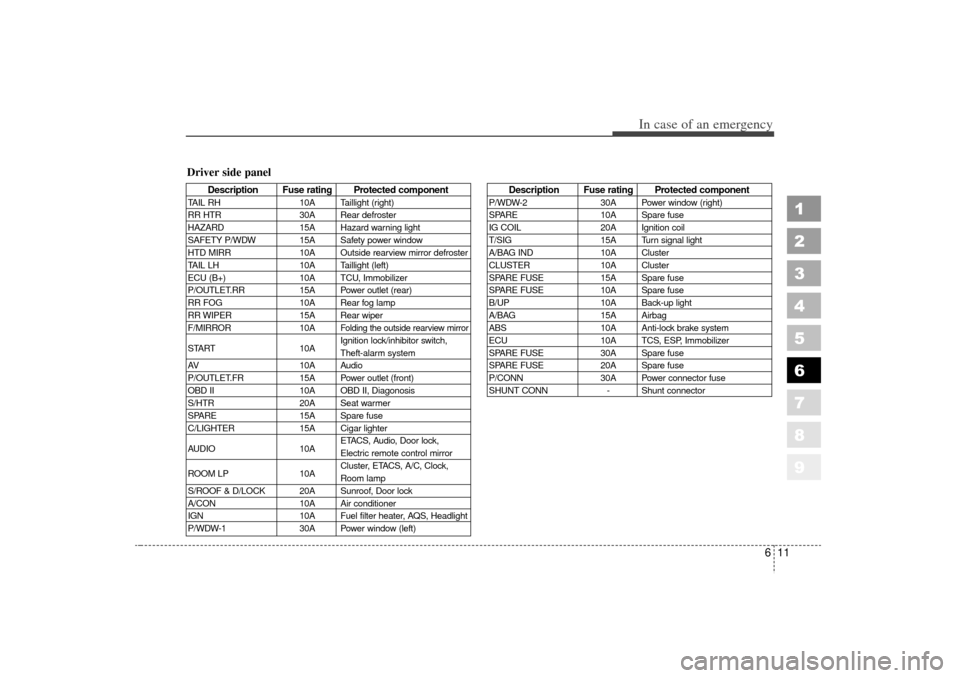
Description Fuse rating Protected component
TAIL RH10A Taillight (right)
RR HTR 30A Rear defroster
HAZARD 15A Hazard warning light
SAFETY P/WDW 15A Safety power window
HTD MIRR 10A Outside rearview mirror defroster
TAIL LH 10A Taillight (left)
ECU (B+) 10A TCU, Immobilizer
P/OUTLET.RR 15A Power outlet (rear)
RR FOG 10A Rear fog lamp
RR WIPER 15A Rear wiper
F/MIRROR 10A
Folding the outside rearview mirror
START10AIgnition lock/inhibitor switch,
Theft-alarm system
AV 10A Audio
P/OUTLET.FR 15A Power outlet (front)
OBD II 10A OBD II, Diagonosis
S/HTR 20A Seat warmer
SPARE 15A Spare fuse
C/LIGHTER 15A Cigar lighter
AUDIO 10AETACS, Audio, Door lock,
Electric remote control mirror
ROOM LP 10ACluster, ETACS, A/C, Clock,
Room lamp
S/ROOF & D/LOCK 20A Sunroof, Door lock
A/CON 10A Air conditioner
IGN 10A Fuel filter heater, AQS, Headlight
P/WDW-1 30A Power window (left)
Description Fuse rating Protected component
P/WDW-230A Power window (right)
SPARE 10A Spare fuse
IG COIL 20A Ignition coil
T/SIG 15A Turn signal light
A/BAG IND 10A Cluster
CLUSTER 10A Cluster
SPARE FUSE 15A Spare fuse
SPARE FUSE 10A Spare fuse
B/UP 10A Back-up light
A/BAG 15A Airbag
ABS 10A Anti-lock brake system
ECU 10A TCS, ESP, Immobilizer
SPARE FUSE 30A Spare fuse
SPARE FUSE 20A Spare fuse
P/CONN 30A Power connector fuse
SHUNT CONN - Shunt connector
Driver side panel
KM CAN (ENG) 6 new.qxd 7/29/05 9:40 AM Page 11
Page 277 of 354

613
In case of an emergency
1
2
3
4
5
6
7
8
9
Power connector fuse
Your vehicle is equipped with a
power connector fuse to prevent bat-
tery discharge if your vehicle is
parked without being operated for
prolonged periods. Use the following
procedures before parking the vehi-
cle for prolonged period.
1. Turn off the engine.
2. Turn off the headlights and taillights.
3. Open the driver’s side panel cover and pull up the “P/CONN 30A”.
✽ ✽NOTICE If the power connector fuse is
pulled up from the fuse panel, the
warning chime, audio, clock and
interior lamps, etc., will not oper-
ate. Some items must be reset after
replacement. (Refer to “Items to
be reset···.” on page 7-32)
Even though the power connector fuse is pulled up, the battery can
still be discharged by operation of
the headlights or other electrical
devices.
1KMA4005
Power connector fuse
KM CAN (ENG) 6 new.qxd 7/29/05 9:40 AM Page 13
Page 282 of 354
In case of an emergency18
6
1
2
3
4
5
6
7
8
9
When your vehicle is being
towed by another vehicle
other than a tow truck (in case
of an emergency) Turn the ignition switch to ACC so
the steering wheel isn’t locked.
Place the transaxle shift lever in N (Neutral).
Release the parking bake.
Vehicles equipped with automatic transaxles should not exceed 45
km/h (28 mph) and should not be
towed more than 80 km (50 miles).
Vehicles equipped with manual transaxle should not be towed in
excess of 88 km/h (55 mph) and
should not be towed more than
645 km (400 miles). Press the brake pedal with more
force than normal since you will
have reduced brake performance.
More steering effort will be required because the power steer-
ing system will be disabled.
If you are driving down a long hill, the brakes may overheat and brake
performance will be reduced. Stop
often and let the brakes cool off.
✽ ✽ NOTICETo prevent internal damage to the
transaxle, never tow your vehicle
from the rear (backwards) with all
four tires in contact with the sur-
face.
Tips for towing a stuck vehicleThe following methods are effective
when your vehicle is stuck in mud,
sand or similar substances that pre-
vent the vehicle from being driven
out under its own power.
Remove the soil and sand, etc.
from the front and the back of the
tires.
Place a stone or wood under the tires.
KM CAN (ENG) 6 new.qxd 7/29/05 9:40 AM Page 18