2006 KIA Sportage engine
[x] Cancel search: enginePage 235 of 354
523
Driving tips
1
2
3
4
5
6
7
8
9
Stalling while driving uphill
What should I do if my vehicle stalls,
or is about to stall, and I can’t make
it up the hill?
If your vehicle stalls, or is about to
stall while driving uphill, there are
some things you should do, and
there are some things you must not
do. First, here’s what you should do:
Push the brake pedal to stop thevehicle and keep it from rolling
backwards. Also, apply the parking
brake.
If your engine is still running, shift the transaxle into reverse, release
the parking brake, and slowly back
down the hill in reverse. If your engine has stopped run-
ning, you’ll need to restart it. With
the brake pedal depressed and the
parking brake still applied, shift a
manual transaxle to N (Neutral), or
an automatic transaxle to P (Park)
and restart the engine. Then, shift
to reverse, release the parking
brake, and slowly back down the
hill in reverse.
As you are backing down the hill, put your left hand on the steering
wheel at the 12 o’clock position.
This way, you’ll be able to tell if
your wheels are straight or turned
to the left or right as you back
down. Here are some things you must not
do if you stall, or are about to stall,
when going up a hill.
Never attempt to prevent a stall by
depressing the clutch or shifting to
N (Neutral) to “rev-up” the engine
and regain forward momentum.
This won’t work. Your vehicle will
roll backwards very quickly and
you could go out of control or roll
over.
Instead, apply the brake to stop the
vehicle. Then apply the parking
brake. Shift into reverse, release the
parking brake, and slowly back
down.
KM CAN (ENG) 5 new.qxd 7/29/05 9:38 AM Page 23
Page 236 of 354
Driving tips24
5
1
2
3
4
5
6
7
8
9
Stalled on a steep uphill
If your vehicle stalls and you can’t
back down the hill, try this: Set the
parking brake, put your transaxle in 1
(First) gear or P (Park), and turn the
engine off. Leave the vehicle and get
some help. If your vehicle is at an
angle to the slope of the hill, exit the
vehicle on the uphill side and stay
clear of the path the vehicle would
take if it rolled downhill. Leave it in 1
(First) gear for manual transaxle or P
(Park) for automatic transaxle.
CAUTION -
Stalling
Never attempt to turn around if
you are about to stall when
going up a hill. If the hill is steep
enough to stall your vehicle, it’s
steep enough to cause you to
roll over if you turn around. If
you can’t make it up, you must
back down the hill.
WARNING
- Exiting vehicle
Getting out on the downhill
(low) side of a vehicle stopped
across an incline is dangerous.
If the vehicle rolls over, you
could be crushed or fatally
injured. Always get out on the
uphill (high) side of the vehicle
and stay well clear of the
rollover path.
KM CAN (ENG) 5 new.qxd 7/29/05 9:38 AM Page 24
Page 237 of 354
525
Driving tips
1
2
3
4
5
6
7
8
9
Driving downhill
Going downhill can be considerably
more dangerous than driving uphill.
When off-roading takes you downhill,
you’ll want to consider many of the
same things you thought about
before you went uphill. As a brief
reminder, those include:
How steep is the downhill? Will I beable to maintain vehicle control?
What’s the surface like? Smooth? Rough? Slippery? Hard-packed
dirt? Gravel?
Are there hidden surface obsta- cles? Ruts? Logs? Boulders?
What’s at the bottom of the hill? Is there a hidden creek bank or even
a river bottom with large rocks?
Have changes in the weather con- ditions and their effect on the ter-
rain since you went uphill made
your task more difficult? Once you have decided that you can
go down a hill safely, try to keep your
vehicle headed straight down, and
use a low gear. This way, engine
braking can help your brakes so they
won’t have to do all the work.
Descend slowly, keeping your vehi-
cle under control at all times.
WARNING
- Leaving vehi-
cle
If you are going to leave your
vehicle, set the parking brake
and shift a manual transaxle to
1(First), or an automatic
transaxle to P (Park).
KM CAN (ENG) 5 new.qxd 7/29/05 9:38 AM Page 25
Page 239 of 354
527
Driving tips
1
2
3
4
5
6
7
8
9
Stalling downhill
Stalling is much more likely to hap-
pen going uphill. But if it happens
going downhill, here’s what to do.
Stop your vehicle by applying thebrakes. Then apply the parking
brake.
Move the shift lever to P (Park) in automatic transaxle or shift to N
(Neutral) in manual transaxle and,
while still braking, restart the
engine.
Shift back to a low gear, release the parking brake, and drive
straight down.
If the engine won’t start, get out and seek help. Exit on the uphill
side of the vehicle and stay clear of
the path the vehicle would take if it
rolled downhill. Driving across an incline
Sooner or later, an off-road trail will
probably go across the incline of a
hill. If this happens, you have to
decide whether or not to try to drive
across the incline. Here are some
things to consider:
A hill that can be driven straight up
or down may be too steep to drive
across. When you go straight up or
down a hill, the length of the wheel
base (the distance from the front
wheels to the rear wheels) reduces
the likelihood the vehicle will tum-
ble end over end. But when you
drive across an incline, the much
narrower track width (the distance
between the left and right wheels)
may not prevent the vehicle from
tilting and rolling over. Also, driving
across an incline puts more weight
on the downhill wheels. This could
cause a downhill slide or a rollover. Surface conditions can be a prob-
lem when you drive across a hill.
Loose gravel, muddy spots, or
even wet grass can cause your
tires to slip sideways. If the vehicle
slips sideways, it can hit something
that will tip it (a rock, a rut, etc.) and
cause it to roll over.
Hidden obstacles can make the steepness of the incline even
worse. If you drive across a rock
with the uphill wheels, or if the
downhill wheels drop into a rut or
depression, your vehicle can tilt
even more.
For reasons like these, you need to
decide carefully whether or not to try
to drive across an incline. Just
because the trail goes across the
incline doesn’t mean you have to
drive it.
KM CAN (ENG) 5 new.qxd 7/29/05 9:38 AM Page 27
Page 241 of 354
529
Driving tips
1
2
3
4
5
6
7
8
9
Driving in mud, sand, snow, or
iceWhen you drive in mud, sand, snow,
or ice, your wheels won’t get good
traction. You can’t accelerate as
quickly, turning is more difficult, and
you’ll need longer braking distances.
It’s best to use a low gear when
you’re in mud, the deeper the mud,
the lower the gear. In extremely deep
mud, the idea is to keep your vehicle
moving so you don’t get stuck.
When you drive on sand, you’ll
sense a change in wheel traction.
But it will depend upon how loosely
packed the sand is. On loosely
packed sand (as on beaches or sand
dunes) your tires will tend to sink into
the sand. This has an effect on steer-
ing, accelerating, and braking. You
may want to reduce the air pressure
in your tires slightly when driving on
sand. This will improve traction.
Remember to re-inflate them the first
chance that you have after you leave
the loosely packed sand.
✽ ✽NOTICE In case of loss of traction in mud,
loose soil, or sand, turn the steer-
ing wheel rapidly from side-to-
side. This can help generate addi-
tional traction.
Do not gun the engine. This will cause the tires to spin and dig
down, not forward, and could
bury the vehicle to the frame.
Smooth, easy power is better than
too much power.
WARNING
- Exiting vehi-
cle
Getting out on the downhill
(low) side of a vehicle stopped
across an incline is dangerous.
If the vehicle rolls over, you
could be crushed or fatally
injured. Always get out on the
uphill (high) side of the vehicle
and stay well clear of the
rollover path.
KM CAN (ENG) 5 new.qxd 7/29/05 9:38 AM Page 29
Page 242 of 354
Driving tips30
5
1
2
3
4
5
6
7
8
9
Hard-packed snow and ice offer the
worst tire traction. On these surfaces,
it’s very easy to lose control. On wet
ice, for example, the traction is so
poor that you will even have difficulty
accelerating. And if you do get mov-
ing, poor steering and difficult brak-
ing can easily cause you to slide out
of control.
Driving in waterLight rain causes no special off-road
driving problems. However, heavy
rain can cause flash flooding, and
flood waters demand extreme cau-
tion.
Find out how deep the water is
before you drive through it. If it’s
deep enough to cover your wheel
bearing hubs, axles, or exhaust pipe,
don’t try it, You probably won’t get
through. Also, water that deep can
damage your axle and other vehicle
parts.
If the water isn’t too deep, then drive
through slowly. At fast speeds, water
can splash on your ignition system
and your vehicle can stall. Stalling
can also occur if your tailpipe goes
underwater. As long as your tailpipe
is underwater, you will not be able to
start your engine. When you go
through water, remember that it may
take you longer to stop when your
brakes are wet. If you have driven through water that
was deep enough to cover your
wheel bearing hubs, it may be a
good idea to have an Authorized Kia
dealer or other competent service
center repack your front wheel bear-
ings and examine your rear-end fluid
for evidence of water.
WARNING
- Frozen sur-
faces
Driving on frozen lakes, ponds
or rivers can be dangerous.
Underwater springs, currents
under the ice, or sudden thaws
can weaken the ice. Your vehicle
could fall through the ice and
you and your passengers could
drown. Drive your vehicle on
safe surfaces only.
KM CAN (ENG) 5 new.qxd 7/29/05 9:38 AM Page 30
Page 245 of 354
533
Driving tips
1
2
3
4
5
6
7
8
9
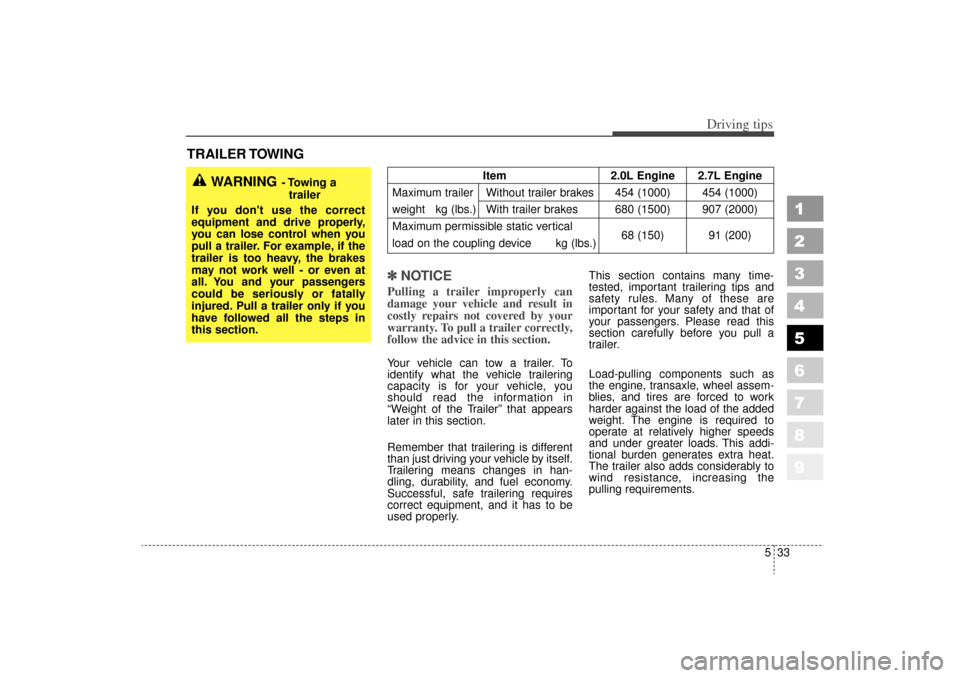
TRAILER TOWING✽ ✽NOTICE
Pulling a trailer improperly can
damage your vehicle and result in
costly repairs not covered by your
warranty. To pull a trailer correctly,
follow the advice in this section. Your vehicle can tow a trailer. To
identify what the vehicle trailering
capacity is for your vehicle, you
should read the information in
“Weight of the Trailer” that appears
later in this section.
Remember that trailering is different
than just driving your vehicle by itself.
Trailering means changes in han-
dling, durability, and fuel economy.
Successful, safe trailering requires
correct equipment, and it has to be
used properly. This section contains many time-
tested, important trailering tips and
safety rules. Many of these are
important for your safety and that of
your passengers. Please read this
section carefully before you pull a
trailer.
Load-pulling components such as
the engine, transaxle, wheel assem-
blies, and tires are forced to work
harder against the load of the added
weight. The engine is required to
operate at relatively higher speeds
and under greater loads. This addi-
tional burden generates extra heat.
The trailer also adds considerably to
wind resistance, increasing the
pulling requirements.
WARNING
- Towing a
trailer
If you don't use the correct
equipment and drive properly,
you can lose control when you
pull a trailer. For example, if the
trailer is too heavy, the brakes
may not work well - or even at
all. You and your passengers
could be seriously or fatally
injured. Pull a trailer only if you
have followed all the steps in
this section.
Item 2.0L Engine 2.7L Engine
Maximum trailer Without trailer brakes 454 (1000) 454 (1000)
weight kg (lbs.) With trailer brakes 680 (1500) 907 (2000)
Maximum permissible static vertical
load on the coupling device kg (lbs.) 68 (150) 91 (200)
KM CAN (ENG) 5 new.qxd 7/29/05 9:38 AM Page 33
Page 246 of 354
Driving tips34
5
1
2
3
4
5
6
7
8
9
If you do decide to pull a trailerHere are some important points if
you decide to pull a trailer:
State, provincial, county and
municipal government have vary-
ing trailering laws. Make sure your
hitch, mirrors, lights and wiring
arrangements are legal, not only
where you live, but also where
you’ll be driving. A good source for
this information is provincial or
local law enforcement agencies.
Consider using a sway control. You can ask a hitch dealer about sway
control.
After your odometer indicates 800 km (500 miles) or more, you can
tow a trailer. For the first 800 km
(500 miles) that you tow a trailer,
don’t drive over 80 km/h (50 mph)
and don’t make starts at full throt-
tle. This helps your engine and
other parts of your vehicle “wear” in
at the heavier loads. Always drive at a safe speed (less
than 100 km/h) commensurate
with road conditions.
On a long uphill grade, do not exceed 70 km/h (45 mph) or the
posted towing speed limit,
whichever is lower.
The important considerations have to do with weight: Weight of the trailer
How heavy can a trailer safely be? It
should never weigh more than the
maximum trailer weight with trailer
brakes. But even that can be too
heavy.
It depends on how you plan to use
your trailer. For example, speed, alti-
tude, road grades, outside tempera-
ture and how much your vehicle is
used to pull a trailer are all important.
The ideal trailer weight can also
depend on any special equipment
that you have on your vehicle.
KM CAN (ENG) 5 new.qxd 7/29/05 9:38 AM Page 34