Page 249 of 312

Use a towing strap less than 5 m
(16 feet) long. Attach a white or red
cloth (about 30 cm (12 inches)
wide) in the middle of the strap for
easy visibility.
Drive carefully so that the towing
strap is not loosened during towing.When Your Vehicle is Being Towed
by Another Vehicle Other Than a
Tow Truck (In Case Of an
Emergency) (2WD Vehicles or
Part-time 4WD Vehicles)
Turn the ignition switch to ACC so
the steering wheel isn’t locked.
Place the transmission shift lever in
N (Neutral).
Place the transfer shift knob for
part-time 4WD operation in the 2HI
position.
Release the parking bake.
Vehicle equipped with automatic
transmissions should not exceed
45km/h (28 mph) and should not be
towed more than 80km (50 miles).
IN CASE OF AN EMERGENCY
6-17
S4BLA613
✽ ✽
NOTICERemove the rear drive shaft if it is
necessary to exceed 45km/h (28
mph) and/or 80km (50 miles). If the
drive shaft cannot be removed, stop
every 80km (50 miles) and start
the engine. Allow the engine to idle
for a few minutes. This will ensure
that the transmission is sufficiently
lubricated.
BL-ENG (CAN)-6.qxd 7/28/05 5:57 PM Page 17
Page 251 of 312

IF YOU HAVE A FLAT TIRE Storing the Jack and Tools
Jack is stored in the compartment of
the cargo area.
Jack handle and wheel lug nut
wrench are located in the cargo area
floor.Removing the Spare Tire
Your spare tire is stored underneath
your vehicle, directly below the cargo
area.
1. Assemble the wheel lug nut
wrench to the jack handle.
2. Open the rear hatch.3. Insert the jack handle into the hole
just above the rear bumper. The
resistance to turning will be felt
when properly engaged.
4. Turn the jack handle counter-clock-
wise until the spare tire reaches
the ground. Turn the jack handle
10~13 revolutions counter-clock-
wise more after the spare tire
reaches the ground, and draw the
spare tire towards rear of vehicle.
Never rotate the jack handle more
than 17 revolutions, otherwise the
spare tire carrier may be damaged.
IN CASE OF AN EMERGENCY
6-19
S2BLA614C
S2BLA628
S2BLA615C
WARNING
Hold the handle firmly and turn
it slowly to lower the spare tire.
The separation of the wrench
from the handle could cause
loss the control and personal
injury.
BL-ENG (CAN)-6.qxd 7/28/05 5:57 PM Page 19
Page 252 of 312
5. Remove the retainer from the cen-
ter of the spare tire.Storing the Spare Tire
1. Lay the tire on the ground with the
valve stem facing up.
2. Place the wheel under the vehicle
and install the retainer through the
wheel center.
3. Turn the handle clockwise until it
clicks.Changing Tires
Jacking instructions
The jack is provided for emergency
tire changing only.
Follow jacking instructions to reduce
the possibility of personal injury.IN CASE OF AN EMERGENCY6-20
S2BLA617A
S2BLA624A
BL-ENG (CAN)-6.qxd 7/28/05 5:57 PM Page 20
Page 254 of 312
4. Remove the wheel lug nut wrench,
jack, jack handle, and spare tire
from the vehicle.
5. Block both the front and rear of the
wheel that is diagonally opposite
the jack position.
6. Loosen the wheel lug nuts counter-
clockwise one turn each, but do
not remove any nut until the tire
has been raised off the ground.7. Place the jack at the front or rear
jacking position closest to the tire
you are changing.IN CASE OF AN EMERGENCY6-22
S2BLA619A
S2BLA620
WARNING - Changing Tires
To prevent vehicle movements
while changing a tire, always
set the parking brake fully, and
always block the wheel diago-
nally opposite the wheel being
changed.
BL-ENG (CAN)-6.qxd 7/28/05 5:57 PM Page 22
Page 255 of 312
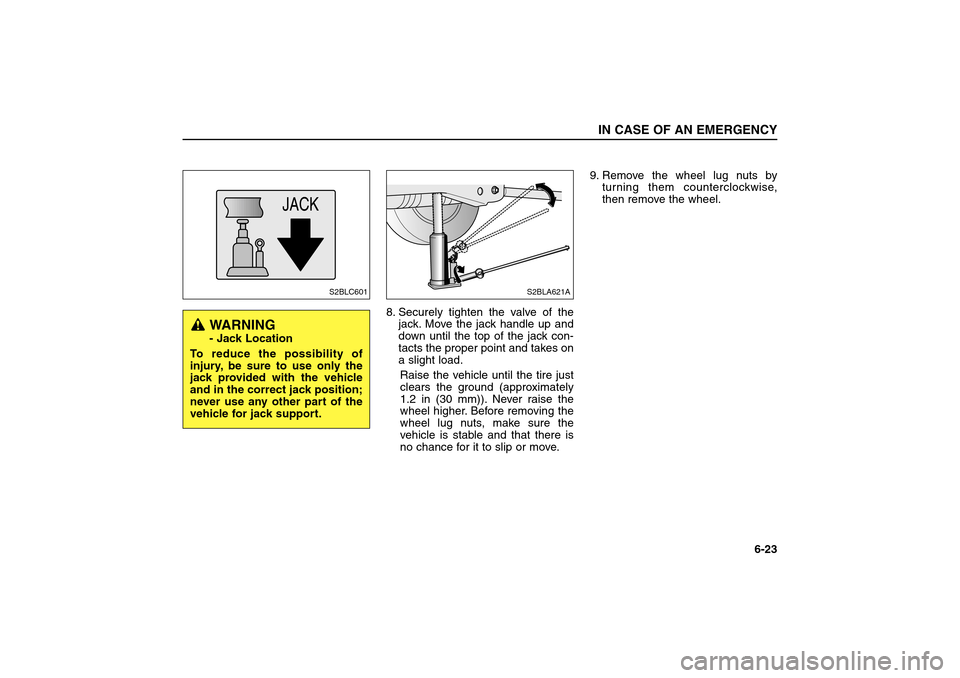
8. Securely tighten the valve of the
jack. Move the jack handle up and
down until the top of the jack con-
tacts the proper point and takes on
a slight load.
Raise the vehicle until the tire just
clears the ground (approximately
1.2 in (30 mm)). Never raise the
wheel higher. Before removing the
wheel lug nuts, make sure the
vehicle is stable and that there is
no chance for it to slip or move.9. Remove the wheel lug nuts by
turning them counterclockwise,
then remove the wheel.
IN CASE OF AN EMERGENCY
6-23
JACK
S2BLC601
S2BLA621A
WARNING - Jack Location
To reduce the possibility of
injury, be sure to use only the
jack provided with the vehicle
and in the correct jack position;
never use any other part of the
vehicle for jack support.
BL-ENG (CAN)-6.qxd 7/28/05 5:57 PM Page 23
Page 262 of 312
MAINTENANCE
7-5
MAINTENANCE SCHEDULE (CONTINUED)
Kilometers or time in months, whichever comes first
× 1,000 km 8 16 24 32 40 48 56 64 72 80 88 96 104 112 120 128
# Months 4 8 12 16 20 24 28 32 36 40 44 48 52 56 60 64
Automatic transaxle fluid (1) I I I R I I I R I I I R I I I R
Chassis & underbody bolts & nuts I I I I I IIIIIIII III
Tire condition & inflation pressure I I I I I IIIIIIII III
Wheel alignment (4)
Tire rotation
Steering operation & linkage I I I I I IIIIIIII III
Power steering fluid & lines I I IIIIII
Driveshaft u-joints (SUV) L L L L L LLLLLLLL LLL
Driveshaft dust boots I I I I I
Seat belts, buckles & anchors I I I I I IIIIIIII III
Lock, hinges & hood latch L L L L L LLLLLLLL LLL
MAINTENANCE
INTERVALS
MAINTENANCE
ITEM
Inspect when abnormal condition noted
Rotate the tires every 12,000 km
Chassis and body (Continued)
BL-ENG (CAN)-7.qxd 7/28/05 5:58 PM Page 5
Page 268 of 312

ENGINE COOLING SYSTEMThe high-pressure cooling system
has a reservoir filled with year-round
antifreeze coolant. The reservoir is
filled at the factory.
Check the antifreeze protection and
coolant level at least once a year, at
the beginning of the winter season,
and before traveling to a colder cli-
mate.Checking the Coolant Level
MAINTENANCE
7-11
WARNING- Removing Radiator Cap
Never attempt to remove the
radiator cap while the engine
is operating. Doing so might
lead to cooling system and
engine damage and could
result in serious personal
injury from escaping hot
coolant or steam. Turn the
engine off and wait until it has
cooled. Even then, use
extreme care when removing
the radiator cap. Wrap a thick
towel around it, and turn it
counterclockwise slowly to
the first stop. Step back while
the pressure is released from
the cooling system. When you
are sure all the pressure has
been released, press down on
the cap, using a thick towel,
and continue turning counter-
clockwise to remove it.
(Continued)
(Continued)
Even if the engine is not oper-
ating, do not remove the radi-
ator cap or the drain plug
while the engine and radiator
are hot. Hot coolant and
steam may still blow out
under pressure, causing seri-
ous injury.
BL-ENG (CAN)-7.qxd 7/28/05 5:58 PM Page 11
Page 270 of 312

For mixture percentage, refer to the
following table1. Turn the coolant reservoir cap
counterclockwise to remove it.
2. Loosen the radiator drain plug and
drain the coolant into a suitable
container.
3. With the plug loose, flush the sys-
tem with running water.
4. Drain the system completely and
retighten the drain plug. Add the
necessary amount of ethylene-
glycol-based coolant and water to
provide the required protection
against freezing and corrosion. In
extremely cold climates, add ethyl-
ene-glycol based coolant in accor-
dance with the instructions of the
manufacturer.5. Run the engine at idle with the
coolant reservoir cap off. Slowly
add additional coolant as neces-
sary.
6. At this point, wait until the engine
reaches normal operating temper-
ature. Depress the accelerator two
or three times; then add coolant as
required. Be careful not to burn
yourself.
7. Replace the coolant reservoir cap.
Inspect all connections for leaks
and recheck the coolant level in the
reservoir. Recheck again after a
few days and add coolant as nec-
essary.
MAINTENANCE
7-13
-15°C (5°F) 35 65
-25°C (-13°F) 40 60
-35°C (-31°F) 50 50
-45°C (-49°F) 60 40Ambient TemperatureMixture Percentage
(volume)
Coolant
SolutionWater
CAUTION
To prevent burning yourself, do
not remove the radiator cap or
loosen the drain plug while the
engine is hot.
BL-ENG (CAN)-7.qxd 7/28/05 5:58 PM Page 13