2006 KIA Sorento lock
[x] Cancel search: lockPage 198 of 312

Use antifreeze-formulated wind-
shield washer fluid. (Do not use
engine coolant antifreeze.)
Do not use the parking brake if it
might freeze. When parking, shift to
1 (First) or R (Reverse) with a man-
ual transmission or P (Park) with an
automatic transmission, and block
the rear wheels.Snow Tires
If you mount snow tires on your Kia,
make sure they are radial tires of the
same size and load range as the orig-
inal tires. Mount snow tires on all four
wheels to balance your vehicle’s han-
dling in all weather conditions. Keep
in mind that the traction provided by
snow tires on dry roads may not be
as high as your vehicle’s original
equipment tires. You should drive
cautiously even when the roads are
clear. Check with the tire dealer for
maximum speed recommendations.Do not install studded tires without
first checking local, provincial and
municipal regulations for possible
restrictions against their use.
DRIVING TIPS
5-11
WARNING- Snow Tire Size
Snow tires should be equivalent
in size and type to the vehicle’s
standard tires. Otherwise, the
safety and handling of your
vehicle may be adversely affect-
ed.
BL-ENG (CAN)-5.qxd 7/28/05 5:56 PM Page 11
Page 208 of 312

Approaching a hill
When you approach a hill, you need
to decide if it’s one of those hills that’s
just too steep to climb, descend, or
cross. Steepness can be difficult to
judge. On a very small hill, for exam-
ple, there may be a smooth, constant
incline with only a small change in
elevation where you can easily see
all the way to the top. On a large hill,
the incline may get steeper as you
near the top, but you may not see this
because the crest of the hill is hidden
by bushes, grass, or shrubs.
Here are some other things to con-
sider as you approach a hill:
Is there a constant incline, or does
the hill get sharply steeper in
places?
Is there good traction on the hill-
side, or will the surface cause tire
slipping? Is there a straight path up or down
the hill so you won’t have to make
turning maneuvers?
Are there obstructions on the hill
that can block your path (boulders,
trees, logs or ruts)?
What’s beyond the hill? Is there a
cliff, an embankment, a drop-off, or
a fence? Get out of the vehicle and
walk the hill if you are unsure. It’s
the smart way to find out.
Is the hill simply too rough? Steep
hills often have ruts, gullies,
troughs, and exposed rocks
because they are more susceptible
to the effects of erosion.
How have weather conditions
affected the terrain? Is there likely
to be mud, snow or ice on the hill?
What time of day is it? Are temper-
atures dropping so that wet sur-
faces will start to freeze?
DRIVING TIPS
5-21
WARNING- Driving on Hills
Many hills are simply too steep
for any vehicle. If you drive up
them, you will stall. If you drive
down them, you can’t control
your speed. In either case, you
could flip over. If you drive
across them, you will roll over.
You could be seriously or fatal-
ly injured. If you have any doubt
about the steepness, don’t drive
up or down the hill, even if it
means that you have to turn
around and find another route.
Re-tracking is a normal part of
safe off-roading.
BL-ENG (CAN)-5.qxd 7/28/05 5:56 PM Page 21
Page 210 of 312

Stalling while Driving Uphill
What should I do if my vehicle stalls,
or is about to stall, and I can’t make it
up the hill?
If your vehicle stalls, or is about to
stall while driving uphill, there are
some things you should do, and there
are some things you must not do.
First, here’s what you should do:
Push the brake pedal to stop the
vehicle and keep it from rolling
backwards. Also, apply the parking
brake.
If your engine is still running, shift
the transmission into reverse,
release the parking brake, and
slowly back down the hill in reverse. If your engine has stopped running,
you’ll need to restart it. With the
brake pedal depressed and the
parking brake still applied, shift a
manual transmission to N (Neutral),
or an automatic transmission to P
(Park) and restart the engine. Then,
shift to reverse, release the parking
brake, and slowly back down the
hill in reverse.
As you are backing down the hill,
put your left hand on the steering
wheel at the 12 o’clock position.
This way, you’ll be able to tell if your
wheels are straight or turned to the
left or right as you back down.
DRIVING TIPS
5-23
WARNING
- Driving over
Hills
Driving to the top (crest) of a hill
at full speed can cause an acci-
dent and result in serious or
fatal injury. There could be a
drop-off, embankment, cliff,
another vehicle or people sit-
ting on the ground. As you near
the top of a hill, slow down and
stay alert.
BL-ENG (CAN)-5.qxd 7/28/05 5:56 PM Page 23
Page 213 of 312
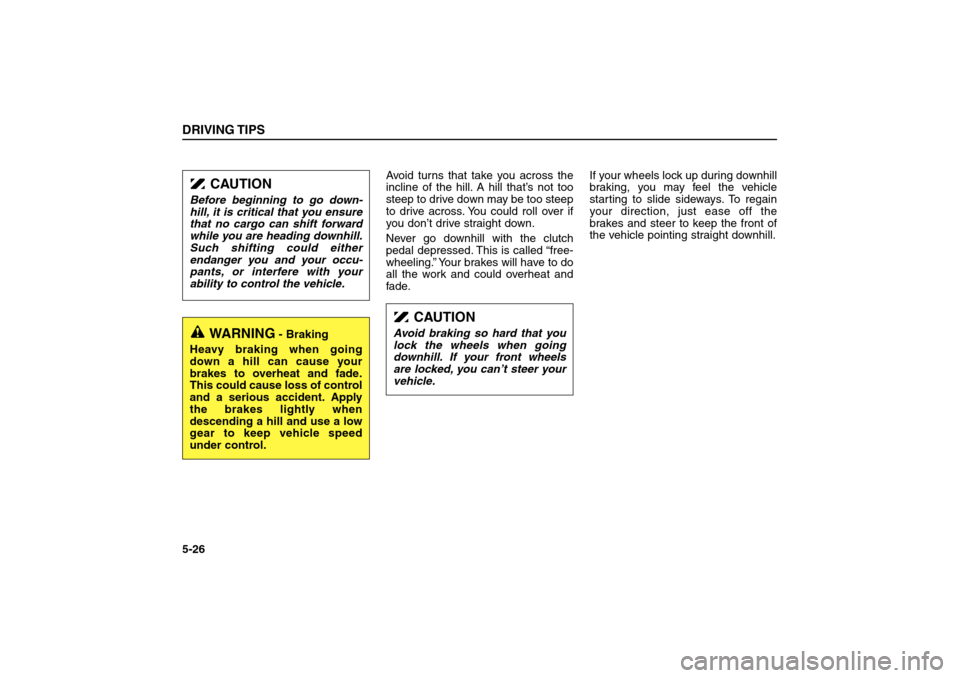
Avoid turns that take you across the
incline of the hill. A hill that’s not too
steep to drive down may be too steep
to drive across. You could roll over if
you don’t drive straight down.
Never go downhill with the clutch
pedal depressed. This is called “free-
wheeling.” Your brakes will have to do
all the work and could overheat and
fade.If your wheels lock up during downhill
braking, you may feel the vehicle
starting to slide sideways. To regain
your direction, just ease off the
brakes and steer to keep the front of
the vehicle pointing straight downhill.
DRIVING TIPS5-26
CAUTION
Before beginning to go down-
hill, it is critical that you ensure
that no cargo can shift forward
while you are heading downhill.
Such shifting could either
endanger you and your occu-
pants, or interfere with your
ability to control the vehicle.
WARNING
- Braking
Heavy braking when going
down a hill can cause your
brakes to overheat and fade.
This could cause loss of control
and a serious accident. Apply
the brakes lightly when
descending a hill and use a low
gear to keep vehicle speed
under control.
CAUTION
Avoid braking so hard that you
lock the wheels when going
downhill. If your front wheels
are locked, you can’t steer your
vehicle.
BL-ENG (CAN)-5.qxd 7/28/05 5:56 PM Page 26
Page 240 of 312

1. Turn the ignition switch and all
other switches off.
2. Pull the suspected fuse straight
out. Use the removal tool provided
on the main fuse box in the engine
compartment fuse relay box (if
equipped). Refer to the fuse panel
chart on the fuse panel cover to
identify the likely problem fuse or
electrical circuit.3. Check the removed fuse; replace it
if it is blown. The number of fuses
vary according to the vehicle
model. Check both the passenger
and engine compartment fuse box
covers.
4. Push in a new fuse of the same rat-
ing, and make sure it fits tightly in
the clips.
If it fits loosely, consult an authorized
Kia dealer.If you do not have a spare, use a fuse
of the same rating from a circuit you
may not need for operating the vehi-
cle, such as the radio or room lamp
fuse.
If the headlights or other electrical
components do not work and the
fuses are OK, check the fuse block in
the engine compartment. If a fuse is
blown, it must be replaced.
1. Turn the ignition switch and all
other switches off.
2. Remove the fuse block cover by
unhooking the tab on one end and
tilting the cover back toward the
other end.
3. Check the fuses. If one is blown,
replace it with a new one of the
same rating.IN CASE OF AN EMERGENCY6-8
FUSE
S2BLA604
BL-ENG (CAN)-6.qxd 7/28/05 5:57 PM Page 8
Page 242 of 312

Fuse panel description
Driver-side kick panelIN CASE OF AN EMERGENCY6-10
( )
( ) (
) ( ) ( )
( )
W/SHD
15AS/ROOF
20A
( )PREMIUM
AUDIO30A
( )S/WARMER20A
(
)
O/S MIRROR10A
(
)
RELAY COIL10ASTART
10A
METER
10AENGINE
10A HAZARD
15AP/SCK(CTR)
15A
CIGAR (FRT)
15A
DRL/OBD-II10AWIPER(FRT)
20A
TCCS
20AROOM LAMP10A FOG (RR)
15AP/SCK
(FRT,RR)
30ASTOP LAMP
20ATURN LAMP
10A
A/BAG
10A
( )TRAILER15A WIPER(RR)
10AACC
10A
22 23 24 19 20 21
16 17 18
13 14 15 10 11 12789 456 123USE THE DESIGNATED FUSES ONLY.
*( ) IS OPTION.
Description FUSE RATING PROTECTED OMPONENT
1. W/SHD 15 A Defroster
2. S/ROOF 20 A Sunroof
3. START 10 A Starting system, PCM, ACC
4. HAZARD 15 A Turn & Hazard flasher unit
5. P/SCK(CTR) 15 A Center power socket
6. CIGAR (FRT) 15 A Cigar lighter
7. DRL/OBD-II 10 A Check connector
8. WIPER (FRT) 20 A Wiper & Washer, Head light,
Front
heater & Aircon, Cooling system, Defroster
9. P/SCK (FRT, RR) 30 A Front and rear power socket
10. RELAY COIL 10 A Relay coil
11. WIPER (RR) 10 A Wiper & Washer, ETWIS, Heater & Aircon,
Trip computer, sunroof
12. ACC 10 A Power mirror, Cigar lighter, Power Socket,
Clock, Keyless entry, Audio
13. TCCS 20 A Transfer case control unit
14. FOG (RR) 15 A Rear fog lamp
15. O/S MIRROR 10 A Electric remote control mirror
16. ROOM LAMP 10 A Instrument cluster, ETWIS, Head light, DRL,
Keyless entry, Room lamp, Sunvior lamp, Clock
17. S/WARMER 20 A Seat warmer
18.
PREMIUM AUDIO
30 A Audio
19. STOP LAMP 20 A Stop light
20. TURN LAMP 10 A Turn & Hazard flasher unit
21. A/BAG 10 A Airbag
22. METER 10 A PCM, ACC, Trip computer, Stop light ,DRL,
ETWIS, Instrument cluster, Front heater & Aircon
23. TRAILER 15 A Trailer accessory
24. ENGINE 10 APCM, Cooling, Speed sensor, Diagnosis connector,
ACC, Instrument cluster, ABS
BL-ENG (CAN)-6.qxd 7/28/05 5:57 PM Page 10
Page 243 of 312

Engine compartment
IN CASE OF AN EMERGENCY
6-11
( )MAIN 120A
HORN20A15A 15A 25A
15A10A 15A 10A 10A 25A 25A
15A 15A 15A 15A 10A
AUDIO
HEAD(HI)
HEAD(LO)
INJECTOR
DEF25A 20A 15A 10ASPARE
SPARE
SPARE
SPARE
MEMORY15A(F/FOG)
ILLUMIP/TRN
P/W(LH)O
2(DN)
O2(UP)
P/W(RH) ECU (EXT)
FUEL
FUSE
PULLER
START
RELAY
MAIN
RELAY
F/BLW
RELAY
P/WIN
RELAY
C/FAN (L)
RELAY A/CON
RELAY
USE THE DESIGNATED FUSES ONLY.
*( ) FOR OPTION.
K52Y
C/F (H)
RELAYC/FAN (2)
RELAY
FUEL
RELAYHORN
RELAY HEAD(LO)
RELAY HEAD(HI)
RELAYTNS
RELAYDEF
RELAY
F/FOG
RELAY
IGN 2
30ABTN 3
40A
ABS
40A
C /FAN (1)
40AF/BLW
30A
C/FAN (2)
30ABTN 1
40A
IGN 1
40ABTN 2
30A( )
( )
HORN 15 A Horm
P/TRN 10 A PCM, Main relay
INJECTOR 15 A PCM
AUDIO 20 A Audio
HEAD (HI) 15 A Head Light
ILLUMI 10 A Key hole illumination
O2(DN) 15 A PCM
HEAD (LO) 15 A Head light
EXT 15 A
DRL, License lamp, Tail lamp, Position lamp, Turn lamp
P/W (LH) 25 A Power window
O2(UP) 15 A PCM
DEF 25 A Defroster
FUEL 15 A Fuel pump relay
P/W (RH) 25 A Power window
ECU 10 A PCM, Cooling
MEMORY 10 A Front heater & aircon, Etwis, Keyless entry system
F/FOG 15 A Front fog lamp
IGN 2 30 A Ignition switch
BTN 3 40 A Turn & Hazard flasher unit, Power door lock
ABS 1 40 A ABS
C/FAN (1) 40 A Cooling system
F/BLW 30 A Front heater & Aircon
C/FAN (2) 30 A Cooling system
BTN 1 40 A Cigar lighter, Power socket
IGN 1 40 A Ignition switch
BTN 2 30 A Power seat, PCM
BL-ENG (CAN)-6.qxd 7/28/05 5:57 PM Page 11
Page 244 of 312

Memory fuse
Your vehicle is equipped with a
“Memory Fuse”to prevent battery
discharge if your vehicle is parked
without being operated for prolonged
periods. Use the following proce-
dures before parking the vehicle for
prolonged period.1. Turn off the engine.
2. Turn off the headlights and tail
lights.
3. Open the main fuse box cover in
engine compartment and pull up
the “AUDIO FUSE 20A”. This will
change the memory fuse mode to
prevent battery discharge.IN CASE OF AN EMERGENCY6-12
S2BLA606B
CAUTION
• If the memory fuse is pulled
up from the fuse box housing,
the key reminder warning
chime, door ajar warning
chime and light, and clock will
not operate. The clock must
be reset.
Even though the memory fuse
is pulled up, the battery can
still be discharged by opera-
tion of the headlights or other
electrical devices.
BL-ENG (CAN)-6.qxd 7/28/05 5:57 PM Page 12