2006 KIA Sorento steering
[x] Cancel search: steeringPage 216 of 312

Driving in Mud, Sand, Snow, or Ice
When you drive in mud, sand, snow,
or ice, your wheels won’t get good
traction. You can’t accelerate as
quickly, turning is more difficult, and
you’ll need longer braking distances.
It’s best to use a low gear when
you’re in mud, the deeper the mud,
the lower the gear. In extremely deep
mud, the idea is to keep your vehicle
moving so you don’t get stuck.
When you drive on sand, you’ll sense
a change in wheel traction. But it will
depend upon how loosely packed the
sand is. On loosely packed sand (as
on beaches or sand dunes) your tires
will tend to sink into the sand.This has an effect on steering, accel-
erating, and braking. You may want to
reduce the air pressure in your tires
slightly when driving on sand. This
will improve traction. Remember to
re-inflate them the first chance that
you have after you leave the loosely
packed sand.Hard-packed snow and ice offer the
worst tire traction. On these surfaces,
it’s very easy to lose control. On wet
ice, for example, the traction is so
poor that you will even have difficulty
accelerating. And if you do get mov-
ing, poor steering and difficult braking
can easily cause you to slide out of
control.
DRIVING TIPS
5-29
✽ ✽
NOTICE In case of loss of traction in mud,
loose soil, or sand, turn the steer-
ing wheel rapidly from side-to-
side. This can help generate addi-
tional traction.
Do not gun the engine. This will
cause the tires to spin and dig
down, not forward, and could
bury the vehicle to the frame.
Smooth, easy power is better than
too much power.
WARNING- Frozen Surfaces
Driving on frozen lakes, ponds
or rivers can be dangerous.
Underwater springs, currents
under the ice, or sudden thaws
can weaken the ice. Your vehicle
could fall through the ice and
you and your passengers could
drown. Drive your vehicle on
safe surfaces only.
BL-ENG (CAN)-5.qxd 7/28/05 5:56 PM Page 29
Page 217 of 312

Driving in Water
Light rain causes no special off-road
driving problems. However, heavy
rain can cause flash flooding, and
flood waters demand extreme cau-
tion.
Find out how deep the water is before
you drive through it. If it’s deep
enough to cover your wheel bearing
hubs, axles, or exhaust pipe, don’t try
it. You probably won’t get through.
Also, water that deep can damage
your axle and other vehicle parts.If the water isn’t too deep, then drive
through slowly. At fast speeds, water
can splash on your ignition system
and your vehicle can stall. Stalling
can also occur if your tailpipe goes
underwater. As long as your tailpipe
is underwater, you will not be able to
start your engine. When you go
through water, remember that it may
take you longer to stop when your
brakes are wet.
If you have driven through water that
was deep enough to cover your
wheel bearing hubs, it may be a good
idea to have an authorized Kia dealer
repack your front wheel bearings and
examine your rear-end fluid for evi-
dence of water.After Off-Road Driving
Remove any brush or debris that has
collected on the underbody, chassis
or under the hood. These accumula-
tions can be a fire hazard.
After driving in mud or sand, clean
and check the brake linings.
Accumulation of mud or sand can
cause glazing and uneven braking.
Check the body structure, steering,
suspension, wheels, tires, and
exhaust system for damage. Also,
check the fuel lines and cooling sys-
tem for any leakage. Your vehicle will
also require more frequent service
due to off-road use.DRIVING TIPS5-30
BL-ENG (CAN)-5.qxd 7/28/05 5:56 PM Page 30
Page 223 of 312

Weight of the Trailer Tongue
The tongue load of any trailer is an
important weight to measure
because it affects the total gross
vehicle weight (GVW) of your vehicle.
This weight includes the curb weight
of the vehicle, any cargo you may
carry in it, and the people who will be
riding in the vehicle. And if you tow a
trailer, you must add the tongue load
to the GVW because your vehicle will
also be carrying that weight.
The trailer tongue should weigh a
maximum of 10% of the total loaded
trailer weight. After you’ve loaded
your trailer, weigh the trailer and then
the tongue, separately, to see if the
weights are proper. If they aren’t, you
may be able to correct them simply
by moving some items around in the
trailer.Too little tongue load can make the
trailer unstable and cause it to sway.
Too much tongue load reduces front-
tire traction and steering control.DRIVING TIPS5-36
WARNING
An improperly loaded trailer
can cause loss of control of
your vehicle.
Never load a trailer with more
weight in the rear than in the
front. The front should be
loaded with approximately
60% of the total trailer load;
the rear should be loaded with
approximately 40% of the total
trailer load.
Never exceed the maximum
weight limits of the trailer or
trailer towing equipment.
Improper loading can result in
damage to your vehicle and/or
personal injury. Check
weights and loading at a com-
mercial scale or highway
patrol office equipped with
scales.
BL-ENG (CAN)-5.qxd 7/28/05 5:56 PM Page 36
Page 226 of 312

Backing up
Hold the bottom of the steering wheel
with one hand. Then, to move the
trailer to the left, just move your hand
to the left. To move the trailer to the
right, move your hand to the right.
Always back up slowly and, if possi-
ble, have someone guide you.
Making turns
When you’re turning with a trailer,
make wider turns than normal. Do
this so your trailer won’t strike soft
shoulders, curbs, road signs, trees,
or other objects. Avoid jerky or sud-
den maneuvers. Signal well in
advance.Turn signals when towing a trailer
When you tow a trailer, your vehicle
has to have a different turn signal
flasher and extra wiring.
The green arrows on your instrument
panel will flash whenever you signal a
turn or lane change. Properly con-
nected, the trailer lights will also flash
to alert other drivers that you’re about
to turn, change lanes, or stop.
When towing a trailer, the green
arrows on your instrument panel will
flash for turns even if the bulbs on the
trailer are burned out. Thus, you may
think drivers behind you are seeing
your signals when, in fact, they are
not. It’s important to check occasion-
ally to be sure the trailer bulbs are still
working. You must also check the
lights every time you disconnect and
then reconnect the wires.Do not connect a trailer lighting sys-
tem directly to your vehicle’s lighting
system.
Use only an approved trailer wiring
harness. Your authorized Kia dealer
can assist you in installing the wiring
harness.
DRIVING TIPS
5-39
WARNING
Using an improper trailer wiring
harness could lead to malfunc-
tioning of your vehicles electri-
cal system and a possible acci-
dent.
BL-ENG (CAN)-5.qxd 7/28/05 5:56 PM Page 39
Page 247 of 312
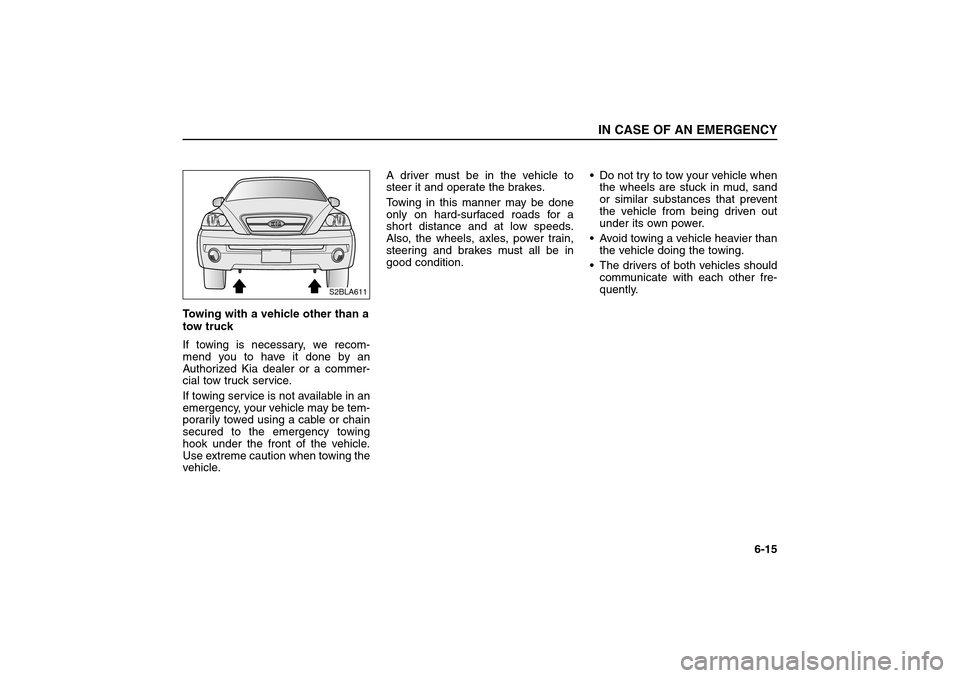
Towing with a vehicle other than a
tow truck
If towing is necessary, we recom-
mend you to have it done by an
Authorized Kia dealer or a commer-
cial tow truck service.
If towing service is not available in an
emergency, your vehicle may be tem-
porarily towed using a cable or chain
secured to the emergency towing
hook under the front of the vehicle.
Use extreme caution when towing the
vehicle.A driver must be in the vehicle to
steer it and operate the brakes.
Towing in this manner may be done
only on hard-surfaced roads for a
short distance and at low speeds.
Also, the wheels, axles, power train,
steering and brakes must all be in
good condition.Do not try to tow your vehicle when
the wheels are stuck in mud, sand
or similar substances that prevent
the vehicle from being driven out
under its own power.
Avoid towing a vehicle heavier than
the vehicle doing the towing.
The drivers of both vehicles should
communicate with each other fre-
quently.
IN CASE OF AN EMERGENCY
6-15
S2BLA611
BL-ENG (CAN)-6.qxd 7/28/05 5:57 PM Page 15
Page 249 of 312

Use a towing strap less than 5 m
(16 feet) long. Attach a white or red
cloth (about 30 cm (12 inches)
wide) in the middle of the strap for
easy visibility.
Drive carefully so that the towing
strap is not loosened during towing.When Your Vehicle is Being Towed
by Another Vehicle Other Than a
Tow Truck (In Case Of an
Emergency) (2WD Vehicles or
Part-time 4WD Vehicles)
Turn the ignition switch to ACC so
the steering wheel isn’t locked.
Place the transmission shift lever in
N (Neutral).
Place the transfer shift knob for
part-time 4WD operation in the 2HI
position.
Release the parking bake.
Vehicle equipped with automatic
transmissions should not exceed
45km/h (28 mph) and should not be
towed more than 80km (50 miles).
IN CASE OF AN EMERGENCY
6-17
S4BLA613
✽ ✽
NOTICERemove the rear drive shaft if it is
necessary to exceed 45km/h (28
mph) and/or 80km (50 miles). If the
drive shaft cannot be removed, stop
every 80km (50 miles) and start
the engine. Allow the engine to idle
for a few minutes. This will ensure
that the transmission is sufficiently
lubricated.
BL-ENG (CAN)-6.qxd 7/28/05 5:57 PM Page 17
Page 250 of 312
Press the brake pedal with more
force than normal since you will
have reduced brake performance.
More steering effort will be required
because the power steering system
will be disabled.
If you are driving down a long hill,
the brakes may overheat and brake
performance will be reduced. Stop
often and let the brakes cool off.Tips for towing a stuck vehicle
The following methods are effective
when your vehicle is stuck in mud,
sand or similar substances that pre-
vent the vehicle from being driven out
under its own power.
Remove the soil and sand, etc.
from the front and the back of the
tires.
Place a stone or wood under the
tires.IN CASE OF AN EMERGENCY6-18✽ ✽
NOTICETo prevent internal damage to the
transmission, never tow your vehi-
cle from the rear (backwards) with
all four tires in contact with the sur-
face.
BL-ENG (CAN)-6.qxd 7/28/05 5:57 PM Page 18
Page 258 of 312

7-1
MAINTENANCEMaintenance Services . . . . . . . . . . . . . . . . . . . . . . . . . . . . . . 7-2
Maintenance Schedule . . . . . . . . . . . . . . . . . . . . . . . . . . . . . 7-3
Owner Maintenance . . . . . . . . . . . . . . . . . . . . . . . . . . . . . . . . 7-7
Engine Compartment . . . . . . . . . . . . . . . . . . . . . . . . . . . . . . . 7-8
Engine Oil and Oil Filter . . . . . . . . . . . . . . . . . . . . . . . . . . . . 7-9
Engine Cooling System . . . . . . . . . . . . . . . . . . . . . . . . . . . . 7-11
Brakes and Clutch . . . . . . . . . . . . . . . . . . . . . . . . . . . . . . . . 7-14
Parking Brake . . . . . . . . . . . . . . . . . . . . . . . . . . . . . . . . . . . . 7-15
Power Steering . . . . . . . . . . . . . . . . . . . . . . . . . . . . . . . . . . . 7-16
Automatic Transmission . . . . . . . . . . . . . . . . . . . . . . . . . . . 7-17
Lubricants and Fluids . . . . . . . . . . . . . . . . . . . . . . . . . . . . . 7-19
Air Cleaner . . . . . . . . . . . . . . . . . . . . . . . . . . . . . . . . . . . . . . 7-20
Wiper Blades . . . . . . . . . . . . . . . . . . . . . . . . . . . . . . . . . . . . 7-21
Battery . . . . . . . . . . . . . . . . . . . . . . . . . . . . . . . . . . . . . . . . . 7-23
Tires and Wheels . . . . . . . . . . . . . . . . . . . . . . . . . . . . . . . . . 7-26
Bulb Replacement . . . . . . . . . . . . . . . . . . . . . . . . . . . . . . . . 7-33
Lubricant Specifications . . . . . . . . . . . . . . . . . . . . . . . . . . . 7-41
Exterior Care . . . . . . . . . . . . . . . . . . . . . . . . . . . . . . . . . . . . 7-43
Interior Care . . . . . . . . . . . . . . . . . . . . . . . . . . . . . . . . . . . . . 7-47
7
BL-ENG (CAN)-7.qxd 7/28/05 5:58 PM Page 1