Page 110 of 312

When driving down a sloping road
with the transaxle in O/D (5th), you
can decrease the vehicle speed with-
out using the brakes by pressing the
O/D OFF button.
When the ignition is switched OFF,
O/D OFF mode is automatically can-
celled.
O/D OFF indicator
This indicator light illuminates in the
instrument panel when the O/D mode
is cancelled.P (Park)
This position locks the transmission
and prevents the front wheels from
rotating. Always come to a complete
stop before shifting into this position.DRIVING YOUR VEHICLE4-12✽ ✽
NOTICEIf the O/D OFF indicator flashes, it
indicates an electrical problem with
the transaxle. Should this occur,
have the vehicle checked by an
Authorized Kia Dealer as soon as
possible.
WARNING
Shifting into P (Park) while the
vehicle is in motion will cause
the drive wheels to lock which
will cause you to lose control
of the vehicle.
Do not use the P (Park) posi-
tion in place of the parking
brake. Always make sure the
shift lever is latched in the P
(Park) position so that it can-
not be moved unless the lock
release button is pushed in,
AND set the parking brake
fully.
(Continued)
(Continued)
Before leaving the driver’s
seat, always make sure the
shift lever is in the P (PARK)
position. Set the parking
brake fully, shut the engine off
and take the key with you.
Unexpected and sudden vehi-
cle movement can occur if
you do not follow these pre-
cautions in the order speci-
fied.
Never leave a child unattend-
ed in a vehicle.
CAUTION
The transmission may be dam-
aged if you shift into P (Park)
while the vehicle is in motion.
BL-ENG (CAN)-4.qxd 7/28/05 5:55 PM Page 12
Page 115 of 312

Transmission ranges
P (Park)
This position locks the transmission
and prevents the front wheels from
rotating. Always come to a complete
stop before shifting into this position.
R (Reverse)
Use this position for backing-up the
vehicle.N (Neutral)
The wheels and transmission are not
locked. The vehicle will roll freely
even on the slightest incline unless
the parking brake or service brakes
are applied.
D (Drive)
This is the normal forward driving
position. The transmission will auto-
matically shift through a 5th gear
sequence, providing the best econo-
my and power.
For extra power when passing anoth-
er vehicle or climbing grades,
depress the accelerator fully, at which
time the transmission will automati-
cally downshift to the next lower gear.
DRIVING YOUR VEHICLE
4-17
CAUTION
The transmission may be dam-
aged if you shift into P (Park)
while the vehicle is in motion.
CAUTION
Always come to a complete
stop before shifting into or out
of R (Reverse); you may dam-
age transmission if you shift
into R while the vehicle is in
motion.
WARNING
Shifting into P (Park) while the
vehicle is in motion will cause
the drive wheels to lock and
you will lose control of the
vehicle.
Always make sure the shift
lever is latched in the P (Park)
position so that it cannot be
moved unless the lock release
button is depressed.
Never leave a child unat-
tached in a vehicle.
BL-ENG (CAN)-4.qxd 7/28/05 5:55 PM Page 17
Page 118 of 312

FOUR WHEEL DRIVE (4WD)For Safe Four-Wheel Drive Operation
Your vehicle allows you to drive in
on-road and off-road conditions.
However, do not try to drive in deep
standing water, mud, or over steep
hills.
When you are driving up or down
hills drive as close to straight up
and down the hill as possible. Use
extreme caution in going up or
down steep hills, since you may flip
your vehicle over depending on the
grade, terrain and water/mud con-
ditions.You must learn how to corner in a
4WD vehicle as soon as possible.
Do not rely on your experience in
conventional 2WD vehicles in
choosing safe cornering speed. You
must drive more slowly.
Drive off-road carefully because
your vehicle may be damaged by
rocks or roots of trees. Become
familiar with the off-road conditions
you are going to drive before you
start.DRIVING YOUR VEHICLE4-20
WARNING- Four Wheel Drive
Driving across the contour of
steep hills can be extremely
dangerous. This danger can
come from slight changes in the
wheel angle which can destabi-
lize the vehicle or, even if the
vehicle is maintaining stability
under power, it can lose that
stability if the vehicle stops its
forward motion. Your vehicle
may roll over without warning
and without time for you to cor-
rect a mistake that could cause
serious injury or death.
CAUTION
Do not grab inside of the steer-
ing wheel when you are driving
off-road. Your arm may be hurt
by a sudden steering maneuver
or from steering wheel rebound
due to impact with objects on
the ground. This may cause you
to lose steering wheel control.
BL-ENG (CAN)-4.qxd 7/28/05 5:55 PM Page 20
Page 124 of 312

For Safe Four-Wheel Drive
Operation
Your vehicle allows you to drive in
on-road and off-road conditions.
However, do not try to drive in deep
standing water, mud, or over steep
hills.
When you are driving up or down
hills, drive as close to straight up
and down the hills as possible. Use
extreme caution in going up or
down steep hills, since you can flip
your vehicle over depending on the
grade, terrain and water/mud con-
ditions.DRIVING YOUR VEHICLE4-26
WARNING
- Four-Wheel
Driving
The conditions on-road or off-
road that demand four-wheel
drive mean all functions of your
vehicle are exposed to more
extreme stress than under high-
way conditions. Slow down,
look ahead, and be ready for
sudden changes in the compo-
sition and traction of the sur-
face under your tires. If you
have any doubt about the safety
of the conditions you are fac-
ing, stop and consider the best
way to proceed. Do not exceed
the ability of yourself or your
vehicle to operate safely.
WARNING
- Steep Hills
Driving across the contour of
steep hills can be extremely
dangerous. This danger can
come from slight changes in the
hill angle which can destabilize
the vehicle. Even if the vehicle
is maintaining stability under
power, it can lose that stability if
the vehicle stops its forward
motion. Your vehicle may roll
over without warning and with-
out time for you to correct a
mistake that could cause seri-
ous injury or death.
HILL1/HILL2 Approach Hill Straight
Up/DownDo not Approach at
Angle
BL-ENG (CAN)-4.qxd 7/28/05 5:55 PM Page 26
Page 129 of 312
In the Event of Brake Failure
If the service brakes should fail to
operate while the vehicle is in motion,
you can make an emergency stop
with the parking brake. The stopping
distance, however, will be much
greater than normal.
DRIVING YOUR VEHICLE
4-31
WARNING- Parking Brake
Pulling on the parking brake
while the vehicle is moving at
normal speeds can cause a
sudden loss of control of the
vehicle. If you must use the
parking brake to stop the vehi-
cle, use great caution in apply-
ing the brake.
WARNING
- Brakes
Do not drive with your foot
resting on the brake pedal.
This will create abnormally
high brake temperatures,
excessive brake lining and
pad wear, and increased stop-
ping distances.
When descending a long or
steep hill, shift to a lower gear
and avoid continuous applica-
tion of the brakes. Continuous
brake application will cause
the brakes to overheat and
could result in a temporary
loss of braking performance.
(Continued)
(Continued)
Wet brakes may result in the
vehicle not slowing down at
the usual rate and pulling to
one side when the brakes are
applied. Applying the brakes
lightly will indicate whether
they have been affected in
this way. Always test your
brakes in this fashion after
driving through deep water. To
dry the brakes, apply them
lightly while maintaining a
safe forward speed until brake
performance returns to nor-
mal.
BL-ENG (CAN)-4.qxd 7/28/05 5:55 PM Page 31
Page 130 of 312

Disc Brake Wear Indicators
Your vehicle has disc brakes.
When your brake pads are worn and
it’s time for new pads, you will hear a
high-pitched warning sound from
your front brakes. You may hear this
sound come and go or it may occur
whenever you depress the brake
pedal.
Please remember that some driving
conditions or climates may cause a
brake squeal when you first apply (or
lightly apply) the brakes. This is nor-
mal and does not indicate a problem
with your brakes.Parking Brake
To set the parking brake, pull the
parking brake handle fully and firmly
upward while applying the service
brake.DRIVING YOUR VEHICLE4-32
S2BLC302B
WARNING
- Brake Wear
This brake wear warning sound
means your vehicle needs serv-
ice. If you ignore this audible
warning, you will eventually
lose braking performance,
which could lead to a serious
accident.
✽ ✽
NOTICETo avoid costly brake repairs, do
not continue to drive with worn
brake pads. Always replace brake
pads or linings as a complete front
or rear axle sets.
CAUTION
Always replace brake pads as
complete front or rear axle sets.
BL-ENG (CAN)-4.qxd 7/28/05 5:55 PM Page 32
Page 131 of 312
To release the parking brake, pull the
handle up slightly and push the
release button. Then lower the handle
to the released position while holding
the button in.Check the brake warning light each
time you start the engine. This warn-
ing will be illuminated when the
engine is running and the parking
brake is set.
Before driving, be sure the parking
brake is fully released and the brake
warning light is off.
DRIVING YOUR VEHICLE
4-33
S2BLC302C
WARNING
To prevent unintentional move-
ment when stopped and leaving
the vehicle, do not use the
gearshift lever in place of the
parking brake. Set the parking
brake AND make sure the
gearshift lever is securely posi-
tioned in 1st (First) gear or R
(Reverse) for manual transmis-
sion equipped vehicles and in P
(Park) for automatic transmis-
sion equipped vehicles.
BL-ENG (CAN)-4.qxd 7/28/05 5:55 PM Page 33
Page 132 of 312
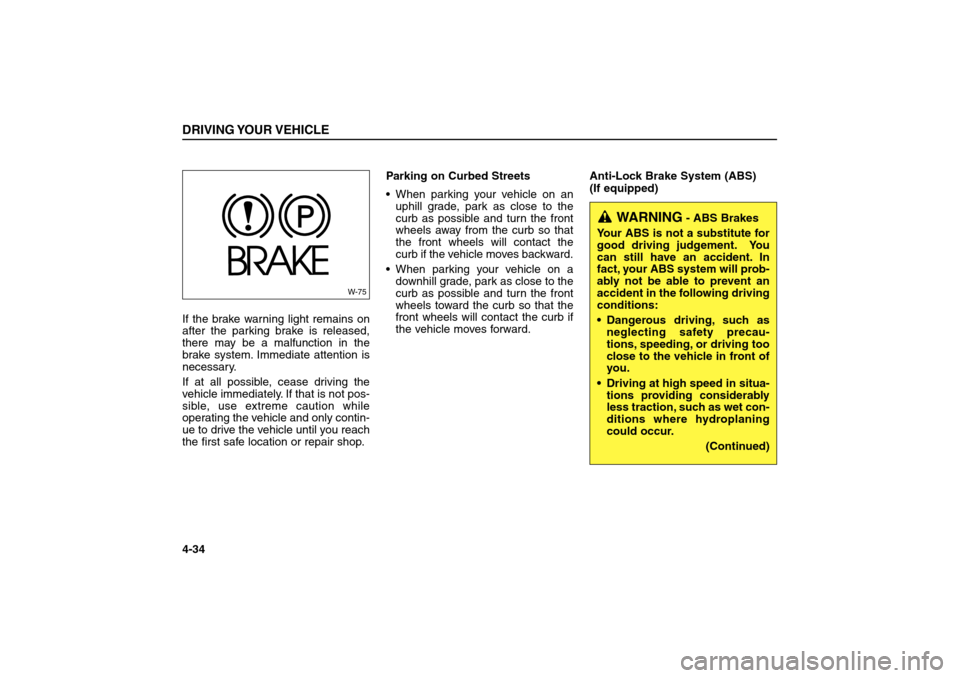
If the brake warning light remains on
after the parking brake is released,
there may be a malfunction in the
brake system. Immediate attention is
necessary.
If at all possible, cease driving the
vehicle immediately. If that is not pos-
sible, use extreme caution while
operating the vehicle and only contin-
ue to drive the vehicle until you reach
the first safe location or repair shop.Parking on Curbed Streets
When parking your vehicle on an
uphill grade, park as close to the
curb as possible and turn the front
wheels away from the curb so that
the front wheels will contact the
curb if the vehicle moves backward.
When parking your vehicle on a
downhill grade, park as close to the
curb as possible and turn the front
wheels toward the curb so that the
front wheels will contact the curb if
the vehicle moves forward.Anti-Lock Brake System (ABS)
(If equipped)DRIVING YOUR VEHICLE4-34
WARNING
- ABS Brakes
Your ABS is not a substitute for
good driving judgement. You
can still have an accident. In
fact, your ABS system will prob-
ably not be able to prevent an
accident in the following driving
conditions:
Dangerous driving, such as
neglecting safety precau-
tions, speeding, or driving too
close to the vehicle in front of
you.
Driving at high speed in situa-
tions providing considerably
less traction, such as wet con-
ditions where hydroplaning
could occur.
(Continued)
W-75
BL-ENG (CAN)-4.qxd 7/28/05 5:55 PM Page 34
