2006 KIA Sorento ABS
[x] Cancel search: ABSPage 143 of 312

WARNINGS AND INDICA-
TORSWarning Lights / Audible Indicators
Checking operation
All warning lights are checked by
turning the ignition switch ON (do not
start the engine). Any light that does
not illuminate should be checked by
an Authorized Kia Dealer.
After starting the engine, check to
make sure that all warning lights are
off. If any are still on, this indicates a
situation that needs attention. When
releasing the parking brake, the
brake system warning light should go
off. The fuel warning light will stay on
if the fuel level is low.Anti-Lock Brake System
(ABS) Warning Light
This light illuminates when you start
the engine. The light will go off if the
ABS system is operating normally.
Also, this light illuminates if the key is
turned to ON and goes off in 2-3 sec-
onds if the system is operating nor-
mally.
O/D OFF Indicator
(A/T:30-40LEi)
This indicator comes on when the
O/D system is deactivated.Engine Oil Pressure
Warning
This warning light indicates the
engine oil pressure is low.
If the warning light illuminates while
driving:
1. Drive safely to the side of the road
and stop.
2. With the engine off, check the
engine oil level. If the level is low,
add oil as required.
If the warning light remains on after
adding oil or if oil is not available, call
an Authorized Kia Dealer.
DRIVING YOUR VEHICLE
4-45
ABSO/D
OFF
✽ ✽
NOTICEIf the engine is not stopped immedi-
ately, severe damage could result.
BL-ENG (CAN)-4.qxd 7/28/05 5:55 PM Page 45
Page 195 of 312

SPECIAL DRIVING
CONDITIONSHazardous Driving Conditions
When hazardous driving conditions
are encountered such as water,
snow, ice, mud, sand, or similar haz-
ards, follow these suggestions:
Drive cautiously and allow extra
distance for braking.
Avoid sudden movements in brak-
ing or steering.
When braking in the four-wheel
drive mode (if equipped), pump the
brake pedal with a light up-and-
down motion until the vehicle is
stopped. If stalled in snow, mud, or sand, use
second gear or shift the transfer
case (if equipped) into four-wheel
drive. Accelerate slowly to avoid
spinning the drive wheels.
Use sand, rock salt, tire chains, or
other non-slip material under the
drive wheels to provide traction
when stalled in ice, snow, or mud.
(If equipped, refer to “Using Four-
Wheel Drive.’’)DRIVING TIPS5-8✽ ✽
NOTICEDo not pump the brake pedal on
ABS equipped vehicle.
WARNING
- Downshifting
On slippery surfaces, down-
shifting can cause an accident.
The sudden change in tire
speed could cause the tires to
skid. Be careful when down-
shifting on slippery surfaces.
Try to drive slowly enough so
you won’t have to make any
sudden changes in gear or vehi-
cle speed.
BL-ENG (CAN)-5.qxd 7/28/05 5:56 PM Page 8
Page 225 of 312

Trailer brakes
If your trailer weighs more than 750
kg (1,650 pounds) loaded, then it
needs its own brakes – and they must
be adequate. Be sure to read and fol-
low the instructions for the trailer
brakes so you’ll be able to install,
adjust and maintain them properly.
Don’t tap into your vehicle’s brake
system.
Do not use a trailer with its own
brakes unless you are absolutely
certain that you have properly set
up the brake system. This is not a
task for amateurs. Use an experi-
enced, competent trailer shop for
this work.Driving with a trailer
Towing a trailer requires a certain
amount of experience. Before setting
out for the open road, you must get to
know your trailer. Acquaint yourself
with the feel of handling and braking
with the added weight of the trailer.
And always keep in mind that the
vehicle you are driving is now a good
deal longer and not nearly so respon-
sive as your vehicle is by itself.
Before you start, check the trailer
hitch and platform, safety chains,
electrical connector(s), lights, tires
and mirror adjustment. If the trailer
has electric brakes, start your vehicle
and trailer moving and then apply the
trailer brake controller by hand to be
sure the brakes are working. This lets
you check your electrical connection
at the same time.
During your trip, check occasionally
to be sure that the load is secure, and
that the lights and any trailer brakes
are still working.Following distance
Stay at least twice as far behind the
vehicle ahead as you would when
driving your vehicle without a trailer.
This can help you avoid situations
that require heavy braking and sud-
den turns.
Passing
You’ll need more passing distance up
ahead when you’re towing a trailer.
And, because you’re a good deal
longer, you’ll need to go much farther
beyond the passed vehicle before
you can return to your lane.DRIVING TIPS5-38
BL-ENG (CAN)-5.qxd 7/28/05 5:56 PM Page 38
Page 228 of 312

Parking on hills
Generally, you should not park your
vehicle, with a trailer attached, on a
hill. People can be seriously or fatally
injured, and both your vehicle and the
trailer can be damaged if they begin a
downhill trajectory.However, if you ever have to park
your trailer on a hill, here’s how to do
it:
1. Apply your brakes, but don’t shift
into gear.
2. Have someone place chocks
under the trailer wheels.
3. When the wheel chocks are in
place, release the brakes until the
chocks absorb the load.
4. Reapply the brakes. Apply your
parking brake, and then shift to R
(Reverse) for a manual transmis-
sion or P (Park) for an automatic
transmission.
5. Be sure the transfer case (if
equipped) is fully engaged in a
drive gear – not in N (Neutral).
6. Release the brakes.
DRIVING TIPS
5-41
WARNING- Parking on a Hill
Parking your vehicle on a hill
with an attached trailer could
cause serious injury or fatal
injury. If the brakes fail, the
vehicle and trailer could roll
down hill and strike people or
property.
WARNING- Parking Brake
Not setting the parking brake
when leaving the vehicle could
lead to a serious accident.
If you have left the engine run-
ning, the vehicle can move sud-
denly. Always set the parking
brake and take the key with you
to be sure your vehicle is
securely parked.
BL-ENG (CAN)-5.qxd 7/28/05 5:56 PM Page 41
Page 242 of 312

Fuse panel description
Driver-side kick panelIN CASE OF AN EMERGENCY6-10
( )
( ) (
) ( ) ( )
( )
W/SHD
15AS/ROOF
20A
( )PREMIUM
AUDIO30A
( )S/WARMER20A
(
)
O/S MIRROR10A
(
)
RELAY COIL10ASTART
10A
METER
10AENGINE
10A HAZARD
15AP/SCK(CTR)
15A
CIGAR (FRT)
15A
DRL/OBD-II10AWIPER(FRT)
20A
TCCS
20AROOM LAMP10A FOG (RR)
15AP/SCK
(FRT,RR)
30ASTOP LAMP
20ATURN LAMP
10A
A/BAG
10A
( )TRAILER15A WIPER(RR)
10AACC
10A
22 23 24 19 20 21
16 17 18
13 14 15 10 11 12789 456 123USE THE DESIGNATED FUSES ONLY.
*( ) IS OPTION.
Description FUSE RATING PROTECTED OMPONENT
1. W/SHD 15 A Defroster
2. S/ROOF 20 A Sunroof
3. START 10 A Starting system, PCM, ACC
4. HAZARD 15 A Turn & Hazard flasher unit
5. P/SCK(CTR) 15 A Center power socket
6. CIGAR (FRT) 15 A Cigar lighter
7. DRL/OBD-II 10 A Check connector
8. WIPER (FRT) 20 A Wiper & Washer, Head light,
Front
heater & Aircon, Cooling system, Defroster
9. P/SCK (FRT, RR) 30 A Front and rear power socket
10. RELAY COIL 10 A Relay coil
11. WIPER (RR) 10 A Wiper & Washer, ETWIS, Heater & Aircon,
Trip computer, sunroof
12. ACC 10 A Power mirror, Cigar lighter, Power Socket,
Clock, Keyless entry, Audio
13. TCCS 20 A Transfer case control unit
14. FOG (RR) 15 A Rear fog lamp
15. O/S MIRROR 10 A Electric remote control mirror
16. ROOM LAMP 10 A Instrument cluster, ETWIS, Head light, DRL,
Keyless entry, Room lamp, Sunvior lamp, Clock
17. S/WARMER 20 A Seat warmer
18.
PREMIUM AUDIO
30 A Audio
19. STOP LAMP 20 A Stop light
20. TURN LAMP 10 A Turn & Hazard flasher unit
21. A/BAG 10 A Airbag
22. METER 10 A PCM, ACC, Trip computer, Stop light ,DRL,
ETWIS, Instrument cluster, Front heater & Aircon
23. TRAILER 15 A Trailer accessory
24. ENGINE 10 APCM, Cooling, Speed sensor, Diagnosis connector,
ACC, Instrument cluster, ABS
BL-ENG (CAN)-6.qxd 7/28/05 5:57 PM Page 10
Page 243 of 312

Engine compartment
IN CASE OF AN EMERGENCY
6-11
( )MAIN 120A
HORN20A15A 15A 25A
15A10A 15A 10A 10A 25A 25A
15A 15A 15A 15A 10A
AUDIO
HEAD(HI)
HEAD(LO)
INJECTOR
DEF25A 20A 15A 10ASPARE
SPARE
SPARE
SPARE
MEMORY15A(F/FOG)
ILLUMIP/TRN
P/W(LH)O
2(DN)
O2(UP)
P/W(RH) ECU (EXT)
FUEL
FUSE
PULLER
START
RELAY
MAIN
RELAY
F/BLW
RELAY
P/WIN
RELAY
C/FAN (L)
RELAY A/CON
RELAY
USE THE DESIGNATED FUSES ONLY.
*( ) FOR OPTION.
K52Y
C/F (H)
RELAYC/FAN (2)
RELAY
FUEL
RELAYHORN
RELAY HEAD(LO)
RELAY HEAD(HI)
RELAYTNS
RELAYDEF
RELAY
F/FOG
RELAY
IGN 2
30ABTN 3
40A
ABS
40A
C /FAN (1)
40AF/BLW
30A
C/FAN (2)
30ABTN 1
40A
IGN 1
40ABTN 2
30A( )
( )
HORN 15 A Horm
P/TRN 10 A PCM, Main relay
INJECTOR 15 A PCM
AUDIO 20 A Audio
HEAD (HI) 15 A Head Light
ILLUMI 10 A Key hole illumination
O2(DN) 15 A PCM
HEAD (LO) 15 A Head light
EXT 15 A
DRL, License lamp, Tail lamp, Position lamp, Turn lamp
P/W (LH) 25 A Power window
O2(UP) 15 A PCM
DEF 25 A Defroster
FUEL 15 A Fuel pump relay
P/W (RH) 25 A Power window
ECU 10 A PCM, Cooling
MEMORY 10 A Front heater & aircon, Etwis, Keyless entry system
F/FOG 15 A Front fog lamp
IGN 2 30 A Ignition switch
BTN 3 40 A Turn & Hazard flasher unit, Power door lock
ABS 1 40 A ABS
C/FAN (1) 40 A Cooling system
F/BLW 30 A Front heater & Aircon
C/FAN (2) 30 A Cooling system
BTN 1 40 A Cigar lighter, Power socket
IGN 1 40 A Ignition switch
BTN 2 30 A Power seat, PCM
BL-ENG (CAN)-6.qxd 7/28/05 5:57 PM Page 11
Page 279 of 312
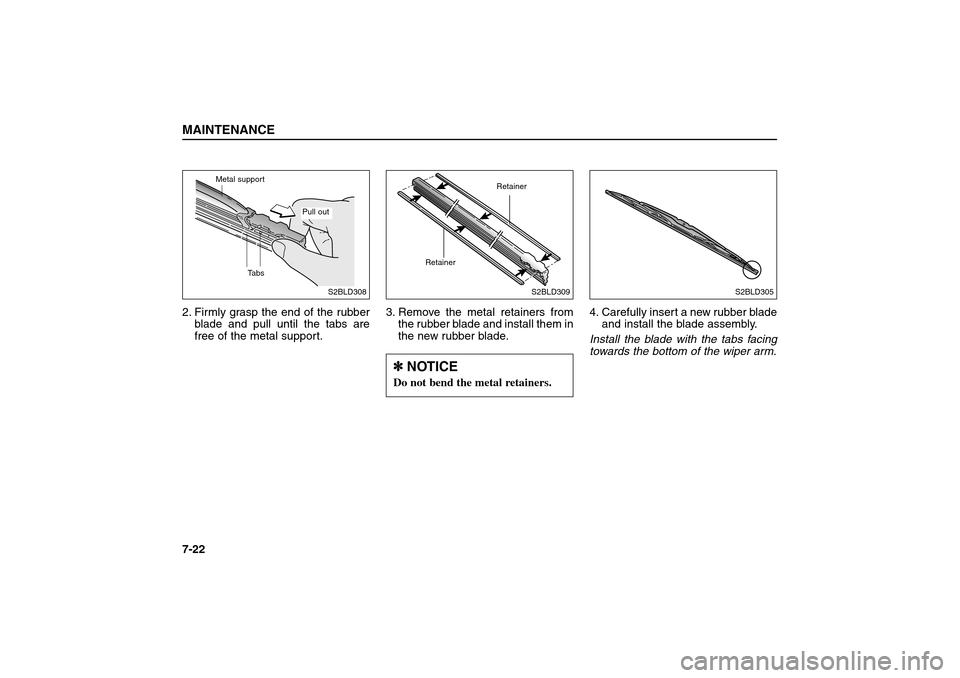
2. Firmly grasp the end of the rubber
blade and pull until the tabs are
free of the metal support.3. Remove the metal retainers from
the rubber blade and install them in
the new rubber blade.4. Carefully insert a new rubber blade
and install the blade assembly.
Install the blade with the tabs facing
towards the bottom of the wiper arm.MAINTENANCE7-22
S2BLD308
Tabs
Metal support
Pull out
S2BLD309
Retainer
Retainer
S2BLD305
✽ ✽
NOTICEDo not bend the metal retainers.
BL-ENG (CAN)-7.qxd 7/28/05 5:58 PM Page 22
Page 292 of 312

7. Remove the bulb from the head-
light assembly.
8. Install a new headlight bulb and
snap the headlight bulb retaining
wire into position by aligning the
wire with the groove on the bulb.
9. Connect the headlight bulb socket-
connector.
10. Install the headlight bulb cover by
turning it clockwise.
11. Connect the headlight main con-
nector.
12. Reinstall the light assembly to the
body of the vehicle.Front Turn Signal Light Bulb
Replacement
1. Open the hood.
2. Remove the light assembly from
the body of the vehicle removing
the bolts.
3. Disconnect the front turn signal
light electrical connector.4. Remove the socket from the
assembly by turning the socket
counter clockwise until the tabs on
the socket align with the slots on
the assembly.
5. Remove the bulb from the socket
by pressing it in and rotating it until
the tabs on the bulb align with the
slot in the socket. Pull the bulb out
of the socket.
MAINTENANCE
7-35
S2BLA729
S2BLA726C Front turn signal light
electrical connector
S2BLA726B
BL-ENG (CAN)-7.qxd 7/28/05 5:58 PM Page 35