Page 83 of 281

373
1 23456789
Knowing your vehicle
When repairing or scrapping thevehicles
Repairing steering wheel, instru- ment panel, center console or
roofs, or installing car audio aroundcenter console or painting front
metal sheet could disable the
airbag system. Have them checked
by an authorized Kia dealer.
When leaving the vehicle at an authorized Kia dealer, inform that
the vehicle is equipped with airbag
system, and leave the owner’s
manual in the vehicle.
Since airbag system contains explosive chemical substances,
contact an authorized Kia dealer
when scrapping the vehicle.
CAUTION
Do not modify any part of the
Supplemental Restraint System. Excessive modification couldmake the airbag system ineffec-tive.
WARNING
Do not modify your steering wheel, seat or any other part of the Supplemental Restraint
System. Modification could
make the system inoperable.
Do not work on the system’s components or wiring. This
could cause the airbags to
inflate inadvertently, possibly
seriously injuring someone.
Working on the system could
also disable the system so
that the airbags would not
deploy in a collision.
Any work on the SRS system, such as removing, installing,
repairing, or any work on the
steering wheel must be per-
formed by a qualified Kia tech-
nician. Improper handling of
the airbag system may result
in serious personal injury.
Page 84 of 281
Knowing your vehicle
74
3
1 23456789
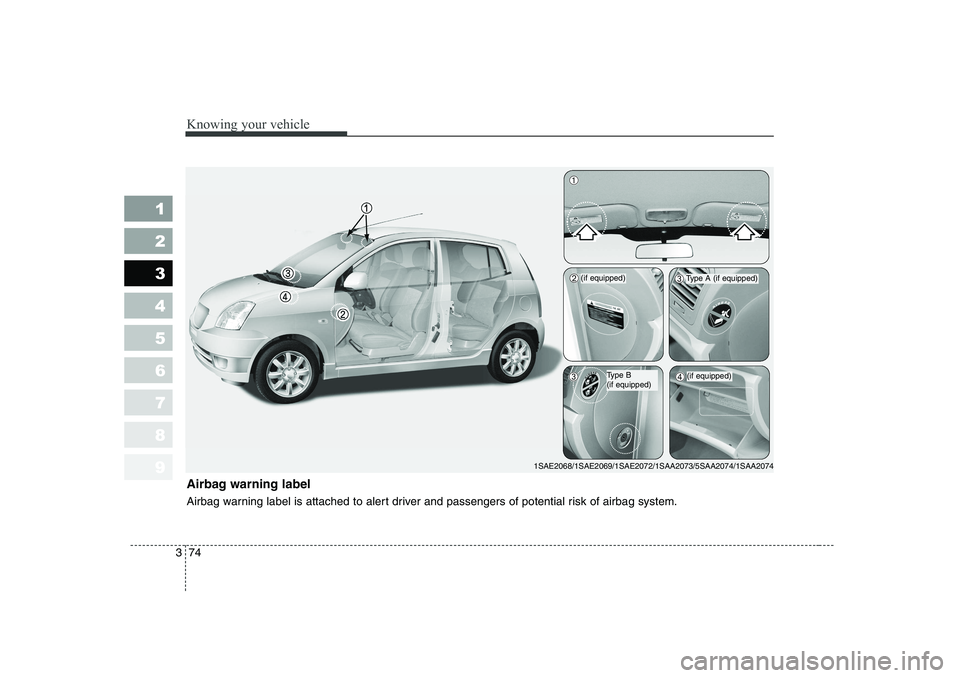
Airbag warning label
Airbag warning label is attached to alert driver and passengers of potential risk of airbag system.
1SAE2068/1SAE2069/1SAE2072/1SAA2073/5SAA2074/1SAA2074
➀
➁➂
➃(if equipped)
Type A (if equipped)
➂Type B (if equipped)
(if equipped)
Page 87 of 281
377
1 23456789
Knowing your vehicle
WARNING - Refueling
If pressurized fuel sprays out, it can cause serious injuries.
Always remove the fuel cap
carefully and slowly. If the cap is
venting fuel or if you hear a
hissing sound, wait until the
condition stops before com-
pletely removing the cap.WARNING
Automotive fuels are flamma-
ble/explosive materials. When
refueling, please note the fol-
lowing guidelines carefully.
Failure to follow these guide-
lines may result in severe per-
sonal injury, severe burns or
death by fire or explosion.
Before refueling always note the location of the Emergency
Gasoline Shut-Off, if available,
at the gas station facility.
Before touching the fuel noz- zle or fuel filler cap, you
should eliminate potentially
dangerous static electricity
discharge by touching anoth-
er metal part of the front of the
vehicle, a safe distance away
from the fuel filler neck, noz-
zle, or other gas source.
(Continued)(Continued)
Do not get back into a vehicleonce you have begun refuel-
ing. Do not touch, rub or slide
against any item or fabric
(polyester, satin, nylon, etc.)
capable of producing static
electricity. Static electricity
discharge can ignite fuel
vapors resulting in explosion.
If you must re-enter the vehi-
cle, you should once again
eliminate potentially danger-ous static electricity dis-
charge by touching a metal
part of the vehicle, away from
the fuel filler neck, nozzle or
other gasoline source.
When using a portable fuel container be sure to place the
container on the ground prior
to refueling. Static electricity
discharge from the container
can ignite fuel vapors causing
a fire. Once refueling has
begun, contact with the vehi-
cle should be maintained until
the filling is complete.
(Continued)
Page 97 of 281
387
1 23456789
Knowing your vehicle
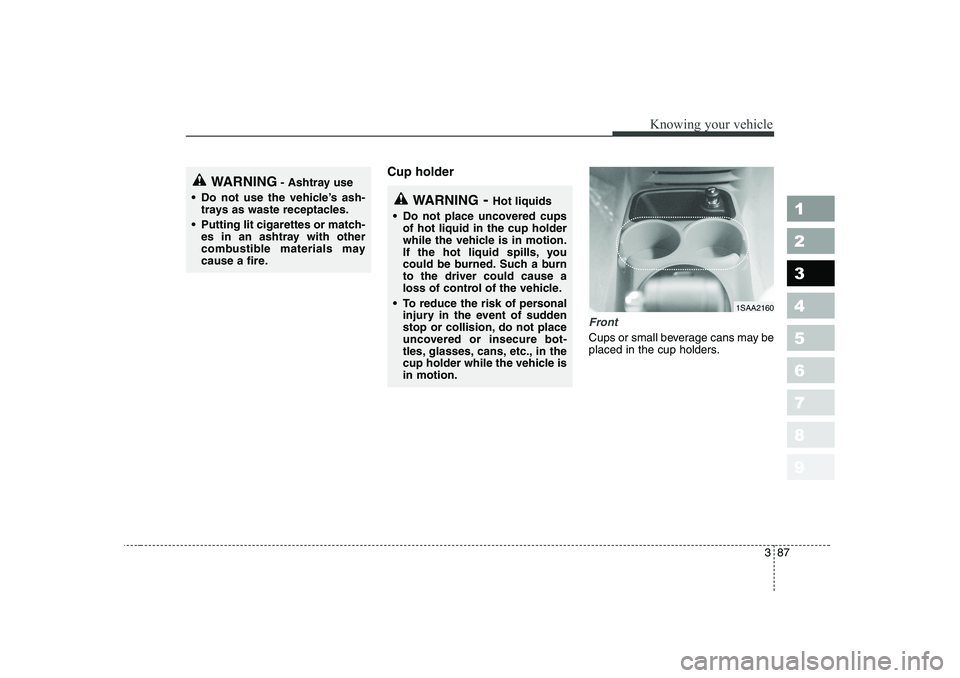
Cup holder
Front
Cups or small beverage cans may be
placed in the cup holders.
WARNING- Ashtray use
Do not use the vehicle’s ash- trays as waste receptacles.
Putting lit cigarettes or match- es in an ashtray with other
combustible materials may
cause a fire.
WARNING - Hot liquids
Do not place uncovered cups of hot liquid in the cup holder
while the vehicle is in motion.
If the hot liquid spills, you
could be burned. Such a burnto the driver could cause a
loss of control of the vehicle.
To reduce the risk of personal injury in the event of sudden
stop or collision, do not place
uncovered or insecure bot-
tles, glasses, cans, etc., in the
cup holder while the vehicle isin motion.
1SAA2160
Page 100 of 281
Knowing your vehicle
90
3
1 23456789
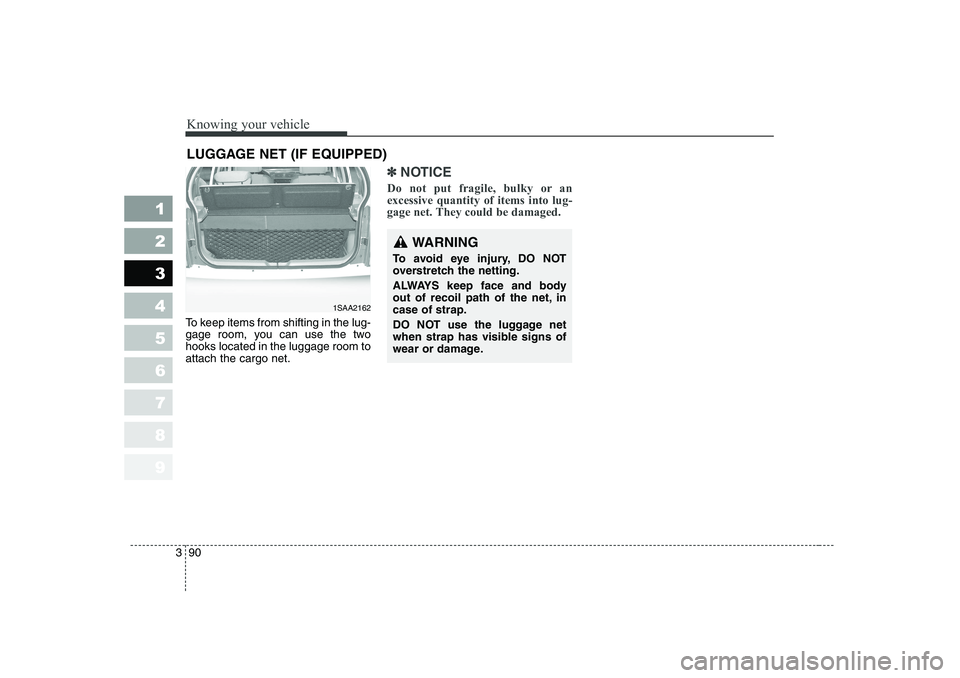
To keep items from shifting in the lug-
gage room, you can use the twohooks located in the luggage room toattach the cargo net.
✽✽
NOTICE
Do not put fragile, bulky or an excessive quantity of items into lug-
gage net. They could be damaged.
LUGGAGE NET (IF EQUIPPED)
1SAA2162
WARNING
To avoid eye injury, DO NOT
overstretch the netting.
ALWAYS keep face and body
out of recoil path of the net, incase of strap.
DO NOT use the luggage net
when strap has visible signs of
wear or damage.
Page 102 of 281
1 23456789Ignition switch / 4-2
Starting the engine / 4-4Manual transaxle / 4-6Automatic transaxle / 4-7Brake system / 4-13
Steering wheel / 4-20
Instrument cluster / 4-23 Gauges / 4-25
Warnings and indicators / 4-26Lighting / 4-33
Wipers and washers / 4-38
Defroster / 4-41
Hazard warning flasher / 4-42
Manual climate control system / 4-43
Windshield defrosting and defogging / 4-52Theft-alarm system / 4-53
Driving your vehicle
Page 103 of 281

Driving your vehicle
2
4
1 23456789
Ignition switch and anti-theft
steering column lock
Ignition switch position
LOCK
The steering wheel locks to protect
against theft. The ignition key can be
removed only in the LOCK position.
When turning the ignition switch to
the LOCK position, push the key
inward at the ACC position and turn
the key toward the LOCK position. ACC (Accessory)
The steering wheel is unlocked and
electrical accessories are operative. ON
The warning lights can be checked
before the engine is started. This is
the normal running position after the
engine is started.
Do not leave the ignition switch ON if
the engine is not running to preventbattery discharge.
START
Turn the ignition key to the START
position to start the engine. The
engine will crank until you release
the key; then it returns to the ON
position. The brake warning lamp
can be checked in this position.
If difficulty is experienced in turning the ignition key to the START posi-tion, turn the steering wheel rightand left to release the tension and then turn the key.
IGNITION SWITCH
1XTA3017
Page 104 of 281

43
1 23456789
Driving your vehicle
(Continued)
• Never reach for the ignitionswitch, or any other controls
through the steering wheel
while the vehicle is in motion.
The presence of your hand orarm in this area could cause a
loss of vehicle control, an
accident and serious bodily
injury or death.
Do not place any movable objects around the driver’s
seat as they may move while
driving, interfere with the driv-er and lead to an accident.WARNING - Ignition key
Never turn the ignition switch to LOCK or ACC while the
vehicle is moving. This wouldresult in loss of directional
control and braking function,
which could cause an immedi-ate accident.
The anti-theft steering column lock is not a substitute for the
parking brake. Before leaving
the driver’s seat, always make
sure the shift lever is engagedin 1 st
gear for manual transaxle
or P (Park) for automatic
transaxle, set the parking
brake fully and shut the
engine off. Unexpected and
sudden vehicle movement
may occur if these precau-tions are not taken.
(Continued)