Page 190 of 225

MAINTENANCE
7-14ENGINE COOLING
SYSTEMThe cooling system is a high-pressure
type with a reservoir and is filled with
year-round antifreeze coolant at the
factory.
Check the antifreeze protection and
coolant level at least once a year, at the
beginning of the winter season, and
before traveling to a colder climate.
CHECKING THE
COOLANT LEVEL
WARNING - Removing
Radiator Cap
Never attempt to remove the
radiator cap while the engine
is operating. Doing so might
lead to cooling system
and/or engine damage and
could result in serious
personal injury from
escaping hot coolant or
steam.
Turn the engine off and wait
until it has cooled. Even then,
use extreme care when
removing the radiator cap.
Wrap a thick towel around it,
and turn it counterclockwise
slowly to the first stop. Step
back while the pressure is
released from the cooling
system. When you are sure
all the pressure has been
released, press down on the
cap, using a thick towel, and
continue turning
counterclockwise to remove
it.
Even if the engine is not
operating, do not remove the
radiator cap or the drain plug
while the engine and radiator
are hot. Hot coolant and
steam may still blow out
under pressure, causing
serious injury.
MS-CNA-Eng 7.QXD 7/25/2005 5:09 PM Page 14
Page 191 of 225
7-15
Check the condition and connections of
all cooling system hoses and heater
hoses. Replace any swollen or
deteriorated hoses.
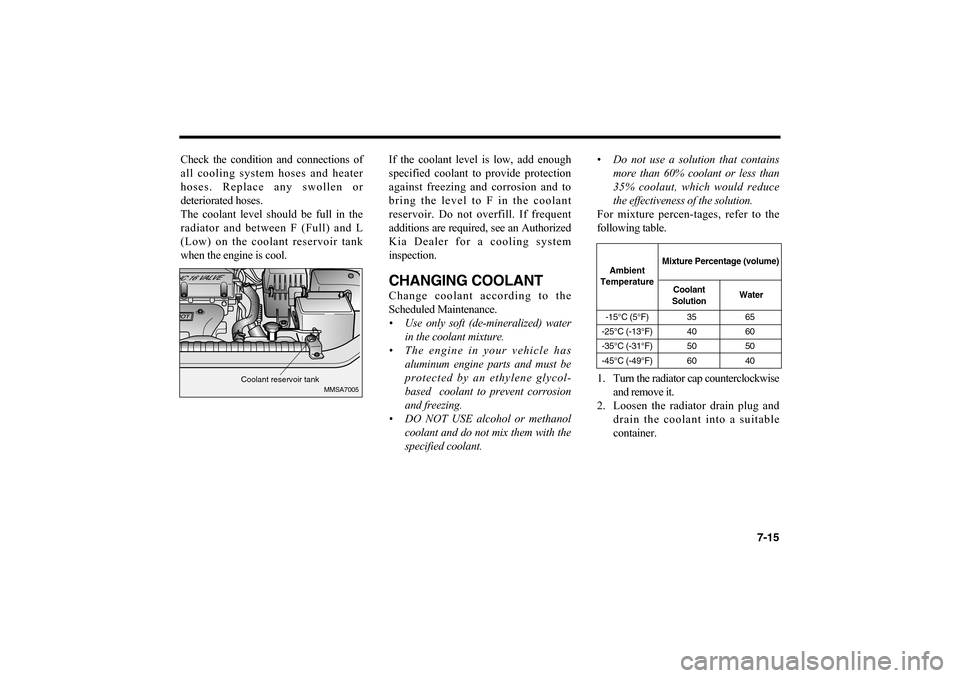
The coolant level should be full in the
radiator and between F (Full) and L
(Low) on the coolant reservoir tank
when the engine is cool.If the coolant level is low, add enough
specified coolant to provide protection
against freezing and corrosion and to
bring the level to F in the coolant
reservoir. Do not overfill. If frequent
additions are required, see an Authorized
Kia Dealer for a cooling system
inspection.
CHANGING COOLANTChange coolant according to the
Scheduled Maintenance.
• Use only soft (de-mineralized) water
in the coolant mixture.
• The engine in your vehicle has
aluminum engine parts and must be
protected by an ethylene glycol-
based coolant to prevent corrosion
and freezing.
• DO NOT USE alcohol or methanol
coolant and do not mix them with the
specified coolant.•Do not use a solution that contains
more than 60% coolant or less than
35% coolaut, which would reduce
the effectiveness of the solution.
For mixture percen-tages, refer to the
following table.
1. Turn the radiator cap counterclockwise
and remove it.
2. Loosen the radiator drain plug and
drain the coolant into a suitable
container.
MMSA7005
Coolant reservoir tank
-15°C (5°F) 35 65
-25°C (-13°F) 40 60
-35°C (-31°F) 50 50
-45°C (-49°F) 60 40Ambient
TemperatureMixture Percentage (volume)
Coolant
SolutionWater
MS-CNA-Eng 7.QXD 7/25/2005 5:09 PM Page 15
Page 192 of 225
MAINTENANCE
7-163. With the drain plug loose, flush the
system with running water.
4. Drain the system completely and
retighten the drain plug. Add the
necessary amount of ethylene glycol
based coolant and water to provide
the required protection against
freezing and corrosion.
In extremely cold climates, add the
necessary amount of ethylene glycol-
based coolant in accordance with the
instructions of the coolant
manufacturer.5. Run the engine at idle with the
radiator cap off. Slowly add
additional coolant if necessary.
6. At this point, wait until the engine
reaches normal operating temperature.
Depress the accelerator two or three
times; then add coolant if required. Be
careful not to burn yourself.
7. Install the radiator cap. Inspect all
connections for leaks and recheck the
coolant level in the reservoir.
Recheck again after a few days of
driving and add coolant as necessary.
MMSA7036
Drain plugRadiator cap
MS-CNA-Eng 7.QXD 7/25/2005 5:09 PM Page 16
Page 194 of 225

MAINTENANCE
7-18PARKING BRAKECHECKING THE PARKING BRAKECheck the stroke of the parking brake by
counting the number of “clicks” heard
while fully applying it from the released
position. Also, the parking brake alone
should securely hold the vehicle on a
fairly steep grade.
If the number of “clicks” is more or less
than specified, have the parking brake
adjusted by an Authorized Kia Dealer.
Stroke:
5-9 “clicks” at a force of 22 lbs. (98N).
POWER STEERINGCHECKING THE POWER
STEERING FLUID LEVELThe power steering fluid level should be
checked periodically. With the engine
off and the vehicle on level ground,
check the fluid level in the power
steering reservoir; it should be between
the MAX and MIN reservoir indicators.Before adding power steering fluid,
thoroughly clean the area around the
reservoir cap to prevent power steering
fluid contamination.
If the level is low, add fluid to the MAX
level.
In the event the power steering system
requires frequent addition of fluid, the
vehicle should be inspected by an
Authorized Kia Dealer.
Use only the specified power steering fluid.
(Refer to “Recommended Lubricants”
later in this section.)
MMSA7007
MMSA7008
✻
NOTICE
To avoid damage to the power
steering pump, do not operate the
vehicle for prolonged periods with
low power steering fluid level.
MS-CNA-Eng 7.QXD 7/25/2005 5:09 PM Page 18
Page 196 of 225

USING THE HOT FLUID SCALE:If the vehicle has been driven and the
fluid is warmed to the normal operating
temperature of approximately 158~176ºF
(70~80ºC), the fluid level should be
within “HOT” range.
• Use the cold scale as a rough reference
only.
• If the outside temperature is lower than
68ºF (20ºC), start the engine and
measure the fluid level after letting the
engine reach operating temperature.• If the vehicle has been driven for an
extended period at high speeds or in
city traffic in hot weather, it is usually
best to measure the fluid level after
stopping the engine and allowing the
fluid to cool for 30 minutes.
When inserting the dipstick, be sure to
insert it completely. When adding fluid,
measure frequently with the dipstick to
make sure the fluid level does not go
above the Full position. Do not overfill.
Use only the specified automatic
transaxle fluid. (Refer to “Recommended
Lubricants” later in this section)
LUBRICANTS AND
FLUIDSCHECKING THE WASHER
FLUID LEVELCheck the fluid level in the washer fluid
reservoir and add fluid if necessary.
Plain water may be used if washer fluid
is not available. However, use
windshield washer solvent with
antifreeze characteristics in cold climates
to prevent freezing.
MAINTENANCE
7-20
HOT
MMSA7011
MMSA7012
MS-CNA-Eng 7.QXD 7/25/2005 5:09 PM Page 20
Page 198 of 225

4. Re-install in the reverse order of removal.
Replace the element according to the
Scheduled Maintenance.
If the vehicle is operated in extremely
dusty or sandy areas, replace the
element more often than at the usual
recommended intervals.
WIPER BLADESWIPER BLADE
MAINTENANCEContamination of either the windshield
or the wiper blades with foreign matter
can reduce the effectiveness of the
windshield wipers. Common sources of
contamination are insects, tree sap, and
hot wax treatments used by some
commercial car washes. If the blades are
not wiping properly, clean both the
window and the blades with a good
cleaner or mild detergent, and
thoroughly rinse with clear water.
WINDSHIELD WIPER BLADE
REPLACEMENTWhen the wipers no longer clean
adequately, the wiper blades may be worn
or cracked, requiring replacement.
MAINTENANCE
7-22
CAUTION
• Do not drive with the air cleaner
removed; this will result in
excessive engine wear.
• Driving without an air cleaner
encourages backfiring, which
could cause a fire in the engine
compartment.
✻
NOTICE
Commercial hot waxes applied by
automatic car washes have been
known to make the windshield
difficult to clean.
✻
NOTICE
To prevent damage to the wiper
blades, do not use gasoline,
kerosene, paint thinner, or other
solvents on or near them.✻
NOTICE
To prevent damage to the wiper
arms or other components, do not
attempt to move the wipers
manually.
MS-CNA-Eng 7.QXD 7/25/2005 5:09 PM Page 22
Page 200 of 225

BATTERY MAINTENANCEFor best battery service:
• Keep the battery securely mounted.
• Keep the battery top clean and dry.
• Keep the terminals and connections
clean, tight, and coated with
petroleum jelly or terminal grease.
• Immediately rinse any spilled
electrolyte from the battery with a
solution of water and baking soda.
• If the vehicle is not going to be used
for an extended period of time,
disconnect the battery cables.
BATTERY RECHARGINGYour vehicle has a maintenance-free,
calcium-based battery.
• If the battery becomes discharged in
a short time (headlights or interior
lights were left on while the vehicle
was not in use), recharge it by slow
(trickle) charging for 10 hours.
• If the battery gradually discharges
because of high electric load while
the vehicle is being used, recharge it
at 20-30A for two hours.
MAINTENANCE
7-24
MMSA7034
(Continued)
Keep batteries out of the
reach of children
because batteries
contain highly corrosive
SULFURIC ACID. Do not allow
battery acid to contact your skin,
eyes, clothing or paint finish.
Wear eye protection
when charging or
working near a battery.
Always provide ventilation when
working in an enclosed space.
When lifting a plastic-cased
battery, excessive pressure
on the case may cause
battery acid to leak, resulting
in personal injury. Lift with a
battery carrier or with your
hands on opposite corners.
Never attempt to charge the
battery when the battery
cables are connected.
The electrical ignition system
works with high voltage. Never
touch these components with
the engine running or the
ignition switched on.
WARNING - Recharging
Battery
When recharging the battery,
observe the following
precautions:
The battery must be removed
from the vehicle and placed
in an area with good
ventilation.
Do not allow cigarettes,
sparks, or flame near the
battery.
MS-CNA-Eng 7.QXD 7/25/2005 5:09 PM Page 24
Page 201 of 225

7-25
TIRES AND WHEELSTIRE CAREFor proper maintenance, safety, and
maximum fuel economy, you must
always maintain recommended tire
inflation pressures and stay within the
load limits and weight distribution
recommended for your vehicle.INFLATION PRESSURESCheck all tire pressures (including the
spare) monthly when the tires are cold.
“Cold tires” means the car has not been
driven for at least three hours or driven
less than one mile (1.6 km).
Recommended pressures must be
maintained to ensure ride quality, vehicle
handling, and minimum tire wear.
Watch the battery during
charging, and stop or reduce
the charging rate if the battery
cells begin gasing (boiling)
violently or if the temperature
of the electrolyte of any cell
exceeds 120°F (49°C).
Wear eye protection when
checking the battery during
charging.
Disconnect the battery
charger in the following
order.
1. Turn off the battery
charger main switch.
2. Unhook the negative
clamp from the negative
battery terminal.
3. Unhook the positive clamp
from the positive battery
terminal.
✻
NOTICE
• Before performing battery
maintenance or recharging, turn
OFF all accessories and stop the
engine.
• When remounted battery,
disconnect the negative (-)
battery cable first. When re-
installing the battery, reconnect
the negative (-) battery cable
last.
MS-CNA-Eng 7.QXD 7/25/2005 5:09 PM Page 25
