Page 99 of 322
Knowing your vehicle88
3
1
2
3
4
5
6
7
8
910
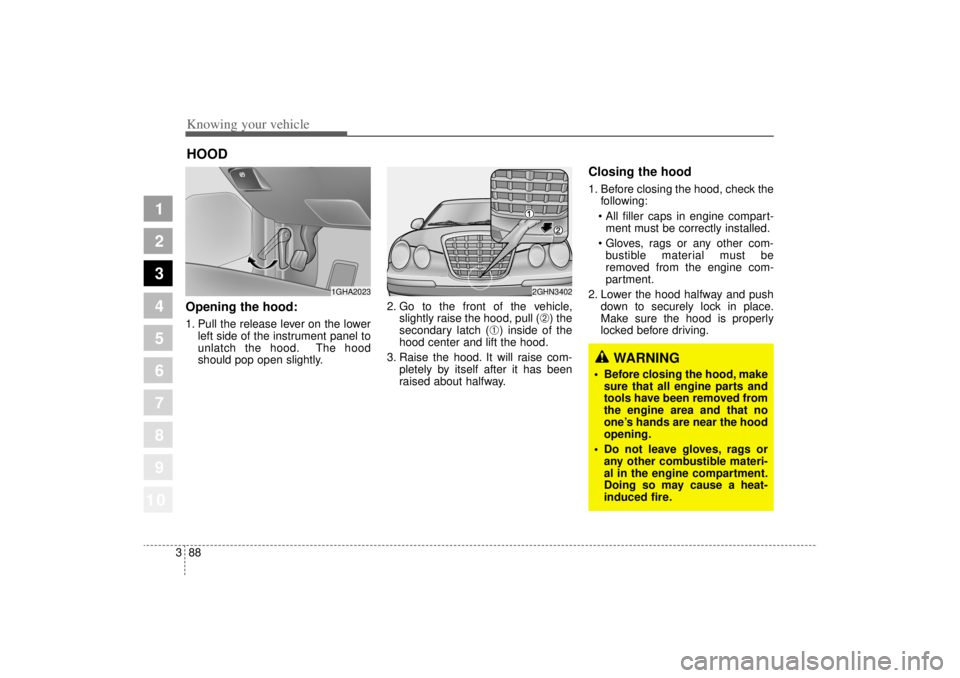
Opening the hood:1. Pull the release lever on the lower
left side of the instrument panel to
unlatch the hood. The hood
should pop open slightly. 2. Go to the front of the vehicle,
slightly raise the hood, pull (
➁) the
secondary latch (
➀) inside of the
hood center and lift the hood.
3. Raise the hood. It will raise com- pletely by itself after it has been
raised about halfway.
Closing the hood1. Before closing the hood, check thefollowing:
All filler caps in engine compart- ment must be correctly installed.
Gloves, rags or any other com- bustible material must be
removed from the engine com-
partment.
2. Lower the hood halfway and push down to securely lock in place.
Make sure the hood is properly
locked before driving.
HOOD
1GHA2023
2GHN3402
WARNING
Before closing the hood, make
sure that all engine parts and
tools have been removed from
the engine area and that no
one’ s hands are near the hood
opening.
Do not leave gloves, rags or
any other combustible materi-
al in the engine compartment.
Doing so may cause a heat-
induced fire.
Page 100 of 322
389
1
2
3
4
5
6
7
8
910
Knowing your vehicle
1. Stop the engine.
2. To open the fuel filler lid, push therelease button located on the dri-
ver ’s lower door. 3. Pull the fuel filler lid out to open.
4. To remove the cap, turn the fuel
tank cap counter-clockwise.
5. Refuel as needed.
6. To install the cap, turn it clockwise until it “clicks”. This indicates that
the cap is securely tightened.
7. Close the fuel filler lid and push it lightly and make sure that it is
securely closed.FUEL FILLER LID
1GHA2021
MMSA3049
WARNING
To avoid injury from sharp
objects, it is recommended that
protective gloves be worn when
opening the fuel filler door man-
ually.
WARNING
- Refueling
If pressurized fuel sprays out, it
can cause serious injuries.
Always remove the fuel cap
carefully and slowly. If the cap is
venting fuel or if you hear a
hissing sound, wait until the
condition stops before com-
pletely removing the cap.
Page 101 of 322
Knowing your vehicle90
3
1
2
3
4
5
6
7
8
910
WARNING
Automotive fuels are flamma-
ble/explosive materials. When
refueling, please note the fol-
lowing guidelines carefully.
Failure to follow these guide-
lines may result in severe per-
sonal injury, severe burns or
death by fire or explosion.
Before refueling always note
the location of the Emergency
Gasoline Shut-Off, if available,
at the gas station facility.
Before touching the fuel noz-
zle or fuel filler cap, you
should eliminate potentially
dangerous static electricity
discharge by touching anoth-
er metal part of the front of the
vehicle, a safe distance away
from the fuel filler neck, noz-
zle, or other gas source.
(Continued)
(Continued)
Do not get back into a vehicle
once you have begun refuel-
ing. Do not touch, rub or slide
against any item or fabric
(polyester, satin, nylon, etc.)
capable of producing static
electricity. Static electricity
discharge can ignite fuel
vapors resulting in explosion.
If you must re-enter the vehi-
cle, you should once again
eliminate potentially danger-
ous static electricity dis-
charge by touching a metal
part of the vehicle, away from
the fuel filler neck, nozzle or
other gasoline source.
When using a portable fuel con-
tainer be sure to place the con-
tainer on the ground prior to
refueling. Static electricity dis-
charge from the container can
ignite fuel vapors causing a
fire. Once refueling has begun,
contact with the vehicle should
be maintained until the filling is
complete. Use only portable
fuel containers designed to
carry and store gasoline.
(Continued)
(Continued)
Do not use cellular phones
around a gas station or while
refueling any vehicle. Electric
current and/or electronic
interference from cellular
phones can potentially ignite
fuel vapors causing a fire. If
you must use your cellular
phone use it in a place away
from the gas station.
When refueling always shut
the engine off. Sparks pro-
duced by electrical compo-
nents related to the engine
can ignite fuel vapors causing
a fire. Always insure that the
engine is OFF before and dur-
ing refueling. Once refueling
is complete, check to make
sure the fuel filler cap and
door are securely closed,
before starting the engine.
(Continued)
Page 109 of 322
Knowing your vehicle98
3
1
2
3
4
5
6
7
8
910
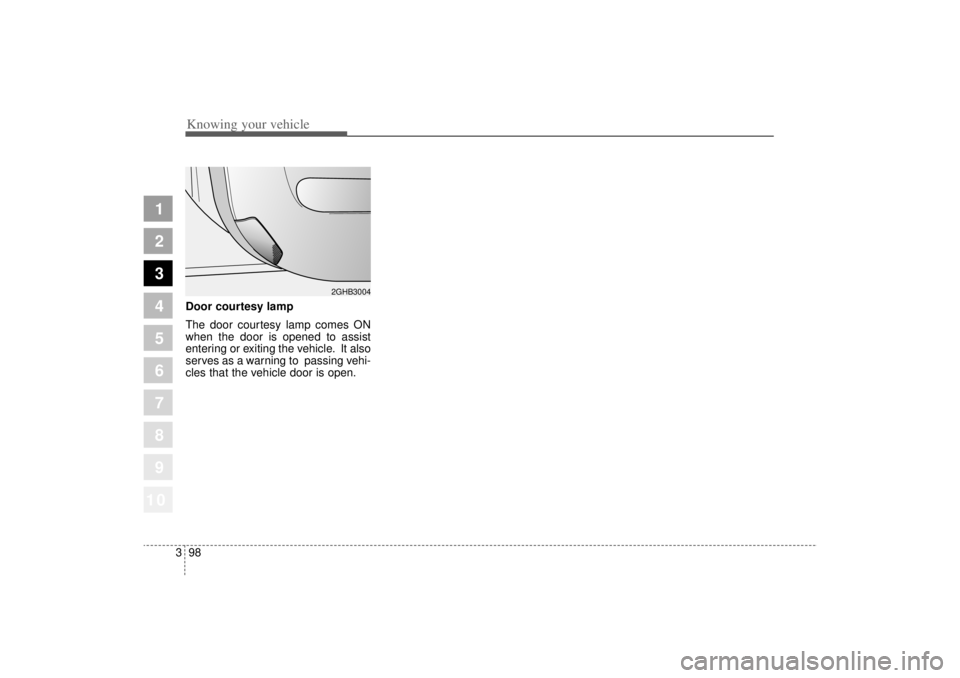
Door courtesy lamp
The door courtesy lamp comes ON
when the door is opened to assist
entering or exiting the vehicle. It also
serves as a warning to passing vehi-
cles that the vehicle door is open.
2GHB3004
Page 110 of 322
399
1
2
3
4
5
6
7
8
910
Knowing your vehicle
✽ ✽NOTICE• To avoid possible theft, do not
leave valuables in the storage com-
partment.
• Since stored items may move while driving, be sure to position them
in the storage compartment so
that they do not make noise or
cause a potential safety hazard
when the vehicle is moving.
• Always keep the storage compart- ment covers closed while driving.
Do not attempt to place many
items in the storage compartment
that the storage compartment
cover can not close securely.
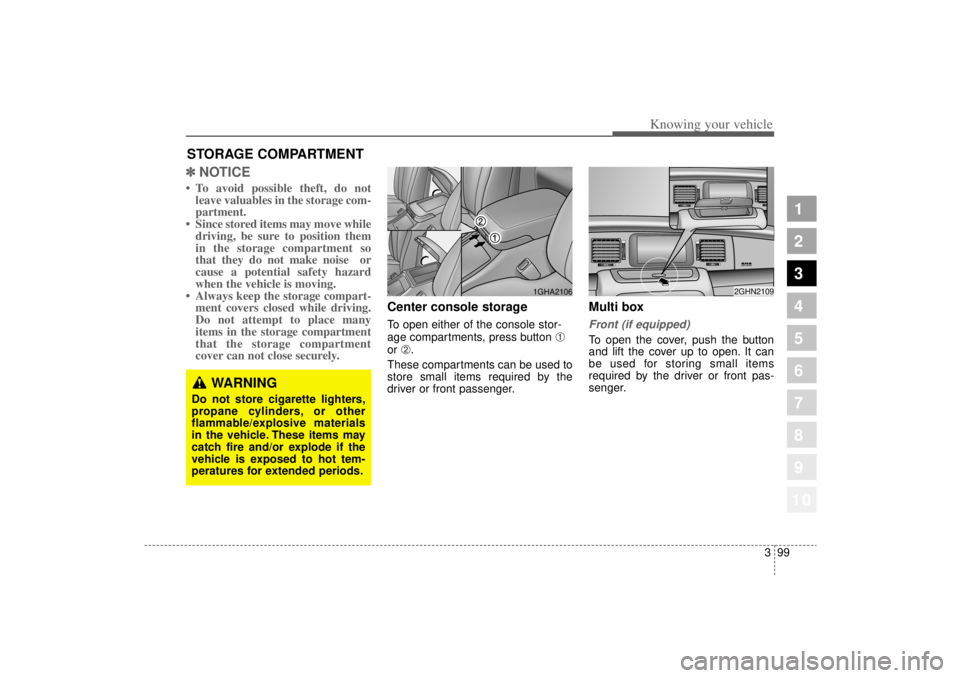
Center console storageTo open either of the console stor-
age compartments, press button
➀
or
➁.
These compartments can be used to
store small items required by the
driver or front passenger.
Multi boxFront (if equipped)To open the cover, push the button
and lift the cover up to open. It can
be used for storing small items
required by the driver or front pas-
senger.
STORAGE COMPARTMENT
WARNING
Do not store cigarette lighters,
propane cylinders, or other
flammable/explosive materials
in the vehicle. These items may
catch fire and/or explode if the
vehicle is exposed to hot tem-
peratures for extended periods.
1GHA2106
2GHN2109
Page 114 of 322
3 103
1
2
3
4
5
6
7
8
910
Knowing your vehicle
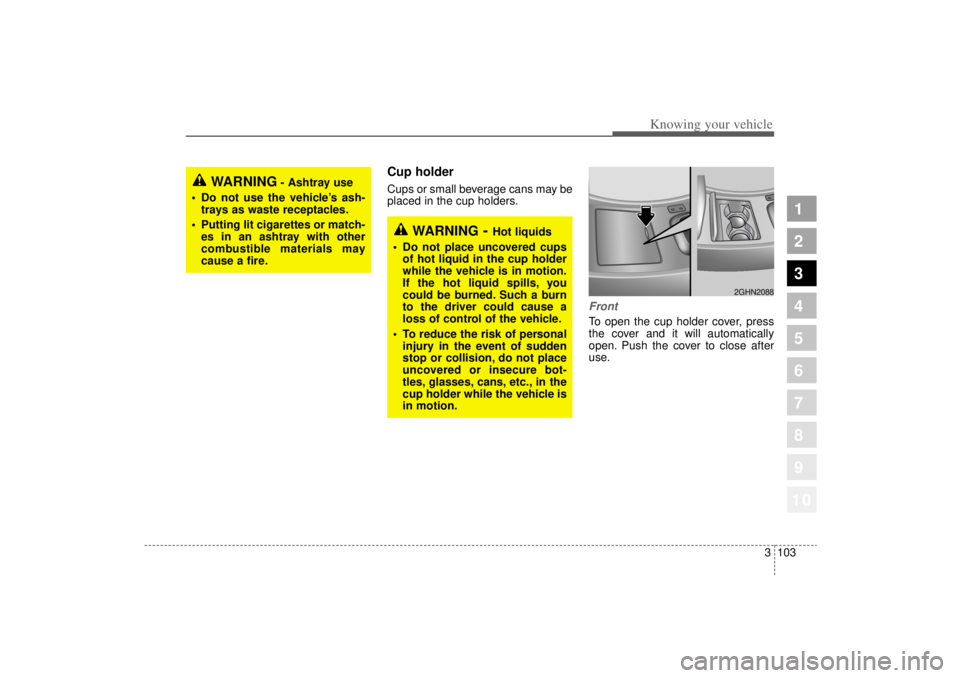
Cup holderCups or small beverage cans may be
placed in the cup holders.
FrontTo open the cup holder cover, press
the cover and it will automatically
open. Push the cover to close after
use.
WARNING
- Ashtray use
Do not use the vehicle ’s ash-
trays as waste receptacles.
Putting lit cigarettes or match-
es in an ashtray with other
combustible materials may
cause a fire.
WARNING
- Hot liquids
Do not place uncovered cups
of hot liquid in the cup holder
while the vehicle is in motion.
If the hot liquid spills, you
could be burned. Such a burn
to the driver could cause a
loss of control of the vehicle.
To reduce the risk of personal
injury in the event of sudden
stop or collision, do not place
uncovered or insecure bot-
tles, glasses, cans, etc., in the
cup holder while the vehicle is
in motion.
2GHN2088
Page 120 of 322
3 109
1
2
3
4
5
6
7
8
910
Knowing your vehicle
Tilting the sunroof Autotilt open
To use the autotilt feature, momen-
tarily (more than 1 second) press the
TILT UP button on the overhead
console. The sunroof will tilt all the
way open. To stop the sunroof tilting
at any point, press any sunroof con-
trol button.
Manual tilt open
Press the TILT UP button on the
overhead console for less than 0.5
second.
Close
To close the sunroof, press the
CLOSE button on the overhead con-
sole and hold it until the sunroof is
closed.
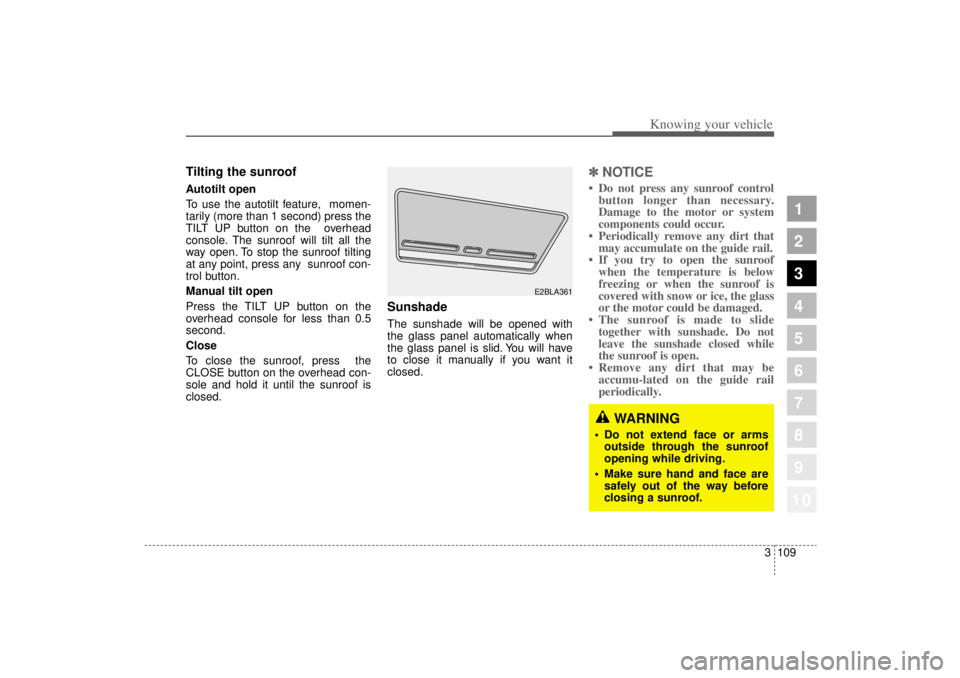
Sunshade The sunshade will be opened with
the glass panel automatically when
the glass panel is slid. You will have
to close it manually if you want it
closed.
✽ ✽NOTICE• Do not press any sunroof control
button longer than necessary.
Damage to the motor or system
components could occur.
• Periodically remove any dirt that may accumulate on the guide rail.
• If you try to open the sunroof when the temperature is below
freezing or when the sunroof is
covered with snow or ice, the glass
or the motor could be damaged.
• The sunroof is made to slide together with sunshade. Do not
leave the sunshade closed while
the sunroof is open.
• Remove any dirt that may be accumu-lated on the guide rail
periodically.
E2BLA361
WARNING
Do not extend face or arms
outside through the sunroof
opening while driving.
Make sure hand and face are
safely out of the way before
closing a sunroof.
Page 123 of 322
1
2
3
4
5
6
7
8
9
Ignition switch / 4-2
Starting the engine / 4-4
Automatic transaxle / 4-5
Brake system / 4-11
Steering wheel / 4-18
Cruise control system / 4-21
Traction control system / 4-26
Electronic stability program / 4-29
Instrument cluster / 4-32
Gauges / 4-34
Warnings and indicators / 4-36
Lighting / 4-44
Wipers and washers / 4-49
Defroster / 4-52
Hazard warning flasher / 4-53
Automatic climate control system / 4-54
Windshield defrosting and defogging / 4-69
Driving your vehicle
10