2006 KIA AMANTI key
[x] Cancel search: keyPage 53 of 322
Knowing your vehicle42
3
1
2
3
4
5
6
7
8
910
WARNING
- Safety belt
care
A damaged belt may not give
you the protection you need in
an accident.
Inspect your safety belts peri-
odically for excessive wear or
damage. Pull out each belt
fully and look for fraying, cuts,
burns or other damage. Pull
the safety belt out and let it
retract a number of times.
Make sure that the lap/shoul-
der belts return smoothly and
easily into the retractor.
Check the latches to make
sure they latch and release
without interference or delay.
Never close the doors on any
part of the lap or shoulder
belt.
Any belt not in good condition
or in good working order
should be promptly replaced.
CAUTION
Never close the doors on any
part of the lap or shoulder belt.It can damage the safety belt orbuckle which could increase therisk of injury in case of an acci-dent.
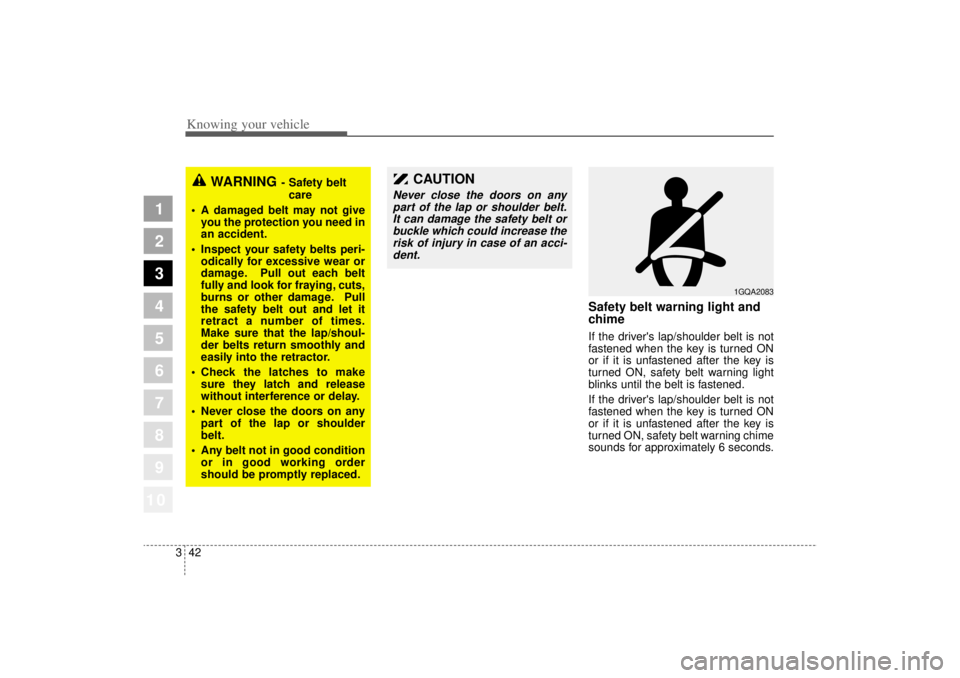
Safety belt warning light and
chimeIf the driver's lap/shoulder belt is not
fastened when the key is turned ON
or if it is unfastened after the key is
turned ON, safety belt warning light
blinks until the belt is fastened.
If the driver's lap/shoulder belt is not
fastened when the key is turned ON
or if it is unfastened after the key is
turned ON, safety belt warning chime
sounds for approximately 6 seconds.
1GQA2083
Page 74 of 322
363
1
2
3
4
5
6
7
8
910
Knowing your vehicle
Air bag system components The main components of your SRS
are:
To indicate that your vehicle is
equipped with air bags, the corre-
sponding air bag covers are
marked with “SRS AIR BAG”.
- Driver’ s air bag (see page 3- 65)
- Passenger’ s air bag(see page 3-
66)
- Side air bag (see page 3- 72)
- Curtain air bag (see page 3- 73)
A diagnostic system that continual-
ly monitors the system operation.
An indicator light to warn you of a
possible problem with the system.
Emergency power backup in case
your car’ s electrical system is dis-
connected in a crash. The SRS uses a collection of sen-
sors to gather information about the
driver’
s and front passenger’ s seat
position, the driver’ s and front pas-
senger’ s safety belt usage and
impact severity.
The driver’ s and front passenger’ s
seat position sensors, which are
installed on the seat track, determine
if the seats are fore or aft of a refer-
ence position. Similarly, the safety
belt usage sensors determine if the
driver and front passenger’ s safety
belts are fastened. These sensors
provide the ability to control the SRS
deployment based on how close the
driver’ s seat is to the steering wheel,
how close the passenger’ s seat is to
the instrument panel, whether or not
the safety belts are fastened, and the
severity of the impact.
(Continued)
If your vehicle has been sub-
jected to flood conditions (e.g.
soaked carpeting/standing
water on the floor of the vehi-
cle, etc.) or if your vehicle has
become flood damaged in any
way, do not attempt to start
the vehicle or put the key in
the ignition before discon-
necting the battery.
Disregarding this precaution
may cause air bag deploy-
ment, which could result in
serious personal injury or
death. If your vehicle is sub-
jected to flooded conditions,
before starting the vehicle,
have the vehicle towed to an
authorized Kia dealer for
inspection and necessary
repairs.
Page 75 of 322
Knowing your vehicle64
3
1
2
3
4
5
6
7
8
910
The advanced SRS offers the ability
to control the air bag inflation with
two levels. A first stage level is pro-
vided for moderate-severity impacts.
A second stage level is provided for
more severe impacts.
According to the impact severity,
seating position and safety belt
usage, the SRSCM (SRS Control
Module) controls the air bag inflation.
Failure to properly wear safety
belts can increase the risk or
severity of injury in an accident.
Additionally, your SRS is equipped
with an occupant classification sys-
tem in the front passenger’ s seat.
The occupant classification system
detects the presence of a passenger
in the front passenger’ s seat and will
turn off the front passenger ’s air bag
under certain conditions. For more
detail, see “Occupant Classification
System” later in this section.
CAUTION
If the seat position sensor is not
working properly, the SRS airbag warning light ( ) on theinstrument panel will illuminateeven if there is no malfunctionof the SRS air bag system,because the SRS air bag warn-ing light is connected with theseat position sensor. If the SRSair bag warning light does notilluminate when the ignition keyis turned to the "ON" position, ifit remains illuminated afterblinking for approximately 6seconds, or if it illuminateswhile the vehicle is being driv-en, have an authorized Kia deal-er inspect the seat position sen-sor and the advanced SRS airbag system as soon as possi-ble.
AIR
BAG
WARNING
Modification to the seat struc-
ture can adversely affect the
seat position sensor and
cause the air bag to deploy at
a different level than should
be provided.
Failure to properly wear safety
belts can increase the risk or
severity of injury by causing
the air bags to deploy at a dif-
ferent level than should be
provided.
Do not place any objects
underneath the front seats
which could damage the seat
position sensor or interfere
with the occupant classifica-
tion system.
Do not place any objects that
may cause magnetic fields
near the front seat. These may
cause a malfunction of the
seat position sensor.
(Continued)
Page 76 of 322
365
1
2
3
4
5
6
7
8
910
Knowing your vehicle
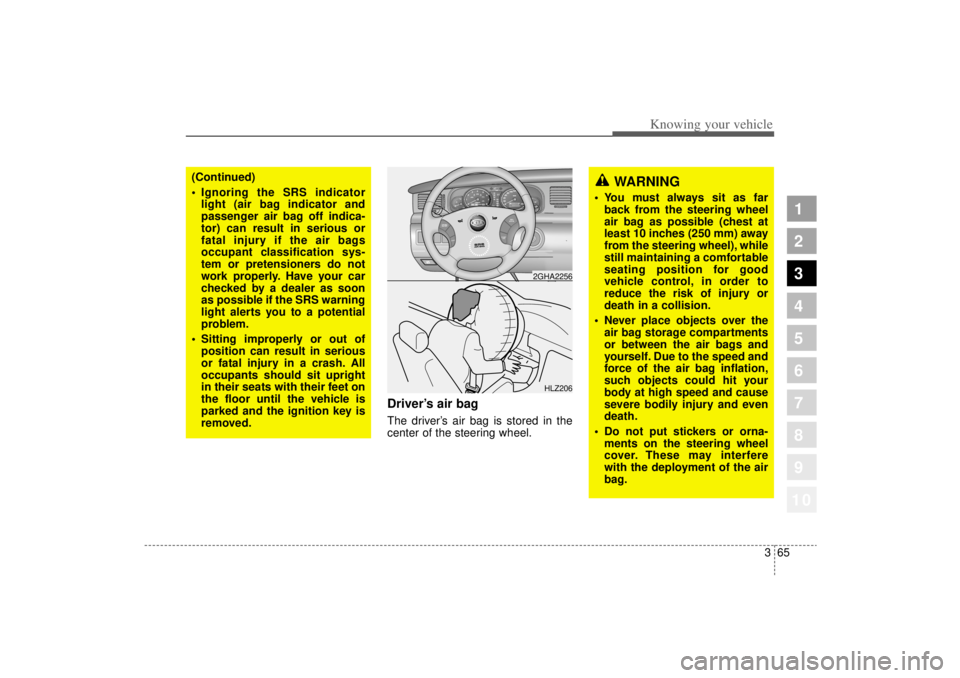
Driver’s air bagThe driver’ s air bag is stored in the
center of the steering wheel.
CRUISE
ON/OFFCAN CE
L
COAST
SETRES
ACCEL
HLZ2062GHA2256
(Continued)
Ignoring the SRS indicator
light (air bag indicator and
passenger air bag off indica-
tor) can result in serious or
fatal injury if the air bags
occupant classification sys-
tem or pretensioners do not
work properly. Have your car
checked by a dealer as soon
as possible if the SRS warning
light alerts you to a potential
problem.
Sitting improperly or out of
position can result in serious
or fatal injury in a crash. All
occupants should sit upright
in their seats with their feet on
the floor until the vehicle is
parked and the ignition key is
removed.
WARNING
You must always sit as far
back from the steering wheel
air bag as possible (chest at
least 10 inches (250 mm) away
from the steering wheel), while
still maintaining a comfortable
seating position for good
vehicle control, in order to
reduce the risk of injury or
death in a collision.
Never place objects over the
air bag storage compartments
or between the air bags and
yourself. Due to the speed and
force of the air bag inflation,
such objects could hit your
body at high speed and cause
severe bodily injury and even
death.
Do not put stickers or orna-
ments on the steering wheel
cover. These may interfere
with the deployment of the air
bag.
Page 78 of 322
367
1
2
3
4
5
6
7
8
910
Knowing your vehicle
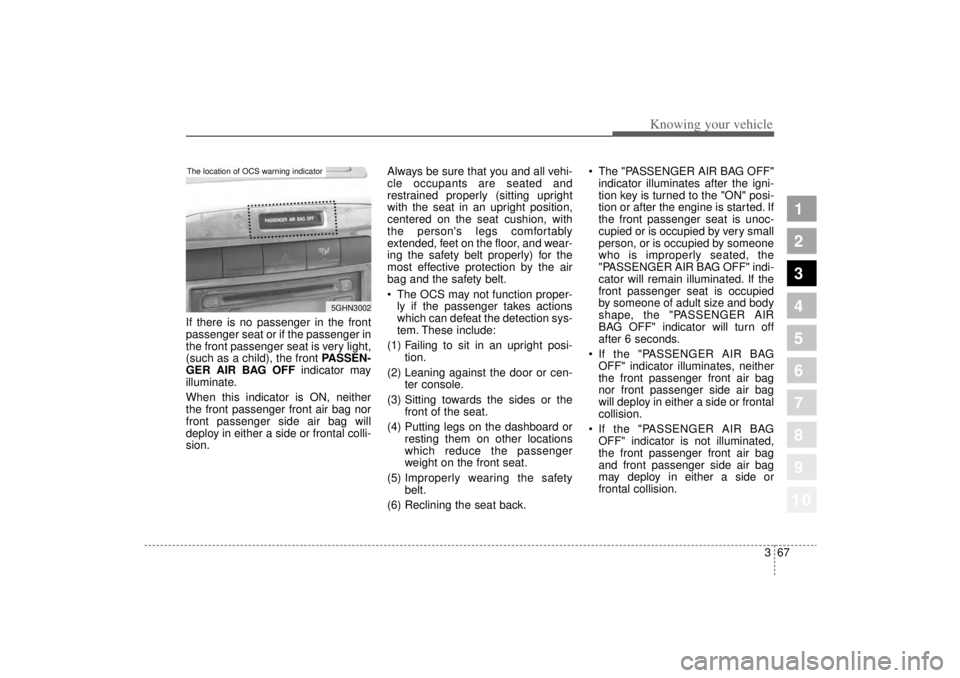
If there is no passenger in the front
passenger seat or if the passenger in
the front passenger seat is very light,
(such as a child), the front PASSEN-
GER AIR BAG OFF indicator may
illuminate.
When this indicator is ON, neither
the front passenger front air bag nor
front passenger side air bag will
deploy in either a side or frontal colli-
sion. Always be sure that you and all vehi-
cle occupants are seated and
restrained properly (sitting upright
with the seat in an upright position,
centered on the seat cushion, with
the person's legs comfortably
extended, feet on the floor, and wear-
ing the safety belt properly) for the
most effective protection by the air
bag and the safety belt.
The OCS may not function proper-
ly if the passenger takes actions
which can defeat the detection sys-
tem. These include:
(1) Failing to sit in an upright posi- tion.
(2) Leaning against the door or cen- ter console.
(3) Sitting towards the sides or the front of the seat.
(4) Putting legs on the dashboard or resting them on other locations
which reduce the passenger
weight on the front seat.
(5) Improperly wearing the safety
belt.
(6) Reclining the seat back.
The "PASSENGER AIR BAG OFF"
indicator illuminates after the igni-
tion key is turned to the "ON" posi-
tion or after the engine is started. If
the front passenger seat is unoc-
cupied or is occupied by very small
person, or is occupied by someone
who is improperly seated, the
"PASSENGER AIR BAG OFF" indi-
cator will remain illuminated. If the
front passenger seat is occupied
by someone of adult size and body
shape, the "PASSENGER AIR
BAG OFF" indicator will turn off
after 6 seconds.
If the "PASSENGER AIR BAG
OFF" indicator illuminates, neither
the front passenger front air bag
nor front passenger side air bag
will deploy in either a side or frontal
collision.
If the "PASSENGER AIR BAG
OFF" indicator is not illuminated,
the front passenger front air bag
and front passenger side air bag
may deploy in either a side or
frontal collision.
5GHN3002
The location of OCS warning indicator
Page 79 of 322
Knowing your vehicle68
3
1
2
3
4
5
6
7
8
910
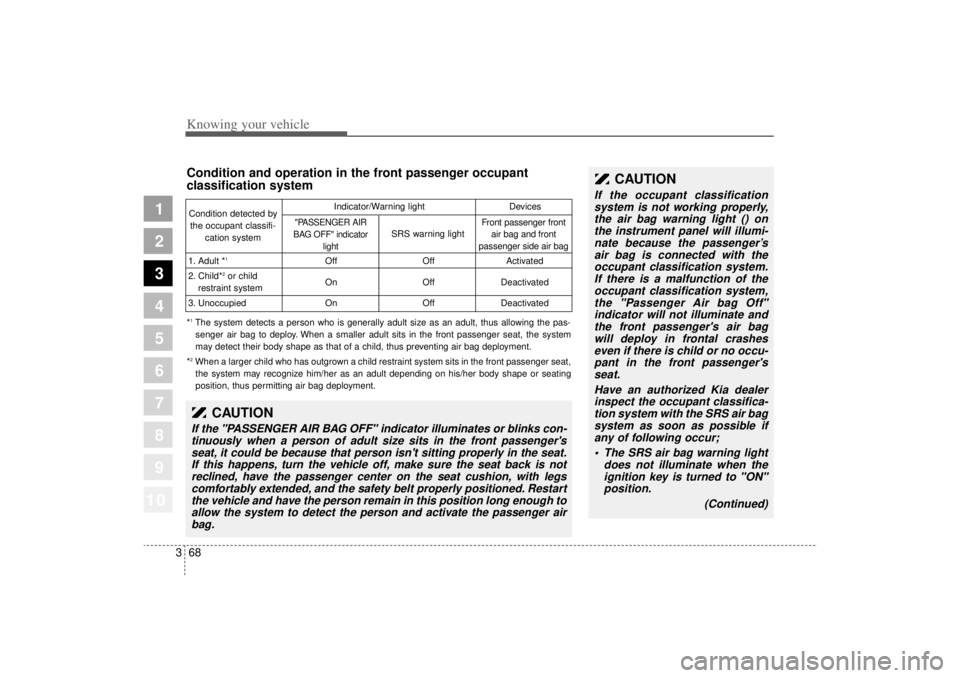
Condition and operation in the front passenger occupant
classification systemCondition detected by
the occupant classifi- cation system
1. Adult *
1
2. Child*
2or child
restraint system
3. Unoccupied Off
On
OnOff
Off
OffActivated
Deactivated
Deactivated
"PASSENGER AIR
BAG OFF" indicator light
SRS warning light Front passenger front
air bag and front
passenger side air bag
Indicator/Warning light
Devices
*1The system detects a person who is generally adult size as an adult, thus allowing the pas-
senger air bag to deploy. When a smaller adult sits in the front passenger seat, the system
may detect their body shape as that of a child, thus preventing air bag deployment.
*2When a larger child who has outgrown a child restraint system sits in the front passenger seat, the system may recognize him/her as an adult depending on his/her body shape or seating
position, thus permitting air bag deployment.
CAUTION
If the "PASSENGER AIR BAG OFF" indicator illuminates or blinks con- tinuously when a person of adult size sits in the front passenger'sseat, it could be because that person isn't sitting properly in the seat.If this happens, turn the vehicle off, make sure the seat back is notreclined, have the passenger center on the seat cushion, with legscomfortably extended, and the safety belt properly positioned. Restartthe vehicle and have the person remain in this position long enough toallow the system to detect the person and activate the passenger airbag.
CAUTION
If the occupant classificationsystem is not working properly,the air bag warning light () onthe instrument panel will illumi-nate because the passenger’ s
air bag is connected with the occupant classification system.If there is a malfunction of theoccupant classification system,the "Passenger Air bag Off"indicator will not illuminate andthe front passenger's air bagwill deploy in frontal crasheseven if there is child or no occu-pant in the front passenger'sseat.
Have an authorized Kia dealerinspect the occupant classifica-tion system with the SRS air bagsystem as soon as possible ifany of following occur;
The SRS air bag warning light
does not illuminate when theignition key is turned to "ON"position.
(Continued)
Page 95 of 322
Knowing your vehicle84
3
1
2
3
4
5
6
7
8
910
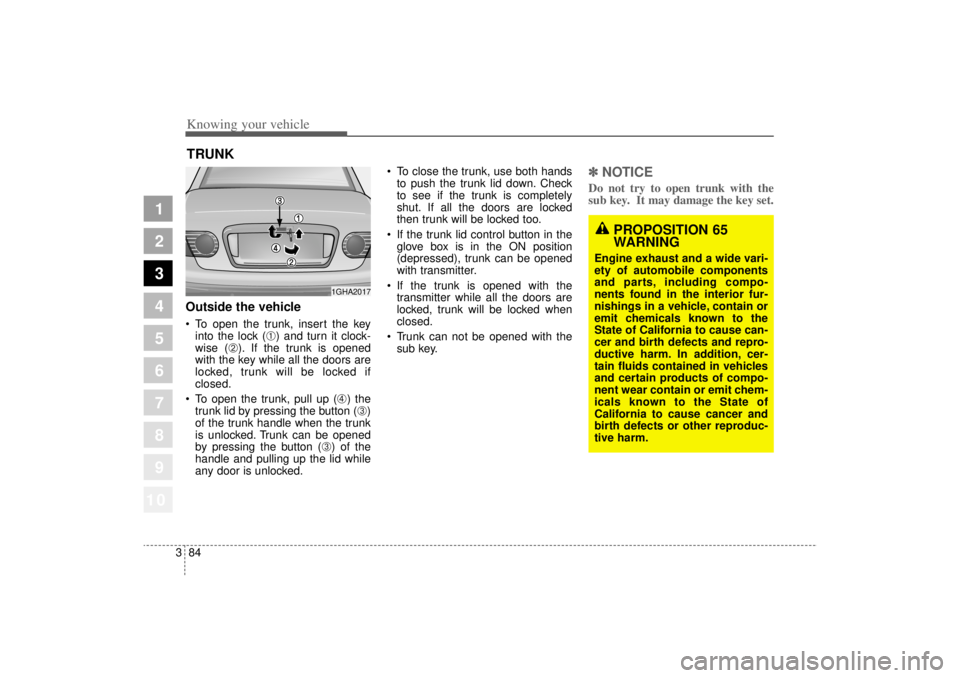
Outside the vehicle To open the trunk, insert the key
into the lock (
➀) and turn it clock-
wise (
➁). If the trunk is opened
with the key while all the doors are
locked, trunk will be locked if
closed.
To open the trunk, pull up (
➃) the
trunk lid by pressing the button (➂)
of the trunk handle when the trunk
is unlocked. Trunk can be opened
by pressing the button (
➂) of the
handle and pulling up the lid while
any door is unlocked.
To close the trunk, use both hands
to push the trunk lid down. Check
to see if the trunk is completely
shut. If all the doors are locked
then trunk will be locked too.
If the trunk lid control button in the
glove box is in the ON position
(depressed), trunk can be opened
with transmitter.
If the trunk is opened with the
transmitter while all the doors are
locked, trunk will be locked when
closed.
Trunk can not be opened with the
sub key.
✽ ✽
NOTICEDo not try to open trunk with the
sub key. It may damage the key set.
TRUNK
1GHA2017
PROPOSITION 65
WARNING
Engine exhaust and a wide vari-
ety of automobile components
and parts, including compo-
nents found in the interior fur-
nishings in a vehicle, contain or
emit chemicals known to the
State of California to cause can-
cer and birth defects and repro-
ductive harm. In addition, cer-
tain fluids contained in vehicles
and certain products of compo-
nent wear contain or emit chem-
icals known to the State of
California to cause cancer and
birth defects or other reproduc-
tive harm.
Page 96 of 322
385
1
2
3
4
5
6
7
8
910
Knowing your vehicle
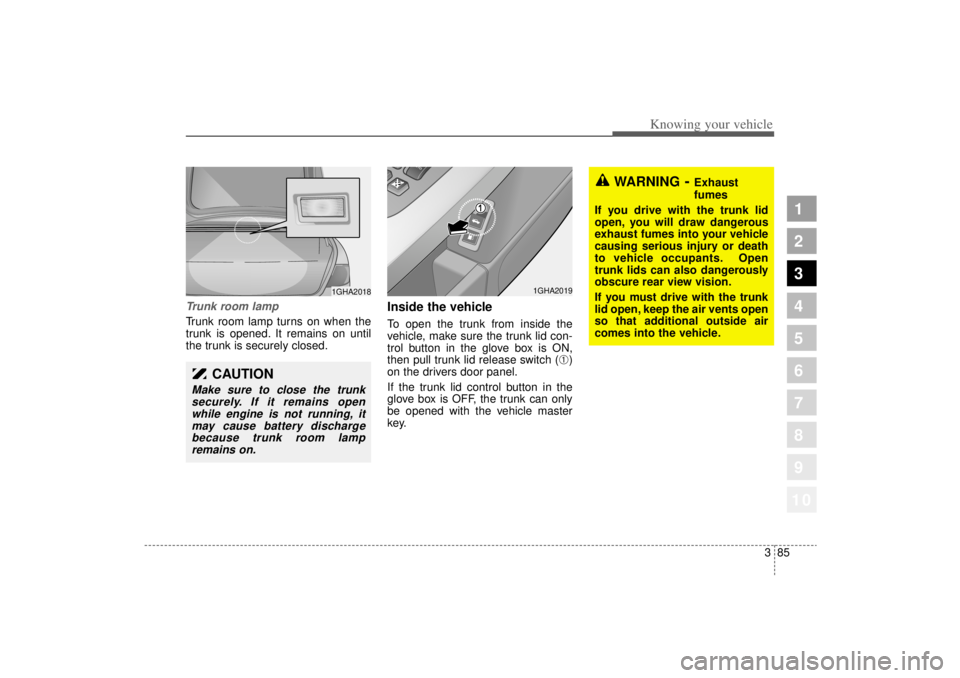
Trunk room lampTrunk room lamp turns on when the
trunk is opened. It remains on until
the trunk is securely closed.
Inside the vehicleTo open the trunk from inside the
vehicle, make sure the trunk lid con-
trol button in the glove box is ON,
then pull trunk lid release switch (
➀)
on the drivers door panel.
If the trunk lid control button in the
glove box is OFF, the trunk can only
be opened with the vehicle master
key.
WARNING
- Exhaust
fumes
If you drive with the trunk lid
open, you will draw dangerous
exhaust fumes into your vehicle
causing serious injury or death
to vehicle occupants. Open
trunk lids can also dangerously
obscure rear view vision.
If you must drive with the trunk
lid open, keep the air vents open
so that additional outside air
comes into the vehicle.
1GHA2018
CAUTION
Make sure to close the trunk securely. If it remains openwhile engine is not running, itmay cause battery dischargebecause trunk room lampremains on.
1GHA2019