2006 KIA AMANTI warning
[x] Cancel search: warningPage 272 of 322
Maintenance28
7
1
2
3
4
5
6
7
8
910
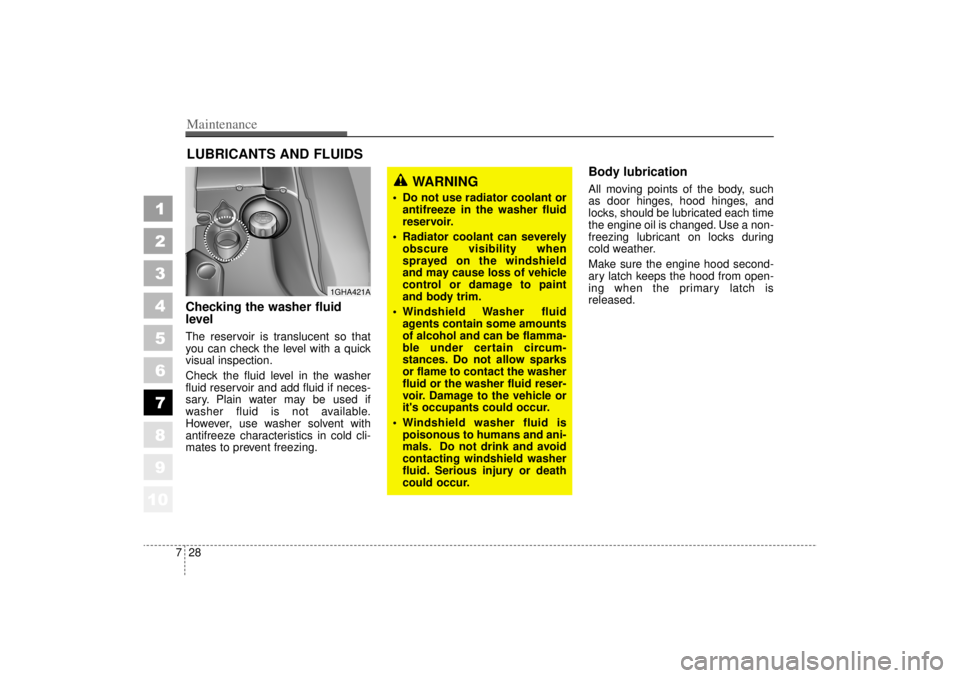
LUBRICANTS AND FLUIDS Checking the washer fluid
level The reservoir is translucent so that
you can check the level with a quick
visual inspection.
Check the fluid level in the washer
fluid reservoir and add fluid if neces-
sary. Plain water may be used if
washer fluid is not available.
However, use washer solvent with
antifreeze characteristics in cold cli-
mates to prevent freezing.
Body lubrication All moving points of the body, such
as door hinges, hood hinges, and
locks, should be lubricated each time
the engine oil is changed. Use a non-
freezing lubricant on locks during
cold weather.
Make sure the engine hood second-
ary latch keeps the hood from open-
ing when the primary latch is
released.
1GHA421A
WARNING
Do not use radiator coolant or
antifreeze in the washer fluid
reservoir.
Radiator coolant can severely obscure visibility when
sprayed on the windshield
and may cause loss of vehicle
control or damage to paint
and body trim.
Windshield Washer fluid agents contain some amounts
of alcohol and can be flamma-
ble under certain circum-
stances. Do not allow sparks
or flame to contact the washer
fluid or the washer fluid reser-
voir. Damage to the vehicle or
it's occupants could occur.
Windshield washer fluid is poisonous to humans and ani-
mals. Do not drink and avoid
contacting windshield washer
fluid. Serious injury or death
could occur.
Page 278 of 322
Maintenance34
7
1
2
3
4
5
6
7
8
910
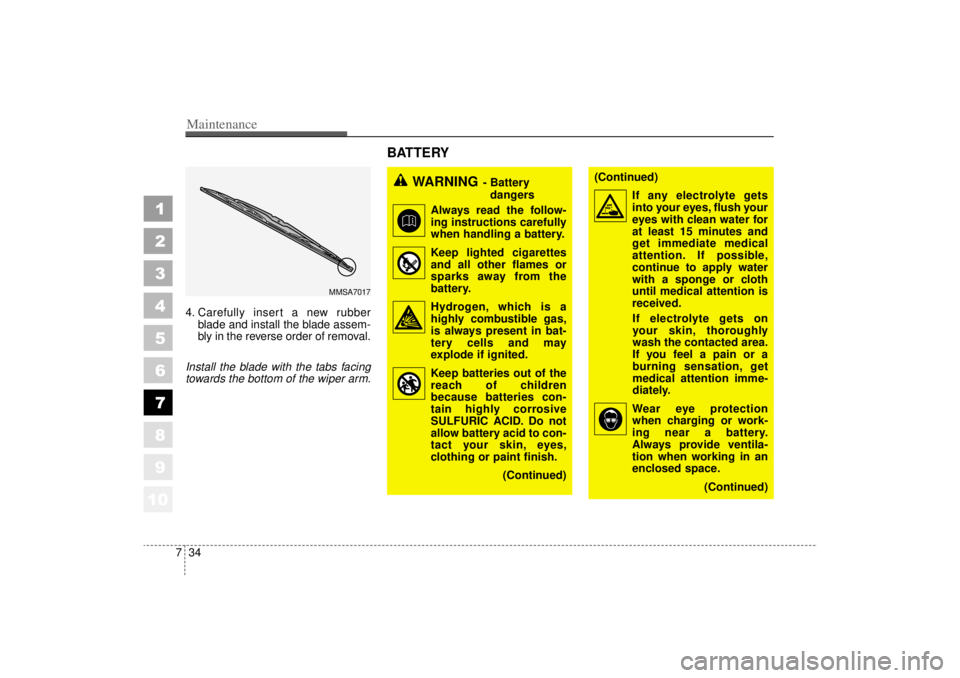
4. Carefully insert a new rubber
blade and install the blade assem-
bly in the reverse order of removal.Install the blade with the tabs facingtowards the bottom of the wiper arm.
BATTERY
MMSA7017
WARNING
- Battery
dangers
Always read the follow-
ing instructions carefully
when handling a battery.
Keep lighted cigarettes and all other flames or
sparks away from the
battery.
Hydrogen, which is a highly combustible gas,
is always present in bat-
tery cells and may
explode if ignited.
Keep batteries out of the reach of children
because batteries con-
tain highly corrosive
SULFURIC ACID. Do not
allow battery acid to con-
tact your skin, eyes,
clothing or paint finish.
(Continued)
(Continued)If any electrolyte getsinto your eyes, flush your
eyes with clean water for
at least 15 minutes and
get immediate medical
attention. If possible,
continue to apply water
with a sponge or cloth
until medical attention is
received.
If electrolyte gets on
your skin, thoroughly
wash the contacted area.
If you feel a pain or a
burning sensation, get
medical attention imme-
diately.
Wear eye protection when charging or work-
ing near a battery.
Always provide ventila-
tion when working in an
enclosed space.
(Continued)
Page 280 of 322
Maintenance36
7
1
2
3
4
5
6
7
8
910
Items to be reset after the battery
has been discharged or the bat-tery has been disconnected. Driver seat position memory sys-
tem (See page 3-34)
Power window (See page 3-15)
Clock (See page 3-106)
Climate control system (See pages
4-59)
Audio (See the audio manual)
Sunroof (See page 3-110)
✽ ✽
NOTICE• Before performing maintenance
or recharging the battery, turn off
all accessories and stop the engine.
• The negative battery cable must be removed first and installed last
when the battery is disconnected.
WARNING
- Recharging
battery
When recharging the battery,
observe the following precau-
tions:
The battery must be removed
from the vehicle and placed in
an area with good ventilation.
Do not allow cigarettes,
sparks, or flame near the bat-
tery.
Watch the battery during
charging, and stop or reduce
the charging rate if the battery
cells begin gassing (boiling)
violently or if the temperature
of the electrolyte of any cell
exceeds 120°F (49°C).
Wear eye protection when
checking the battery during
charging.
(Continued)
(Continued)
Disconnect the battery charg-
er in the following order.
1. Turn off the battery charger main switch.
2. Unhook the negative clamp from the negative battery ter-
minal.
3. Unhook the positive clamp from the positive battery ter-
minal.
Page 281 of 322
737
Maintenance
1
2
3
4
5
6
7
8
910
TIRES AND WHEELS Tires care For proper maintenance, safety, and
maximum fuel economy, you must
always maintain recommended tire
inflation pressures and stay within
the load limits and weight distribution
recommended for your vehicle.Inflation pressures All tire pressures (including the
spare) should be checked every day
when the tires are cold.“Cold Tires”
means the vehicle has not been driv-
en for at least three hours or driven
less than one mile (1.6 km).
Recommended pressures must be
maintained for the best ride, top vehi-
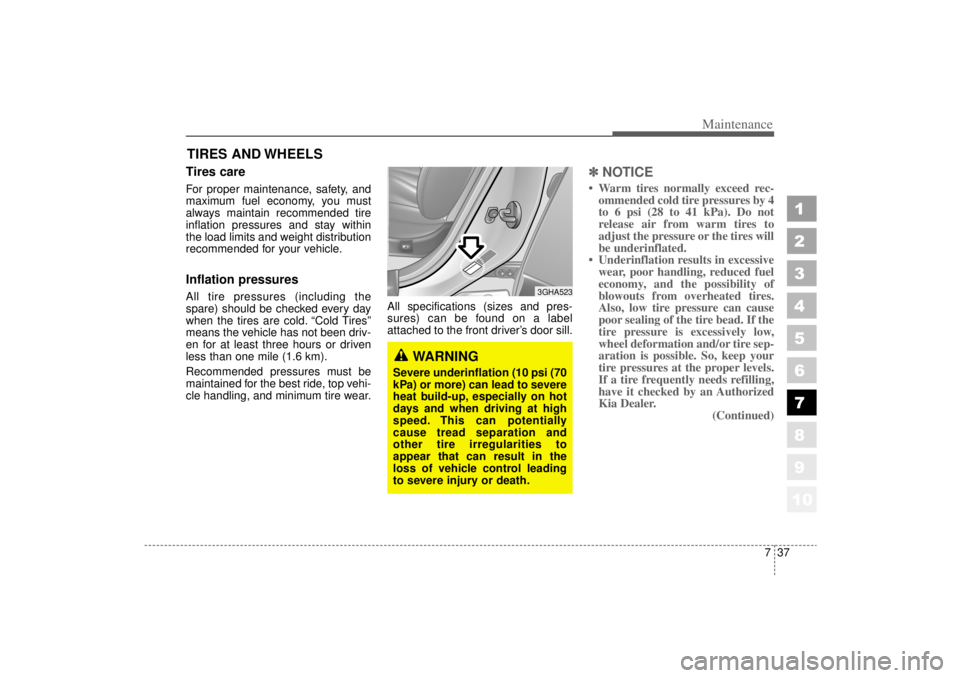
cle handling, and minimum tire wear. All specifications (sizes and pres-
sures) can be found on a label
attached to the front driver’
s door sill.
✽ ✽
NOTICE• Warm tires normally exceed rec-
ommended cold tire pressures by 4
to 6 psi (28 to 41 kPa). Do not
release air from warm tires to
adjust the pressure or the tires will
be underinflated.
• Underinflation results in excessive wear, poor handling, reduced fuel
economy, and the possibility of
blowouts from overheated tires.
Also, low tire pressure can cause
poor sealing of the tire bead. If the
tire pressure is excessively low,
wheel deformation and/or tire sep-
aration is possible. So, keep your
tire pressures at the proper levels.
If a tire frequently needs refilling,
have it checked by an Authorized
Kia Dealer. (Continued)
3GHA523
WARNING
Severe underinflation (10 psi (70
kPa) or more) can lead to severe
heat build-up, especially on hot
days and when driving at high
speed. This can potentially
cause tread separation and
other tire irregularities to
appear that can result in the
loss of vehicle control leading
to severe injury or death.
Page 282 of 322
Maintenance38
7
1
2
3
4
5
6
7
8
910
(Continued)
• Overinflation produces a harsh
ride, handling problems, excessive
wear at the center of the tire tread,
and a greater possibility of dam-
age from road hazards.
• Be sure to reinstall the tire infla- tion valve caps. Without the valve
cap, dirt or moisture could get into
the valve core and cause air leak-
age. If the cap have been lost,
install new one as soon as possible.
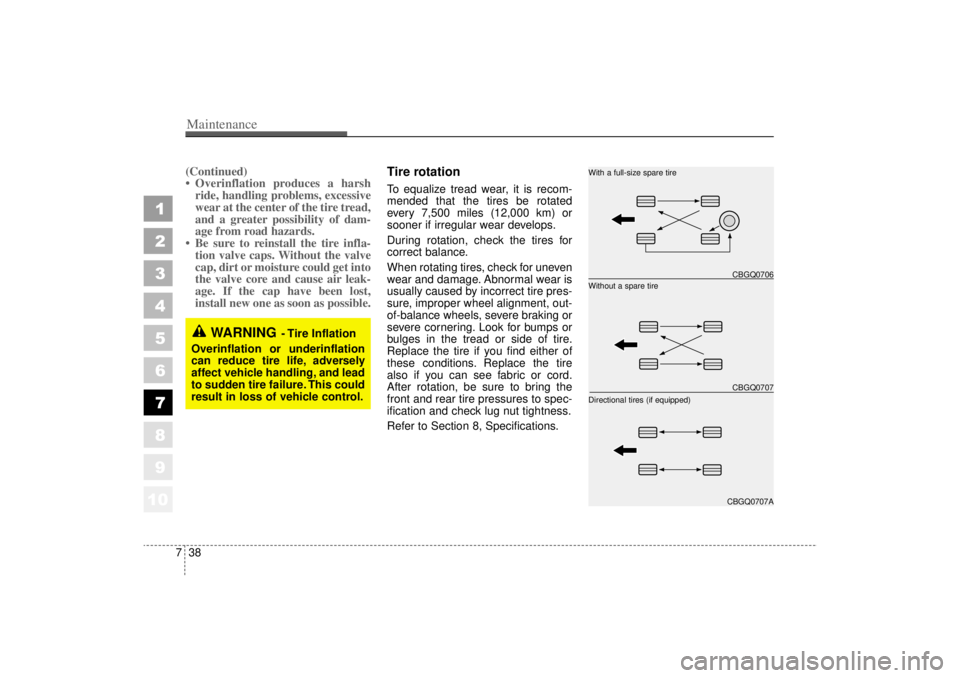
Tire rotation To equalize tread wear, it is recom-
mended that the tires be rotated
every 7,500 miles (12,000 km) or
sooner if irregular wear develops.
During rotation, check the tires for
correct balance.
When rotating tires, check for uneven
wear and damage. Abnormal wear is
usually caused by incorrect tire pres-
sure, improper wheel alignment, out-
of-balance wheels, severe braking or
severe cornering. Look for bumps or
bulges in the tread or side of tire.
Replace the tire if you find either of
these conditions. Replace the tire
also if you can see fabric or cord.
After rotation, be sure to bring the
front and rear tire pressures to spec-
ification and check lug nut tightness.
Refer to Section 8, Specifications.
WARNING
- Tire Inflation
Overinflation or underinflation
can reduce tire life, adversely
affect vehicle handling, and lead
to sudden tire failure. This could
result in loss of vehicle control.
CBGQ0706CBGQ0707CBGQ0707A
Without a spare tire With a full-size spare tire
Directional tires (if equipped)
Page 284 of 322
Maintenance40
7
1
2
3
4
5
6
7
8
910
WARNING
A wheel that is not the correct
size may adversely affect wheel
and bearing life, braking and
stopping abilities, handling
characteristics, ground clear-
ance, body-to-tire clearance,
snow chain clearance,
speedometer calibration, head-
light aim and bumper height.Wheel replacement When replacing the metal wheels for
any reason, make sure the new
wheels are equivalent to the original
factory units in diameter, rim width
and offset.
WARNING
When replacing tires, never
mix radial, bias-belted, and
bias-type tires. All four tires
should be of the same size,
design and construction. Use
only the tire sizes listed on the
Tire Label found below the
door striker on the driver’ s
side. Make sure that all tires
and wheels are the same size
and have the same load-carry-
ing capacity. Use only tire and
wheel combinations recom-
mended on the Tire Label or
by an Authorized Kia Dealer.
Failure to follow these precau-
tions can adversely affect the
safety and handling of your
vehicle.
(Continued)
(Continued)
The use of any other tire size
or type may seriously affect
ride, handling, ground clear-
ance, tire clearance, and
speedometer calibration.
Driving on worn-out tires is
very hazardous and will
reduce braking effectiveness,
steering accuracy, and trac-
tion.
It is best to replace all four
tires at the same time. If that is
not possible, or necessary,
then replace the two front or
two rear tires as a pair.
Replacing just one tire can
seriously affect your vehicle’ s
handling.
Page 287 of 322
743
Maintenance
1
2
3
4
5
6
7
8
910
Checking a tire lifeIf any tires that are over 6 years
based on the manufacturing date,
tire strength and performance
decline with age naturally (even if the
tires are not used like a spare tire).
Therefore, the tires should be
replaced by new ones including the
spare tire. You can find the manufac-
turing date on the tire sidewall (pos-
sibly only on the inside of the wheel),
which has DOT marking. DOT is seri-
al numbers on tires, which consist of
a combination of numbers and
English letters. You can check the
manufacturing date to the last four
position of the DOT.
DOT : XXXX XXXX OOOO
The front part of the DOT means a
plant code number, tire size and
tread pattern and the last four num-
bers indicate week and year manu-
factured.
For example:
DOT XXXX XXXX 1602 represents
that the tire was produced in the 16th
week of 2002.
WARNING
A tire more than 6 years old may
cause separation of the cord
layers inside the tire leading to
loss of vehicle or a serious
injury. Therefore, make sure to
check the manufacturing date
and replace the old tire in 6
years after the tire manufactur-
ing date.
WARNING
- Tire temperature
The temperature grade for this
tire is established for a tire that
is properly inflated and not
overloaded. Excessive speed,
underinflation, or excessive
loading, either separately or in
combination, can cause heat
build-up and possible sudden
tires failure. This can cause loss
of vehicle control and serious
injury or death.
Page 288 of 322
Maintenance44
7
1
2
3
4
5
6
7
8
910
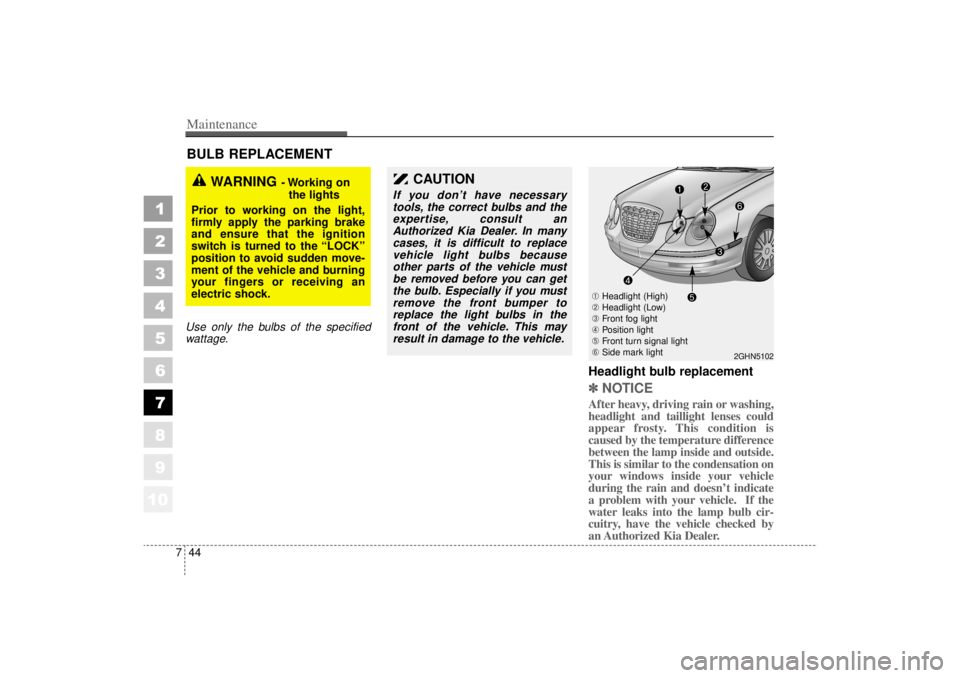
BULB REPLACEMENT Use only the bulbs of the specified
wattage.
Headlight bulb replacement ✽ ✽ NOTICEAfter heavy, driving rain or washing,
headlight and taillight lenses could
appear frosty. This condition is
caused by the temperature difference
between the lamp inside and outside.
This is similar to the condensation on
your windows inside your vehicle
during the rain and doesn’t indicate
a problem with your vehicle. If the
water leaks into the lamp bulb cir-
cuitry, have the vehicle checked by
an Authorized Kia Dealer.
WARNING
- Working on
the lights
Prior to working on the light,
firmly apply the parking brake
and ensure that the ignition
switch is turned to the “LOCK”
position to avoid sudden move-
ment of the vehicle and burning
your fingers or receiving an
electric shock.
CAUTION
If you don’ t have necessary
tools, the correct bulbs and the expertise, consult anAuthorized Kia Dealer. In manycases, it is difficult to replacevehicle light bulbs becauseother parts of the vehicle mustbe removed before you can getthe bulb. Especially if you mustremove the front bumper toreplace the light bulbs in thefront of the vehicle. This mayresult in damage to the vehicle.
2GHN5102
➀ Headlight (High)
➁ Headlight (Low)
➂ Front fog light
➃ Position light
➄ Front turn signal light
➅ Side mark light