Page 226 of 320

This section explains why it is
important to keep your vehicle well
maintained and how to f ollow basic
maintenance saf ety precautions.
This section also includes
instructions on how to read the
maintenance messages in the
inf ormation display, a maintenance
record, and instructions f or simple
maintenance tasks you may want to
take care of yourself .
If you have the skills and tools to
perf orm more complex maintenance
tasks on your vehicle, you may want
to purchase the service manual. See
page f or inf ormation on how to
obtain a copy, or see your dealer.......................
Maintenance Saf ety .224
....................
Maintenance Minder .225
....................
Maintenance Record .233
..............................
Fluid Locations .235
........................
Adding Engine Oil .236
.........
Changing the Oil and Filter .237
..............................
Engine Coolant .239
....................
Windshield Washers .240
....
Automatic Transmission Fluid .241
.................
Rear Dif f erential Fluid .242
.............
Transf er Assembly Fluid .243
....................................
Brake Fluid .243
....................
Power Steering Fluid .244
....................................
Timing Belt .244
.............................................
Lights .245
................
Cleaning the Seat Belts .251
.....................................
Floor Mats .252
..................
Dust and Pollen Filter .252
.................................
Wiper Blades .253
...............................................
Tires .255
...................
Checking the Battery .260
.............................
Vehicle Storage .262
305
Maintenance
Maint enance
223
�����—�
���—�����y�
�������������y���
�(�����������y���������y
Page 227 of 320
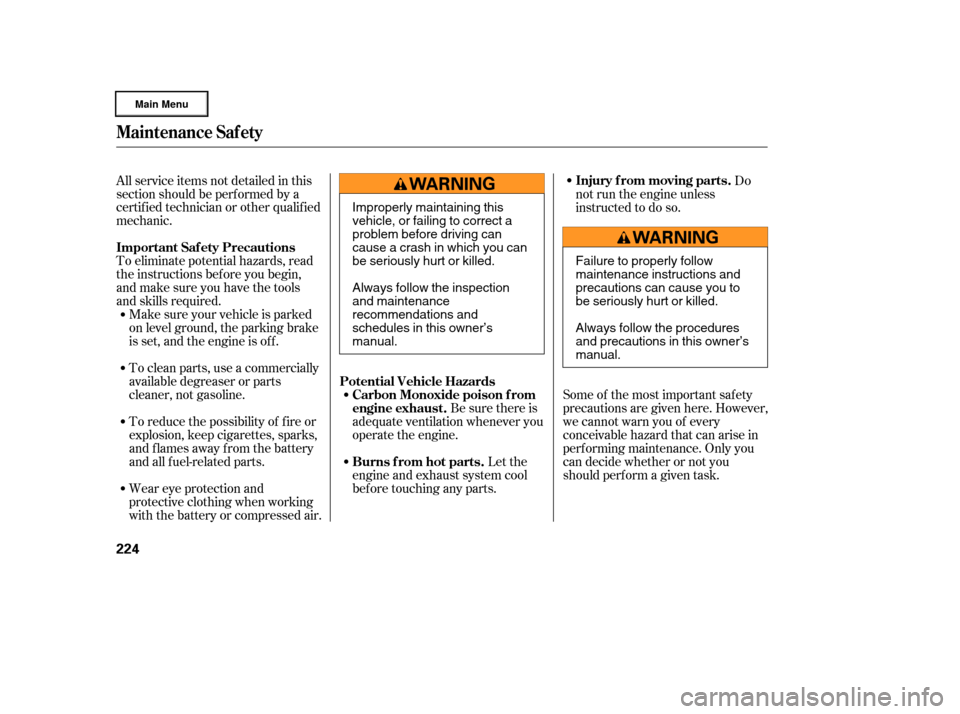
To eliminate potential hazards, read
the instructions bef ore you begin,
and make sure you have the tools
and skills required. All service items not detailed in this
section should be perf ormed by a
certif ied technician or other qualif ied
mechanic.Make sure your vehicle is parked
on level ground, the parking brake
is set, and the engine is of f .
To clean parts, use a commercially
available degreaser or parts
cleaner, not gasoline.
To reduce the possibility of f ire or
explosion, keep cigarettes, sparks,
and flames away from the battery
and all f uel-related parts.
Wear eye protection and
protective clothing when working
with the battery or compressed air. Be sure there is
adequate ventilation whenever you
operate the engine. Some of the most important saf ety
precautions are given here. However,
we cannot warn you of every
conceivable hazard that can arise in
perf orming maintenance. Only you
can decide whether or not you
should perf orm a given task.Do
not run the engine unless
instructed to do so.
Let the
engine and exhaust system cool
bef ore touching any parts.
Maintenance Saf ety
Important Saf ety Precautions
Carbon Monoxide poison f rom
engine exhaust.
Potential Vehicle Hazards Injury f rom moving parts.
Burns f rom hot parts.
224
Improperly maintaining this
vehicle, or failing to correct a
problem before driving can
cause a crash in which you can
be seriously hurt or killed.
Always follow the inspection
and maintenance
recommendations and
schedules in this owner’s
manual. Failure to properly follow
maintenance instructions and
precautions can cause you to
be seriously hurt or killed.
Always follow the procedures
and precautions in this owner’s
manual.
�����—�
���—�����y�
���������
���y���
�(�����������y���������y
Page 234 of 320
�µ�µ�µ
�µ
�µ �µ
Youshouldcheckthefollowing
items at the specif ied intervals. If
you are unsure of how to perf orm
any check, turn to the appropriate
page listed.
Engine oil level Check every
time you fill the fuel tank. See
page .
Engine coolant level Check the
radiator reserve tank every time
you f ill the f uel tank. See page .
Automatic transmission Check
the f luid level monthly. See page .
Brakes Check the f luid level
monthly. See page .
Tires Check the tire pressure
monthly. Examine the tread f or
wear and foreign objects. See page . Lights Check the operation of
the headlights, parking lights,
taillights, high-mount brake light,
and license plate lights monthly.
See page .
256 245
178 178
241 243
CONT INUED
Maintenance Minder
Owner’s Maintenance Checks
Maint enance
231
�����—�
���—�����y�
���������
���y���
�(�����������y���������y
Page 235 of 320

�Î
�Ì �Ì
�Ì
�Î
Maintenance Minder
232
: Maintenance Main Items
Replace engine oil
Replace engine oil and oil filter
Rotate tires
Inspect front and rear brakes
Check parking brake adjustment
Inspect these items: Tie rod ends, steering gear box, and boots
Suspension components
Driveshaft boots
Brake hoses and lines (including ABS)
All fluid levels and condition of fluids
Exhaust system
Fuel lines and connections
Maintenance Sub Items
Rotate tires
Replace air cleaner element If you drive in dusty conditions, replace
every 15,000 miles (24,000 km). Maintenance Sub Items
Replace dust and pollen filter
Inspect drive belt
Replace transmission and transfer fluid
Replace spark plugs
Replace timing belt and inspect water pump
Inspect valve clearance
Replace engine coolant
Replace VTM-4 rear differential fluid
2
3
4
5
Symbol
A
B
Symbol 1
2 Symbol
6
1
See information on maintenance and emissions warranty on page .Independent of the maintenance messages in the information display,
replace the brake fluid every 3 years.
Inspect idle speed every 160,000 miles (256,000 km).
Adjust the valves during services A, B, 1, 2, or 3 only if they are noisy.
If the message ‘‘SERVICE dUE NOW’’ does not appear more than 12 months
after the display is reset, change the engine oil every year.
NOTE: 1:
230
If you drive primarily in urban areas that have high
concentrations of soot in the air from industry and from diesel-
powered vehicles, replace every 15,000 miles (24,000 km).
Driving in mountainous areas at very low vehicle speeds or
trailer towing results in higher transmission and transfer
temperatures or frequently fully loaded. This requires
transmission and transfer fluid changes more frequently
than recommended by the Maintenance Minder.
If you regulary drive your vehicle under these conditions, have
the transmission and transfer fluid changed every 30,000 miles
(48,000 km).
If you drive regularly in very high temperatures (over 110°F,
43°C), in very low temperatures (under-20°F, -29°C), or towing a
trailer, replace every 60,000 mile (U.S.)/100,000 km (Canada)
Driving in mountainous areas at very low vehicle speeds or
trailer towing results in higher level of mechanical (shear) stress
to fluid or frequently fully loaded. This requires differential fluid
changes more frequently than recommended by the
Maintenance Minder. If you regularly drive your vehicle under
these conditions, have the differential fluid changed at
7,500 miles (12,000 km), then every 15,000 miles (24,000 km).
Maintenance Minder
�����—�����—�����y�
�������������y���
�(�����������y���������y
Page 236 of 320
CONT INUED
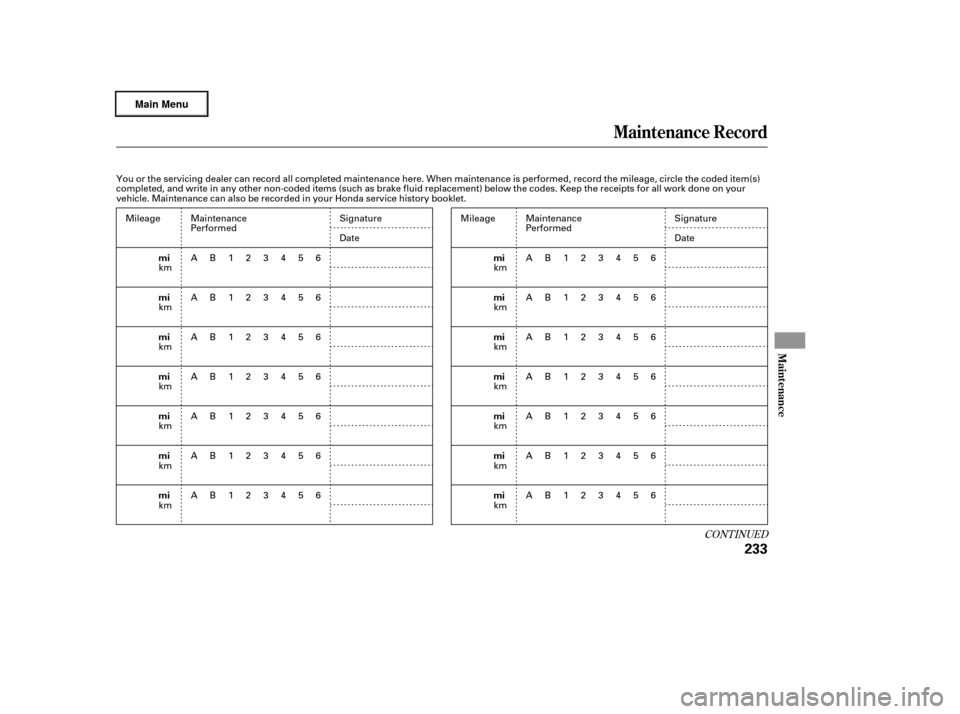
Maintenance Record
Maint enance
233
mi
mi
mi
mi
mi
mi
mimi
mi
mi
mi
mi
mi
mi
You or the servicing dealer can record all completed maintenance here. When maintenance is performed, record the mileage, circle the coded item(s)
completed, and write in any other non-coded items (such as brake fluid replacement) below the codes. Keep the receipts for all work done on your
vehicle. Maintenance can also be recorded in your Honda service history booklet.
Mileage
km
km
km
km
km
km
kmMaintenance
Performed
AB123456
AB123456
AB123456
AB123456
AB123456
AB123456
AB123456
Signature
Date
Mileage
km
km
km
km
km
km
km Signature
Date
Maintenance
Performed
AB123456
AB123456
AB123456
AB123456
AB123456
AB123456
AB123456
�����—�����—�����y�
�������������y���
�(�����������y���������y
Page 238 of 320
�Î
�Î
Fluid Locations
Maint enance
235
ENGINE OIL DIPSTICK
(Orange loop)
WASHER FLUID
(Blue cap)RADIATOR CAP AUTOMATIC
TRANSMISSION
FLUID DIPSTICK
(Yellow loop)
BRAKE FLUID
(Gray cap)
ENGINE
COOLANT
RESERVOIR POWER STEERING
FLUID (Red cap) ENGINE OIL FILL CAP
: Under the gray cover
�����—�����—�����y�
�������������y���
�(�����������y���������y
Page 246 of 320

The transf er assembly should be
drained and ref illed with new f luid
when this service is indicated by a
maintenance message on the
inf ormation display.
Always use Hypoid gear oil GL4 or
GL5 with a viscosity of SAE 90 or 80-
90W, and have your dealer replace
the transf er assembly f luid.Check the brake f luid level in the
reservoir monthly.
Replace the brake f luid according to
the time recommendation in the
maintenance minder schedule.
Brake f luid marked DOT 5 is not
compatible with your vehicle’s
braking system and can cause
extensive damage. Using any non-Honda brake f luid can
cause corrosion and decrease the lif e
of the system. Have the brake
system f lushed and ref illed with
Honda Heavy Duty Brake Fluid
DOT 3 as soon as possible. Always use Honda Heavy Duty
Brake Fluid DOT 3. If it is not
available, you should use only DOT 3
or DOT 4 f luid, f rom a sealed
container, as a temporary
replacement.
The f luid level should be between
theMINandMAXmarksontheside
of the reservoir. If the level is at or
below the MIN mark, your brake
system needs attention. Have the
brake system inspected f or leaks or
worn brake pads.
Brake Fluid
Transf er Assembly Fluid
Transf er A ssembly Fluid, Brake Fluid
Maint enance
243
MAX
MIN
�����—�
���—�����y�
���������
���y���
�(�����������y���������y
Page 250 of 320
Remove the socket by turning it
one-quarter turn counterclockwise.
Remove the burned-out bulb by
pulling it straight out of the socket.
Drop open the tailgate.
Remove the two bolts, and remove
the rear light assembly f rom the
rear pillar.
Determine which of the three
bulbs is burned out: brake/
taillight, turn signal/hazard light,
or back-up light.
Insert the socket back into the
headlight assembly. Turn it
clockwise to lock it in place.
Turn on the lights to make sure
the new bulb is working.
Put the inner f ender cover in place.
Install and lock each holding clip
bypushingonthecenter.
1.
2.
3.
5.
4.
5.
6.
7.
CONT INUED
Lights
Replacing Rear Bulbs
Maint enance
247
�����—�
���—�����y�
�������������y���
�(�����������y���������y