Page 213 of 320
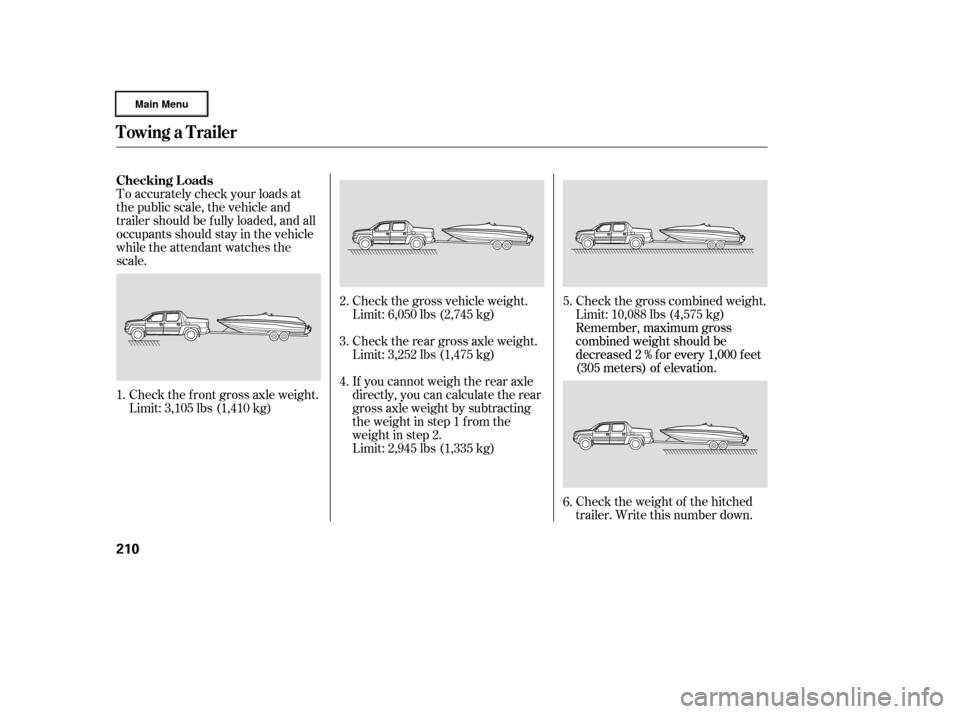
To accurately check your loads at
the public scale, the vehicle and
trailer should be f ully loaded, and all
occupants should stay in the vehicle
while the attendant watches the
scale.Check the f ront gross axle weight.
Limit: 3,105 lbs (1,410 kg) Check the gross vehicle weight.
Limit: 6,050 lbs (2,745 kg)
Check the weight of the hitched
trailer. Write this number down. Remember, maximum gross
combined weight should be
decreased 2 % f or every 1,000 f eet
(305 meters) of elevation. Check the gross combined weight.
Limit: 10,088 lbs (4,575 kg)
Remember, maximum gross
combined weight should be
decreased 2 % f or every 1,000 f eet
(305 meters) of elevation.
If you cannot weigh the rear axle
directly, you can calculate the rear
gross axle weight by subtracting
the weight in step 1 from the
weight in step 2.
Limit: 2,945 lbs (1,335 kg) Check the rear gross axle weight.
Limit: 3,252 lbs (1,475 kg)
1. 2.
3.
4.
5.
6.
Towing a Trailer
Checking L oads
210
�����—�
���—�����y�
�������������y���
�(�����������y�����
���y
Page 214 of 320

CONT INUED
Check the weight of the unhitched
trailer. Limit: See page .Your dealer of f ers a trailer package
that includes a hitch, a ball mount,
and a wiring harness.
Discuss any additional needs with
your trailer sales or rental agency,
and make sure all equipment is
properly installed, maintained, and
also meets state, f ederal, province,
and local regulations. Towing generally requires a variety
of supplemental equipment. To
ensure the best quality, we
recommend that you purchase
Honda equipment whenever possible. We strongly recommend that you
have your dealer install a class 3
hitch. Using non-Honda equipment
may result in serious damage to your
vehicle.
Read the trailer manufacturer’s
instructions, and select the
appropriate draw bar f or the height
of the trailer you will be towing.
A weight distributing hitch is not
recommended f or use with your
vehicle, as an improperly adjusted
weight distributing hitch may reduce
handling, stability, and braking
perf ormance.
Calculate the tongue load.
Subtract the weight in step6f rom
the weight in step 7.
Limit: See page .
Recommended: See page . 207
7.
8.
209209
Towing a Trailer
T owing Equipment and
A ccessoriesHitch
Weight Distributing Hitch
Driving
211
�����—�����—�����y�
����
��������y���
�(�����������y�����
���y
Page 215 of 320
There are two common types of
trailer brakes: surge and electric.
Surge brakes are common f or boat
trailers, since the brakes will get wet.
If you choose electric brakes, be
sure they are electrically actuated.
Do not attempt to tap into your
vehicle’s hydraulic system. No
matter how successf ul it may seem,
any attempt to attach trailer brakes
to your vehicle’s hydraulic system
will lower braking ef f ectiveness and
create a potential hazard.
Seeyourtrailermanufacturerfor
more inf ormation on installing
electric brakes. Honda requires that any trailer with
a total trailer weight of 1,000 lbs (455
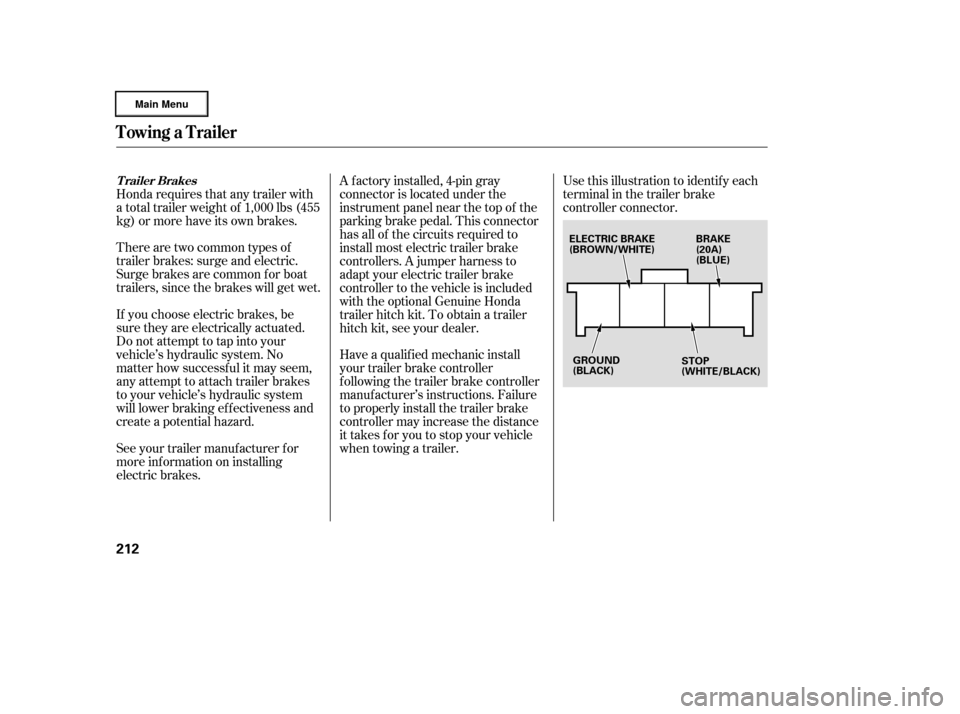
kg) or more have its own brakes.A f actory installed, 4-pin gray
connector is located under the
instrument panel near the top of the
parking brake pedal. This connector
has all of the circuits required to
install most electric trailer brake
controllers. A jumper harness to
adapt your electric trailer brake
controller to the vehicle is included
with the optional Genuine Honda
trailer hitch kit. To obtain a trailer
hitch kit, see your dealer.
Have a qualif ied mechanic install
your trailer brake controller
f ollowing the trailer brake controller
manuf acturer’s instructions. Failure
to properly install the trailer brake
controller may increase the distance
it takes f or you to stop your vehicle
when towing a trailer.Use this illustration to identif y each
terminal in the trailer brake
controller connector.
Towing a Trailer
Trailer Brakes
212
BRAKE
(20A)
(BLUE)
GROUND
(BLACK)
ELECTRIC BRAKE
(BROWN/WHITE)
STOP
(WHITE/BLACK)
�����—�����—�����y�
����
��������y���
�(�����������y�����
���y
Page 218 of 320

The added weight, length, and
height of a trailer will af f ect your
vehicle’s handling and perf ormance,
so driving with a trailer requires
some special driving skills and
techniques.
Your vehicle tires and spare are in
good condition and properly
inf lated.
When preparing to tow, and
bef ore driving away, be sure to
check the f ollowing:
Foryoursafetyandthesafetyof
others,taketimetopracticedriving
maneuvers bef ore heading f or the
open road, and f ollow the guidelines
below.Towing perf ormance can be
af f ected by high altitude, high
temperature, or when climbing
steep grades. Theref ore, premium
fuelisrecommendedwhentowing
more than 3,500 lbs (1,590 kg).
Avoid towing a trailer during your
vehicle’s f irst 600 miles (1,000 km).
The trailer tires and spare are in
good condition and inf lated as
recommended by the trailer
maker.
You may want to fill the fuel tank
with premium f uel. Premium f uel
provides improved perf ormance.
The vehicle has been properly
serviced, and the tires, brakes,
suspension, cooling system, and
lights are in good operating
condition.
The trailer has been properly
serviced and is in good condition.
All weights and loads are within
limits.
Thehitch,safetychains,andany
other attachments are secure.
Allitemsonandinthetrailerare
properly secured and cannot shif t
while you drive.
CONT INUED
Driving Saf ely With a T railer
Pre-T ow Checklist
Towing a Trailer
Break-In Period
Driving
215
�����—�
���—�����y�
������
������y���
�(�����������y���������y
Page 225 of 320
Use a nylon strap to attach your
vehicle to the recovery vehicle, and
caref ully take out the slack in the
strap. Once the strap is tight, the
recovery vehicle should apply f orce.
Remember that the recovery vehicle
needs good traction to avoid
becoming stuck, too.
You should never use a jack to try to
get unstuck. Your vehicle could
easily slip of f the jack and hurt you
or someone else.You may saf ely tow a trailer of f -road
if you f ollow these guidelines:
Do not exceed the trailer weight
or tongue limits (see page ).
Stay on smooth, level dirt roads,
and avoid driving in hilly terrain.
Allow extra room f or starting,
stopping, and turning.
Slow down if you encounter bumps
or other obstacles. 209
Towing a Trailer Off-Road
Of f -Highway Driving Guidelines
222
�����—�
���—�����y�
�������������y���
�(�����������y���������y
Page 239 of 320
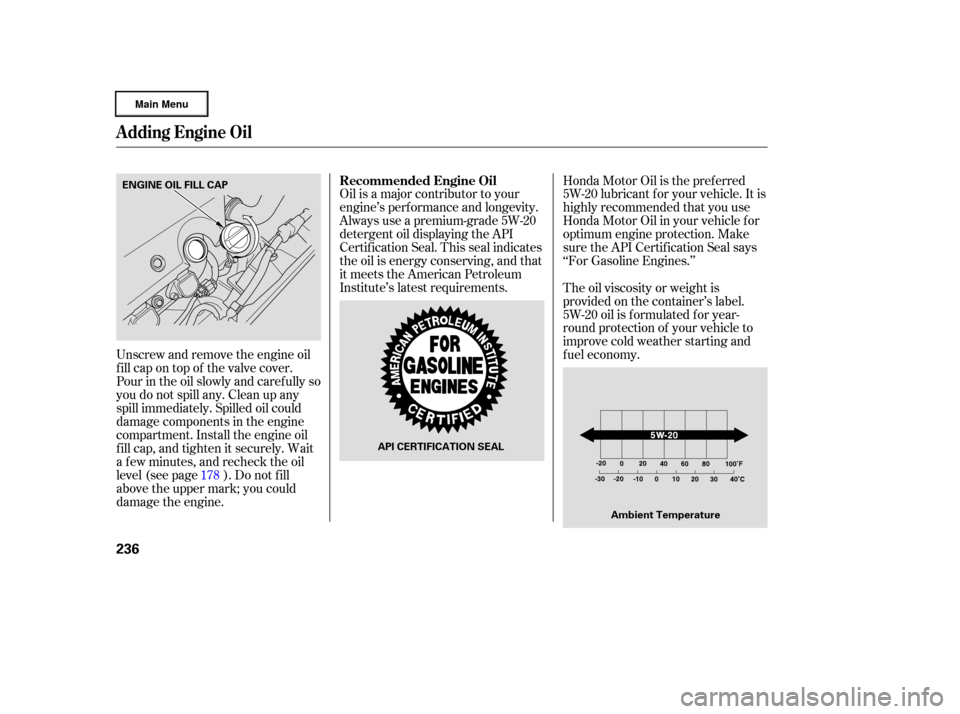
Oil is a major contributor to your
engine’s perf ormance and longevity.
Always use a premium-grade 5W-20
detergent oil displaying the API
Certif ication Seal. This seal indicates
the oil is energy conserving, and that
it meets the American Petroleum
Institute’s latest requirements.Honda Motor Oil is the pref erred
5W-20 lubricant f or your vehicle. It is
highly recommended that you use
Honda Motor Oil in your vehicle f or
optimum engine protection. Make
sure the API Certif ication Seal says
‘‘For Gasoline Engines.’’
Unscrew and remove the engine oil
fill cap on top of the valve cover.
Pour in the oil slowly and caref ully so
you do not spill any. Clean up any
spill immediately. Spilled oil could
damage components in the engine
compartment. Install the engine oil
f ill cap, and tighten it securely. Wait
a f ew minutes, and recheck the oil
level (see page ). Do not f ill
above the upper mark; you could
damage the engine. The oil viscosity or weight is
provided on the container’s label.
5W-20 oil is f ormulated f or year-
round protection of your vehicle to
improve cold weather starting and
f uel economy.
178 Recommended Engine Oil
A dding Engine Oil
236
API CERTIFICATION SEAL
Ambient Temperature
ENGINE OIL FILL CAP
�����—�
���—�����y�
�������������y���
�(�����������y�������
�y
Page 240 of 320

Open the hood, and remove the
engine oil f ill cap. Remove the oil
drain bolt and washer f rom the
bottom of the engine. Drain the oil
into an appropriate container.
Your vehicle does not require any oil
additives. Additives may adversely
af f ect the engine or transmission
perf ormance and durability. You may use a synthetic motor oil if
it meets the same requirements
given f or a conventional motor oil: it
displays the API Certif ication Seal,
and it is the proper weight. You must
f ollow the oil and f ilter change
intervals shown on the information
display. Always change the oil and f ilter
according to the maintenance
messages shown on the odometer
and trip meter display. The oil and
f ilter collect contaminants that can
damage your engine if they are not
removed regularly.
Changing the oil and f ilter requires
special tools and access f rom
underneath the vehicle. The vehicle
should be raised on a service station-
type hydraulic lif t f or this service.
Unless you have the knowledge and
proper equipment, you should have
this maintenance done by a skilled
mechanic.
Run the engine until it reaches
normal operating temperature,
then shut it off.
1. 2.
CONT INUED
Synthetic Oil
Engine Oil A dditivesChanging the Oil and Filter
A dding Engine Oil, Changing the Oil and Filter
Maint enance
237
WASHER
DRAIN BOLT
�����—�
���—�����y�
�������������y���
�(�����������y���������y
Page 260 of 320

In addition to proper inf lation,
correct wheel alignment helps to
decrease tire wear. If you f ind a tire
is worn unevenly, have your dealer
check the wheel alignment.To help increase tire lif e and
distribute wear more evenly, rotate
the tires every 7,500 miles (12,000
km). Move the tires to the positions
showninthecharteachtimethey
are rotated. If you purchase
directional tires, rotate only f ront-to-
back.
Have your dealer check the tires if
you f eel a consistent vibration while
driving. A tire should always be
rebalanced if it is removed f rom the
wheel. When you have new tires
installed, make sure they are
balanced. This increases riding
comf ort and tire lif e. For best results,
have the installer perform a dynamic
balance.
Your tires have wear indicators
molded into the tread. When the
tread wears down, you will see a
band 1/2 inch (12.7 mm) wide across
the tread. This shows there is less
than 1/16 inch (1.6 mm) of tread lef t
on the tire.
A tire this worn gives very little
traction on wet roads. You should
replace the tire if you can see three
or more tread wear indicators.
For vehicles equipped with aluminum
wheels:
T ire Maintenance T ire Rotation
Tires
Maint enance
257
Front
(For Non-directional
Tires and Wheels) Front
(For Directional
Tires and Wheels)
TREAD WEAR INDICATORS INDICATOR LOCATION MARKS
Improper wheel weights can damage
your vehicle’s aluminum wheels. Use
only Honda wheel weights f or
balancing.
�����—�
���—�����y�
�������������y���
�(�����������y���������y