Page 179 of 320

Whenever f illing a f uel container,
use an approved f uel container, and
place it on the ground. Do not f ill the
f uel container in the vehicle,
including the pickup bed and the
In-Bed Trunk. Make sure to put the
f uel pump nozzle in the f uel f iller of
the container securely and to handle
it properly.
Your vehicle has a warning label f or
f illing a portable f uel container on
the lef t rear side of the pickup bed. Before placing the fuel container in
the vehicle, wipe up any spill
completely. Gasoline or f uel vapors are
extremely f lammable and explosive.
Improperly handling f uel can cause
the explosion in which you can be
seriously injured.
Screw the fuel fill cap back on
until it clicks. If you do not
properly tighten the cap, the
malf unction indicator lamp may
come on (see page ). You will
also see a ‘‘CHECK FUEL CAP’’
message on the odometer display.
Push the f uel f ill door closed until
it latches.
5.
6.
279
Service Station Procedures
Filling a Port able Fuel Cont ainer
176
Do not fill a portable fuel
container in the pickup bed.
Static electricity can ignite gas
vapors and you can be burned.
�����—�����—�����y�
����
��������y���
�(�����������y���
���
�y
Page 185 of 320
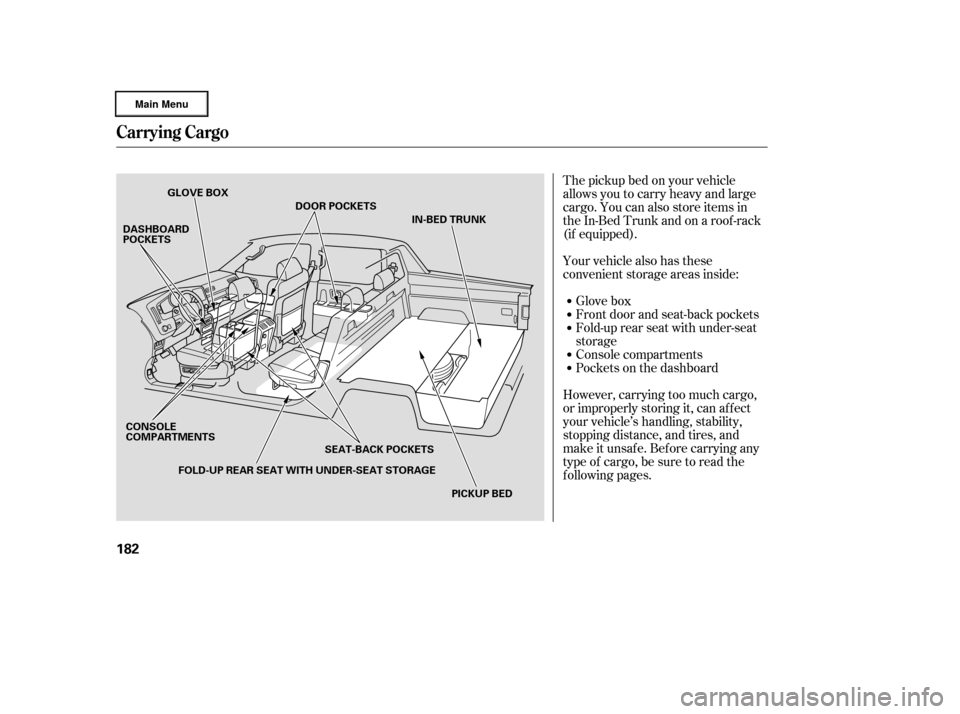
The pickup bed on your vehicle
allows you to carry heavy and large
cargo. You can also store items in
theIn-BedTrunkandonaroof-rack
(if equipped).
Your vehicle also has these
convenient storage areas inside:Glove box
Front door and seat-back pockets
Fold-up rear seat with under-seat
storage
Console compartments
Pockets on the dashboard
However, carrying too much cargo,
or improperly storing it, can af f ect
your vehicle’s handling, stability,
stopping distance, and tires, and
make it unsaf e. Bef ore carrying any
type of cargo, be sure to read the
f ollowing pages.
Carrying Cargo
182
GLOVE BOX DOOR POCKETS
DASHBOARD
POCKETS
PICKUP BED
CONSOLE
COMPARTMENTS
SEAT-BACK POCKETS
FOLD-UP REAR SEAT WITH UNDER-SEAT STORAGE IN-BED TRUNK
�����—�
���—�����y�
�������������y���
�(�����������y���
�����y
Page 187 of 320

Store or secure all items that could
be thrown around and hurt
someone during a crash.
Be sure items placed on the f loor
behind the f ront seats cannot roll
under the seats and interf ere with
the pedals or seat operation.
Keep the glove box closed while
driving. If it is open, a passenger
could injure their knees during a
crash or sudden stop.
If you lif t up the rear seats, f ollow
the instructions above, and be sure
to keep cargo height below the
bottom of the windows. If cargo is
higher, it could interf ere with
proper operation of the side
curtain airbags.Distribute cargo evenly on the
f loor in the In-Bed Trunk, placing
the heaviest items on the bottom
and as far forward as possible. Tie
down items that could be thrown
during a crash or sudden stop.
Make sure the In-Bed Trunk lid is
closed securely bef ore driving.
Distribute cargo evenly on the
floor of the cargo area with the
rear seats f olded up, placing the
heaviest items on the bottom and
as far forward as possible. Tie
down items that could be thrown
about the vehicle during a crash or
sudden stop.
Be sure the total weight of the
items in the In-Bed Trunk does not
exceed 300 lbs (136 kg).
If you carry any items on a roof
rack,besurethetotalweightof
the rack and the items does not
exceed 165 lbs (75 kg).
If you use an accessory roof rack,
the roof rack weight limit may be
lower. Ref er to the inf ormation that
came with your roof rack.
Carrying Items in the Passenger
Compartment
Carrying Cargo in the In-Bed
T runk or on a Roof Rack
Carrying Cargo
184
�����—�
���—�����y�
���������
���y���
�(�����������y���
�����y
Page 189 of 320
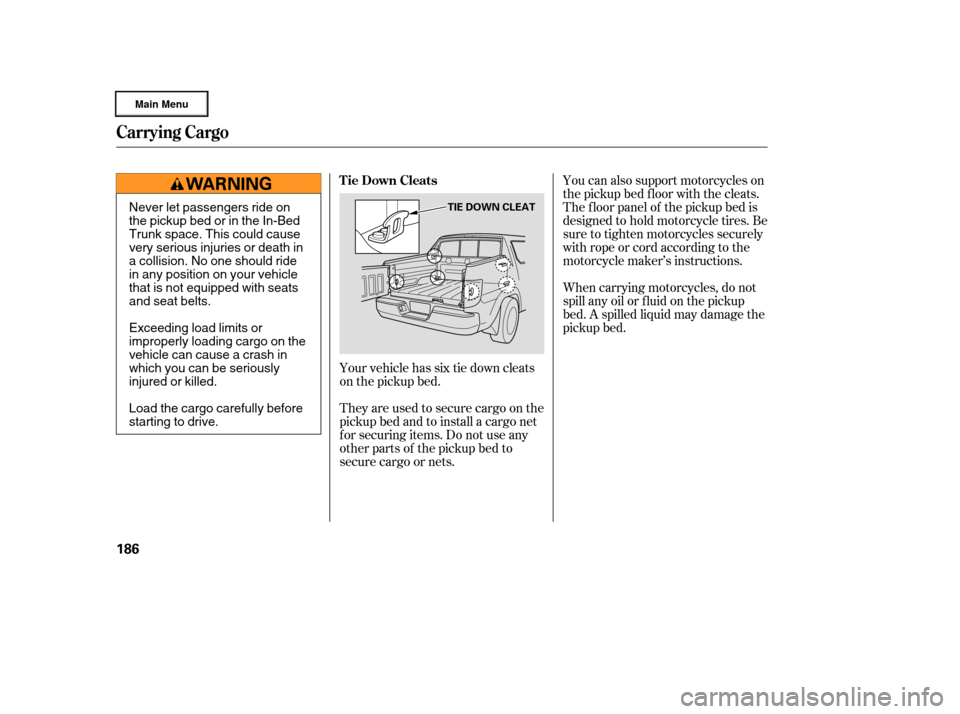
Your vehicle has six tie down cleats
on the pickup bed.You can also support motorcycles on
the pickup bed floor with the cleats.
The f loor panel of the pickup bed is
designed to hold motorcycle tires. Be
sure to tighten motorcycles securely
with rope or cord according to the
motorcycle maker’s instructions.
When carrying motorcycles, do not
spill any oil or f luid on the pickup
bed. A spilled liquid may damage the
pickup bed.
They are used to secure cargo on the
pickup bed and to install a cargo net
f or securing items. Do not use any
other parts of the pickup bed to
secure cargo or nets.
Carrying Cargo
Tie Down Cleats
186
TIE DOWN CLEATNever let passengers ride on
the pickup bed or in the In-Bed
Trunk space. This could cause
very serious injuries or death in
a collision. No one should ride
in any position on your vehicle
that is not equipped with seats
and seat belts.
Exceeding load limits or
improperly loading cargo on the
vehicle can cause a crash in
which you can be seriously
injured or killed.
Load the cargo carefully before
starting to drive.
�����—�
���—�����y�
�������������y���
�(�����������y���
���
�y
Page 190 of 320
The cargo net can be used to hold
items in the pickup bed. Secure all
items properly. The net may not
prevent heavy items f rom being
thrown outward in a crash or a
sudden stop.The cargo cover can be used to
cover the cargo area on the pickup
bed.
Your vehicle’s pickup bed has a rust
resistant surf ace. To repair small
chips and scratches in the bed, a
repair kit is available f rom your
dealer. More extensive damage
should be repaired by your dealer.
To avoid problems with the bed
surf ace and the In-Bed Trunk lid, do
not use spray-in bed liner products.
Carrying Cargo
Optional Cargo Net
Optional Cargo Cover
Pickup Bed Repair
Bef ore Driving
187
�����—�
���—�����y�
�������������y���
�(�����������y���
�����y
Page 194 of 320

Youshoulddothefollowingchecks
and adjustments bef ore you drive
your vehicle.Make sure all windows, mirrors,
and outside lights are clean and
unobstructed. Remove f rost, snow,
or ice.
Check that the hood is f ully closed.
Check that the tailgate is f ully
closed when it is not used as an
extended pickup bed.
Visually check the tires. If a tire
looks low, use a gauge to check its
pressure.
Check that any items you may be
carrying are stored properly or
f astened down securely. Check the adjustment of the
inside and outside mirrors (see
page ).
Check the steering wheel
adjustment (see page ).
Make sure the doors and In-Bed
Trunk are securely closed and
locked.
Fasten your seat belt. Check that
your passengers have f astened
their seat belts (see page ).
When you start the engine, check
the gauges and indicators in the
instrument panel (see page ).
Check the seat adjustment (see
pages and ).
1.
2.
3.
4.
5.
6.
8. 7.
9.
10.
11. 14
57
107
76
95 97
Preparing to Drive
Driving
191
�����—�
���—�����y�
���������
���y���
�(�����������y���
�����y
Page 204 of 320

Make sure the moonroof (if
equipped) and the windows are
closed.
Turn of f the lights.
Place any packages, valuables, etc.
in the cargo area in your vehicle or
the In-Bed Trunk, or take them
with you.
Lock the doors.
Check the indicator on the driver’s
door to verify that the security
system is set.
Never park over dry leaves, tall
grass, or other f lammable
materials. The hot three way
catalytic converter could cause
these materials to catch on fire.
Set the parking brake bef ore you put
the transmission in Park. This keeps
the vehicle from moving and putting
pressure on the parking mechanism
in the transmission. Always use the parking brake when
you park your vehicle. Make sure
the parking brake is set f irmly or
your vehicle may roll if it is on an
incline.
On vehicles with security system
As required by the FCC:
This device complies with Part 15 of theFCC rules. Operation is subject to thef ollowing two conditions: (1) This devicemay not cause harmf ul interf erence, and(2) this device must accept anyinterf erence received, includinginterf erence that may cause undesiredoperation.
Changes or modif ications not expresslyapproved by the party responsible f orcompliance could void the user’sauthority to operate the equipment.
This device complies with IndustryCanada Standard RSS-210.Operation is subject to the f ollowing twoconditions: (1) this device may not causeinterf erence, and (2) this device mustaccept any interf erence that may causeundesired operation of the device.
CONT INUED
Parking T ips
Parking
Tire Pressure Monitoring System (TPMS), Parking
Driving
201
�����—�
���—�����y�
�������������y���
�(�����������y���������y
Page 212 of 320
�Î�Î�Î
�Î
�Î�Î
�µ�µ
Number of
Occupants 2
3
4
5 Max. T railer Weight Max. T ongue Load
Towing Weight Guidelines
Driving
209
Total Trailer Weight and Tongue Load Guidelines:
The corresponding weight limits assume occupants fill seats from the front of the vehicle to the back, each occupant weights 150 lbs (70 kg),
and each has 15 lbs (7 kg) of cargo in the cab, pickup bed, or In-Bed Trunk. Any additional weight, including cargo or accessories, reduces
the maximum trailer weight and maximum tongue load. Never exceed the gross axle weight ratings (see page ).
Recommended tongue load should be 5 15% of the total trailer weight for boat trailers, and 10 15% of the total trailer weight for all other
trailers.
208
5000 lbs (2268 kg)
4750 lbs (2155 kg)
4750 lbs (2155 kg)
4500 lbs (2041 kg)
600 lbs (272 kg)
600 lbs (272 kg)
570 lbs (258 kg)
516 lbs (234 kg)
�����—�����—�����y�
����
��������y���
�(�����������y�����
���y