Page 56 of 316
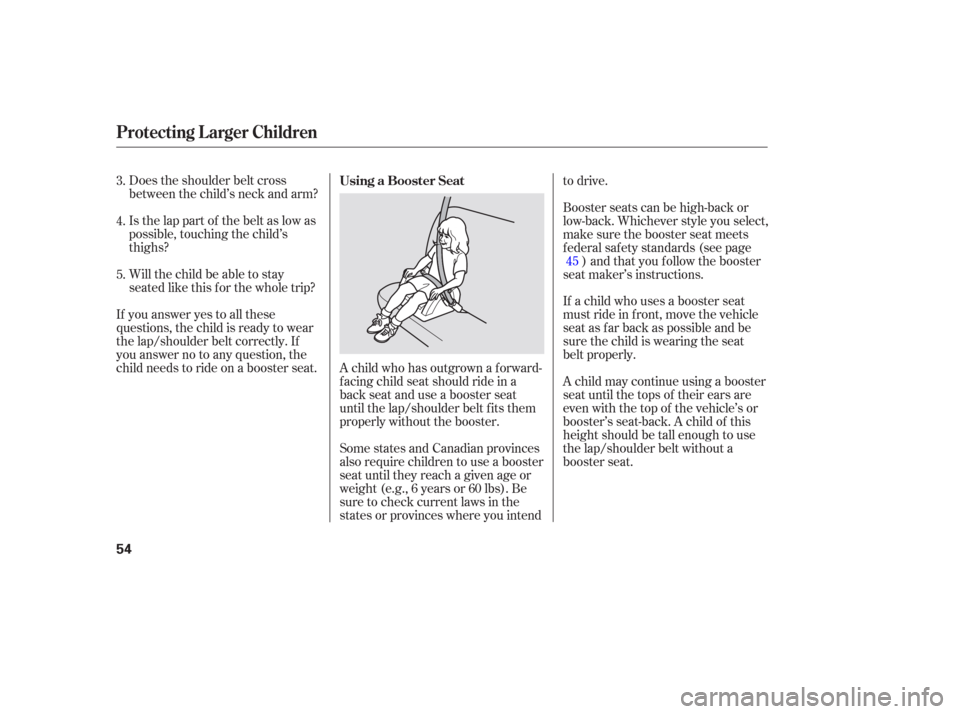
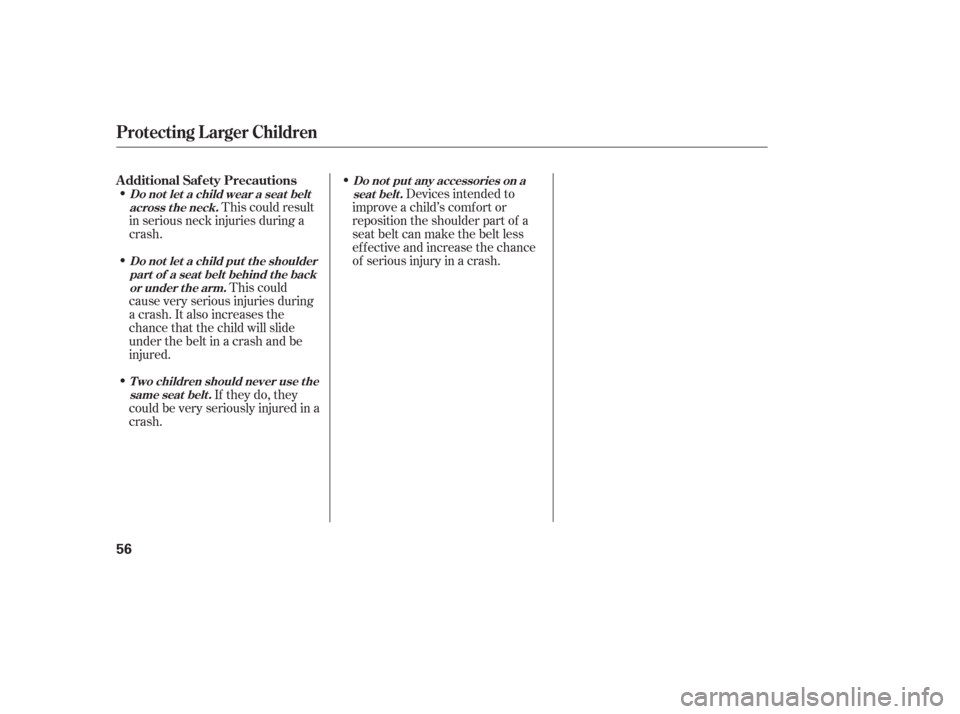
Does the shoulder belt cross
between the child’s neck and arm?
Is the lap part of the belt as low as
possible, touching the child’s
thighs?
Will the child be able to stay
seated like this f or the whole trip?
If you answer yes to all these
questions, the child is ready to wear
the lap/shoulder belt correctly. If
you answer no to any question, the
child needs to ride on a booster seat. A child who has outgrown a f orward- f acing child seat should ride in a
back seat and use a booster seat
until the lap/shoulder belt f its them
properly without the booster.
Some states and Canadian provinces
also require children to use a booster
seat until they reach a given age or
weight (e.g., 6 years or 60 lbs). Be
sure to check current laws in the
states or provinces where you intendto drive.
If a child who uses a booster seat
must ride in f ront, move the vehicle
seat as far back as possible and be
sure the child is wearing the seat
belt properly.
A child may continue using a booster
seat until the tops of their ears are
even with the top of the vehicle’s or
booster’s seat-back. A child of this
height should be tall enough to use
the lap/shoulder belt without a
booster seat. Booster seats can be high-back or
low-back. Whichever style you select,
make sure the booster seat meets
f ederal saf ety standards (see page
) and that you f ollow the booster
seat maker’s instructions.
4.
5. 3.
45
Using a Booster Seat
Protecting L arger Children
54
Page 57 of 316
If you decide that a child can saf ely
ride up f ront, be sure to:Caref ully read the owner’s manual,
and make sure you understand all
seat belt instructions and all saf ety
inf ormation.
Move the vehicle seat to the rear-
most position.
Have the child sit up straight, back
against the seat, and feet on or
near the f loor.
Check that the child’s seat belt is
properly and securely positioned.
Supervise the child. Even mature
children sometimes need to be
reminded to f asten the seat belts
or sit properly.
Of course, children vary widely. And
while age may be one indicator of
when a child can saf ely ride in f ront,
there are other important f actors you
should consider.
If the passenger’s front airbag
inf lates in a moderate to severe
f rontal collision, the airbag can cause
serious injuries to a child who is
unrestrained, improperly restrained,
sitting too close to the airbag, or out
of position.
A side airbag also poses risks. If any
part of a larger child’s body is in the
path of a deploying side airbag, the
child could receive possibly serious
injuries. The National Highway Traffic Safety
Administration and Transport
Canada recommend that all children
age 12 and under be properly
restrained in a back seat. Physically, a child must be large
enough f or the lap/shoulder belt to
properly f it (see pages and ). If
the seat belt does not f it properly,
with or without the child sitting on a
booster seat, the child should not sit
in f ront.
To saf ely ride in f ront, a child must
be able to f ollow the rules, including
sitting properly, and wearing the seat
belt properly throughout a ride.16 53
Physical Size
Maturity
When Can a L arger Child Sit in
Front
Protecting L arger Children
Driver and Passenger Saf ety
55
Page 58 of 316
This could result
in serious neck injuries during a
crash. Devices intended to
improve a child’s comf ort or
reposition the shoulder part of a
seat belt can make the belt less
ef f ective and increase the chance
of serious injury in a crash.
This could
cause very serious injuries during
a crash. It also increases the
chance that the child will slide
under the belt in a crash and be
injured.
If they do, they
could be very seriously injured in a
crash.
Do not let a child wear a seat belt
across t he neck. Do not put any accessories on a
seat belt.
Do not let a child put the shoulder part of a seat belt behind t he backor under t he arm.
T wo children should never use t hesame seat belt .
Additional Saf ety Precautions
Protecting L arger Children
56
Page 63 of 316

�Î
�Î�Î
�Î �Î
If equipped.
The U.S. instrument panel is shown. Dif f erences f or the Canadian models are noted in the text.
:
Instrument Panel
Instruments and Controls
61
LIGHTS ON INDICATOR
HIGH BEAM INDICATOR
A/T TEMPERATURE
INDICATOR VEHICLE STABILITY ASSIST
SYSTEM (VSA) INDICATOR
MAINTENANCE MINDER
INDICATOR LOW OIL PRESSURE
INDICATORVSA ACTIVATION
INDICATOR
CRUISE CONTROL
INDICATOR TPMS INDICATOR
SIDE AIRBAG OFF
INDICATOR
LOW FUEL INDICATOR
FOG LIGHT INDICATOR
(P.69)
(P.69) (P.
69)
DOOR AND TAILGATE
OPEN MONITOR
TIRE PRESSURE
MONITOR
SEAT BELT REMINDER INDICATOR
ANTI-LOCK BRAKE SYSTEM INDICATOR
(P.67)
(P.68)
(P.64)
VTM-4 INDICATOR (P.68)
FUEL ECONOMY INDICATOR (P.68)
CHARGING SYSTEM
INDICATOR (P.62) (P.62)(P.64)
(P.67) (P.63)
(P.
62)
(P.
63) (P.
65)(P.
66)
(P.
65)
LOW TIRE PRESSURE
INDICATOR (P.
65)
IMMOBILIZER SYSTEM
INDICATOR
(P.
64)
(P.67)
(P.63)
PARKING BRAKE
AND BRAKE
SYSTEM
INDICATOR
SUPPLEMENTAL RESTRAINT SYSTEM
INDICATOR
MALFUNCTION
INDICATOR LAMP
(P.62)
BRAKE LAMP
INDICATOR (P.66) (P.63)
Page 64 of 316
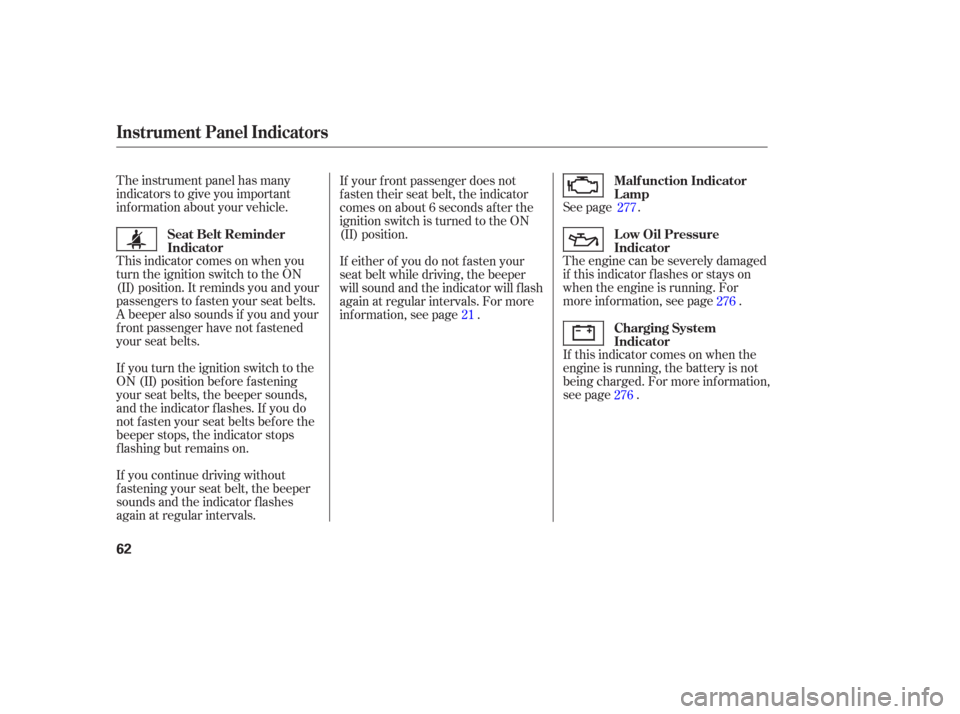
The instrument panel has many
indicators to give you important
inf ormation about your vehicle.See page .
The engine can be severely damaged
if this indicator f lashes or stays on
when the engine is running. For
more information, see page .
If this indicator comes on when the
engine is running, the battery is not
being charged. For more inf ormation,
see page .
This indicator comes on when you
turn the ignition switch to the ON
(II) position. It reminds you and your
passengers to f asten your seat belts.
A beeper also sounds if you and your
f ront passenger have not f astened
your seat belts.
If you turn the ignition switch to the
ON (II) position bef ore f astening
your seat belts, the beeper sounds,
and the indicator f lashes. If you do
not fasten your seat belts before the
beeper stops, the indicator stops
f lashing but remains on. If either of you do not f asten your
seat belt while driving, the beeper
will sound and the indicator will f lash
again at regular intervals. For more
inf ormation, see page .
If you continue driving without
f astening your seat belt, the beeper
sounds and the indicator f lashes
again at regular intervals. If your f ront passenger does not
f asten their seat belt, the indicator
comes on about 6 seconds af ter the
ignition switch is turned to the ON
(II) position.
21 277
276
276
Seat Belt Reminder
Indicator
Malf unction Indicator
Lamp
L ow Oil Pressure
Indicator
Charging System
Indicator
Instrument Panel Indicators
62
Page 65 of 316

This indicator normally comes on f or
a f ew seconds when you turn the
ignition switch to the ON (II)
position, and when the ignition
switch is turned to the START (III)
position. If it comes on at any other
time, there is a problem with the
ABS. If this happens, have your
vehicle checked at a dealer. With
this on, your vehicle still has normal
braking ability but no anti-lock
brakes. For more inf ormation, see
page .
This indicator has two f unctions:
Itcomesonwhenyouturnthe
ignition switch to the ON (II)
position. It is a reminder to check
the parking brake. A beeper
sounds if you try to drive with the
parking brake not f ully released.
Driving with the parking brake not
fully released can damage the
brakes and tires.
If it stays on after you have fully
released the parking brake while
the engine is running, or if it
comes on while driving, there
could be a problem with the brake
system. For more inf ormation, see
page .
This indicator comes on brief ly when
you turn the ignition switch to the
ON (II) position. If it comes on at
any other time, it indicates a
potential problem with your f ront
airbags. This indicator will also alert
you to a potential problem with your
side airbags, passenger’s side airbag
automatic cutoff system, side curtain
airbags, automatic seat belt
tensioners, driver’s seat position
sensor, or the f ront passenger’s
weight sensors. For more
inf ormation, see page .
This indicator comes on when you
turn the ignition switch to the ON
(II) position. If it comes on at any
other time, it indicates that the
passenger’s side airbag has
automatically shut off. For more
inf ormation, see page .
1.
2.
33
34 278 210
Instrument Panel Indicators
Anti-lock Brake System
(A BS) Indicator
Parking Brake and Brake System
Indicator
Supplemental Restraint
System Indicator
Side A irbag Of f
Indicator
Instruments and Controls
63
U.S. Canada
U.S. Canada
Page 91 of 316

To change the angle of the seats in
the second row seat-backs, pull up
the handle on the seat-back. Moving
the short vertical switch f orward or
backward adjusts the seat back in
those directions.The left and right halves can be
f olded separately.
Push the whole seat backwards until
f ully latches. Make sure the seat is
locked and secured bef ore driving.
If you are f olding the lef t half of
the seat, use the ignition key to
release the center seat belt from
thedetachableanchor(seepage
).
Lower the head restraint f ully.
Pull up the handle on the outside
of the seat-back.
Fold the seat-back forward.
Reverse this procedure to return the
seat to its upright position. Make
sure the seat is locked and secured
bef ore driving. To get into the third row seats, pull
up the lever on the outside of the
passenger’s side second row seat-
back. The seat-back will tilt f orward,
and the seat will slide f orward.
To adjust the seats forward and
backward, pull up on the lever under
the seat cushion. Af ter moving the
seat, make sure it is locked into
position. 2.
3. 1.
4.
18
A djusting the Second Row Seats Folding the Second Row Seats T hird Seat A ccess
Seats
Instruments and Controls
89
SECOND
ROW SEAT
RELEASE LEVER
Page 92 of 316

Remove the head restraints by
pushing the release buttons and
pulling the restraints out.
Store the head restraints under
the cargo area floor. Insert the
shafts into the holes in the sides of
the storage compartment.Use the ignition key to release the
seat belt from the detachable
anchor (see page ).
Unlock the seat-back by pulling
the handle. Push the seat-back
forward.
Make sure you clip the small latch
plate of each outer shoulder belt to
the seat belt webbing whenever the
third seat is f olded.
Pull the handle on the back of the
seat, move the seat-back to the
desired position and release the
handle. Let the seat-back latch into
the new position. Make sure all items in the cargo area
are secured. Loose items can f ly
f orward and cause injury if you have
to brake hard (See
on page ). Reinstall the head restraints,
reconnect the seat belts, and make
sure the seats are secured bef ore
driving. Reverse this procedure to return the
seat to its upright position.
1.
2. 3.
4.
18
193
A djusting the T hird Row Seat Folding the T hird Row Seat
Carrying Cargo
Seats
90
THIRD ROW
SEATHANDLE