Page 35 of 316

In a moderate to severe side impact,
sensors will detect rapid deceleration
and signal the control unit to
instantly inflate the side curtain
airbag on the driver’s or the
passenger’s side of the vehicle.If the impact is on the passenger’s
side, the passenger’s side curtain
airbag will inflate even if there are no
occupants on that side of the vehicle.
If the roll rate sensor detects your
vehicle is about roll over, the control
unit will instantly deploy both side
curtain airbags.
To get the best protection f rom the
side curtain airbags, occupants
should wear their seat belts and sit
upright and well back in their seats.
The SRS indicator alerts
you to a potential problem
with your airbags or seat belt
tensioners.
When you turn the ignition switch to
the ON (II) position, this indicator
comes on brief ly then goes of f . This
tells you the system is working
properly.
CONT INUED
How Your Side Curtain A irbags
Work How the SRS Indicator Works
In a Side ImpactIn a Rollover
Additional Inf ormation About Your Airbags
Driver and Passenger Saf ety
33
SIDE CURTAIN AIRBAG
Page 36 of 316

This indicator
alerts you that the
passenger’s side
airbag has been automatically shut
of f . It does mean there is a
problem with your side airbags.
If the indicator comes on at any
other time, or does not come on at all,
you should have the system checked
by your dealer. For example:
If the SRS indicator does not come
on after you turn the ignition
switch to the ON (II) position.
If the indicator stays on after the
engine starts.
If the indicator comes on or
flashesonandoff whileyoudrive.
If you see any of these indications,
the airbags and seat belt tensioners
may not work properly when you
need them. When you turn the ignition switch to
the ON (II) position, the indicator
should come on brief ly and then go
off(seepage ).Ifitdoesn’tcome
on, stays on, or comes on while
driving without a passenger in the
f ront seat, have the system checked.
63
HowtheSideAirbagOff
Indicator Works
not
Additional Inf ormation About Your Airbags
34
U.S.
CanadaIgnoring the SRS indicator can
result in serious injury or death
if the airbag systems or
tensioners do not work properly.
Have your vehicle checked by a
dealer as soon as possible if
the SRS indicator alerts you to
a possible problem.
Page 37 of 316

This indicator alerts you that the
passenger’s f ront airbag has been
shut of f because weight sensors
detect an inf ant or small child may
be in the f ront passenger’s seat. It
does mean there is a problem
with the airbag.The passenger airbag of f indicator
may also come on and of f repeatedly
if total weight on the seat is near the
airbag cutoff threshold.
If nooneisridinginthefrontseat,
the airbag will be automatically shut
of f . However, the indicator will not
come on.
If the indicator comes on with no
passenger in the f ront, or with an
adult in the seat, there may be a
problem with the advanced airbag
system. Have the vehicle checked by
your dealer as soon as possible. If this happens, have the passenger
ride properly restrained in a back
seat. If the passenger must ride in
front, move the seat as far to the
rear as possible, and have the
passenger sit upright and wear the
seat belt properly.
Additional Inf ormation About Your Airbags
How the Passenger Airbag Of f
Indicator Works
not
Driver and Passenger Saf ety
35
PASSENGER AIRBAG OFF INDICATOR
U.S. models
Canadian models
2WD
4WD
PASSENGER AIRBAG OFF INDICATOR
Page 38 of 316

Take your vehicle to an
authorized dealer as soon as
possible. If you ignore this
indication, your airbags may not
operate properly.
Your airbag systems are virtually
maintenance f ree, and there are no
parts you can saf ely service.
However, you must have your
vehicle serviced if:
Do not try to remove or replace
anyairbagbyyourself.Thismust
be done by your dealer or a
knowledgeable body shop.Any airbag
that has deployed must be
replaced along with the control
unit and other related parts. Any
seat belt tensioner that activates
must also be replaced.
Even if your
airbags do not inflate, your dealer
should inspect the driver’s seat
position sensor, the f ront
passenger’s weight sensors, the
f ront seat belt tensioners, and all
seat belts worn during the crash to
make sure they are operating
properly.
Additional Inf ormation About Your Airbags
T he SRS indicat or alert s you t o a
problem.
An airbag ever inf lates.
If your vehicle has a moderat e t osevere impact .Airbag Service
36
Page 39 of 316

Together, airbags and
seat belts provide the best
protection.
Tampering could cause
the airbags to deploy, possibly
causing very serious injury. Improperly replacing
or covering f ront seat-back covers
can prevent your side airbags f rom
inf lating during a side impact.
This could make the
driver’s seat position sensor or the
f ront passenger’s weight sensors
inef f ective. If it is necessary to
remove or modif y a f ront seat to
accommodate a person with
disabilities, f irst contact Honda
Automobile Customer Service at
(800) 999-1009. If water or another liquid
soaks into a seat-back, it can
prevent the side airbag cutof f
system f rom working properly.
Additional Inf ormation About Your Airbags
Additional Saf ety Precautions
Donotattempttodeactivateyour
airbags.
Do not tamper with airbagcomponent s or wiring f or anyreason. Do not cover or replace f ront seat -
back covers wit hout consult ingyour dealer.
Do not remove or modif y a f ront seat without consulting yourdealer. Do not expose the f ront seat-backs
to liquid.
Driver and Passenger Saf ety
37
Page 40 of 316
�µ
�µ�µ
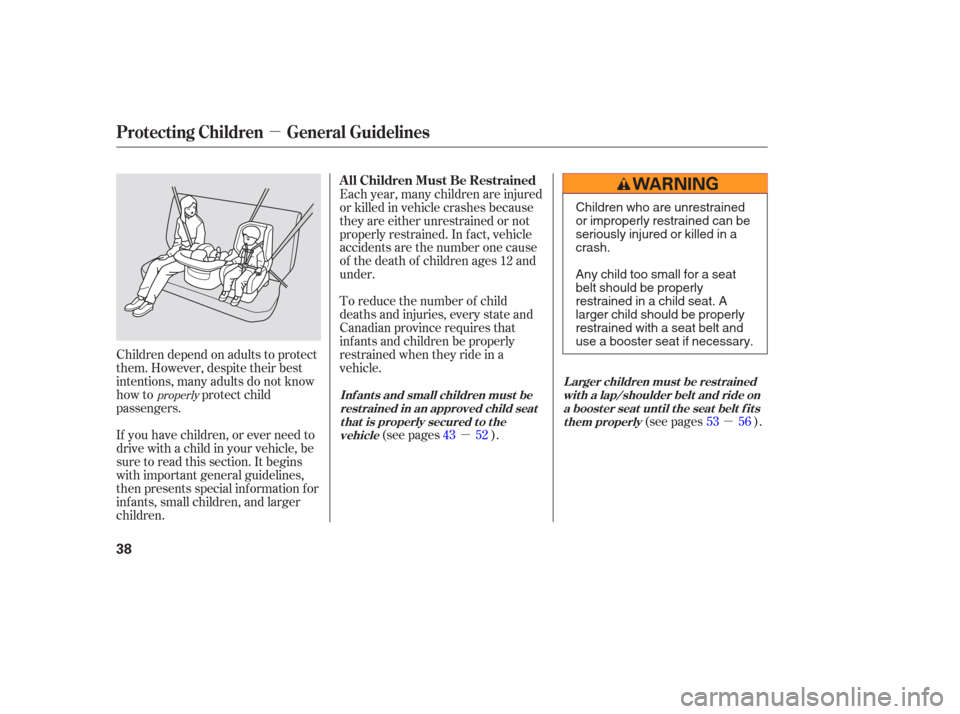
If you have children, or ever need to
drive with a child in your vehicle, be
sure to read this section. It begins
with important general guidelines,
then presents special inf ormation f or
infants, small children, and larger
children. Each year, many children are injured
or killed in vehicle crashes because
they are either unrestrained or not
properly restrained. In f act, vehicle
accidents are the number one cause
of the death of children ages 12 and
under.
To reduce the number of child
deaths and injuries, every state and
Canadian province requires that
inf ants and children be properly
restrained when they ride in a
vehicle.
(see pages ). (see pages ).
Children depend on adults to protect
them. However, despite their best
intentions, many adults do not know
how to protect child
passengers.
43 5253 56
properly
Protecting Children General Guidelines
All Children Must Be Restrained
Inf ant s and small children must be
rest rained in an approved child seatt hat is properly secured t o t hevehicle Larger children must be restrained
wit h a lap/shoulder belt and ride ona boost er seat unt il t he seat belt f it st hem properly
38
Children who are unrestrained
or improperly restrained can be
seriously injured or killed in a
crash.
Any child too small for a seat
belt should be properly
restrained in a child seat. A
larger child should be properly
restrained with a seat belt and
use a booster seat if necessary.
Page 41 of 316
�µ
Front airbags have been designed to
help protect adults in a moderate to
severe f rontal collision. To do this,
the passenger’s f ront airbag is quite
large, and it can inflate with enough
f orce to cause very serious injuries.If the vehicle seat is
too far forward, or the child’s head is
thrown f orward during a collision, an
inflating front airbag can strike the
child with enough f orce to kill or
very seriously injure a small child.
Whenever possible,
larger children should sit in the back
seat, on a booster seat if needed, and
be properly restrained with a seat
belt (see page f or important
inf ormation about protecting larger
children).
Children who ride in back are less
likely to be injured by striking
interior vehicle parts during a
collision or hard braking. Also,
children cannot be injured by an
inflating front airbag when they ride
in the back. According to accident statistics,
children of all ages and sizes are
saf er when they are restrained in a
back seat. The National Highway
Traf f ic Saf ety Administration and
Transport Canada recommend that
all children age 12 and under be
properly restrained in a back seat. Even though your vehicle has an
advanced front airbag system that
automatically turns the passenger’s
front airbag off (see page ),
please f ollow these guidelines:
If
the airbag inf lates, it can hit the back
of the child seat with enough force
to kill or very seriously injure an
inf ant. 53
35
CONT INUED
Protecting Children General Guidelines
Small Children
Placing a f orward-f acing child seat int he f ront seat of a vehicle equippedwit h a passenger’s f ront airbag canbe hazardous.
Larger ChildrenChildren who have outgrown childseat s are also at risk of being injuredor killed by an inf lat ing passenger’sfront airbag.
Inf ant s
Never put a rear-f acing child seat int he f ront seat of a vehicle equippedwit h a passenger’s f ront airbag.All Children Should Sit in a Back
Seat The Passenger’s Front Airbag
Can Pose Serious Risks
Driver and Passenger Saf ety
39
Page 43 of 316
�µ
Many parents say they pref er to put
an inf ant or small child in the f ront
passenger seat so they can watch the
child, or because the child requires
attention.
Placing a child in the f ront seat
exposes the child to hazards in a
f rontal collision, and paying close
attention to a child distracts the
driver from the important tasks of
driving, placing both of you at risk.
Your vehicle has a back seat where
children can be properly restrained.
If you ever have to carry a group of
children, and a child must ride in
front:
Place the largest child in the f ront
seat, provided the child is large
enough to wear the lap/shoulder
belt properly (see page ).
Move the vehicle seat as far to the
rear as possible (see page ).
Have the child sit upright and well
backintheseat(seepage ).
Make sure the seat belt is properly
positioned and secured (see page ). If a child requires close physical
attention or f requent visual
contact, we strongly recommend
that another adult ride with the
child in a back seat. The back seat
is f ar saf er f or a child than the
front.
53
18
18 13
Protecting Children General Guidelines
If a Child Requires Close
Attention
If You Must Drive with Several
Children
Driver and Passenger Saf ety
41