Page 254 of 316
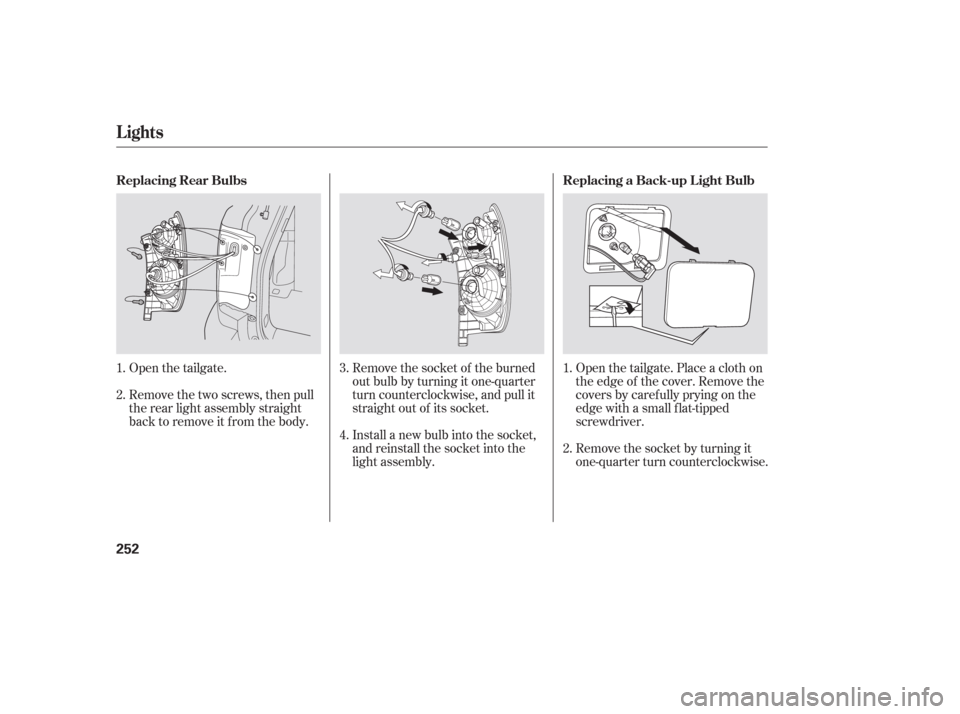
Open the tailgate.
Remove the two screws, then pull
the rear light assembly straight
back to remove it from the body.Open the tailgate. Place a cloth on
the edge of the cover. Remove the
covers by caref ully prying on the
edge with a small f lat-tipped
screwdriver.
Remove the socket by turning it
one-quarter turn counterclockwise.
Remove the socket of the burned
out bulb by turning it one-quarter
turn counterclockwise, and pull it
straight out of its socket.
Install a new bulb into the socket,
and reinstall the socket into the
light assembly. 1.
1.
2. 3.
2.
4.
Lights
Replacing Rear Bulbs
Replacing a Back-up L ight Bulb
252
Page 255 of 316
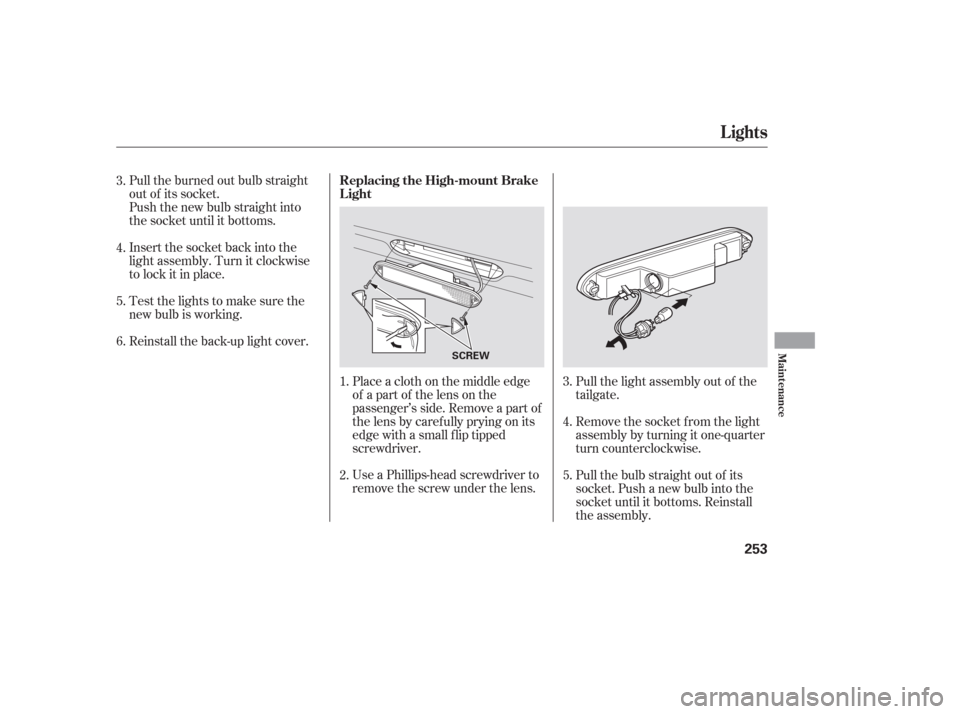
Use a Phillips-head screwdriver to
remove the screw under the lens. Place a cloth on the middle edge
of a part of the lens on the
passenger’s side. Remove a part of
the lens by caref ully prying on its
edge with a small f lip tipped
screwdriver.
Reinstall the back-up light cover. Testthelightstomakesurethe
new bulb is working. Pull the burned out bulb straight
out of its socket.
Push the new bulb straight into
the socket until it bottoms.
Insert the socket back into the
light assembly. Turn it clockwise
to lock it in place.
Pull the light assembly out of the
tailgate.
Pull the bulb straight out of its
socket. Push a new bulb into the
socket until it bottoms. Reinstall
the assembly. Remove the socket f rom the light
assembly by turning it one-quarter
turn counterclockwise.
1.
4.
5. 3.
2.
4.
5.
6. 3.
Lights
Replacing the High-mount Brake
Light
Maint enance
253
SCREW
Page 269 of 316
Park the vehicle on f irm, level, and
non-slippery ground. Put the
transmission in Park. Apply the
parking brake.Thetoolsandjackarebehinda
cover in the cargo area on the
driver’s side. Remove the cover by
pushing the top of it.
Turn the jack’s end
counterclockwise to loosen it, then
remove the jack and tools.
If you have a f lat tire while driving,
stop in a saf e place to change it.
Drive slowly along the shoulder until
you get to an exit or an area that is
far away from the traffic lanes.
Turn on the hazard warning lights,
and turn the ignition switch to the
LOCK (0) position. Have all
passengers get out of the vehicle
while you change the tire.
2. 1.
3.
4.
CONT INUED
Changing a Flat Tire
Taking Care of the Unexpected
267
SPARE TIRE
TOOLS
COVER
JACK
The vehicle can easily roll off
the jack, seriously injuring
anyone underneath.
Follow the directions for
changing a tire exactly, and
never get under the vehicle
when it is supported only by the
jack.
Page 273 of 316

Diagnosing why the engine won’t
start f alls into two areas, depending
on what you hear when you turn the
ignition switch to the START (III)
position:You hear nothing, or almost
nothing. The engine’s starter
motor does not operate at all, or
operates very slowly.
You can hear the starter motor
operating normally, or the starter
motor sounds like it is spinning
f aster than normal, but the engine
does not start up and run.
When you turn the ignition switch to
the START (III) position, you do not
hear the normal noise of the engine
trying to start. You may hear a
clicking sound or series of clicks, or
nothing at all. Check the transmission interlock.
The transmission must be in Park
or neutral or the starter will not
operate.
If the headlights dim noticeably or
go out when you try to start the
engine, either the battery is dis-
charged or the connections are
corroded. Check the condition of
the battery and terminal connec-
tions (see page ). You can
then try jump starting the vehicle
f rom a booster battery (see page
).
Are you using the proper starting
procedure? Ref er to on page .
In this case, the starter motor’s
speed sounds normal, or even f aster
than normal, when you turn the
ignition switch to the START (III)
position, but the engine does not run.
Check these things: Turn the ignition switch to the ON
(II) position. Turn on the
headlights, and check their
brightness. If the headlights are
very dim or do not come on at all,
the battery is discharged. See
on page .
Turn the ignition switch to the
START (III) position. If the
headlights do not dim, check the
condition of the f uses. If the f uses
areOK,thereisprobably
something wrong with the
electrical circuit f or the ignition
switch or starter motor. You will
need a qualif ied technician to
determine the problem (see on page ).272
262
272
199
Nothing Happens or the Starter
Motor Operates Very Slowly
Starting the
Engine
T he Starter Operates Normally
Jump Starting
Emergency T owing
If the Engine Won’t Start
Taking Care of the Unexpected
271
278
Page 274 of 316

�´�´
There may be an electrical
problem, such as no power to the
f uel pump. Check all the f uses
(see page ).
If youfindnothingwrong,youwill
need a qualif ied technician to f ind
the problem. See on page . Although this seems like a simple
procedure, you should take several
precautions.
Open the hood, and check the
physical condition of the battery.
In very cold weather, check the
condition of the electrolyte. If it
seems slushy or f rozen, do not try
jump starting until it thaws.
Are you using a properly coded
key? An improperly coded key will
cause the immobilizer system
indicator in the dash panel to blink
rapidly (see page ).
Connect one jumper cable to the
positive ( ) terminal on your
battery. Connect the other end to
the positive ( ) terminal on the
booster battery. Turn of f all the electrical acces-
sories: heater, A/C, climate
control, stereo system, lights, etc.
Do you have f uel? Check the f uel
gauge; the low f uel indicator may
not be working.
You cannot start your vehicle by
pushing or pulling it. Put the transmission in neutral or
Park, and set the parking brake.
1.
2.
3.
64
279 Emergency
T owing Jump Starting
To Jump Start Your Vehicle:
If the Engine Won’t Start, Jump Starting
272
A battery can explode if you do
not follow the correct procedure,
seriously injuring anyone
nearby.
Keep all sparks, open flames,
and smoking materials away
from the battery.
If a battery sits in extreme cold, the
electrolyte inside can f reeze.
Attempting to jump start with a f rozen
battery can cause it to rupture.
278
Page 276 of 316

The pointer of the vehicle’s
temperature gauge should stay in
the midrange. If it climbs to the red
mark, you should determine the
reason (hot day, driving up a steep
hill, etc.).
If the vehicle overheats, you should
take immediate action. The only
indication may be the temperature
gauge climbing to or above the red
mark. Or you may see steam or
spray coming f rom under the hood.If you do not see steam or spray,
leave the engine running, and
watch the temperature gauge. If
the high heat is due to overloading,
the engine should start to cool
down almost immediately. If it
does, wait until the temperature
gauge comes down to the midpoint,
then continue driving.
If the temperature gauge stays at
the red mark, turn of f the engine.
Look f or any obvious coolant leaks,
such as a split radiator hose.
Everything is still extremely hot,
so use caution. If you f ind a leak, it
must be repaired bef ore you
continue driving (see
If you do not f ind an obvious leak,
check the coolant level in the
radiator reserve tank. Add coolant
if the level is below the MIN mark.
If you see steam and/or spray
coming f rom under the hood, turn
of f the engine. Wait until you see
no more signs of steam or spray,
then open the hood. Saf ely pull to the side of the road.
Put the transmission in neutral or
Park, and set the parking brake.
Turn of f all the accessories, and
turn on the hazard warning lights.
5.
6. 4.
1.
2. 3.
If the Engine Overheats
Emergency
T owing
274
Steam and spray from an
overheated engine can
seriously scald you.
Do not open the hood if steam
is coming out.
Driving with the temperature gauge
pointer at the red mark can cause
serious damage to the engine. on page278).
Page 278 of 316

Let the vehicle sit f or a minute.
Open the hood, and check the oil
level (see page ). An engine
very low on oil can lose pressure
during cornering and other driving
maneuvers.
If necessary, add oil to bring the
level back to the full mark on the
dipstick (see page ).
Start the engine, and watch the oil
pressure light. If it does not go out
within ten seconds, turn off the
engine. There is a mechanical
problem that needs to be repaired
bef ore you can continue driving.
(Seeon page
Saf ely pull of f the road, and shut
of f the engine. Turn on the hazard
warning lights.
This indicator should never
come on when the engine is
running. If it starts f lashing or stays
on, the oil pressure has dropped very
low or lost pressure. Serious engine
damage is possible, and you should
take immediate action.
Go to a service station or garage
where you can get technical
assistance. Immediately turn of f all electrical
accessories. Try not to use other
electrically operated controls such as
the power windows. Keep the engine
running; starting the engine will
discharge the battery rapidly.If the charging system
indicator comes on brightly
when the engine is running, the
battery is not being charged.
1.
2.
3.
4. 189
239
L ow Oil Pressure Indicator
Emergency T owingCharging System Indicator
L ow Oil Pressure Indicator, Charging System Indicator
276
Running the engine with low oil
pressure can cause serious mechanical
damage almost immediately. Turn of f
the engine as soon as you can saf ely get
the vehicle stopped.
278).
Page 282 of 316
To open the passenger’s side, pull
the right edge of the cover.
The primary under-hood f use box is
locatedonthepassenger’sside.The
secondary f use box is next to the
battery.If something electrical in your
vehicle stops working, the first thing
youshouldcheckforisablownfuse.
Determine f rom the chart on pages
and , or the diagram on the
f use box lid, which f use or f uses
control that device. The diagram f or
the interior driver’s side f use box is
on the kick panel below the f use box.
Check those f uses f irst, but check all
the f uses bef ore deciding that a
blown f use is the cause. Replace any
blown f uses, and check if the device
works.
Turn the ignition switch to the
LOCK (0) position. Make sure the
headlights and all other
accessories are of f .
Remove the cover f rom the f use
box.
1.
2. 283 284
Fuses
Checking and Replacing Fuses
280
PASSENGER’ S SIDE INTERIOR
UNDER-
HOOD
FUSE
BOX