Page 51 of 420
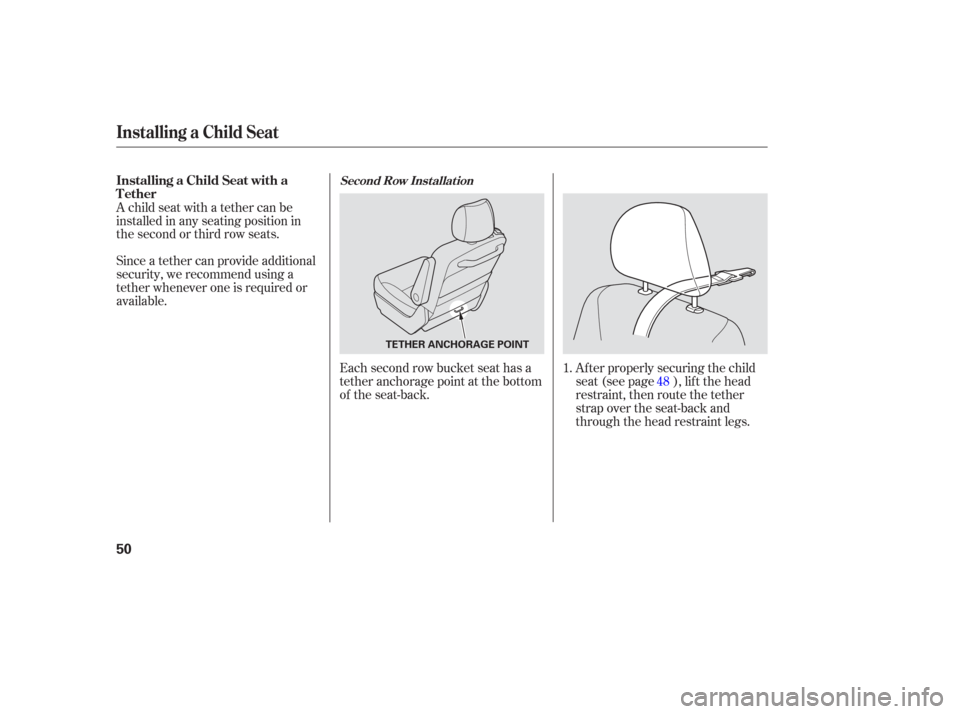
Each second row bucket seat has a
tether anchorage point at the bottom
of the seat-back.Af ter properly securing the child
seat (see page ), lif t the head
restraint, then route the tether
strap over the seat-back and
through the head restraint legs.
A child seat with a tether can be
installed in any seating position in
the second or third row seats.
Since a tether can provide additional
security, we recommend using a
tether whenever one is required or
available.
1.48
Installing a Child Seat
Installing a Child Seat with a
TetherSecond Row Inst allat ion
50
TETHER ANCHORAGE POINT
Page 52 of 420
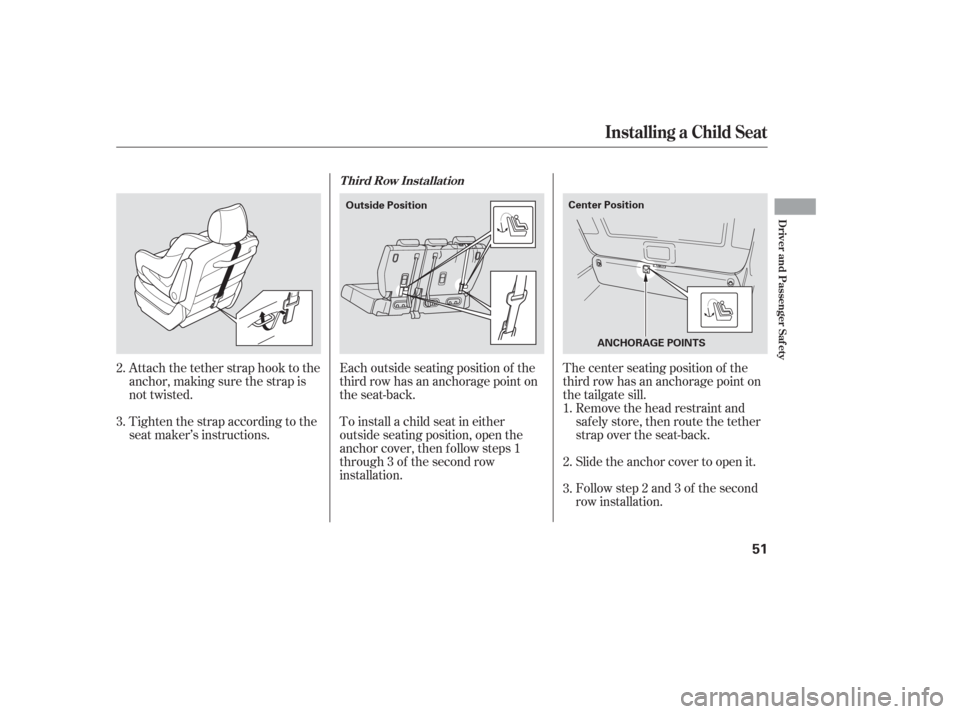
Attach the tether strap hook to the
anchor, making sure the strap is
not twisted.
Tighten the strap according to the
seat maker’s instructions.Remove the head restraint and
safely store, then route the tether
strap over the seat-back.
Slide the anchor cover to open it.
Follow step 2 and 3 of the second
row installation.
The center seating position of the
third row has an anchorage point on
the tailgate sill.
Each outside seating position of the
third row has an anchorage point on
the seat-back.
To install a child seat in either
outside seating position, open the
anchor cover, then f ollow steps 1
through 3 of the second row
installation.
2.
1.
3.
2.
3.
T hird Row Inst allat ion
Installing a Child Seat
Driver and Passenger Saf ety
51
ANCHORAGE POINTS
Center Position
Outside Position
Page 53 of 420
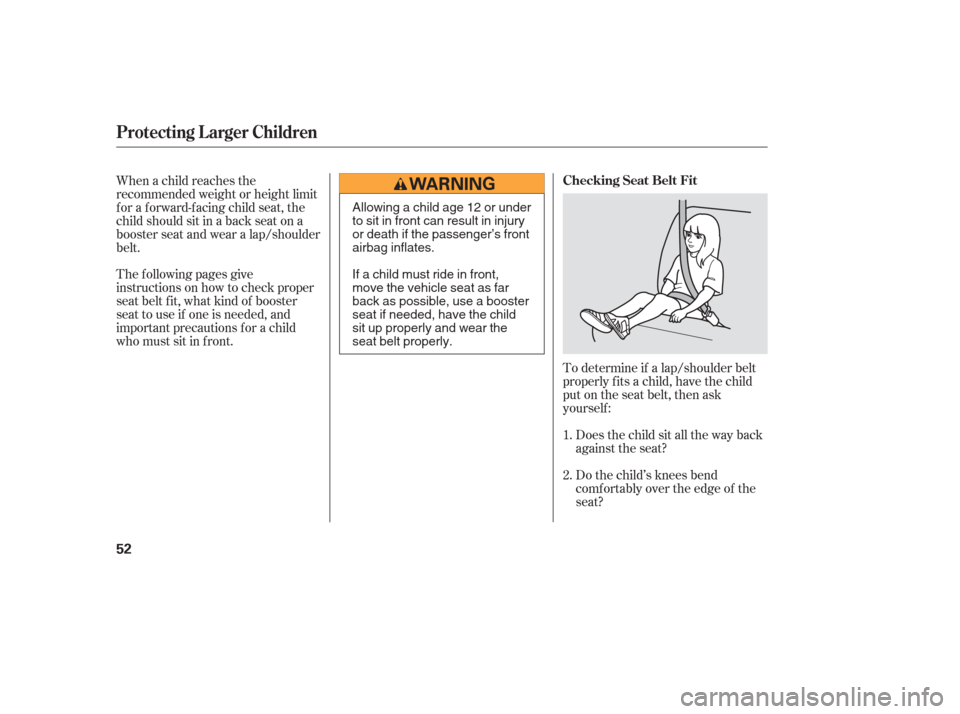
To determine if a lap/shoulder belt
properly f its a child, have the child
put on the seat belt, then ask
yourself :Does the child sit all the way back
against the seat?
Do the child’s knees bend
comf ortably over the edge of the
seat?
When a child reaches the
recommended weight or height limit
for a forward-facing child seat, the
child should sit in a back seat on a
booster seat and wear a lap/shoulder
belt.
The f ollowing pages give
instructions on how to check proper
seat belt f it, what kind of booster
seat to use if one is needed, and
important precautions f or a child
who must sit in f ront.
1.
2.
Protecting L arger Children
Checking Seat Belt Fit
52
Allowing a child age 12 or under
to sit in front can result in injury
or death if the passenger’s front
airbag inflates.
If a child must ride in front,
move the vehicle seat as far
back as possible, use a booster
seat if needed, have the child
sit up properly and wear the
seat belt properly.
Page 54 of 420
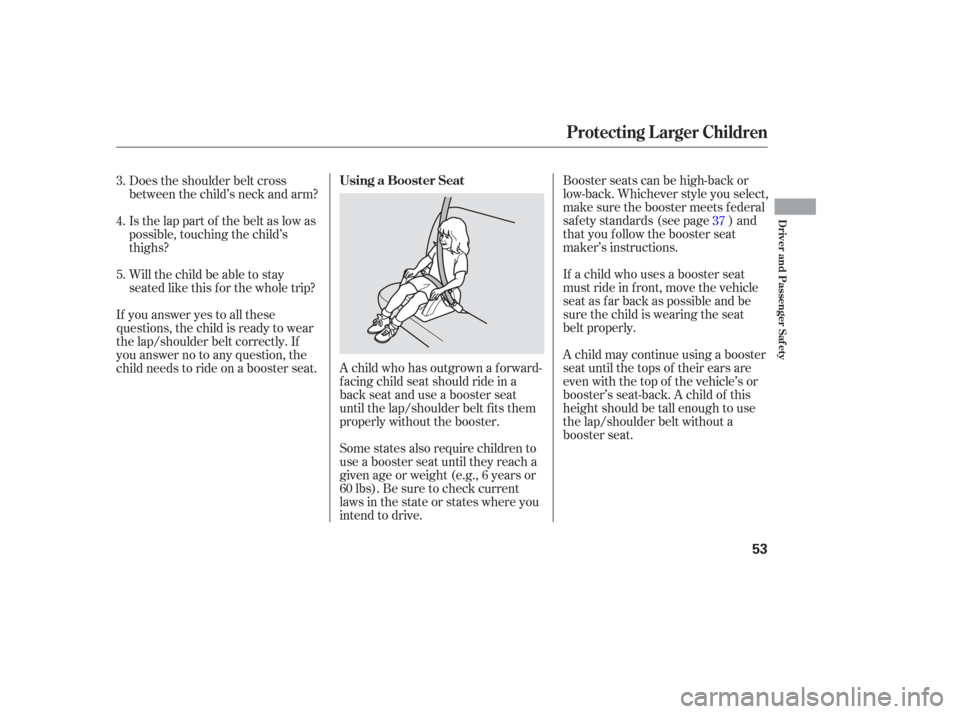
Booster seats can be high-back or
low-back. Whichever style you select,
make sure the booster meets f ederal
saf ety standards (see page ) and
that you f ollow the booster seat
maker’s instructions.
If a child who uses a booster seat
must ride in f ront, move the vehicle
seat as far back as possible and be
sure the child is wearing the seat
belt properly.
A child may continue using a booster
seat until the tops of their ears are
even with the top of the vehicle’s or
booster’s seat-back. A child of this
height should be tall enough to use
the lap/shoulder belt without a
booster seat.
A child who has outgrown a forward-
f acing child seat should ride in a
back seat and use a booster seat
until the lap/shoulder belt f its them
properly without the booster.
Does the shoulder belt cross
between the child’s neck and arm?
Is the lap part of the belt as low as
possible, touching the child’s
thighs?
Will the child be able to stay
seated like this f or the whole trip?
Some states also require children to
use a booster seat until they reach a
given age or weight (e.g., 6 years or
60 lbs). Be sure to check current
laws in the state or states where you
intend to drive.
If you answer yes to all these
questions, the child is ready to wear
the lap/shoulder belt correctly. If
you answer no to any question, the
child needs to ride on a booster seat.
37
3.
4.
5.
Protecting L arger Children
Using a Booster Seat
Driver and Passenger Saf ety
53
Page 55 of 420
If you decide that a child can saf ely
ride up f ront, be sure to:Caref ully read the owner’s manual,
and make sure you understand all
seat belt instructions and all saf ety
inf ormation.
Move the vehicle seat to the rear-
most position.
Have the child sit up straight, back
against the seat, and feet on or
near the f loor.
Check that the child’s seat belt is
properly and securely positioned.
Supervise the child. Even mature
children sometimes need to be
reminded to f asten the seat belts
or sit properly.
To saf ely ride in f ront, a child must
be able to f ollow the rules, including
sitting properly, and wearing the seat
belt properly throughout a ride. Of course, children vary widely. And
while age may be one indicator of
when a child can saf ely ride in the
f ront, there are other important
f actors you should consider.
Physically, a child must be large
enough f or the lap/shoulder belt to
properly f it (see page ). If the seat
belt does not f it properly, with or
without the child sitting on a booster
seat, the child should not sit in f ront.
The National Highway Traffic Safety
Administration and Transport
Canada recommend that all children
age 12 and under be properly
restrained in a back seat.
If the passenger’s airbag inf lates in a
moderate to severe f rontal collision,
the airbag can cause serious injuries
to a child who is unrestrained,
improperly restrained, sitting too
close to the airbag, or out of position.
A side airbag also poses risks. If any
part of a larger child’s body is in the
path of a deploying side airbag, the
child could receive possibly serious
injuries. 52
Protecting L arger Children
Maturity
Physical Size
When Can a L arger Child Sit in
Front
54
Page 56 of 420
This could result in
serious neck injuries during a crash.
This could cause
very serious injuries during a crash.
It also increases the chance that the
child will slide under the belt in a
crash and be injured. Devices intended to improve a
child’s comf ort or reposition the
shoulder part of a seat belt can make
the belt less ef f ective and increase
the chance of serious injury in a
crash.
If they do, they could
be very seriously injured in a crash.
Protecting L arger Children
Additional Saf ety Precautions
Do not let a child wear a seat belt
across t he neck.
Do not let a child put the shoulderpart of a seat belt behind t he back orunder the arm. Do not put any accessories on a seat
belt.
T wo children should never use the same seat belt .
Driver and Passenger Saf ety
55
Page 60 of 420

This section gives inf ormation about
the controls and displays that
contribute to the daily operation of
your vehicle. All the essential
controls are within easy reach............................
Control Locations .60............................
Instrument Panel .61
..........
Instrument Panel Indicators .63
.............................................
Gauges .71
.............
Multi-Inf ormation Display .74
Controls Near the Steering
.........................................
Wheel .124
Windshield Wipers and .....................................
Washers .125
Rear Window Wiper and .......................................
Washer .126
.........
Turn Signal and Headlights .126
......
Instrument Panel Brightness .129
...............
Hazard Warning Button .130
...............
Rear Window Def ogger .130
........
Steering Wheel Adjustment .131
.............................
Keys and Locks .132
......................
Immobilizer System .133
..............................
Ignition Switch .134
.....................
Remote Transmitter .135
....................................
Door Locks .141
....................
Power Door Locks .141
............
Childproof Door Locks .142
..........................................
Tailgate .142
..........................
Power Tailgate .143
.................................
Sliding Doors .146
...............................................
Seats .152..................................
Seat Heaters .164
Driver’s Seat Position Memory ........................................
System .165
............................
Power Windows .167
.......................................
Moonroof .170
...........................................
Mirrors .171
...............................
Parking Brake .172
.
Adjustable Driver’s Foot Pedals .173
.........
Interior Convenience Items .174
..........
Retractable Center Tray .175
.....................
Beverage Holders .175
................
Integrated Sunshade .177
....................
Sunglasses Holder .178
................
Conversation Mirror .178
...................................
Sun Visor .179
............................
Vanity Mirror .179
...................
Rear Compartment .179
Removable Second Row
..................................
Console .180
...............
In-Floor Storage Area .181
......................
Lower Glove Box .184
......................
Upper Glove Box .184
...........................
Center Pocket .185
........
Accessory Power Sockets . 186
.......................
AC Power Outlet .186
...............................
Interior Lights .187
Instruments and Controls
Inst rument s and Cont rols
59
Page 143 of 420
With the childproof door locks on,
automatic operation with the inside
door handle is disabled.To open the tailgate, pull the handle,
then lif t up. To close the tailgate, use
the inner handle to pull it down, then
press down on the back edge.
Keep the tailgate closed at all times
while driving to avoid damaging the
tailgate and to prevent exhaust gas
f rom getting into the interior. Seeon page
.
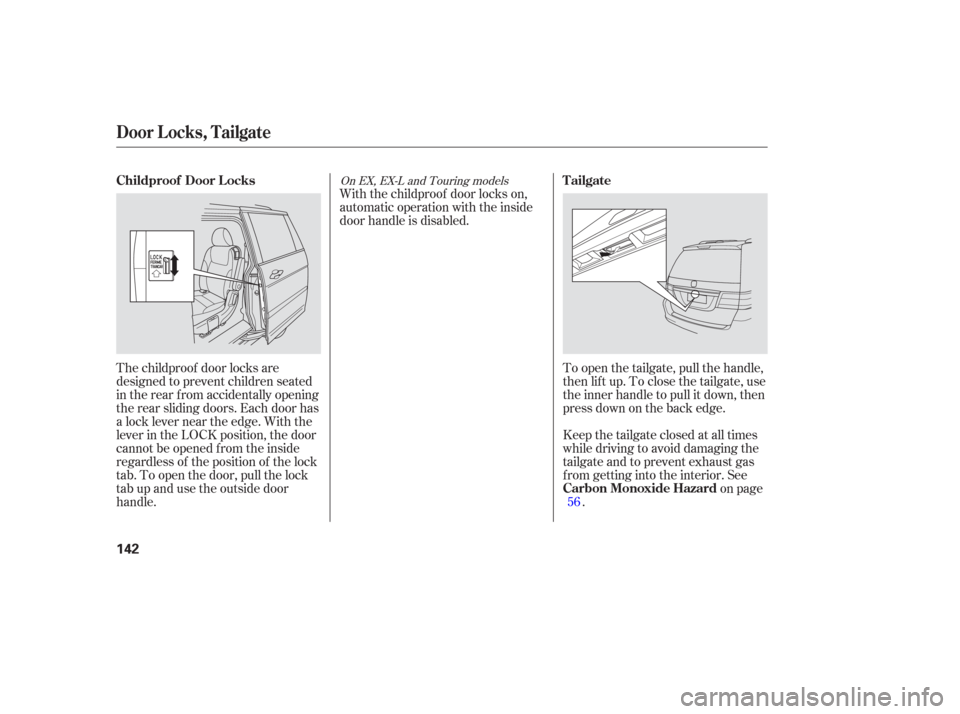
The childproof door locks are
designed to prevent children seated
in the rear f rom accidentally opening
the rear sliding doors. Each door has
a lock lever near the edge. With the
lever in the LOCK position, the door
cannot be opened f rom the inside
regardless of the position of the lock
tab. To open the door, pull the lock
tab up and use the outside door
handle.
56
On EX, EX-L and Touring modelsChildproof Door L ocksT ailgate
Carbon Monoxide Hazard
Door L ocks, T ailgat e
142