Page 165 of 253
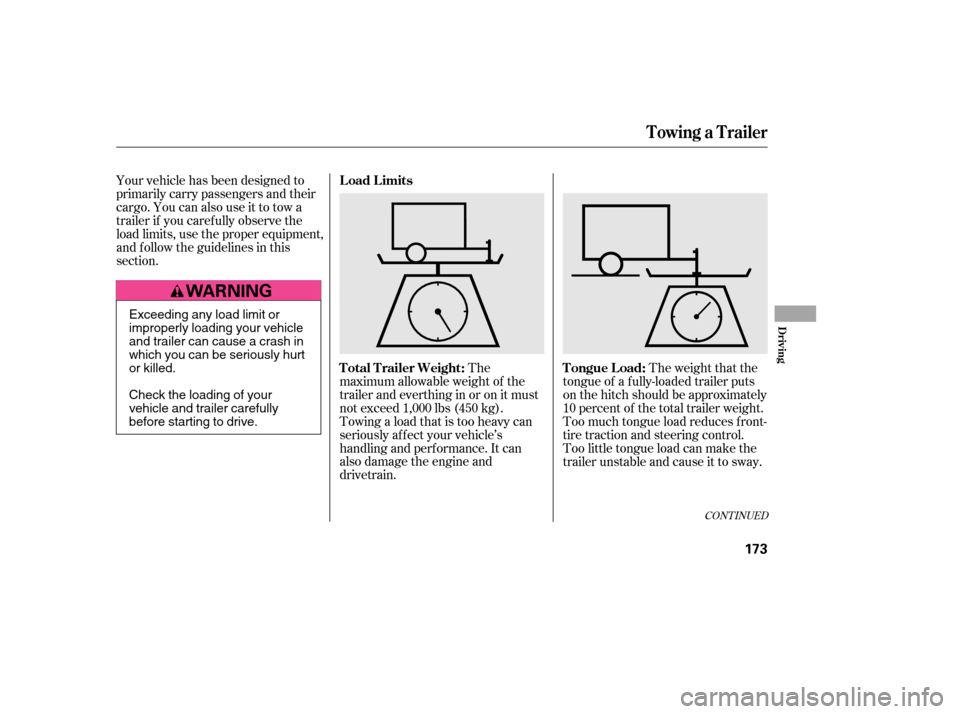
Your vehicle has been designed to
primarily carry passengers and their
cargo. You can also use it to tow a
trailer if you caref ully observe the
load limits, use the proper equipment,
and f ollow the guidelines in this
section.The
maximum allowable weight of the
trailerandeverthinginoronitmust
not exceed 1,000 lbs (450 kg).
Towing a load that is too heavy can
seriously af f ect your vehicle’s
handling and perf ormance. It can
also damage the engine and
drivetrain. Theweightthatthe
tongue of a f ully-loaded trailer puts
on the hitch should be approximately
10 percent of the total trailer weight.
Too much tongue load reduces f ront-
tire traction and steering control.
Too little tongue load can make the
trailer unstable and cause it to sway.
CONT INUED
Towing a Trailer
Load Limits
T otal T railer Weight: T ongue L oad:
Driving
173
Exceeding any load limit or
improperly loading your vehicle
and trailer can cause a crash in
which you can be seriously hurt
or killed.
Check the loading of your
vehicle and trailer carefully
beforestartingtodrive.
�����—�����—�����y�
�����������
�y���
�(�#���������y���
�����y
Page 169 of 253
When preparing to tow, and bef ore
driving away, be sure to check the
f ollowing:The vehicle has been properly
serviced, and the tires, brakes,
suspension, cooling system, and
lights are in good operating
condition.
All weights and loads are within
limits (see pages and ).
Thehitch,safetychains,andany
other attachments are secure.
All items in or on the trailer are
properly secured and cannot shif t
while you drive.
The lights and brakes on your
vehicle and the trailer are working
properly. Your vehicle tires and spare are
properly inf lated (see page ),
and the trailer tires and spare are
trailer maker.
Crosswinds and air turbulence
caused by passing trucks can disrupt
your steering and cause trailer to
sway. When being passed by a large
vehicle, keep a constant speed, and
steer straight ahead. Do not try to
make quick steering or braking
corrections. Always drive slowly and have
someone guide you when backing up.
Grip the of the steering
wheel; then turn the wheel to the lef t
to get the trailer to move to the lef t,
andturnthewheelrighttomovethe
trailer to the right.
Follow all normal precautions when
parking, including f irmly setting the
parking brake and putting the
transmission in Park (automatic) or
in 1st or reverse (manual). Also,
place wheel chocks at each of the
trailer’s tires.
173 174 210
bottom
Towing a Trailer
Pre-T ow Checklist
Handling Crosswinds and Buf f et ing
Backing Up
Parking
Driving
177
�����—�����—�����y�
�������������y���
�(�#���������y���
�����y
Page 178 of 253

�Ì�Ì
�Ì
Maintenance Minder
187
: Maintenance Sub Items
Rotate tires
Replace air cleaner element If you drive in dusty conditions, replace
every 15,000 miles (24,000 km).
Replace dust and pollen filter If you drive primarily in urban areas that have high
concentrations of soot in the air from industry and
from diesel-powered vehicles, replace every 15,000
miles (24,000 km).
Inspect drive belt
Replace transmission fluid
Replace spark plugs
Inspect valve clearance
Replace engine coolant
Maintenance Main Items
Replace engine oil
Replace engine oil and oil filter
Inspect front and rear brakes
Check parking brake adjustment
Inspect these items: Tie rod ends, steering gear box, and boots
Suspension components
Driveshaft boots
Brake hoses and lines (including ABS)
All fluid levels and condition of fluids
Exhaust system
Fuel lines and connections
AB
Symbol
Symbol
12 3 4 5
If the message ‘‘SERVICE OIL’’ does not appear more than 12 months after
the display is reset, change the engine oil every year.
See information on maintenance and emissions warranty on page .
Independent of the maintenance minder display, replace the brake fluid
every 3 years.
Inspect idle speed every 160,000 miles (256,000 km).
Adjust the valves during services A, B, 1, 2, or 3 only if they are noisy.
NOTE:
185
1:
11
Maintenance Minder
�����—�����—�����y�
�������������y���
�(�#���������y���
�����y
Page 181 of 253
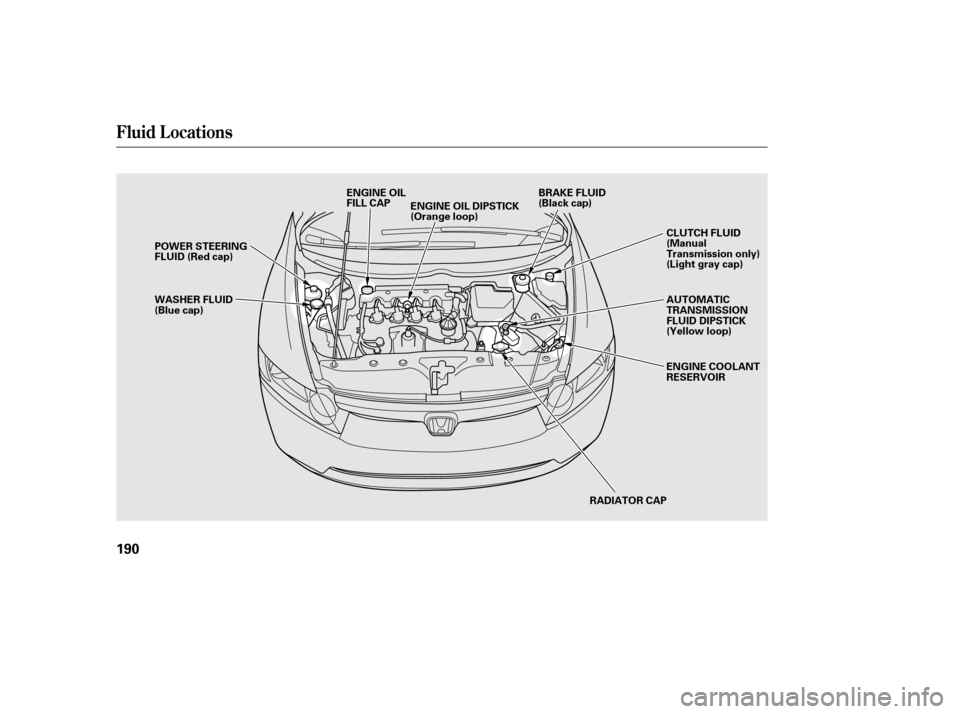
Fluid Locations
190
RADIATOR CAP
ENGINE OIL DIPSTICK
(Orange loop)
ENGINE OIL
FILL CAP
WASHER FLUID
(Blue cap)
POWER STEERING
FLUID (Red cap)
AUTOMATIC
TRANSMISSION
FLUID DIPSTICK
(Yellow loop)
ENGINE COOLANT
RESERVOIR
CLUTCH FLUID
(Manual
Transmission only)
(Light gray cap)
BRAKE FLUID
(Black cap)
�����—�����—���
�y�
�������������y���
�(�#���������y���
�����y
Page 190 of 253
Always use Honda Power Steering
Fluid. You may use another power
steering f luid as an emergency
replacement, but have the power
steering system f lushed and ref illed
with Honda PSF as soon as possible.
A low power steering f luid level can
indicate a leak in the system. Check
the f luid level f requently, and have
the system inspected as soon as
possible.
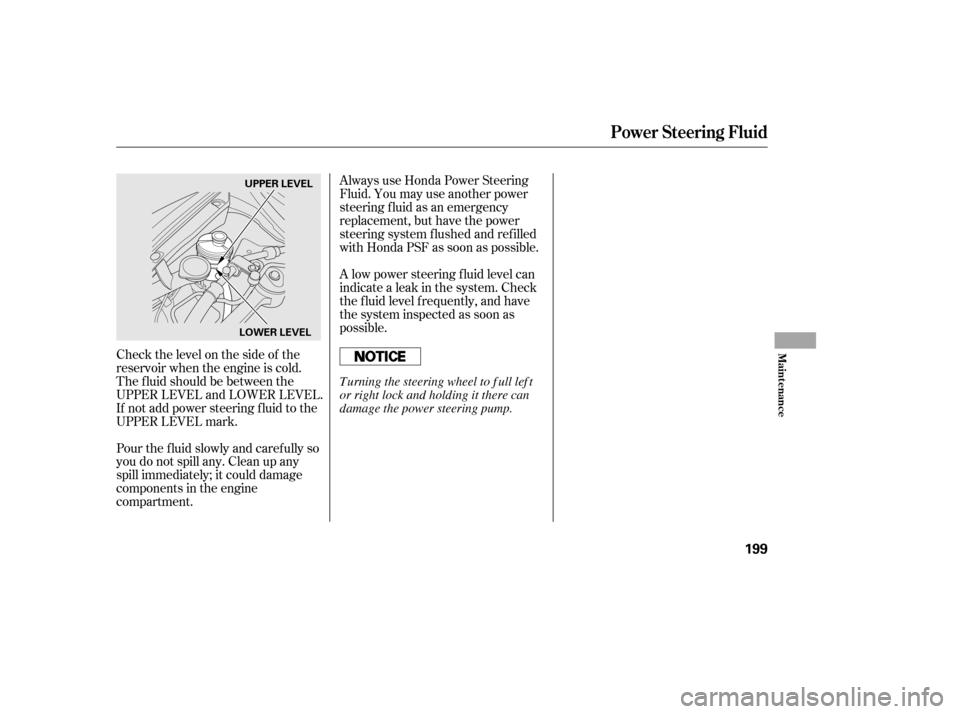
Check the level on the side of the
reservoir when the engine is cold.
The f luid should be between the
UPPER LEVEL and LOWER LEVEL.
If not add power steering f luid to the
UPPER LEVEL mark.
Pour the f luid slowly and caref ully so
you do not spill any. Clean up any
spill immediately; it could damage
components in the engine
compartment.
Power Steering Fluid
Maint enance
199
UPPER LEVEL
LOWER LEVEL
T urning the steering wheel to f ull lef t
or right lock and holding it there can
damage the power steering pump.
�����—�����—�����y�
�����������
�y���
�(�#���������y���������y
Page 192 of 253
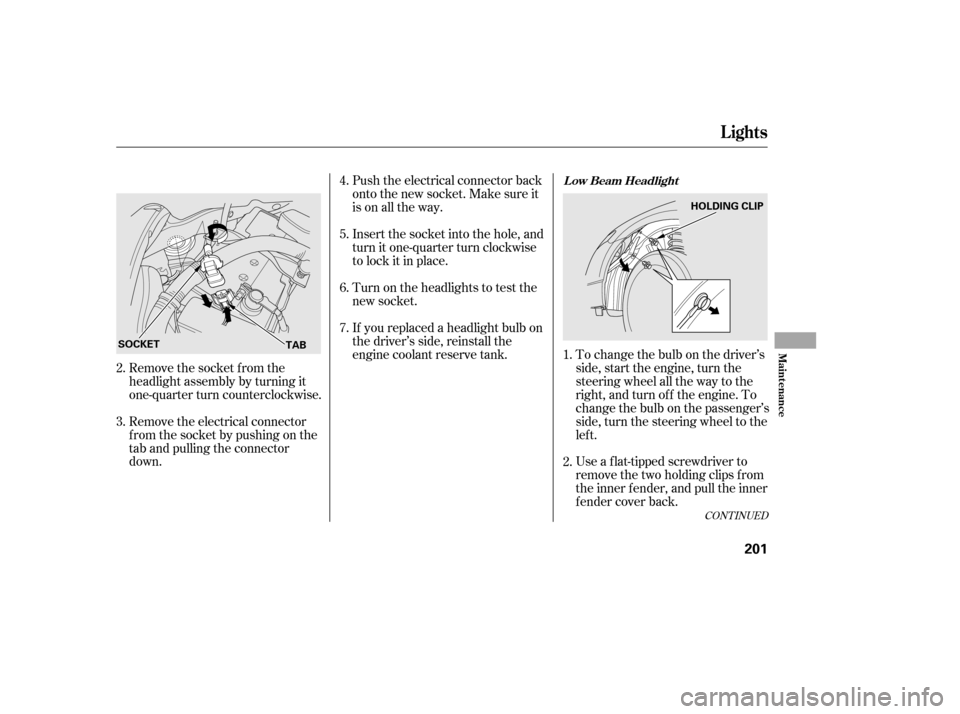
If youreplacedaheadlightbulbon
the driver’s side, reinstall the
engine coolant reserve tank.
Remove the socket from the
headlight assembly by turning it
one-quarter turn counterclockwise.
Remove the electrical connector
f rom the socket by pushing on the
tab and pulling the connector
down. Insert the socket into the hole, and
turn it one-quarter turn clockwise
to lock it in place.
Push the electrical connector back
ontothenewsocket.Makesureit
is on all the way.
Turn on the headlights to test the
new socket.
To change the bulb on the driver’s
side, start the engine, turn the
steering wheel all the way to the
right, and turn of f the engine. To
change the bulb on the passenger’s
side, turn the steering wheel to the
lef t.
Use a f lat-tipped screwdriver to
remove the two holding clips f rom
the inner f ender, and pull the inner
f ender cover back.
2. 3.
2.
4.5.6. 7.
1.
CONT INUED
Lights
L ow Beam Headlight
Maint enance
201
TAB HOLDING CLIP
SOCKET
�����—�����—�����y�
�������������y���
�(�#���������y���������y
Page 193 of 253
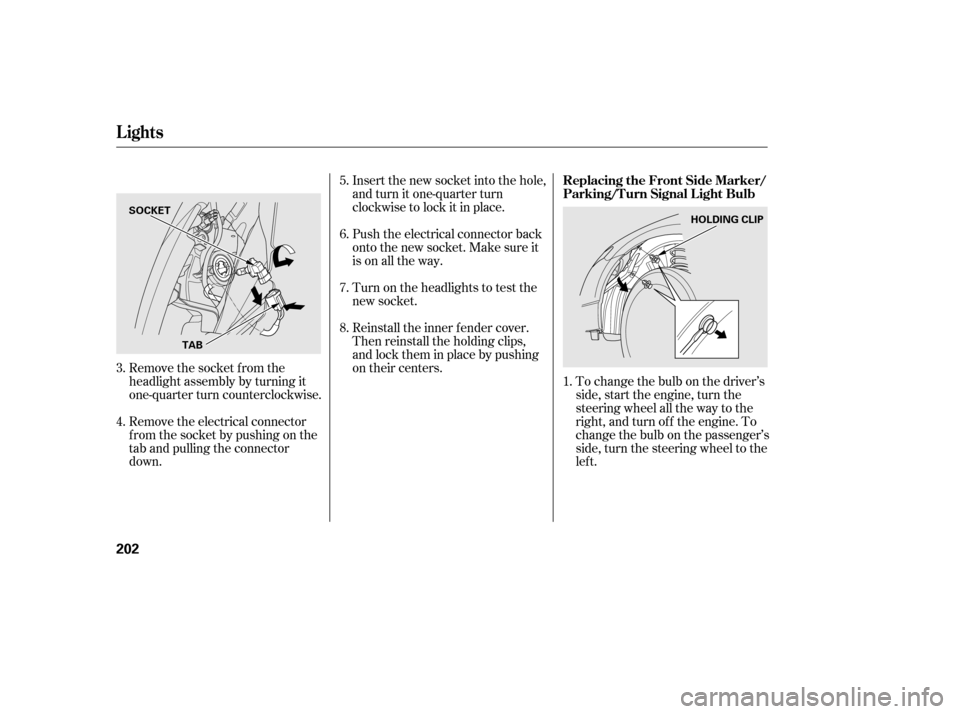
To change the bulb on the driver’s
side, start the engine, turn the
steering wheel all the way to the
right, and turn of f the engine. To
change the bulb on the passenger’s
side, turn the steering wheel to the
lef t.
Reinstall the inner f ender cover.
Then reinstall the holding clips,
andlocktheminplacebypushing
on their centers.
Remove the socket from the
headlight assembly by turning it
one-quarter turn counterclockwise.
Remove the electrical connector
f rom the socket by pushing on the
tab and pulling the connector
down. Push the electrical connector back
ontothenewsocket.Makesureit
is on all the way.
Turn on the headlights to test the
new socket.
Insert the new socket into the hole,
and turn it one-quarter turn
clockwise to lock it in place.
5. 6.
1.
7. 8.
3. 4.
Lights
Replacing the Front Side Marker/
Parking/Turn Signal Light Bulb
202
TAB HOLDING CLIP
SOCKET
�����—�����—�����y�
�������������y���
�(�#���������y���������y
Page 203 of 253
It is best to replace all f our tires at
thesametime.If thatisnotpossible
or necessary, replace the two f ront
tires or two rear tires as a pair.
Replacing just one tire can seriously
af f ect your vehicle’s handling.
If you ever replace a wheel, make
sure that the wheel’s specif ications
match those of the original wheels.
Replacement wheels are available at
your dealer.
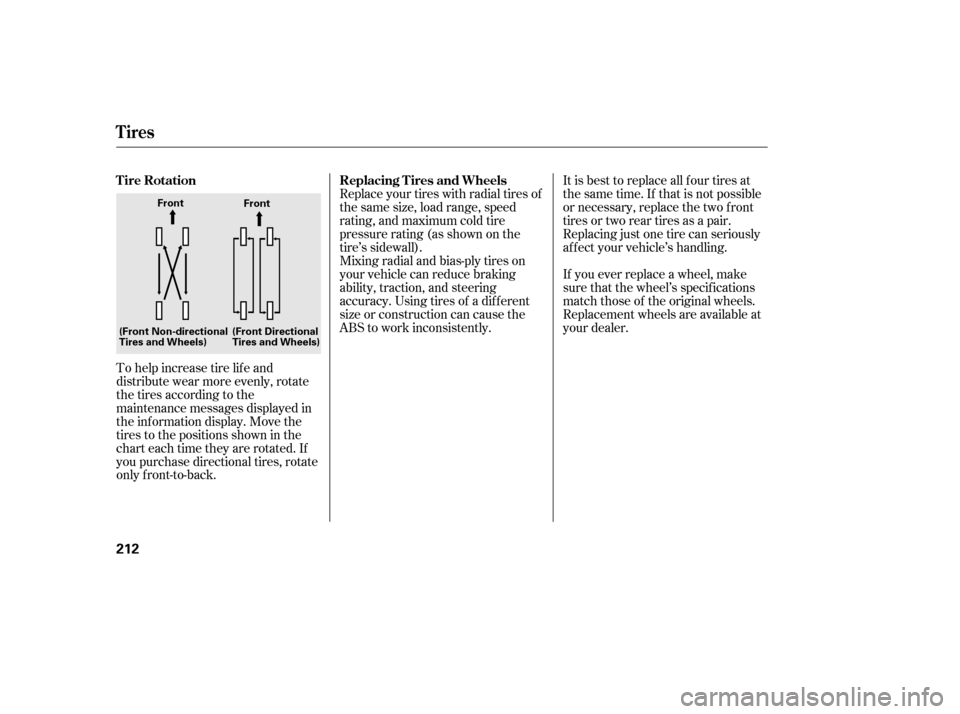
To help increase tire lif e and
distribute wear more evenly, rotate
the tires according to the
maintenance messages displayed in
the information display. Move the
tires to the positions shown in the
chart each time they are rotated. If
you purchase directional tires, rotate
only f ront-to-back. Replace your tires with radial tires of
the same size, load range, speed
rating, and maximum cold tire
pressure rating (as shown on the
tire’s sidewall).
Mixing radial and bias-ply tires on
your vehicle can reduce braking
ability, traction, and steering
accuracy. Using tires of a dif f erent
size or construction can cause the
ABS to work inconsistently.
T ire Rotation Replacing T ires and Wheels
Tires
212
Front
Front
(Front Directional
Tires and Wheels)
(Front Non-directional
Tires and Wheels)
�����—�����—�����y�
������
������y���
�(�#���������y�����
���y