2006 GREAT WALL HOVER light
[x] Cancel search: lightPage 233 of 425
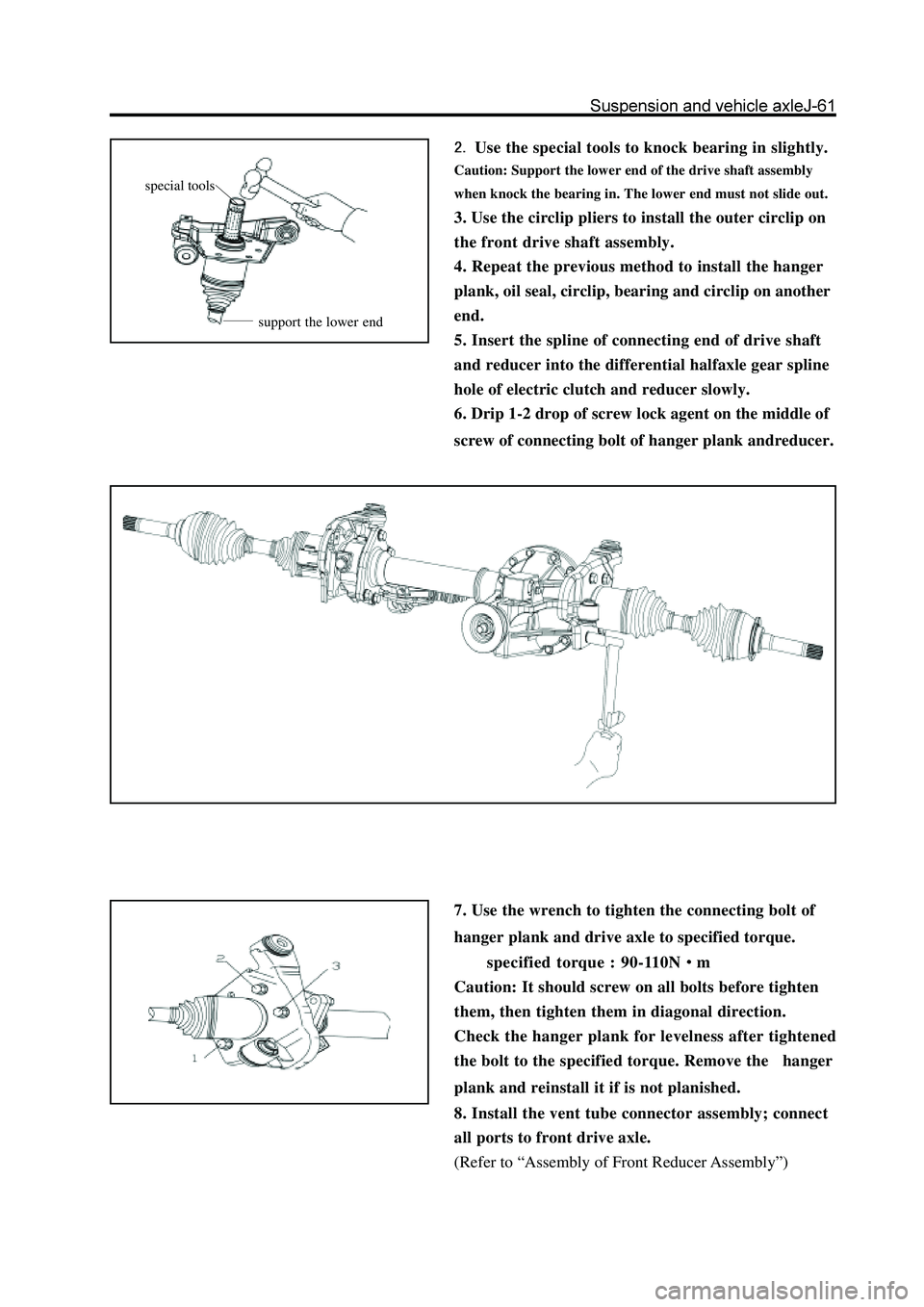
Use the special tools to knock bearing in slightly.
Caution: Support the lower end of the drive shaft assembly
when knock the bearing in. The lower end must not slide out.
3. Use the circlip pliers to install the outer circlip on
the front drive shaft assembly.
4. Repeat the previous method to install the hanger
plank, oil seal, circlip, bearing and circlip on another
end.
5. Insert the spline of connecting end of drive shaft
and reducer into the differential halfaxle gear spline
hole of electric clutch and reducer slowly.
6. Drip 1-2 drop of screw lock agent on the middle of
screw of connecting bolt of hanger plank andreducer.
7. Use the wrench to tighten the connecting bolt of
hanger plank and drive axle to specified torque.
specified torque : 90-110N
m
Caution: It should screw on all bolts before tighten
them, then tighten them in diagonal direction.
Check the hanger plank for levelness after tightened
the bolt to the specified torque. Remove the hanger
plank and reinstall it if is not planished.
8. Install the vent tube connector assembly; connect
all ports to front drive axle.
(Refer to “Assembly of Front Reducer Assembly”)
special tools
support the lower end
Page 245 of 425

9. Remove the sealant on the matching surface
between the flange and electric clutch housing by
knife.
Caution: Do not scratch the matching surface.
10. Use the special tools to knock the new seal in the
oil seal position in flange.
Caution: Before install the new oil seal, it should
coat the lip with thin lithium base grease, and the oil
seal should be in alignment position.
11. Insert the spline of small end of major semiaxle
in the spline of front reducer half axle gear slightly,
then use the brass bar and hand hammer to knock it
in.
Caution: When knock in the major semiaxle, must
not damage the inside needle bearing of large end
spline of major semiaxle.
12. Use the circlip pliers to install the circlip in the
flange and clamp the bearing outer race.
Caution: The circlip should be replaced if it has
serious deformation.
13. Use the clean cloth to wipe the matching surface
of flange and electric clutch housing respectively.
Page 265 of 425

electric clutch detector
37. Detect the electric clutch assembly .
a. Measure the clearance between the shift fork and shift fork
sleeve.
Range of clearance : 0.2-0.4mm
It should replace the electric clutch assembly and shift fork
sleeve when the clearance is not in the range.
b. Connect the electric clutch assembly to the electric clutch
detector and power the electric clutch detector with220V
power supply to test the electric clutch (Before the test,
adjustthe test controller status to make the motor starting time
is 3s ,the time form found the actuator is not in position to
restartingis 2.5s and the time of controller to redrive the
electric clutch is2s) The motor starts for 3s when the gear
switch is shifted form 2WD to 4WD, the lamp flashes at the
same time, the clutch is in 4WD status, the indicator lamp is
light always. If does not reach the 4WD status in the first
time, then the controller restarts it for 2s after 2.5s delay, the
lamp flashes at the same time; if it is still not in position, then
the indicator lamp flashes twice continuously, the indicator
lamp is extinguished for 1s, the motor is stopped. That means
the electric clutch is unqualified and should be replaced by the
qualified product. The motor starts for 3s normally when the
clutch is shifted form 4WD to 2WD, the lamp flashes at the
same time, when the clutch is in 2WD status, the indicator
lamp is extinguished always. If does not reach the 2WD status
in the first time, then the controller restarts it for 2s after 2.5s
delay, the lamp flashes at the same time; if it is still not in
2WD status, then the indicator lamp flashes twice
continuously, the indicator lamp is extinguished for 1s, the
motor is stopped.
That means the electric clutch is unqualified and should be
replaced by the qualified product.
38. Cover the shift fork sleeve on the major
semiaxle spline.
39. Install the separator housing on the front axle
tube flange and use the bolt to tighten it to the
specified torque
(The bolt should be precoated
with the screw lock agent and the amount should be
just can cover the complete screw)
specified torque : 90-110Nm
Caution: Before installation, remove the foreign material on
two matching surfaces of separator housing and front axle
tube flange; and precoat the 1596 silicon rubber plane sealant
on the front axle tube flange. Caution: Prevent the sealant
from entering into the screw hole.
40. Press in the plastic vent tube on the electric
clutch housing and front axle tube.
41. Install two location pins in the location pin hole
of electric clutch housing respectively.
42. Coat the connecting surface of electric clutch
housing and electric clutch with 1596 silicon rubber
sealant uniformly; level it by plate.
Caution: The connecting surface should be cleaned
and must not have the oil and other foreign
matters. The sealant must not enter into the elec-
tric clutch housing and screw hole.
Page 291 of 425
Brake-5
Check and adjustment
Check and adjustment of brake pedal
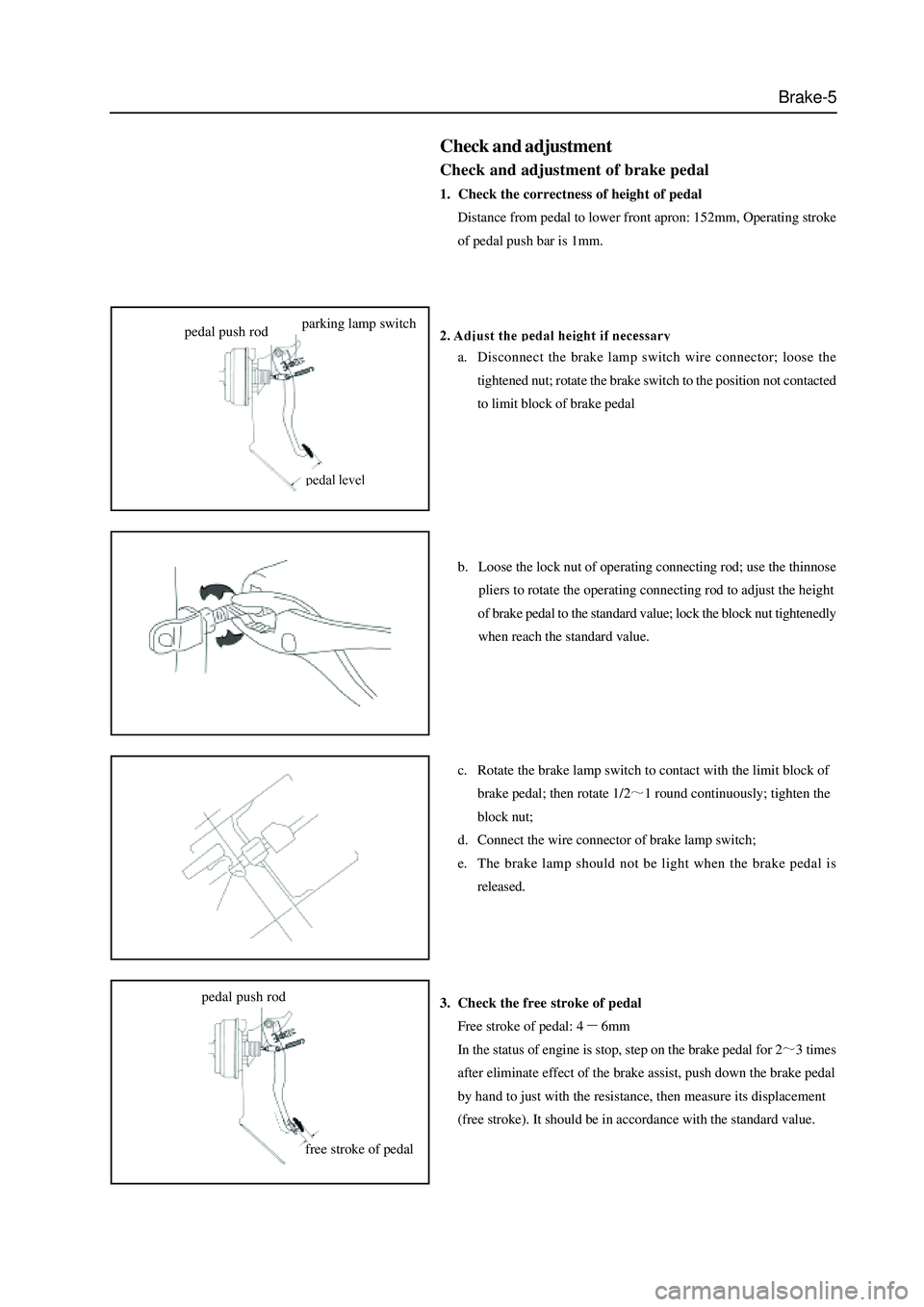
1. Check the correctness of height of pedal
Distance from pedal to lower front apron: 152mm, Operating stroke
of pedal push bar is 1mm.
a. Disconnect the brake lamp switch wire connector; loose the
tightened nut; rotate the brake switch to the position not contacted
to limit block of brake pedal
b. Loose the lock nut of operating connecting rod; use the thinnose
pliers to rotate the operating connecting rod to adjust the height
of brake pedal to the standard value; lock the block nut tightenedly
when reach the standard value.
c. Rotate the brake lamp switch to contact with the limit block of
brake pedal; then rotate 1/2
1 round continuously; tighten the
block nut;
d. Connect the wire connector of brake lamp switch;
e. The brake lamp should not be light when the brake pedal is
released.
3. Check the free stroke of pedal
Free stroke of pedal: 4
6mm
In the status of engine is stop, step on the brake pedal for 2
3 times
after eliminate effect of the brake assist, push down the brake pedal
by hand to just with the resistance, then measure its displacement
(free stroke). It should be in accordance with the standard value.
pedal push rodparking lamp switch
free stroke of pedal pedal push rod
Page 314 of 425

Brake-28
10. Adjust the clearance between the brake drum and brake shoe.
Poke the adjusting hole plug on the brake drum, insert the screwdriver
into the clearance-adjusting hole; rotate the clearance-adjusting gear
to expand the brake shoe until the brake disc can not be rotated by
hand. Then rotate it for 3-5 teeth in anticlockwise, rotate the brake
disc by hand at the same time, it is proper that it can rotate freely
and without the contact between the abrasion and disc. It is allowable
that the non-running-in brake shoe has the slight abrasion sensing.
When adjust the clearance, the left and right wheel must be adjust at
the same, install the adjusting hole plug after the completion of
adjusting .
11.Rear brake caliper assembly
12.Rear wheel assembly
Tighten torque :120N.m
Page 317 of 425

Brake-31
Antilock Braking System (ABS)
Cautions
1. It must not remove or install the electric elements and wire bunch plug when the ignition switch is in ON to avoid
the damage of ECU. It should turn off the ignition switch if needs disassembly.
2. Pay attention to do not knock or impact the ABS ECU during the maintenance and repair, for it will damage the
ABS ECU easily.
3. The wheel speed sensor and hydraulic unit (integrated with ECU) of BOSCH ABS8.0 can not be repaired, it should
be replaced in integral if damaged.
4. After the brake system is maintained, the brake pedal maybe soft. Discharge the air according to the normal brake
system.
5. It must use the brake fluid from original manufacturer; the brake fluid of different number cannot be used in mixed,
otherwise it will cause the failure of brake system. Select the tyre of original type as most as possible
Repair of Antilock Braking System (ABS)
1. It should process the failure diagnosis for the brake system before process the ABS failure diagnosis. It can
diagnose out the failure rapidly by using Table 1. In Table 1, the small number means the failure which occurs most
possibly. Check each element according to the sequence and maintain or replace it if necessary.
2. Check the following elements for normal operation before the diagnosis:
Brake fluid level and brake fluid quality
Pressure of tyre, size of tyre, shape and depth of tyre figure
Other brake component
These components will affect the brake effect of the ABS. Check the system sensor, connecting wire and connector for correct
installation, arrangement and connection. Ensure the completeness of fuse, repair or replace it if necessary.
3. Process the analysis and diagnosis according to the ABS advanced by owner. Use the diagnosis instrument (Annex
1) for final check and confirmation. It must process the run inspection after the competition of all ABS maintenance.
The test condition is shown as follows:
a. Confirm the tyre complies with the requirement, the tyre pressure is normal.
b. The brake system (including brake light ) is normal
c. The brake system is without leakage.
d. The position and installation of wheel speed sensor is correct.
e. All fuses are normal.
4. test method:
Run for 1 min at least when the vehicle speed is beyond 40Km/h, process a proper brake. Then read out the failure code to
ensure the ABS is without failure code.
Page 328 of 425

B-Black Br- Brown G- Green Gr- Gray L- Lake blue Lg- Light green
Or- Orange P- Pink R- Red V- Violet W- White Y- Yellow
Page 351 of 425

Controller of the Central Door Lock
1. Positive pole of the power supply (12V) is connected to the positive pole of car’s battery through a 15A fuse; when the
engine is started, the voltage is not less than 10V.
2. Output of the central door lock. The unlock cable connected to the executor of the central door lock is usuall
y grounded
through the normally-closed contact of the internal relay; when the door is unlocked by the remote controller or unlocked
manually, the public contact of the relay will get through with the normally-open contact, realizing an output of 12V
voltage.
3. Out
put of the central door lock. The lock cable connected to the executor of the central door lock is usually grounded
through the normally-closed contact of the internal relay; when the door is locked by the remote controller or locked
manually, the public contact of the relay will get through the normally-open contact, realizing an output of 12V voltage.
4. Key detection cable. This cable is connected to the ignition lock of the car and will
get through with the grounding wire
when the key is inserted into. (negative input)
5. Ri
ght direction indicator. The cable is connected to the positive pole of the right direction indicator of the car; an output of
12V voltage will be available when this cable is at work.
6. Left direction indicator. The cable is connected to the
positive pole of the right direction indicator of the car; an output of
12V voltage will be available when this cable is at work.
7. Negative input of door switch, which is connected to the door switch of the car; this cable will be earthed when the door is
opened. (Interior lights will be on)
a. Open the door and then close it, the reading light will be on for 10 seconds; if during this period, it is detected that the key has
been inserted into the ignition lock or the door closed, then the reading light will turn off.
b. When the key is pulled out of the ignition lock, then reading light will turn on, during this period, if the key is reinserted into
the ignition lock or the door lock, the reading light will be off; if there is not any action when the door is closed within 1
minute, the reading light will automatically turn off.
8. ON power supply detection cable. A conductive wire connected to the ON gear of the ignition lock. (When the ke
y is turned
to the ON position, a 12V output will be available)
9. Car s
peedometer detection cable, which is connected to the detection cable of car's speedometer. (When the car is
accelerated to the speed of 15km/h, the instruments unit will out
put a 500mS rectangular positive pulse to the central door
lock controller, which will control the locking of the central door lock when this 500mS rectangular positive pulse signal is
detected by the controller.)
10. Output of window closing si
gnal. When the door is locked by the remote controller, this line will be available with an
output of 12V positive current for one second and then be off. (No output)
11. Locking signal. The locking signal line connected to the central door lock of car's left front door is connected throu
gh with
the grounding line when at work. (Earthing)
12. Unlockin
g signal. The unlocking signal line connected to the central door lock of car's left front door is connected through
with the grounding line when at work. (Earthing)
13. Ne
gative pole of the power supply, which is connected to the car body, (earthing) line shall be as short as possible,
over-length will produce the interference.
Function of controller of the central door lock
1. Locking. When all the car doors are closed, press LOCK button of the remote controller once, at this time, the direction
indicator will flash once and the central door lock is closed.
2. Unlocking. At the locking state, press UNLOCK button of the remote controller once, at this time, the direction indicato
r
will flash two times and the central door lock is opened.
3. Car-findin
g function. At the locking state, press LOCK bottom of the remote controller once, and at this time, the direction
indicator will flash ten times quickly. Press UNLOCK button of the remote controller to quit the car-finding function.
4. Automatic
prevention function. At the locking state, press UNLOCK button of the remote controller to open the lock; if the