2006 FORD TRANSIT light
[x] Cancel search: lightPage 129 of 234
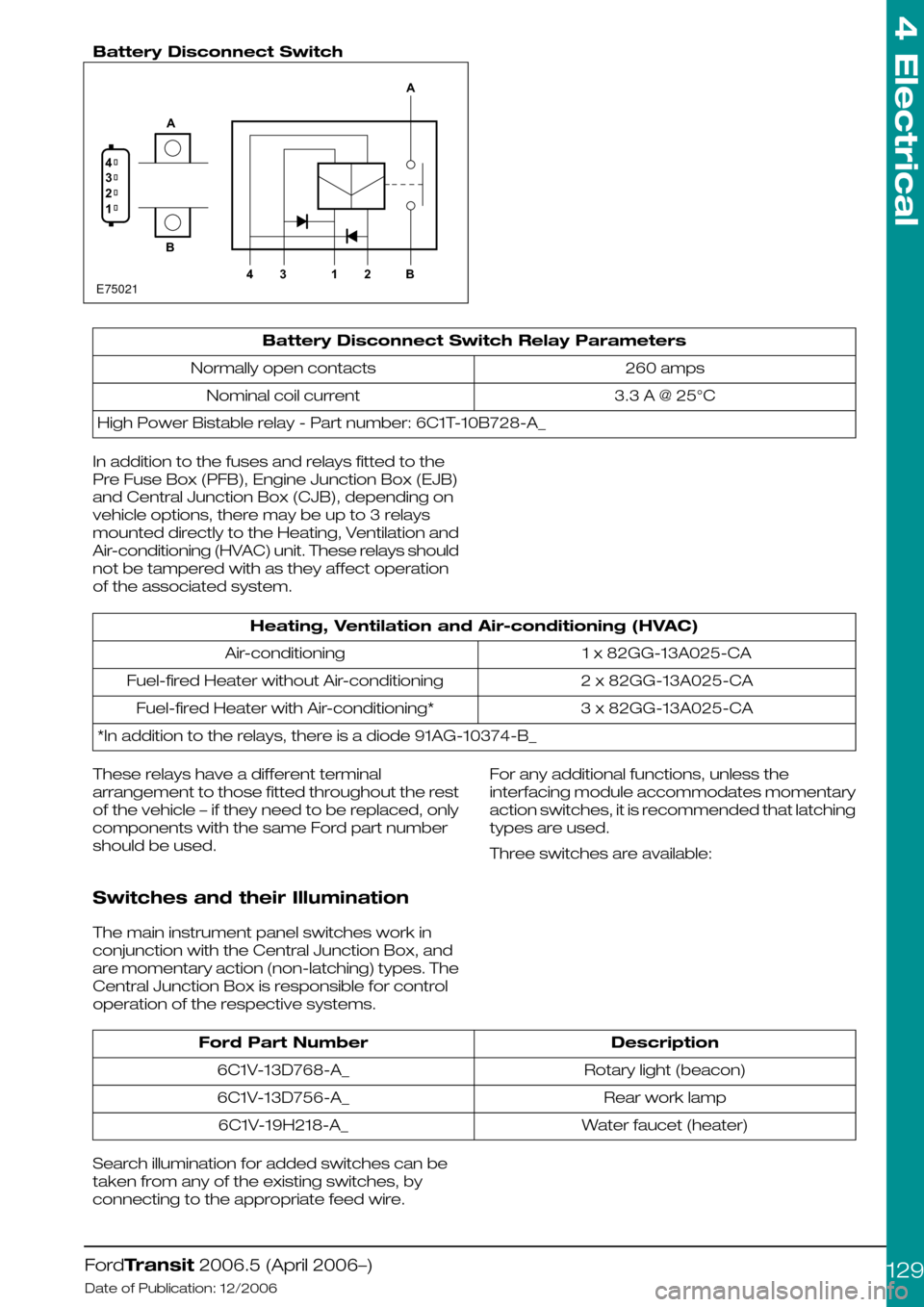
Battery Disconnect Switch
Battery Disconnect Switch Relay Parameters
260 ampsNormally open contacts
3.3 A @ 25°CNominal coil current
High Power Bistable relay - Part number: 6C1T-10B728-A_
In addition to the fuses and relays fitted to the
Pre Fuse Box (PFB), Engine Junction Box (EJB)
and Central Junction Box (CJB), depending on
vehicle options, there may be up to 3 relays
mounted directly to the Heating, Ventilation and
Air-conditioning (HVAC) unit. These relays should
not be tampered with as they affect operation
of the associated system.
Heating, Ventilation and Air-conditioning (HVAC)
1 x 82GG-13A025-CAAir-conditioning
2 x 82GG-13A025-CAFuel-fired Heater without Air-conditioning
3 x 82GG-13A025-CAFuel-fired Heater with Air-conditioning*
*In addition to the relays, there is a diode 91AG-10374-B_
These relays have a different terminal
arrangement to those fitted throughout the rest
of the vehicle – if they need to be replaced, only
components with the same Ford part number
should be used.
Switches and their Illumination
The main instrument panel switches work in
conjunction with the Central Junction Box, and
are momentary action (non-latching) types. The
Central Junction Box is responsible for control
operation of the respective systems.
For any additional functions, unless the
interfacing module accommodates momentary
action switches, it is recommended that latching
types are used.
Three switches are available:
DescriptionFord Part Number
Rotary light (beacon)6C1V-13D768-A_
Rear work lamp6C1V-13D756-A_
Water faucet (heater)6C1V-19H218-A_
Search illumination for added switches can be
taken from any of the existing switches, by
connecting to the appropriate feed wire.
FordTransit 2006.5 (April 2006–)
Date of Publication: 12/2006
4 Electrical
129E750211234AB4312BA
Page 134 of 234

Where wires are required to be extended, break
in points should only be at existing connector
points and only Ford approved connectors should
be used.
Ford approved link harnesses should be used.
Unused Connectors
The harnesses may have a number of unused
connectors – these are dedicated to other
features and options, e.g. heated seats, but are
not always present depending on level of
harness fitted. Ford do not recommend the use
of these connectors for any other purpose than
that intended by design.
Power Outlet / Cigar Lighter
Both features adopt a 20A fusing strategy. With
a single battery system, continued loading of
these features will lead to battery drain, and risk
vehicle starting. If continuous power is required,
a second battery option should be installed and
the customer connection points, where fitted,
utilized.
4.14.4 Installation and Routing Guides
Anti-Lock Brake System Wiring Harness Routing
The installation and routing of Ford wiring
(including those provided as part of accessory
kits such as trailer tow) have been fully-validated
and have passed the requisite EMC tests. Ford
Motor Company; however, are not responsible
for the vehicle’s EMC immunity when
non-Ford-approved systems are installed.
WARNING: Do not route other wiring
near/close to electrical cables with
the Antilock Brake System and
Traction Control System cables
because of extraneous signal risk.
It is generally not recommended to
hang it off existing looms or pipes.
Wiring must be suitably fixed without any
detrimental effect on other wiring.
Single or bunched looms must maintain the
following clearances:
FordTransit 2006.5 (April 2006–)
Date of Publication: 12/2006
4 Electrical
134E79034
Page 136 of 234

Right Hand Drive Dash Panel
DescriptionItem
East/West Engine and Tachograph1
Available2
Global Site Management antenna3
Available4
Available5
4.14.5 Electrics for Tow bar
Tow bar electrical system may be ordered as a
13-pin DIN connector, as part of the original
vehicle build.
Where it is required to add trailer towing to an
existing vehicle, and to ensure compliance with
lighting regulations, the appropriate wiring
accessory kit can be obtained from your Ford
Dealer. Fitment of non-Ford trailer tow wiring is
not advisable due to Central Junction Box control
of lighting, and meeting legal lighting regulations.
Contact your local Ford dealer for details of a
harness that connects to the base vehicle
harness. All Transits are provided with a basic
trailer tow interface - this connector is located on
the left hand side of the engine compartment
NOTE: For Van tow bars it is necessary to
connect into the rear lamp unit
For information, there is no trailer tell-tale in the
cluster, and if equipped with the Ford Trailer Tow
module, the vehicle’s rear fog lights are disabled
when a trailer is hitched-up.
A 7-pin trailer tow sub-harness is released by SVO
(part number 6C1V-13B576-A*); currently there
is no 7+7 sub-harness available, but figure E84722
is a proposal detailing the connectivity from the
in-line near the rear of the vehicle. The electrical
schematics for the 13-pin trailer tow system form
part of the workshop manual.
FordTransit 2006.5 (April 2006–)
Date of Publication: 12/2006
4 Electrical
136E7449724513
Page 137 of 234

Trailer Tow Connectivity - Trailer Tow, 12N & 12S Sockets
DescriptionItem
13N490 HarnessA
TubesX
PinsY
The Ford trailer tow system is designed to
support one primary set of direction indicators
installed on to the trailer (left hand side and right
hand side). If additional direction indicators are
required, for example for tall horse boxes, these
should be driven using separate relays with the
coils being energized via the respective primary
direction indicator feeds, and power to the bulbs
being derived from the KL30 (B+) line.
WARNING: Depending on the
vehicle's lighting configuration, the
Central Junction Box (CJB) will not
support trailer direction indicators
wired directly to the vehicle's
direction indicators. If this is
attempted, the relevant CJB circuits
may shut down or perform illegally.
The Central Junction Box (CJB) does not
support the incremental load of powering side
marker lamps on a trailer, if these are required
they should also be driven using separate relays,
as above.
NOTE: The trailer detect circuit is part of the
Ford Trailer Tow module – it is not implement
able separately – and is only operational on
vehicles fitted with power locking.
FordTransit 2006.5 (April 2006–)
Date of Publication: 12/2006
4 Electrical
137E8472241572634617325517113128131441516
Page 147 of 234

4.14.8 Additional Vehicle Signals
/ Features
Reverse Signal
A reverse signal is available on the tail light
connector. In order to avoid electrical issues due
to leakage, and to ensure connector
compatibility, a mating connector with
seals/plugs and pre-crimped wire & terminal
should be used. For Additional information refer
to Adding Connectors, Terminals and Wiring in
this manual.
NOTE: It is not recommended that signal is used
to drive auxiliary equipment directly – a relay (max
300mA) should be used. The existing reverse
light load is close to the threshold and is
hard-wired through the Central Junction Box for
current sensing to generate the appropriate CAN
message.
Chassis Cab (for information only)
ColorWire CSAFunctionPin
Black-Yellow1.5Ground1
Violet-White1.5Brake Light2
Yellow-Green0.5Park Light3
Green-Orange0.75Direction Indicator4
Green-Brown0.75Reverse Light5
Red0.75Fog Light6
Van, Bus and Kombi (for information only)
ColorWire CSAFunctionPin
Green-Brown0.75Reverse Light1
Green-Orange0.75Direction Indicator2
Yellow-Green0.5Park Light3
Violet-White1.5Brake Light4
Black-Grey / Black-Green1.5Ground5
0.75Fog Light6
FordTransit 2006.5 (April 2006–)
Date of Publication: 12/2006
4 Electrical
147
Page 148 of 234

Trailer Light Connector
Reverse Signal on Tail Light Connector
DescriptionItem
Reverse SignalPin 5
In addition, the reverse signal is also available
directly from the Central Junction Box (max.
300mA), but there is no free pin available. For
details, please refer to Figure E84705, connector
C2 (Brown)
Refer to: 4.1 Communications Network (page 90).
and the following Figure E84724 pin 15. The only
way to access this signal at this location
would be via a splice into the existing
wire.
FordTransit 2006.5 (April 2006–)
Date of Publication: 12/2006
4 Electrical
148E84716 5E84723
Page 149 of 234

Connector C2
DescriptionItem
Reverse SignalPin
15
Third Brake/Stop Light
A signal for a third brake / stop light is also
available on the tail light connector (see Reverse
Signal). It can be used directly to feed an LED
stop light, or a conventional stop light with a bulb
(maximum 21W)*
In order to avoid electrical issues due to leakage,
and to ensure connector compatibility, a mating
connector with seals/plugs and pre-crimped wire
& terminal should be used.
For connectivity, see following Figure E84725,
also the details given in the section for Reverse
Signal and in Adding Connectors, Terminals and
Wiring.
Pin for the Third Brake/Stop Light
DescriptionItem
Brake /Stop Light SignalPin 2
The use of the trailer tow connector is not
recommended. IF it must be used, please see
the following figure E4726.
FordTransit 2006.5 (April 2006–)
Date of Publication: 12/2006
4 Electrical
14915E84724 2E84725
Page 150 of 234

Pin Brake Light on Trailer Tow in-line connector at Rear of Vehicle
DescriptionItem
Third Stop LightPin 8
*If an existing third brake/stop lamp is already
fitted, or if the power exceeds 21W, an
intermediate relay must be used.
For Van, Bus and Kombi, the signal should be
derived from the 6-way connector to the rear
light assembly, pin 4.
Additional Position Lights at the Rear
of the Vehicle
The feed for position lights only at the rear
(bottom / top) can be taken from the licence plate
lighting connectors: left and right. For the correct
pin, please refer to Figure E84727; the maximum
load is 10W per side.
NOTE: Any additional position lights should be
taken from the licence plate lights, and no other
source.
In order to avoid electrical issues due to leakage,
and to ensure connector compatibility, a mating
connector with seals/plugs and pre-crimped wire
& terminal should be used. See Adding
Connectors,Terminals and Wiring.
NOTE: Position lamps (front and rear) only
function with the lighting switch in positions 1 or
2; however, the same bulbs are also used for the
parking lamps. There are two operating modes
for the latter, both with the ignition key removed.
1.Ignition off, master light switch to position ‘P’:
all 4 lamps are on.
2.Ignition off, master light switch off, move turn
indicator stalk to either left or right position (and
leave in): tell-tale and chime will operate briefly
and parking lamps (2) on the side selected will
be on.
The position and parking functions operate
independently.
When the position lights are extinguished, the
side marker and end-outline markers turn off
simultaneously, in line with InterRegs No 48, which
states the following:
5.11 - The electrical connections must be such
that the front and rear position lamps, the
end-outline marker lamps, if they exist, the
side-marker lamps, if they exist, and the rear
registration plate lamp can only be switched on
and off simultaneously. This condition does not
apply when using front and rear position lamps,
as well as side-marker lamps when combined or
reciprocally incorporated with said lamps, as
parking lamps and when side-marker lamps are
permitted to flash.
FordTransit 2006.5 (April 2006–)
Date of Publication: 12/2006
4 Electrical
1508E84726