2006 FORD TRANSIT light
[x] Cancel search: lightPage 33 of 234

1.13 Package and Ergonomics
1.13.1 General Component
Package Guidelines
WARNING: Do not modify, drill, cut
or weld any suspension
components, specifically the
steering gear system, subframe or
anti-roll bars, springs or shock
absorbers including mounting
brackets.
The Vehicle Converter has to ensure that
sufficient clearance is maintained under all drive
conditions to moving components such as axles,
fans, steering, brake system etc.
The Vehicle Converter is responsible for all
installed components during the conversion. The
durability has to be confirmed by appropriate test
procedures.
1.13.2 Driver Reach Zones
Controls and/or equipment required to be used
while driving should be located within easy reach
of the driver so as not to impair driver control
1.13.3 Driver Field of View
WARNING: Make sure that the
modified vehicle complies with all
relevant legal requirements.
1.13.4 Conversion Affects on
Parking Aids
WARNING: Ensure that monitors
mounted in the cabin meet the
interior package and safety
requirements
On conversions requiring a rear camera, the
reverse signal may be taken as described in the
electrical section, described in reversing lamps.
Refer to: 4.11 Exterior Lighting (page 116).
1.13.5 Aids for Vehicle Entry and
Exit
Steps
WARNINGS:
Make sure that the modified vehicle
complies with all relevant legal
requirements.
If this modification alters the
homologated dimensions, a new
approval may be necessary.
CAUTION: Make sure that
reinforcements are installed to
maintain the integrity of the original
body structure.
Steps can be ordered as an option on the base
vehicle. Please check for availability.
Where additional steps are installed the required
ground clearance line is to be maintained.
The Vehicle Converter must make sure that a
movable step is set in the stored position when
the vehicle is running. The step surface must be
non-slip.
Grab Handles
WARNING: Make sure that the
location of the no-drill zones are
checked before drilling.
CAUTION: Make sure that
reinforcements are installed to
maintain the integrity of the original
body structure.
Grab handles can be ordered as an option on
the base vehicle. Please check for availability.
NOTE: For further information please contact
your local National Sales Company
representative, or Local Ford Dealer. If they are
unable to help you then please contact the
Vehicle Converter Advisory Service at
[email protected].
FordTransit 2006.5 (April 2006–)
Date of Publication: 12/2006
1 General Information
33
Page 36 of 234
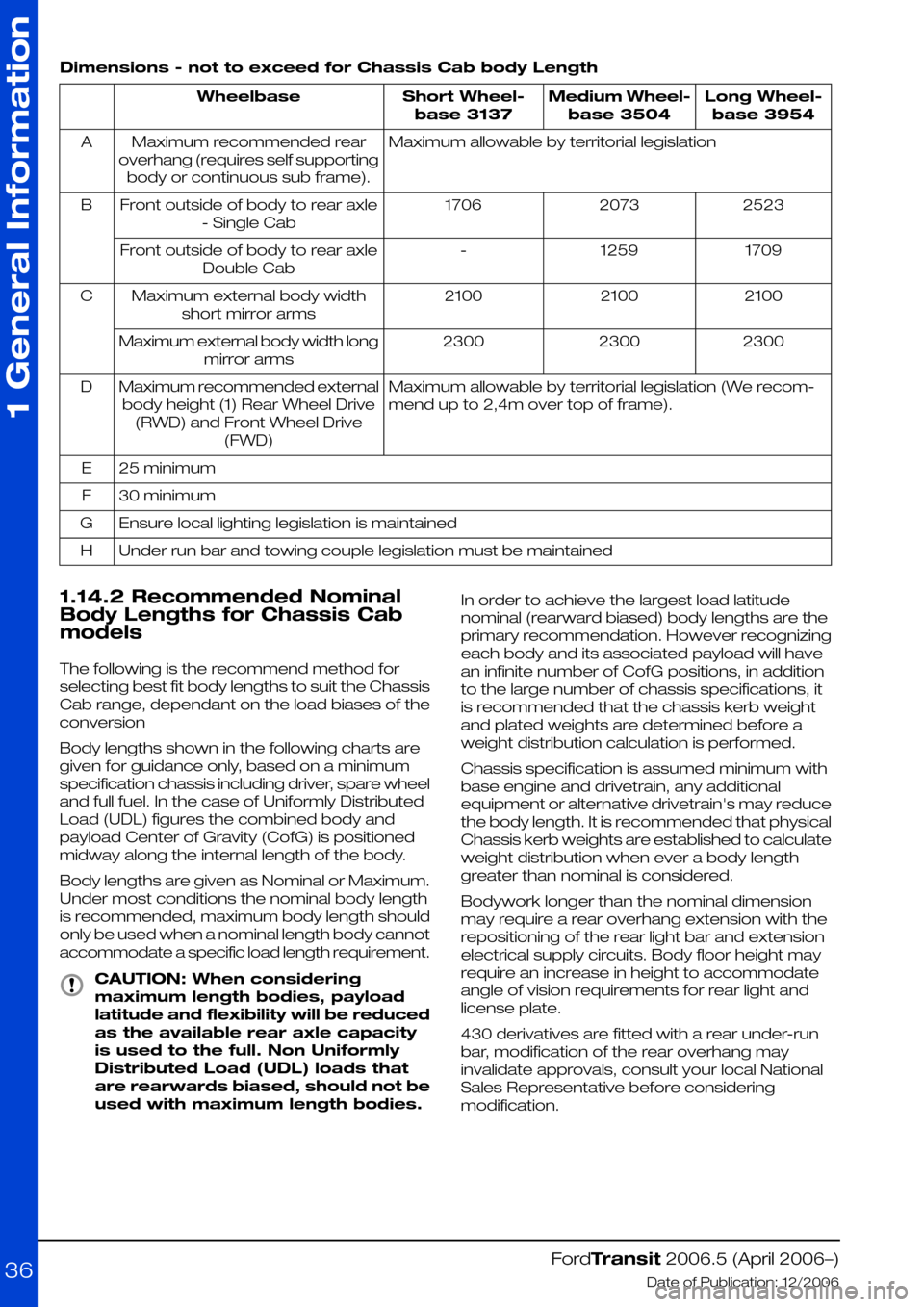
Dimensions - not to exceed for Chassis Cab body Length
Long Wheel-
base 3954
Medium Wheel-
base 3504
Short Wheel-
base 3137
Wheelbase
Maximum allowable by territorial legislationMaximum recommended rear
overhang (requires self supporting
body or continuous sub frame).
A
252320731706Front outside of body to rear axle
- Single Cab
B
17091259-Front outside of body to rear axle
Double Cab
210021002100Maximum external body width
short mirror arms
C
230023002300Maximum external body width long
mirror arms
Maximum allowable by territorial legislation (We recom-
mend up to 2,4m over top of frame).
Maximum recommended external
body height (1) Rear Wheel Drive
(RWD) and Front Wheel Drive
(FWD)
D
25 minimumE
30 minimumF
Ensure local lighting legislation is maintainedG
Under run bar and towing couple legislation must be maintainedH
1.14.2 Recommended Nominal
Body Lengths for Chassis Cab
models
The following is the recommend method for
selecting best fit body lengths to suit the Chassis
Cab range, dependant on the load biases of the
conversion
Body lengths shown in the following charts are
given for guidance only, based on a minimum
specification chassis including driver, spare wheel
and full fuel. In the case of Uniformly Distributed
Load (UDL) figures the combined body and
payload Center of Gravity (CofG) is positioned
midway along the internal length of the body.
Body lengths are given as Nominal or Maximum.
Under most conditions the nominal body length
is recommended, maximum body length should
only be used when a nominal length body cannot
accommodate a specific load length requirement.
CAUTION: When considering
maximum length bodies, payload
latitude and flexibility will be reduced
as the available rear axle capacity
is used to the full. Non Uniformly
Distributed Load (UDL) loads that
are rearwards biased, should not be
used with maximum length bodies.
In order to achieve the largest load latitude
nominal (rearward biased) body lengths are the
primary recommendation. However recognizing
each body and its associated payload will have
an infinite number of CofG positions, in addition
to the large number of chassis specifications, it
is recommended that the chassis kerb weight
and plated weights are determined before a
weight distribution calculation is performed.
Chassis specification is assumed minimum with
base engine and drivetrain, any additional
equipment or alternative drivetrain's may reduce
the body length. It is recommended that physical
Chassis kerb weights are established to calculate
weight distribution when ever a body length
greater than nominal is considered.
Bodywork longer than the nominal dimension
may require a rear overhang extension with the
repositioning of the rear light bar and extension
electrical supply circuits. Body floor height may
require an increase in height to accommodate
angle of vision requirements for rear light and
license plate.
430 derivatives are fitted with a rear under-run
bar, modification of the rear overhang may
invalidate approvals, consult your local National
Sales Representative before considering
modification.
FordTransit 2006.5 (April 2006–)
Date of Publication: 12/2006
1 General Information
36
Page 91 of 234

CAN-Bus System (Architecture)
Antilock Brake SystemKCentral Junction Box (Passenger Junction
Box)
A
Powertrain Control ModuleLVoice Recognition Module/Wireless
connection (blue tooth)
B
Steering Angle SensorMAudio Control Unit (Radio/CD)C*
Yaw Rate SensorNNavigation (Radio/CD)D*
Diagnostic ConnectorPRemote Keyless EntryE
Park Aid ModeQPassive Anti-Theft SystemF
Restraints Control ModuleRRain SensorG
Hybrid Electronic ClusterSBattery Backed Sounder (BBS)H
Interior Motion Sensing (IMS)J
* Either Audio Control Unit or Navigation
4.1.2 Central Junction Box (CJB)
WARNING: Unapproved and/or
incorrect connection to any of the
mating wiring can cause either the
associated systems to shut down
(overload protection), or permanent
damage to the Central Junction Box
itself.
Basic vehicle functions (for example: headlights,
front wipers) are available on all Central Junction
Boxes (CJBs). Increased vehicle features are
available on the mid- and high-level CJBs, as per
the following list:
Incremental FunctionalityCentral Junction Box (CJB)
6C1T-14A073-A_ (low)
(in addition to low level CJB)6C1T-14A073-B_ (mid)
Reverse CyclingRemote Keyless Entry
Slam LockingVIN Identification
Front Fog LightsPerimeter Alarm
Theatre Dimming (Interior Lights)Central and double Locking
Heated WindscreenZonal unlocking
Heated MirrorsAuto Locking on drive away
Rear WipersAuto Relocking on time out
Heated Rear Window(s)Crash Activated unlocking
Mis-locking feedback (audible
and visual)
(in addition to mid-level CJB)6C1T-14A073-C_ (high)
Ambient air temperature meas-
urement
Battery Backed Sounder (BBS)
Rain SensorInterior Motion Sensor (IMS)
Daytime Running LightsZonal opposite door relocking
AutolampsConfigurable unlocking
Fuel Pump Control (petrol only)CAT 1 Alarm (BBS, IMS & Rear
Glass Breakage)
Cruise control
FordTransit 2006.5 (April 2006–)
Date of Publication: 12/2006
4 Electrical
91
Page 92 of 234

The Central Junction Box (CJB) is the prime
control module in the vehicle’s electrical
architecture. It is responsible for management of
most of the vehicle’s lighting, locking and security
systems. The following chart details the
consequences of overloading of the Central
Junction Box.
Maximum Loads on Central Junction Box
Overload ConditionMaximum
Load
Load TypeComponentFunction
Output driver damage5A/100msecRelayLow Side DriverBattery Discon-
nect Switch
Overheat - output shutdown75W@13VBulbLow Side DriverEntry Illumina-
tion
Overheat - output shutdown8A normal, 16A/
10msec in-rush
Electro-mechan-
ical horn
High Side DriverAlarm Siren
Output shutdown if more
than 35mA drawn
25mALogic supplyVoltage trackerAccelerator
Pedal
Blown fuse - if bigger fuse
fitted, relay and/or printed
circuit board damaged
100W@13VBulbRelayBattery Saver
Supply
Blown fuse - if bigger fuse
fitted, relay and/or printed
circuit board damaged
60W@13VBulbRelayLicence Plate
Overheat-output shutdown11W@13VBulbHigh Side DriverCluster Dimming
Blown fuse - if bigger fuse
fitted, relay and/or printed
circuit board damaged
63W@13VBulbRelayPosition Lamp
Left Hand
Blown fuse - if bigger fuse
fitted, relay and/or printed
circuit board damaged
43W@13VBulbRelayPosition Lamp
Right Hand
Overheat-output shutdown3x21W@13VBulbTurn Indicator
Left Hand
Overheat-output shutdown3x21W@13VBulbTurn Indicator
Right Hand
Blown fuse - if bigger fuse
fitted, relay and/or printed
circuit board damaged
15A (fuse
limited)
LatchRelayLock/double
lock
Relay and/or printed circuit
board damaged
5,42A@13V,
2,5mh
LatchUnlock Relay
FordTransit 2006.5 (April 2006–)
Date of Publication: 12/2006
4 Electrical
92
Page 95 of 234

4.3 Charging System
4.3.1 General Information and
Specific Warnings
The Transit electrical system is a 12-Volt supply
with a negative earth return. The alternator and
battery equipment used as standard are
designed for normal operations with the type of
engine fitted. Higher capacity batteries are
available as standard production options and
special vehicle options. Before installing additional
electrical equipment check that the battery
capacity, harness load capability, and alternator
output are suitable for the extra load.
The battery capacity and charge available from
the alternator must be adequate to ensure
engine cranking in unfavorable climatic conditions
but excessive battery capacity could damage
the starter motor.
The Transit utilizes multiplexed vehicle electronics
- it is recommended that the appropriate Ford
proprietary accessory systems are used.
Inappropriate or incorrect connection of
additional equipment could cause mis-operation,
or damage to the vehicle, and so invalidate any
warranty.
Additional connection points are provided
specifically for customer use (except M1 and M2
Bus), and are located on the outside of the
driver's seat base.
Do not jump-start the vehicle directly from the
battery. Use designated jump-start points. Refer
to the owners literature.
4.3.2 Power Management
Settings
There are four Power Management Settings
available:
•Factory
•Transport
•Normal
•Crash
Factory and Transport modes are only active
with ignition off; with ignition on, the vehicle
operates with full functionality. When in Transport
mode, the interior lights, clocks, and power
locking and alarms (where fitted) do not work.
It is possible to switch from Transport Mode to
Normal Mode without the use of any ancillary
equipment, but not vice versa. To change mode,
the brake pedal must be depressed five times,
and the hazard warning switch operated twice
(in any combination) within 10 seconds.
WARNING: It is not possible to return
the transport setting without using
the vehicle's diagnostics.
At the end of production, the vehicle is
configured to the transport setting to minimize
power consumption. As part of the Pre Delivery
Inspection process at the Ford dealership, the
vehicle is reconfigured to normal operation.
4.3.3 Electrical Conversions
Operator requirements for additional and
specialised electrical equipment varies. The
vehicle converter/modifier must, therefore,
consider the following points when designing the
installation:
•Legality and regulatory conformity of the base
vehicle.
•Drive-ability and serviceability of the base
vehicle.
•The effect of regulations governing the
proposed conversion including National
Legislation in the country of sale.
•The method of integrating the circuit into the
base vehicle.
•No additional circuits are to be run alongside
the electrical circuits (shown in blue in the
figure below) associated with the
Management System (shown in green in the
figure below), due to the possible Electro
Motive Force (EMF) effect on the circuits.
FordTransit 2006.5 (April 2006–)
Date of Publication: 12/2006
4 Electrical
95
Page 116 of 234

4.11 Exterior Lighting
Where the following text makes reference to the
addition of wires
Refer to: 4.14 Special Conversions (page 131).
(Adding Connectors, Terminals and Wiring)
WARNING: Make sure that the
modified vehicle complies with all
relevant legal requirements.
4.11.1 Reversing Lamps
These are hard-wired, activated by the reversing
switch on the transmission and passing through
the Central Junction Box where the signal is
sensed. A marginal increase in current (via a relay
or buffered electrical input) is permissible to
trigger a rear-view camera system, or audible
device.
4.11.2 Additional External Lamps
All power for additional exterior lamps must be
taken through the Auxiliary Fuse Box with a
suitable switch and / or relay as required.
Refer to: 4.13 Fuses and Relays (page 119).
• If CAT 6 directional indicators are to be fitted,
the Central Junction Box will need to be
configured for this.
• The load on the reversing lamps should not
exceed a total of 3A (42W).
Lighting Loads
Trailer TowLong Wheel-
base/
Extended
Frame /
Chassis Cab
/ Van
Head
Lamp
Leveling
VehicleMax.
Load
Controlling
Device
Central Junction
Box (CJB)
Outputs
-40~-2x10W60WRelay (F79)Licence Plate Supply
10W
(+2x10W)**
9W^9W15W63WRelay (F76)position Lamp Left (+
Leveling)
10W**9W^9W15W43WRelay (F75)position Lamp Right
(+ Leveling)
---21W + 21W*63WHigh Side
Driver
Direction Indication
Front Left
---21WDirection Indication
Rear Left
---21W + 21W*63WHigh Side
Driver
Direction Indication
Front Right
---21WDirection Indication
Rear Right
Symbols used
Front Dl + Turn Signal side Repeater*
Turn Signal Side Marker (5W) + Roof Marker (4W)^
6 x Side Marker (5W) + 2 x End Outline Marker (5W)~
Worst cases; left supply includes licence plate**
For trailer tow lighting relating to that system.
Refer to: 4.14 Special Conversions (page 131).
(Electrics for Tow bar)
Head Lamps
5AF75
7.5AF76
7.5AF79
FordTransit 2006.5 (April 2006–)
Date of Publication: 12/2006
4 Electrical
116
Page 117 of 234

4.11.3 Lamps – Hazard / Direction
Indication
The maximum permissible load with the standard
system is:
•3 x 21W – front and rear indicators + side
repeaters (Left Hand Side)
•3 x 21W – front and rear indicators + side
repeaters (Right Hand Side)
That is:- 63W per side maximum.
4.11.4 Lamps – Front and Rear
Fog Lights
National Regulations regarding inter-connection
with other front and rear fog lights must be
checked before designing the wiring circuit.
For trailer tow for rear fog lighting relating to that
system.
Refer to: 4.14 Special Conversions (page 131).
(Electrics for Tow bar)
4.11.5 Lamps for Wide Vehicles
Lamps – End outline and side marker
lamps
All Chassis Cab vehicles are fitted with front
marker lamps on the cab roof as standard, less
roof marker lamps they are optional. Where
additional side marker lamps and rear outline
marker lamps are required to comply with local
regulations, access to the appropriate signals
may be obtained from the licence plate lamps.
A special jumper link is available for this purpose
from the local Ford dealer.
The maximum permissible load with the standard
system is:
NOTE: For various vehicles Cat 6 repeater
lamps must be fitted. See legislation for full
details.
•6 x 5W – side marker
•2 x 5W – end outline marker
•2 x 5W – Cat 6
•2 x 4W – roof marker
4.11.6 Electrically operated Door
Mirrors
WARNING: Do not tamper with the
base system (controlled by Central
Junction Box and multiplex
architecture) and any feeds taken
from the associated wiring or
controller.
NOTE: These options are not suitable for
aftermarket or Body Builder fit.
Refer to: 1.14 (page 34).
FordTransit 2006.5 (April 2006–)
Date of Publication: 12/2006
4 Electrical
117
Page 118 of 234

4.12 Interior Lighting
4.12.1 Additional Internal Lamps
Additional cabin interior lighting may be obtained
by directly accessing the connector inside the
dome lamp in the cab.
Additional load space interior lighting may be
obtained by directly accessing the connector
inside the load space lamps in the load space
area.
CAUTION: The maximum total
internal lamp load must not exceed
5A (75W)
Power for the Interior Lights - cabin and
cargo areas – comes from the battery save
system (Central Junction Box pin C2-31), and for
vehicles with power locking,* the circuit for each
area is controlled by a separate pin on the Central
Junction Box:
•Front (cabin) lights, pin C2-22
•Rear (cargo) lights, pin C2-27 wire not present
on chassis cab and cab-van-floor vehicles
* with manual locking vehicles, control of interior
lighting is done directly through the door contact
switches. All vehicles, however, utilise the battery
saver relay to provide power for internal lighting
for a limited time.
Each of these pins on the Central Junction Box
can take a load of 75W. Lights that are controlled
by the battery save circuit will extinguish 30 to
180 minutes after ignition off (dependent on
vehicle configuration).
4.12.2 Additional 'Theatre
Lighting' for rear of vehicle
interior
For chassis cab or cab-van floor (and camper)
vehicles, rear lighting is not utilised and so there
is no wire to pin C2-27. However, converters can
add their own lights (up to the max. load) via the
battery save or a separate switchable feed, by
adding a pre-crimped wire and terminal to
connector C2. This is located on the Central
Junction Box behind the glove box on the
passenger side (please refer to Figures E84705
and E84712).
Refer to: 4.14 Special Conversions (page 131).
(Adding connectors, Terminals and Wiring)
Where higher wattage installations are required,
these should be taken through the Auxiliary Fuse
Box with a suitable switch and / or relay as
required.
Refer to: 4.13 Fuses and Relays (page 119).
FordTransit 2006.5 (April 2006–)
Date of Publication: 12/2006
4 Electrical
118