Page 111 of 198
Downloaded from www.Manualslib.com manuals search engine MANUAL TRANSMISSION
WARNINGS
Engage reverse gear only whenthe vehicle is stationary.
Do not apply any undue lateralforce to the gear lever whenchanging from 5th to 4th gear as thiscould lead to the inadvertentselection of 2nd gear.
To avoid shifting noises whenengaging the reverse gear, waitapproximately three seconds withthe clutch depressed when thevehicle is stationary.
Vehicles with 1.8 l Duratec-SCi enginereach the maximum speed only infifth gear.
Reverse gear − 5-speedtransmission
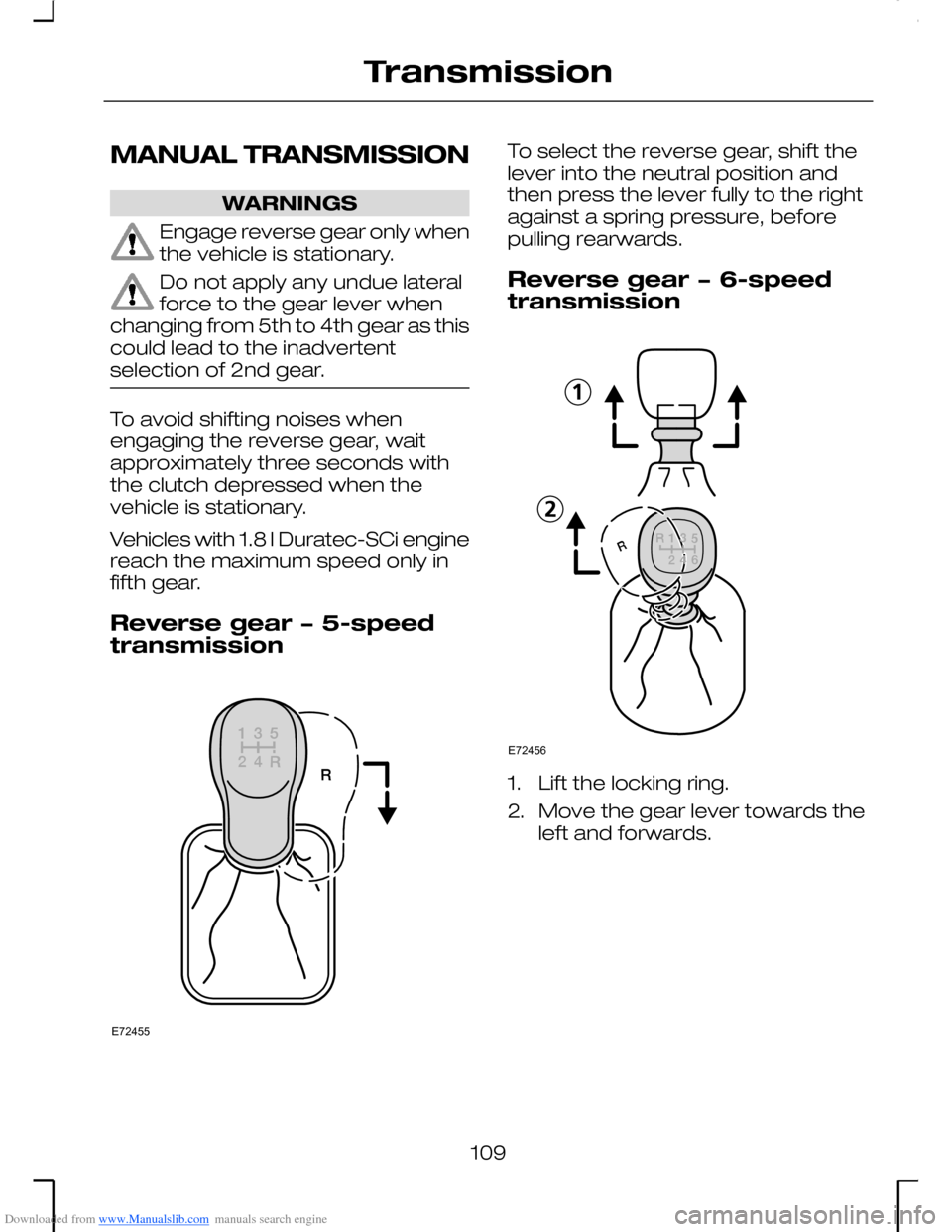
To select the reverse gear, shift thelever into the neutral position andthen press the lever fully to the rightagainst a spring pressure, beforepulling rearwards.
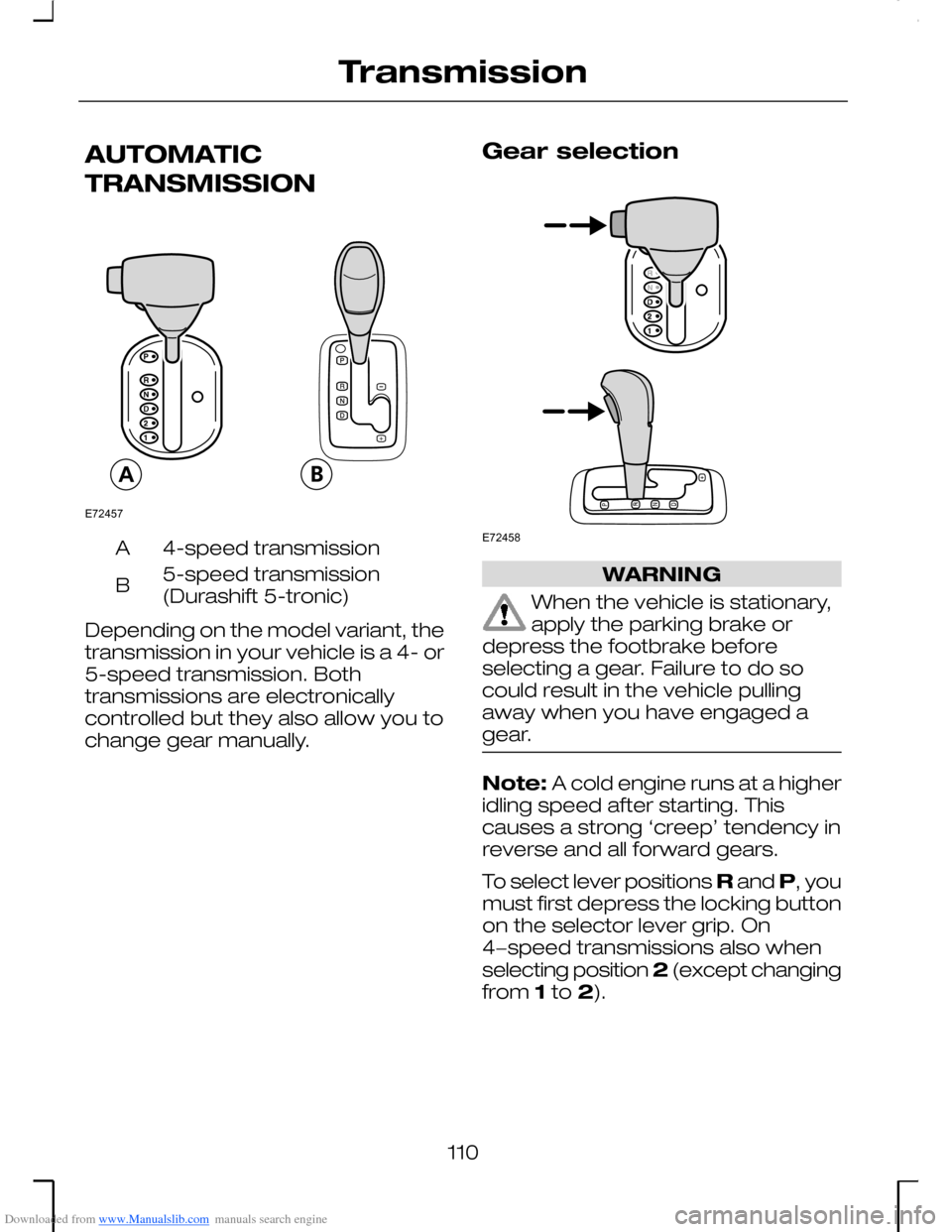
Reverse gear − 6-speedtransmission
1.Lift the locking ring.
2.Move the gear lever towards theleft and forwards.
109
TransmissionE72455 E72456
Page 112 of 198
Downloaded from www.Manualslib.com manuals search engine AUTOMATIC
TRANSMISSION
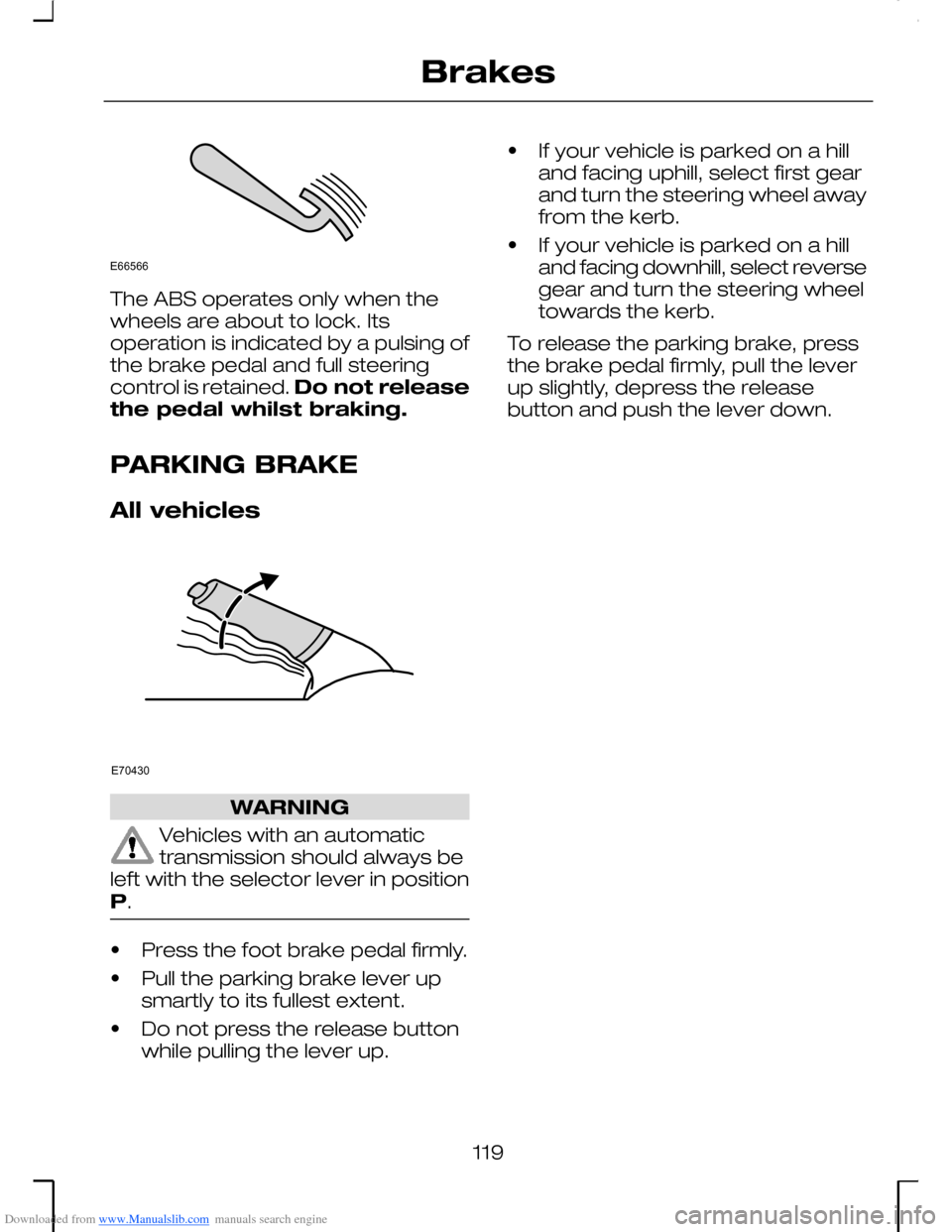
4-speed transmissionA
5-speed transmission(Durashift 5-tronic)B
Depending on the model variant, thetransmission in your vehicle is a 4- or5-speed transmission. Bothtransmissions are electronicallycontrolled but they also allow you tochange gear manually.
Gear selection
WARNING
When the vehicle is stationary,apply the parking brake ordepress the footbrake beforeselecting a gear. Failure to do socould result in the vehicle pullingaway when you have engaged agear.
Note: A cold engine runs at a higheridling speed after starting. Thiscauses a strong ‘creep’ tendency inreverse and all forward gears.
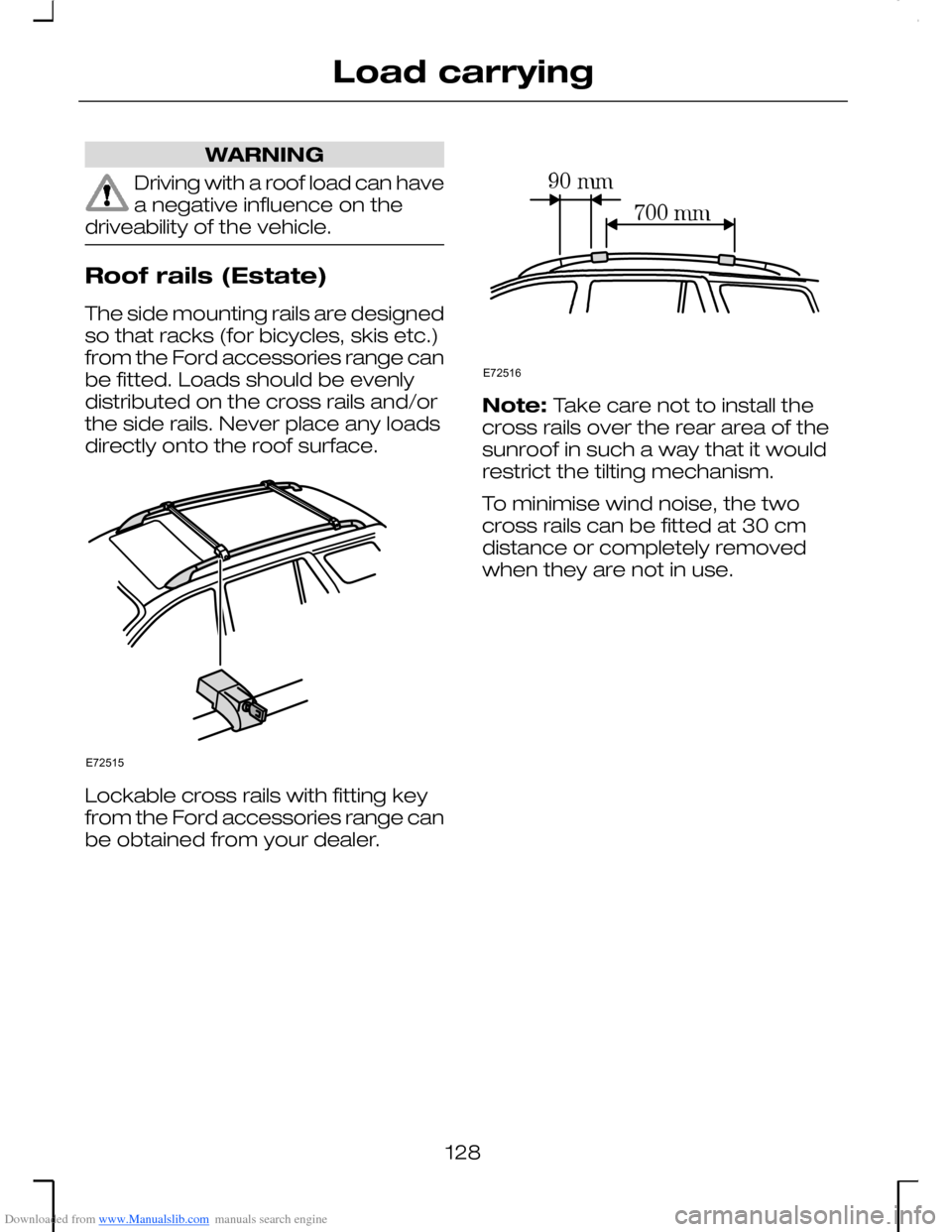
To select lever positions R and P, youmust first depress the locking buttonon the selector lever grip. On4−speed transmissions also whenselecting position 2 (except changingfrom 1 to 2).
110
TransmissionE72457 E72458
Page 113 of 198
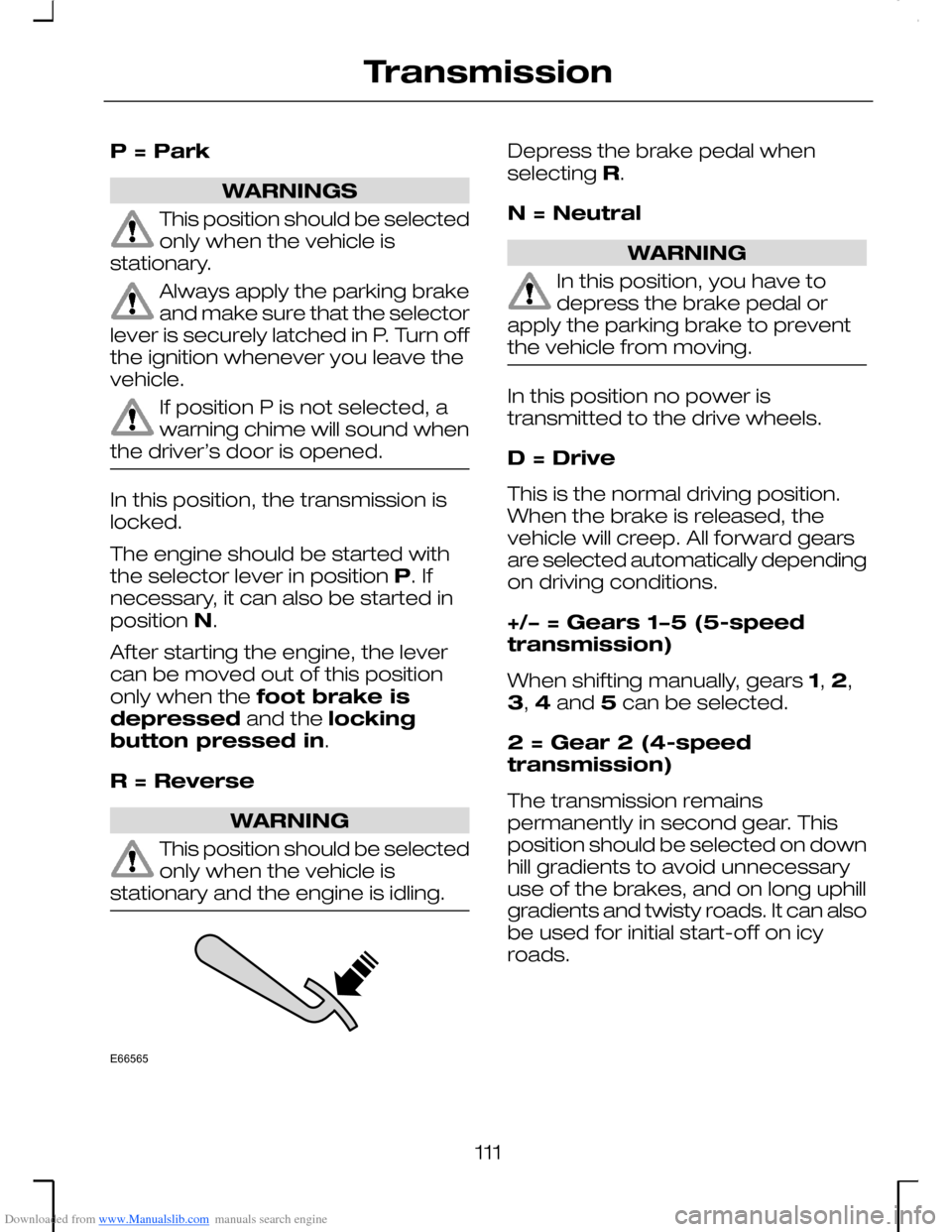
Downloaded from www.Manualslib.com manuals search engine P = Park
WARNINGS
This position should be selectedonly when the vehicle isstationary.
Always apply the parking brakeand make sure that the selectorlever is securely latched in P. Turn offthe ignition whenever you leave thevehicle.
If position P is not selected, awarning chime will sound whenthe driver’s door is opened.
In this position, the transmission islocked.
The engine should be started withthe selector lever in position P. Ifnecessary, it can also be started inposition N.
After starting the engine, the levercan be moved out of this positiononly when the foot brake isdepressed and the lockingbutton pressed in.
R = Reverse
WARNING
This position should be selectedonly when the vehicle isstationary and the engine is idling.
Depress the brake pedal whenselecting R.
N = Neutral
WARNING
In this position, you have todepress the brake pedal orapply the parking brake to preventthe vehicle from moving.
In this position no power istransmitted to the drive wheels.
D = Drive
This is the normal driving position.When the brake is released, thevehicle will creep. All forward gearsare selected automatically dependingon driving conditions.
+/− = Gears 1−5 (5-speedtransmission)
When shifting manually, gears 1, 2,3, 4 and 5 can be selected.
2 = Gear 2 (4-speedtransmission)
The transmission remainspermanently in second gear. Thisposition should be selected on downhill gradients to avoid unnecessaryuse of the brakes, and on long uphillgradients and twisty roads. It can alsobe used for initial start-off on icyroads.
111
TransmissionE66565
Page 118 of 198
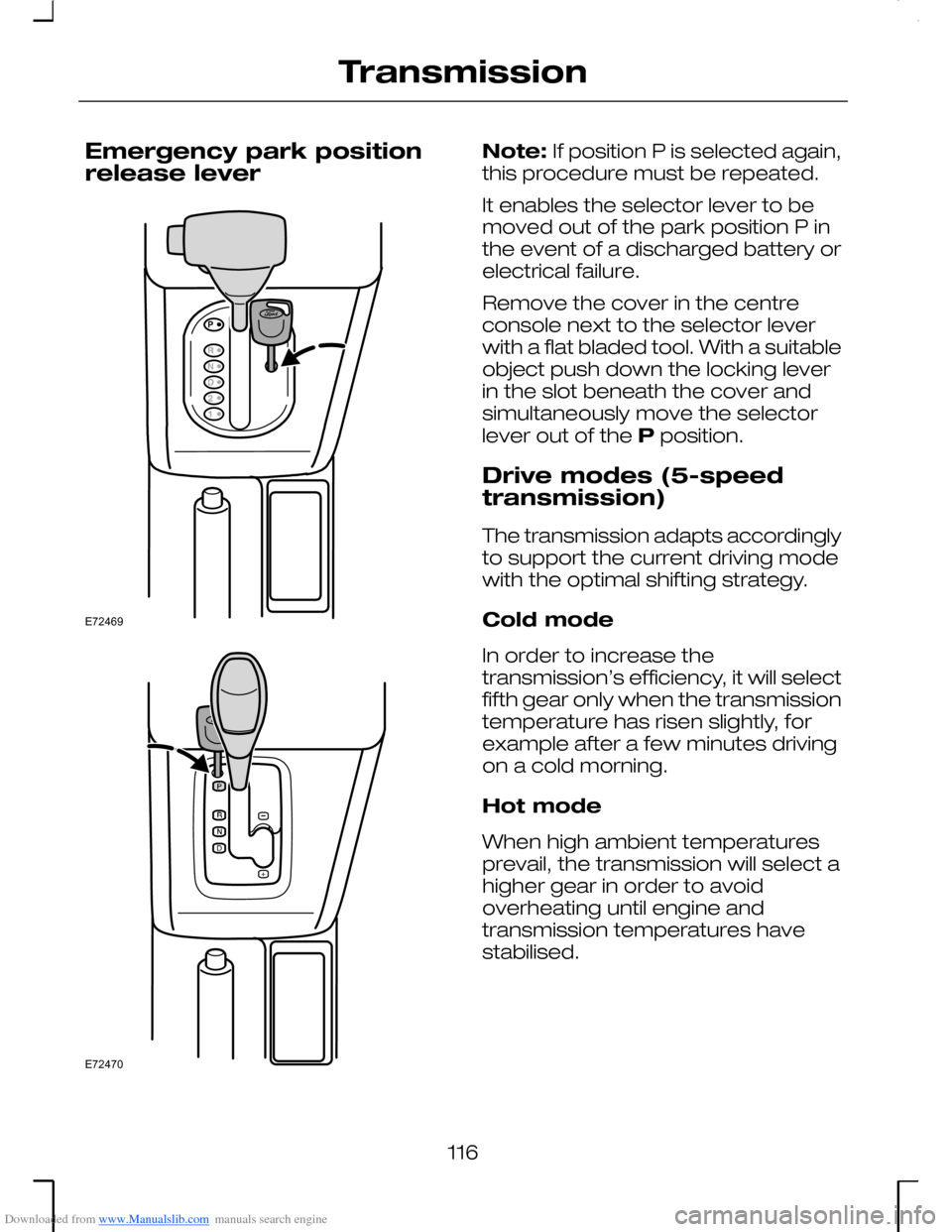
Downloaded from www.Manualslib.com manuals search engine Emergency park positionrelease lever
Note: If position P is selected again,this procedure must be repeated.
It enables the selector lever to bemoved out of the park position P inthe event of a discharged battery orelectrical failure.
Remove the cover in the centreconsole next to the selector leverwith a flat bladed tool. With a suitableobject push down the locking leverin the slot beneath the cover andsimultaneously move the selectorlever out of the P position.
Drive modes (5-speedtransmission)
The transmission adapts accordinglyto support the current driving modewith the optimal shifting strategy.
Cold mode
In order to increase thetransmission’s efficiency, it will selectfifth gear only when the transmissiontemperature has risen slightly, forexample after a few minutes drivingon a cold morning.
Hot mode
When high ambient temperaturesprevail, the transmission will select ahigher gear in order to avoidoverheating until engine andtransmission temperatures havestabilised.
116
TransmissionE72469 E72470
Page 121 of 198
Downloaded from www.Manualslib.com manuals search engine The ABS operates only when thewheels are about to lock. Itsoperation is indicated by a pulsing ofthe brake pedal and full steeringcontrol is retained. Do not releasethe pedal whilst braking.
PARKING BRAKE
All vehicles
WARNING
Vehicles with an automatictransmission should always beleft with the selector lever in positionP.
•Press the foot brake pedal firmly.
•Pull the parking brake lever upsmartly to its fullest extent.
•Do not press the release buttonwhile pulling the lever up.
•If your vehicle is parked on a hilland facing uphill, select first gearand turn the steering wheel awayfrom the kerb.
•If your vehicle is parked on a hilland facing downhill, select reversegear and turn the steering wheeltowards the kerb.
To release the parking brake, pressthe brake pedal firmly, pull the leverup slightly, depress the releasebutton and push the lever down.
119
BrakesE66566 E70430
Page 130 of 198
Downloaded from www.Manualslib.com manuals search engine WARNING
Driving with a roof load can havea negative influence on thedriveability of the vehicle.
Roof rails (Estate)
The side mounting rails are designedso that racks (for bicycles, skis etc.)from the Ford accessories range canbe fitted. Loads should be evenlydistributed on the cross rails and/orthe side rails. Never place any loadsdirectly onto the roof surface.
Lockable cross rails with fitting keyfrom the Ford accessories range canbe obtained from your dealer.
Note: Take care not to install thecross rails over the rear area of thesunroof in such a way that it wouldrestrict the tilting mechanism.
To minimise wind noise, the twocross rails can be fitted at 30 cmdistance or completely removedwhen they are not in use.
128
Load carryingE72515 E72516
Page 131 of 198
Downloaded from www.Manualslib.com manuals search engine TOWING A TRAILER
Note: Mondeo ST vehicles are notapproved for trailer towing.
The maximum vehicle and trailerpayloads represent technicallybinding values for gradients up to 12% and at an altitude of 1 000 metresabove sea level. In high altituderegions, thinner atmosphere canreduce engine performance so thefollowing restrictions will apply:
Above 1 000 metres, the stipulatedmaximum permitted gross trainweight must be reduced by 10 % forevery 1 000 metres in altitude.
Steep gradients
WARNING
The overrun brake on a trailer isnot controlled by the anti-lockbraking system.
Change down in plenty of timebefore downhill gradients.
For vehicles with an automatictransmission, if downhill modeprovides insufficient braking thenselect manual mode and second orfirst gear as necessary.
ESSENTIAL TOWING
CHECKS
WARNING
If any of the following conditionscannot be met, do not use thetow bar and have it inspected by anexpert.
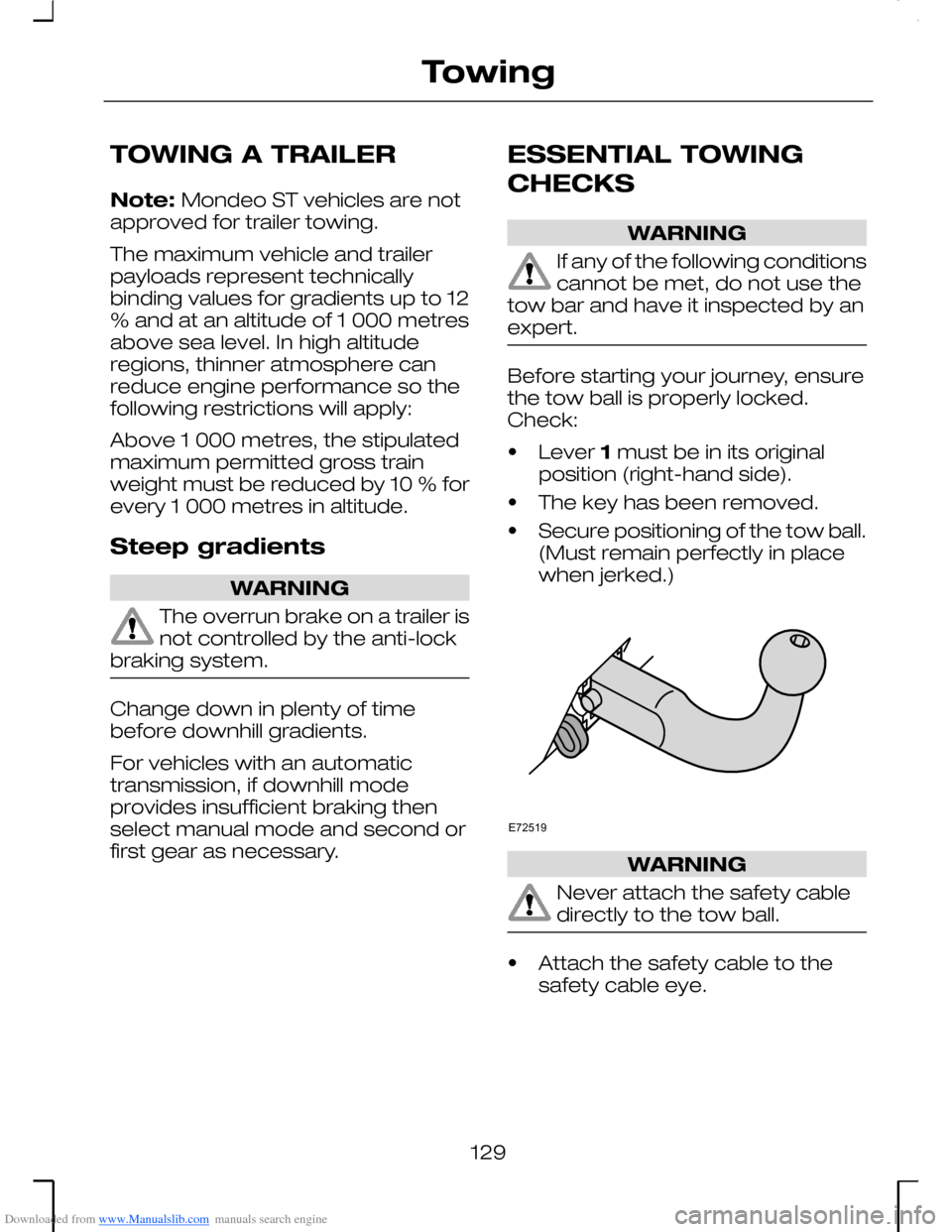
Before starting your journey, ensurethe tow ball is properly locked.Check:
•Lever 1 must be in its originalposition (right-hand side).
•The key has been removed.
•Secure positioning of the tow ball.(Must remain perfectly in placewhen jerked.)
WARNING
Never attach the safety cabledirectly to the tow ball.
•Attach the safety cable to thesafety cable eye.
129
TowingE72519
Page 132 of 198
Downloaded from www.Manualslib.com manuals search engine DETACHABLE TOW BALL
WARNINGS
Remove and reinstall the towball regularly to keep the lockingmechanism working smoothly.
Do not use any tools formounting/dismounting the towball. Do not modify the trailercoupling. Do not disassemble/repairthe tow ball.
To avoid risk of injury, neverunlock the tow ball with thetrailer attached.
To avoid risk of injury, neverleave the detached tow ballunsecured inside the vehicle.
Note: When the tow ball is not inuse, always remove it and secure itwith the strap to the eye on theright-hand side in the rear of theluggage compartment.
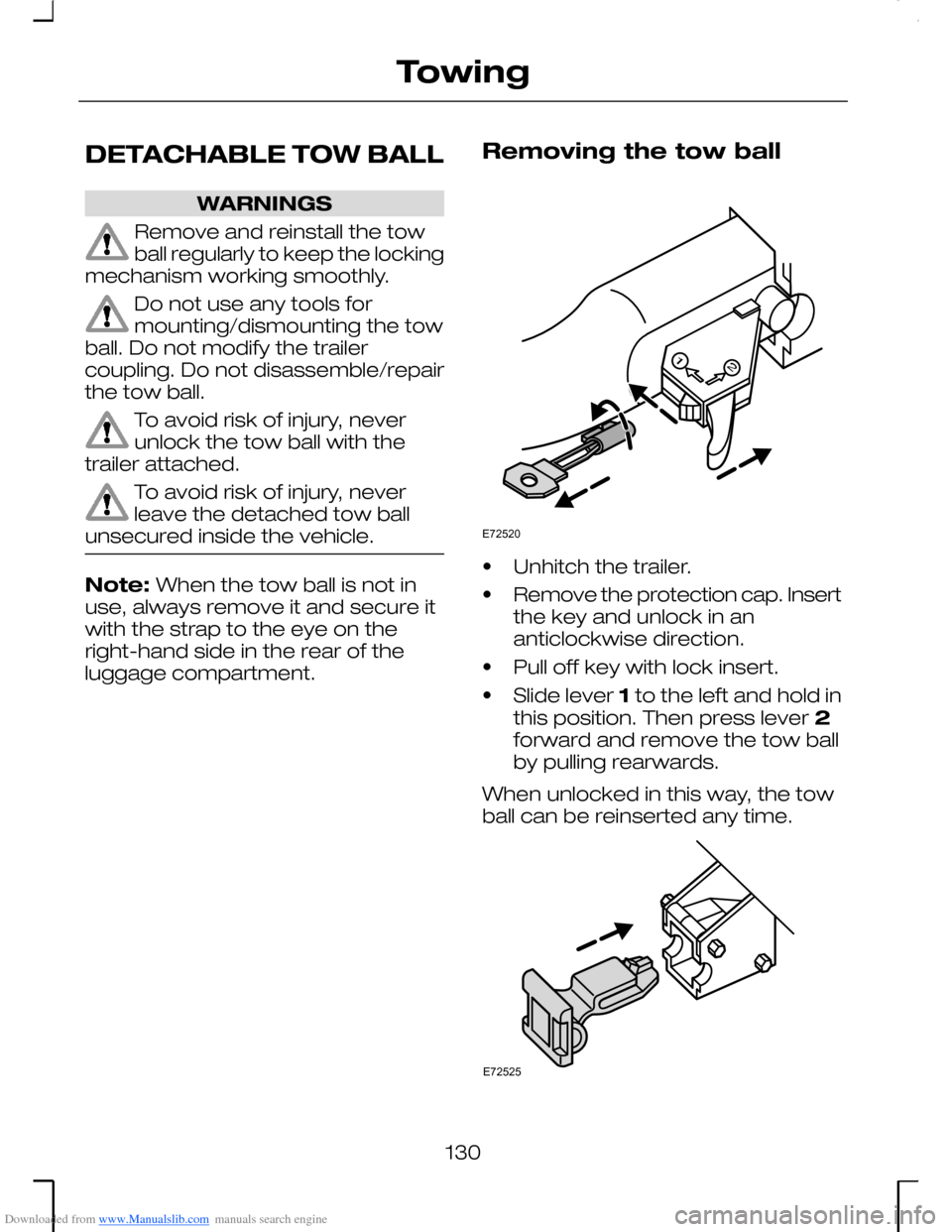
Removing the tow ball
•Unhitch the trailer.
•Remove the protection cap. Insertthe key and unlock in ananticlockwise direction.
•Pull off key with lock insert.
•Slide lever 1 to the left and hold inthis position. Then press lever 2forward and remove the tow ballby pulling rearwards.
When unlocked in this way, the towball can be reinserted any time.
130
TowingE72520 E72525