Page 120 of 198
Downloaded from www.Manualslib.com manuals search engine PRINCIPLE OF
OPERATION
Dual circuit braking system
WARNING
If a brake circuit fails, you will atfirst experience a softer feel tothe brake pedal. You will then needto exert a greater force on the brakepedal, and make allowance forincreased stopping distances. Havethe braking system checked by anexpert before continuing yourjourney.
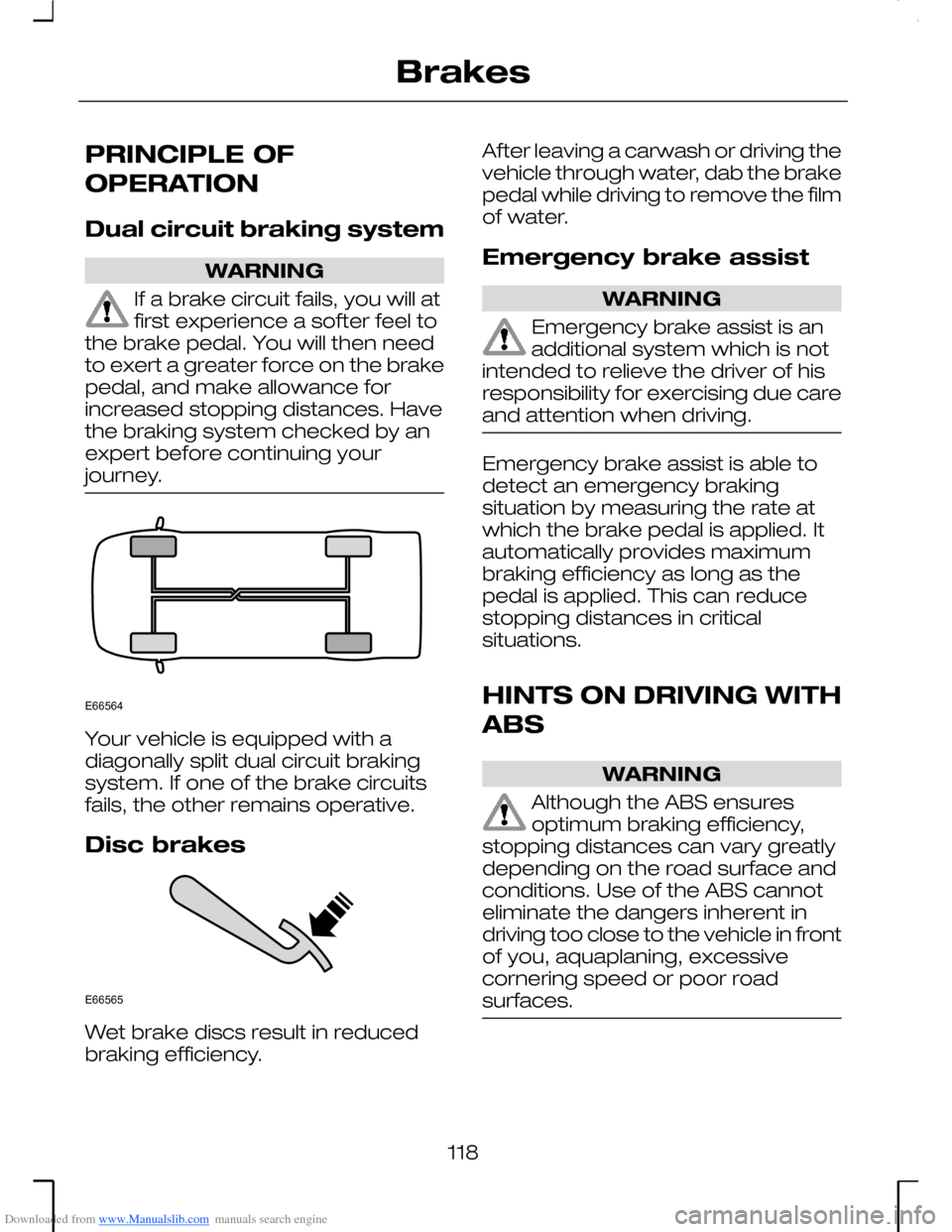
Your vehicle is equipped with adiagonally split dual circuit brakingsystem. If one of the brake circuitsfails, the other remains operative.
Disc brakes
Wet brake discs result in reducedbraking efficiency.
After leaving a carwash or driving thevehicle through water, dab the brakepedal while driving to remove the filmof water.
Emergency brake assist
WARNING
Emergency brake assist is anadditional system which is notintended to relieve the driver of hisresponsibility for exercising due careand attention when driving.
Emergency brake assist is able todetect an emergency brakingsituation by measuring the rate atwhich the brake pedal is applied. Itautomatically provides maximumbraking efficiency as long as thepedal is applied. This can reducestopping distances in criticalsituations.
HINTS ON DRIVING WITH
ABS
WARNING
Although the ABS ensuresoptimum braking efficiency,stopping distances can vary greatlydepending on the road surface andconditions. Use of the ABS cannoteliminate the dangers inherent indriving too close to the vehicle in frontof you, aquaplaning, excessivecornering speed or poor roadsurfaces.
118
BrakesE66564 E66565
Page 123 of 198
Downloaded from www.Manualslib.com manuals search engine PRINCIPLE OF
OPERATION
WARNING
Drivers should never takeunnecessary risks even thoughthe system offers inherently saferdriving potential.
The system reduces wheel spin atthe driven wheels at speeds up to 40km/h (25 mph).
The system may become activewhen accelerating on a slippery roador loose surface, or when pullingaway on a hill.
USING TRACTION
CONTROL
Note: If the indicator lamp does notilluminate when the ignition isswitched on or stays illuminatedwhilst driving, it indicates amalfunction. During a malfunction thesystem will be switched off. Have thesystem checked by an expert.
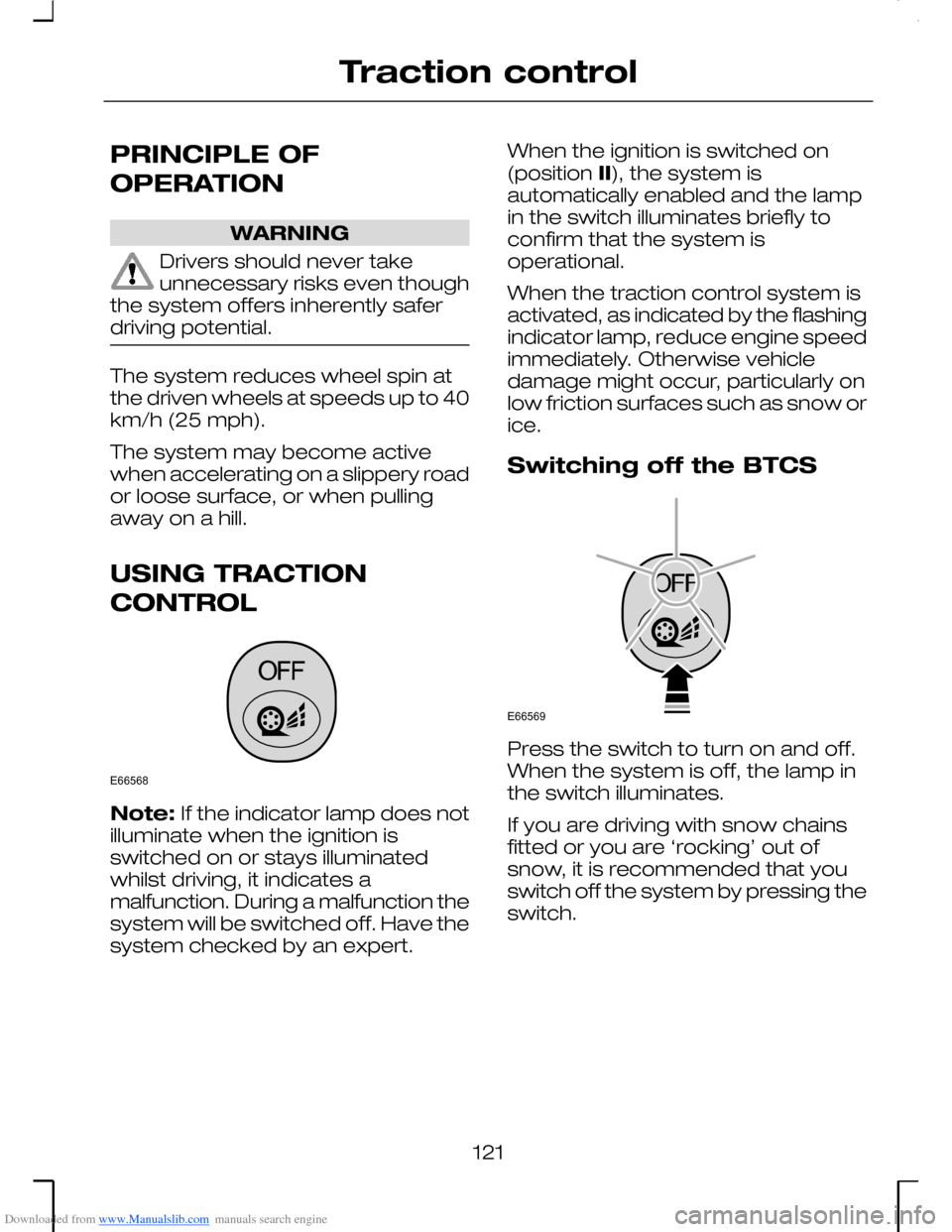
When the ignition is switched on(position II), the system isautomatically enabled and the lampin the switch illuminates briefly toconfirm that the system isoperational.
When the traction control system isactivated, as indicated by the flashingindicator lamp, reduce engine speedimmediately. Otherwise vehicledamage might occur, particularly onlow friction surfaces such as snow orice.
Switching off the BTCS
Press the switch to turn on and off.When the system is off, the lamp inthe switch illuminates.
If you are driving with snow chainsfitted or you are ‘rocking’ out ofsnow, it is recommended that youswitch off the system by pressing theswitch.
121
Traction controlE66568 E66569
Page 125 of 198
Downloaded from www.Manualslib.com manuals search engine PRINCIPLE OF
OPERATION
WARNING
The parking aid is an auxiliarysystem which is not intended torelieve the driver of his responsibilityfor exercising due care and attentionwhen reversing. In particular, someobjects close to the vehicle (approx.30 cm) and above or below thesensors may not be detected by thepark distance sensor and causedamage to the vehicle. Ultrasonicwaves, heavy rain and/or conditionscausing disruptive reflections maylead to objects not being detectedby the sensors. In addition, objectswhich absorb ultrasonic waves maynot always be detected due to theirunfavourable surface characteristics.
USING THE PARKING AID
WARNING
Be careful when a tow bar isinstalled.
Note: If the vehicle is fitted with anoriginal Ford fixed tow bar, particularcare must be taken when reversing.
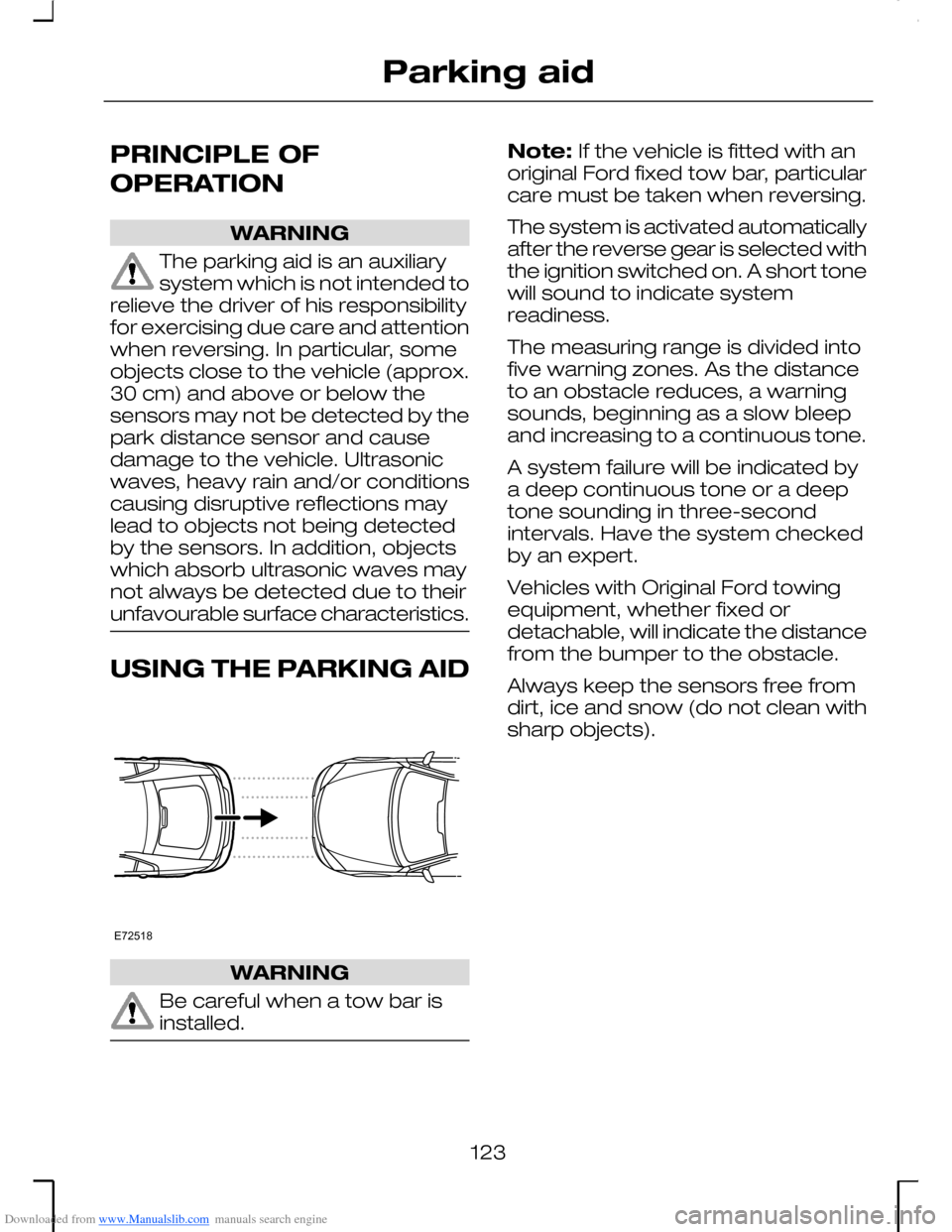
The system is activated automaticallyafter the reverse gear is selected withthe ignition switched on. A short tonewill sound to indicate systemreadiness.
The measuring range is divided intofive warning zones. As the distanceto an obstacle reduces, a warningsounds, beginning as a slow bleepand increasing to a continuous tone.
A system failure will be indicated bya deep continuous tone or a deeptone sounding in three-secondintervals. Have the system checkedby an expert.
Vehicles with Original Ford towingequipment, whether fixed ordetachable, will indicate the distancefrom the bumper to the obstacle.
Always keep the sensors free fromdirt, ice and snow (do not clean withsharp objects).
123
Parking aidE72518
Page 131 of 198
Downloaded from www.Manualslib.com manuals search engine TOWING A TRAILER
Note: Mondeo ST vehicles are notapproved for trailer towing.
The maximum vehicle and trailerpayloads represent technicallybinding values for gradients up to 12% and at an altitude of 1 000 metresabove sea level. In high altituderegions, thinner atmosphere canreduce engine performance so thefollowing restrictions will apply:
Above 1 000 metres, the stipulatedmaximum permitted gross trainweight must be reduced by 10 % forevery 1 000 metres in altitude.
Steep gradients
WARNING
The overrun brake on a trailer isnot controlled by the anti-lockbraking system.
Change down in plenty of timebefore downhill gradients.
For vehicles with an automatictransmission, if downhill modeprovides insufficient braking thenselect manual mode and second orfirst gear as necessary.
ESSENTIAL TOWING
CHECKS
WARNING
If any of the following conditionscannot be met, do not use thetow bar and have it inspected by anexpert.
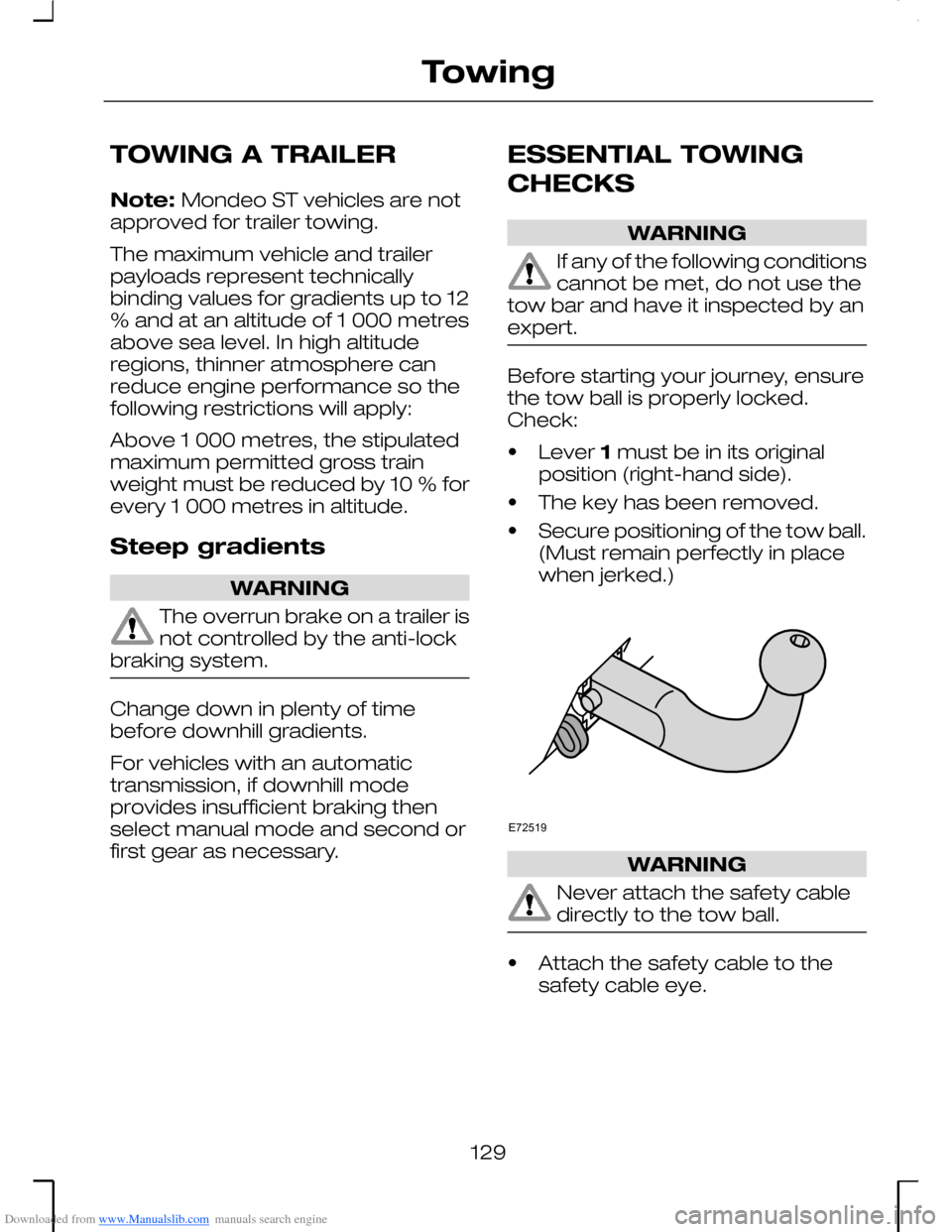
Before starting your journey, ensurethe tow ball is properly locked.Check:
•Lever 1 must be in its originalposition (right-hand side).
•The key has been removed.
•Secure positioning of the tow ball.(Must remain perfectly in placewhen jerked.)
WARNING
Never attach the safety cabledirectly to the tow ball.
•Attach the safety cable to thesafety cable eye.
129
TowingE72519
Page 137 of 198
Downloaded from www.Manualslib.com manuals search engine FUEL CUT-OFF SWITCH
Vehicles with a Duratecengine
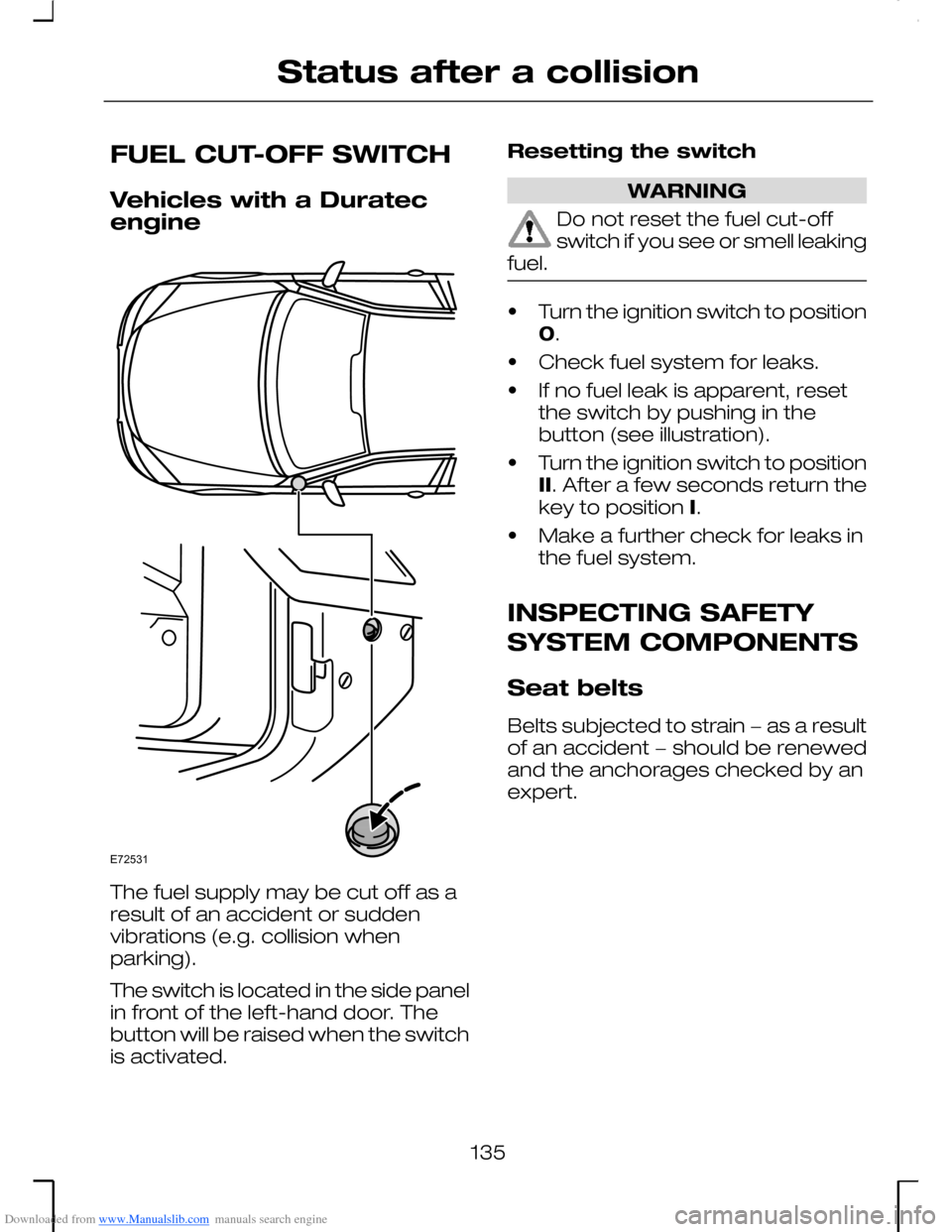
The fuel supply may be cut off as aresult of an accident or suddenvibrations (e.g. collision whenparking).
The switch is located in the side panelin front of the left-hand door. Thebutton will be raised when the switchis activated.
Resetting the switch
WARNING
Do not reset the fuel cut-offswitch if you see or smell leakingfuel.
•Turn the ignition switch to position0.
•Check fuel system for leaks.
•If no fuel leak is apparent, resetthe switch by pushing in thebutton (see illustration).
•Turn the ignition switch to positionII. After a few seconds return thekey to position I.
•Make a further check for leaks inthe fuel system.
INSPECTING SAFETY
SYSTEM COMPONENTS
Seat belts
Belts subjected to strain − as a resultof an accident − should be renewedand the anchorages checked by anexpert.
135
Status after a collisionE72531
Page 138 of 198
Downloaded from www.Manualslib.com manuals search engine FUSE BOX LOCATIONS
WARNING
Any improper alterations to theelectrical or fuel system canendanger the safety of the vehicle asthey could constitute a fire hazard orcause engine damage. Have anywork involving these systems or thereplacement of relays or high currentcarrying fuses carried out by anexpert.
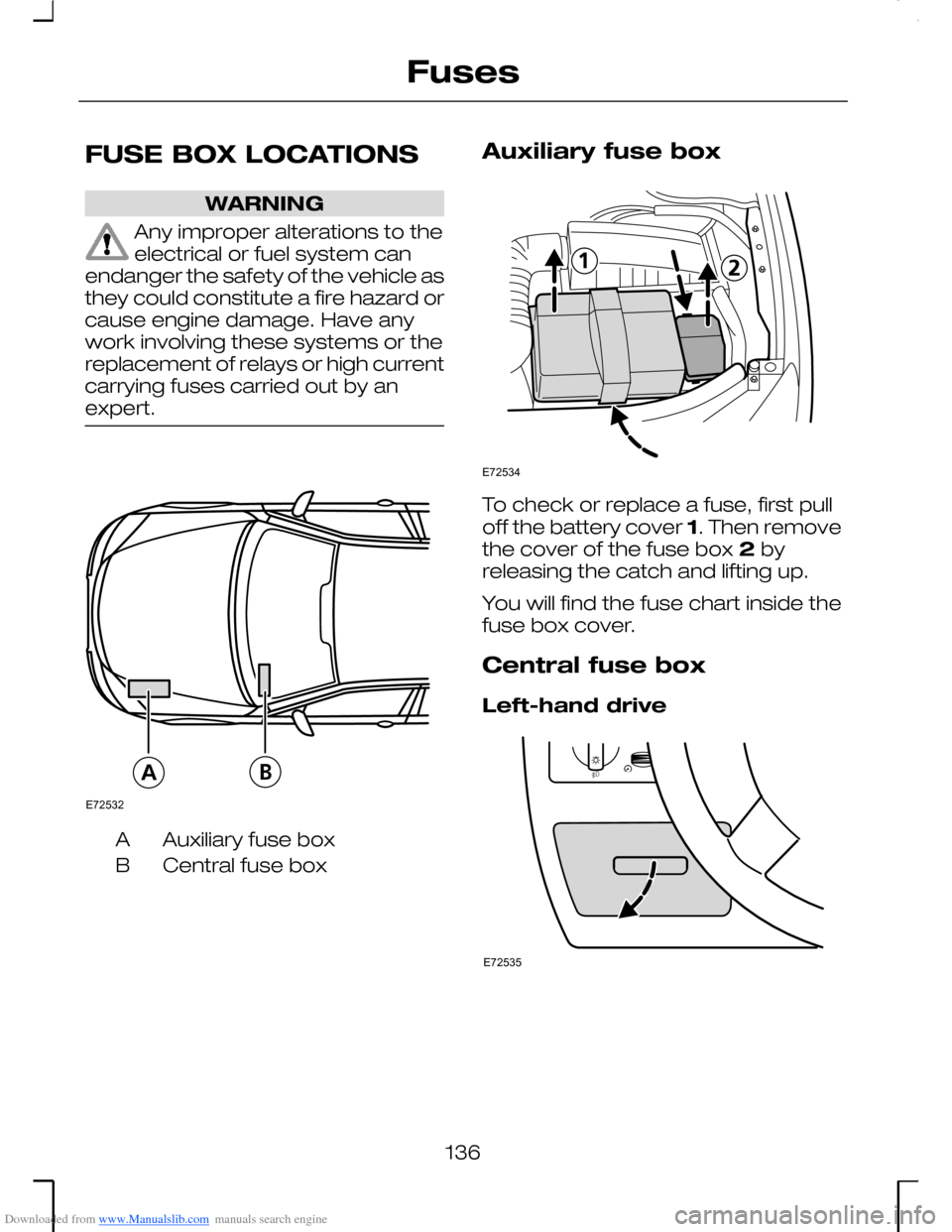
Auxiliary fuse boxA
Central fuse boxB
Auxiliary fuse box
To check or replace a fuse, first pulloff the battery cover 1. Then removethe cover of the fuse box 2 byreleasing the catch and lifting up.
You will find the fuse chart inside thefuse box cover.
Central fuse box
Left-hand drive
136
FusesE72532 E72534 E72535
Page 146 of 198
Downloaded from www.Manualslib.com manuals search engine GENERAL INFORMATION
WARNINGS
The electronic ignition systemworks with high voltage. Nevertouch these components with theengine running or the ignitionswitched on.
The ignition must be switchedoff before working in the enginecompartment. Under some operatingconditions, the cooling system fanmay continue to run for severalminutes after the engine has beenswitched off. This is quite normal.Take care not to get any fingers orclothing such as ties or scarvescaught in the fan.
•Check and top up fluid levelsregularly.
•Check tyre pressure.
•Check brakes and lamps areoperating correctly.
•Check warning and indicatorlamps.
Every day check
•Operation of all exterior andinterior lamps and make sure thatall lenses are clean.
When filling up check
•Engine oil level
•Brake fluid level
•Washer fluid level
•Tyre pressures and condition (onlywhen cold)
Once a month check
•Coolant level (engine cold)
•Assemblies, pipes, hoses andreservoirs for leaks
•Power steering fluid level
•Operation of the air conditioning
•Operation of the parking brake
•Operation of the horn
144
Maintenance
Page 151 of 198
Downloaded from www.Manualslib.com manuals search engine OPENING AND CLOSING
THE BONNET
Opening the bonnet
WARNING
Remove the key immediatelyafter opening the bonnet.
The bonnet must be opened fromthe outside.
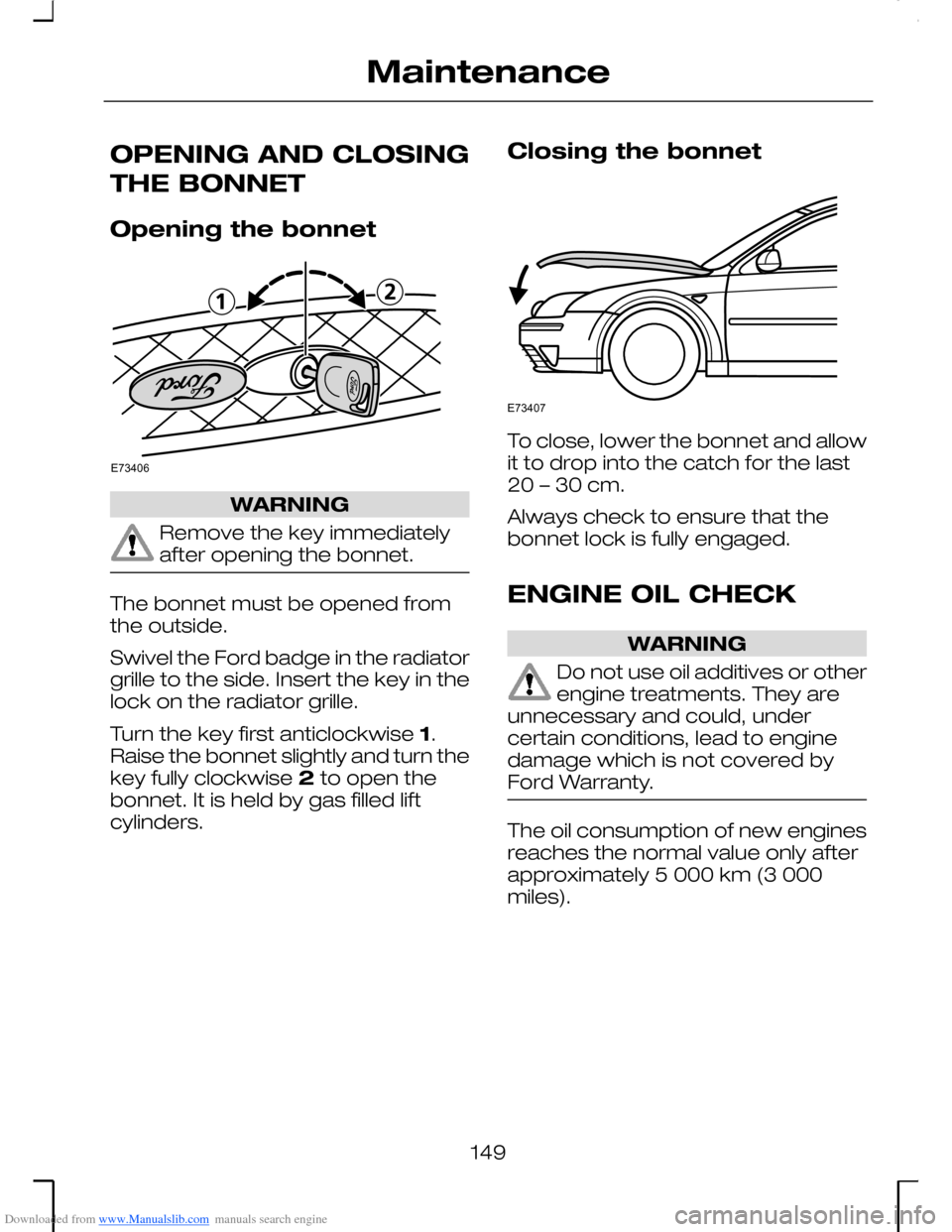
Swivel the Ford badge in the radiatorgrille to the side. Insert the key in thelock on the radiator grille.
Turn the key first anticlockwise 1.Raise the bonnet slightly and turn thekey fully clockwise 2 to open thebonnet. It is held by gas filled liftcylinders.
Closing the bonnet
To close, lower the bonnet and allowit to drop into the catch for the last20 – 30 cm.
Always check to ensure that thebonnet lock is fully engaged.
ENGINE OIL CHECK
WARNING
Do not use oil additives or otherengine treatments. They areunnecessary and could, undercertain conditions, lead to enginedamage which is not covered byFord Warranty.
The oil consumption of new enginesreaches the normal value only afterapproximately 5 000 km (3 000miles).
149
MaintenanceE73406 E73407