Page 131 of 198
Downloaded from www.Manualslib.com manuals search engine TOWING A TRAILER
Note: Mondeo ST vehicles are notapproved for trailer towing.
The maximum vehicle and trailerpayloads represent technicallybinding values for gradients up to 12% and at an altitude of 1 000 metresabove sea level. In high altituderegions, thinner atmosphere canreduce engine performance so thefollowing restrictions will apply:
Above 1 000 metres, the stipulatedmaximum permitted gross trainweight must be reduced by 10 % forevery 1 000 metres in altitude.
Steep gradients
WARNING
The overrun brake on a trailer isnot controlled by the anti-lockbraking system.
Change down in plenty of timebefore downhill gradients.
For vehicles with an automatictransmission, if downhill modeprovides insufficient braking thenselect manual mode and second orfirst gear as necessary.
ESSENTIAL TOWING
CHECKS
WARNING
If any of the following conditionscannot be met, do not use thetow bar and have it inspected by anexpert.
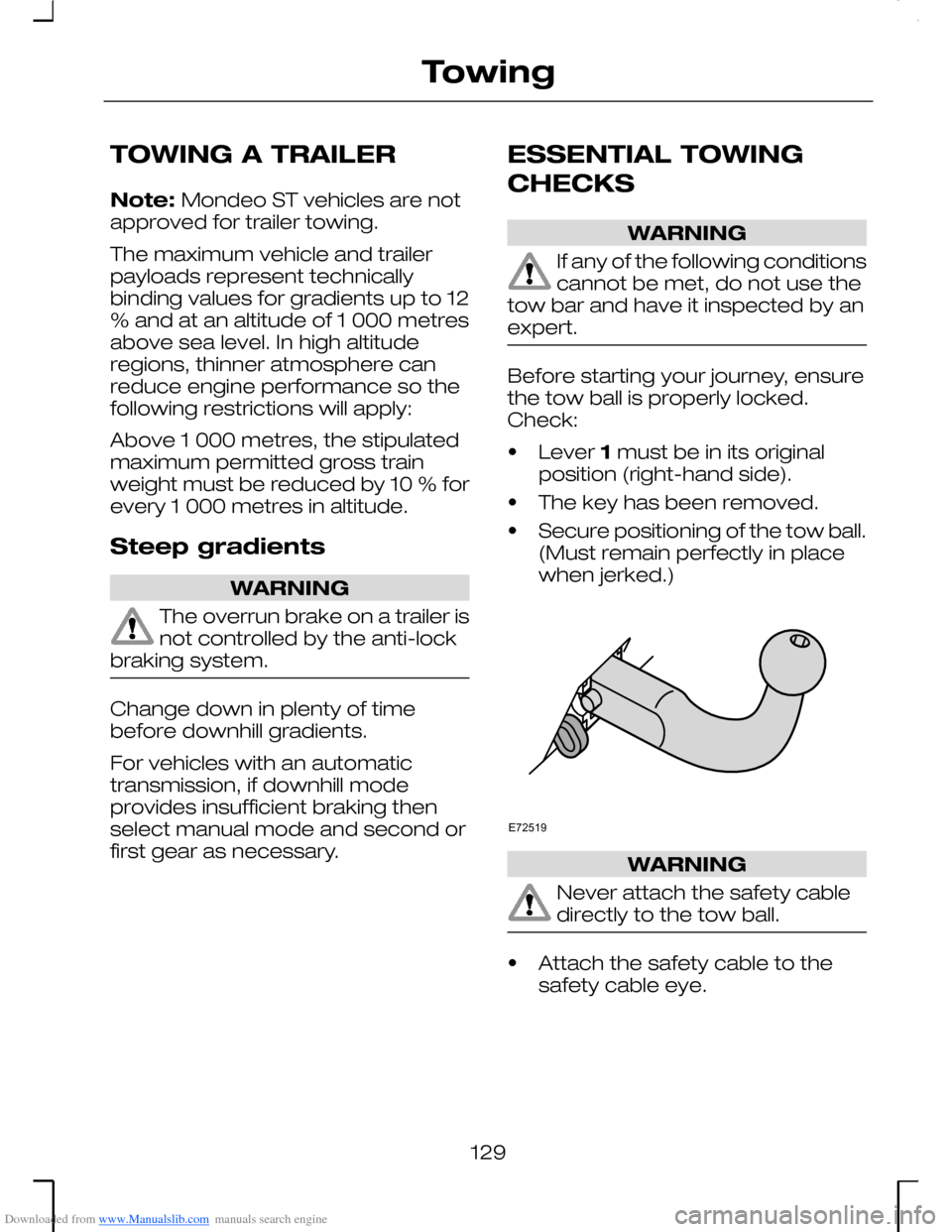
Before starting your journey, ensurethe tow ball is properly locked.Check:
•Lever 1 must be in its originalposition (right-hand side).
•The key has been removed.
•Secure positioning of the tow ball.(Must remain perfectly in placewhen jerked.)
WARNING
Never attach the safety cabledirectly to the tow ball.
•Attach the safety cable to thesafety cable eye.
129
TowingE72519
Page 132 of 198
Downloaded from www.Manualslib.com manuals search engine DETACHABLE TOW BALL
WARNINGS
Remove and reinstall the towball regularly to keep the lockingmechanism working smoothly.
Do not use any tools formounting/dismounting the towball. Do not modify the trailercoupling. Do not disassemble/repairthe tow ball.
To avoid risk of injury, neverunlock the tow ball with thetrailer attached.
To avoid risk of injury, neverleave the detached tow ballunsecured inside the vehicle.
Note: When the tow ball is not inuse, always remove it and secure itwith the strap to the eye on theright-hand side in the rear of theluggage compartment.
Removing the tow ball
•Unhitch the trailer.
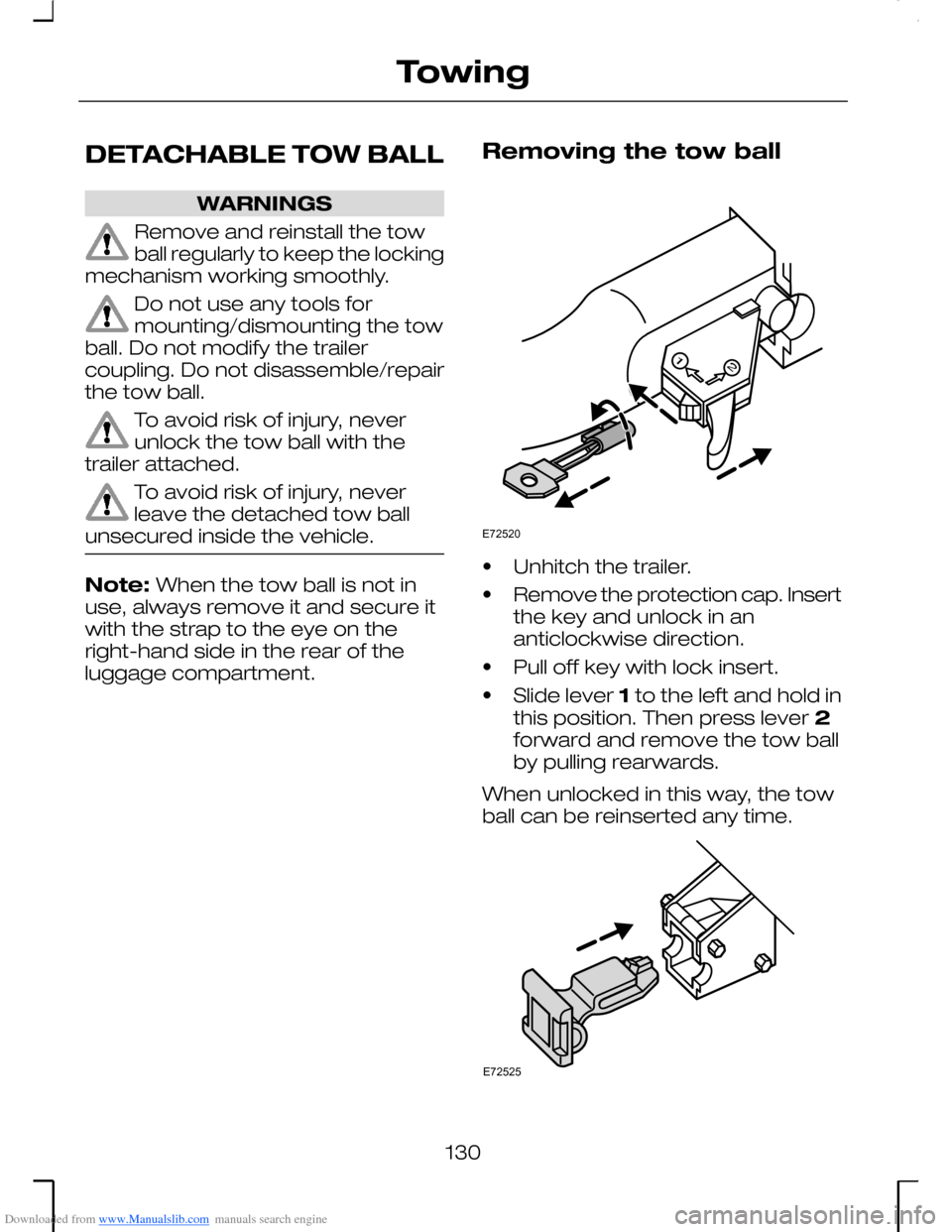
•Remove the protection cap. Insertthe key and unlock in ananticlockwise direction.
•Pull off key with lock insert.
•Slide lever 1 to the left and hold inthis position. Then press lever 2forward and remove the tow ballby pulling rearwards.
When unlocked in this way, the towball can be reinserted any time.
130
TowingE72520 E72525
Page 136 of 198
Downloaded from www.Manualslib.com manuals search engine FIRST AID KIT
4-door and 5-door
Vehicles with a temporaryspare wheel
Storage for a first aid kit is located oneither side of the luggagecompartment.
Vehicles with a full-size sparewheel
A fastening tape to secure a first aidkit is provided on the left side of theluggage compartment.
Estate
Storage for a first aid kit is located onthe left-hand side of the luggagecompartment.
WARNING TRIANGLE
4-door and 5-door
Vehicles with a temporaryspare wheel
Storage for a warning triangle islocated on either side of the luggagecompartment.
Vehicles with a full-size sparewheel
Storage for a warning triangle islocated on the right side of theluggage compartment in a foam trayunder the carpet.
Estate
Storage for a warning triangle islocated on the left-hand side of theluggage compartment.
134
Emergency equipment
Page 155 of 198
Downloaded from www.Manualslib.com manuals search engine POWER STEERING FLUID
CHECK
The fluid level should come up to theMAX mark when the engine is cold.
If it drops below the MIN mark, topup with the specified fluid.
WASHER FLUID CHECK
Front and rear washer systems aresupplied from the same reservoir.The reservoir is located behind theright-hand headlamp.
Replace the cap securely aftertopping up.
Washer jets
To ensure the system functionsproperly, keep the washer jets freeof snow and ice.
Switching on the heated windscreendefrosts both the windscreen andthe front washer jets.
153
MaintenanceE73416 E73422
Page 165 of 198
Downloaded from www.Manualslib.com manuals search engine Removing a wheel
All vehicles
WARNINGS
Park your vehicle in such aposition that neither the trafficnor you are hindered or endangeredwhen changing a wheel.
Set up a warning triangle.
Ensure that the vehicle is onfirm, level ground.
If necessary, secure the vehiclewith suitable chocks.
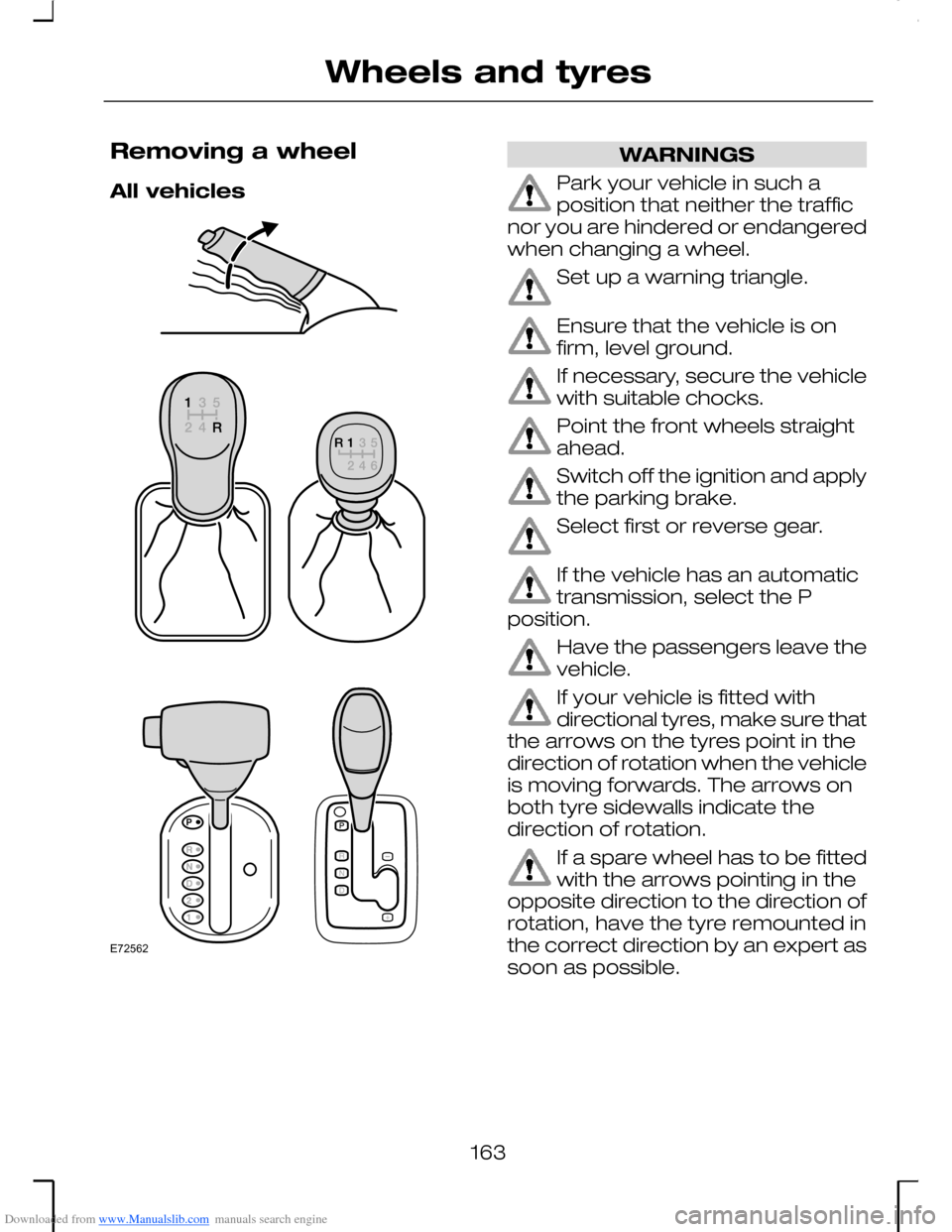
Point the front wheels straightahead.
Switch off the ignition and applythe parking brake.
Select first or reverse gear.
If the vehicle has an automatictransmission, select the Pposition.
Have the passengers leave thevehicle.
If your vehicle is fitted withdirectional tyres, make sure thatthe arrows on the tyres point in thedirection of rotation when the vehicleis moving forwards. The arrows onboth tyre sidewalls indicate thedirection of rotation.
If a spare wheel has to be fittedwith the arrows pointing in theopposite direction to the direction ofrotation, have the tyre remounted inthe correct direction by an expert assoon as possible.
163
Wheels and tyresE72562
Page 167 of 198
Downloaded from www.Manualslib.com manuals search engine •Jack up the vehicle until the wheelis clear of the ground.
•Unscrew and remove the wheelnuts and take off the wheel.
Fitting a wheel
Vehicles with alloy wheels
WARNING
Alloy wheels must never besecured using wheel nuts forsteel wheels.
Note: The wheel nuts of alloy wheelscan also be used for the steel sparewheel for a short time (maximum twoweeks).
All vehicles
•Push the wheel onto the wheelstuds. Screw on the wheel nutsand secure in a clockwisedirection ensuring that thetapered end of the wheel nuts isfacing the wheel.
•Lower the vehicle and remove thejack.
Vehicles with locking wheelnuts
•Insert the nut key onto the lockingnut.
All vehicles
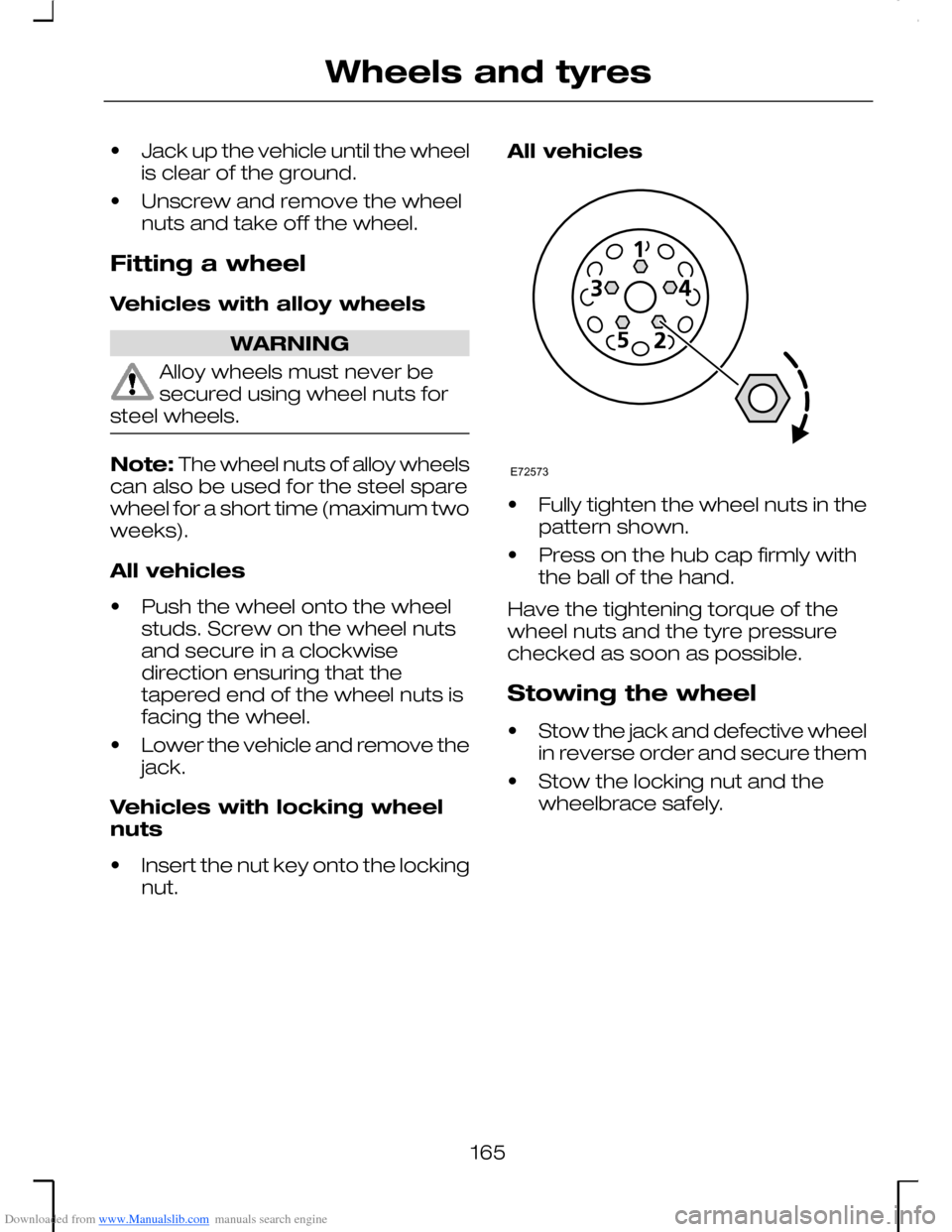
•Fully tighten the wheel nuts in thepattern shown.
•Press on the hub cap firmly withthe ball of the hand.
Have the tightening torque of thewheel nuts and the tyre pressurechecked as soon as possible.
Stowing the wheel
•Stow the jack and defective wheelin reverse order and secure them
•Stow the locking nut and thewheelbrace safely.
165
Wheels and tyresE72573
Page:
< prev 1-8 9-16 17-24