Page 13 of 198
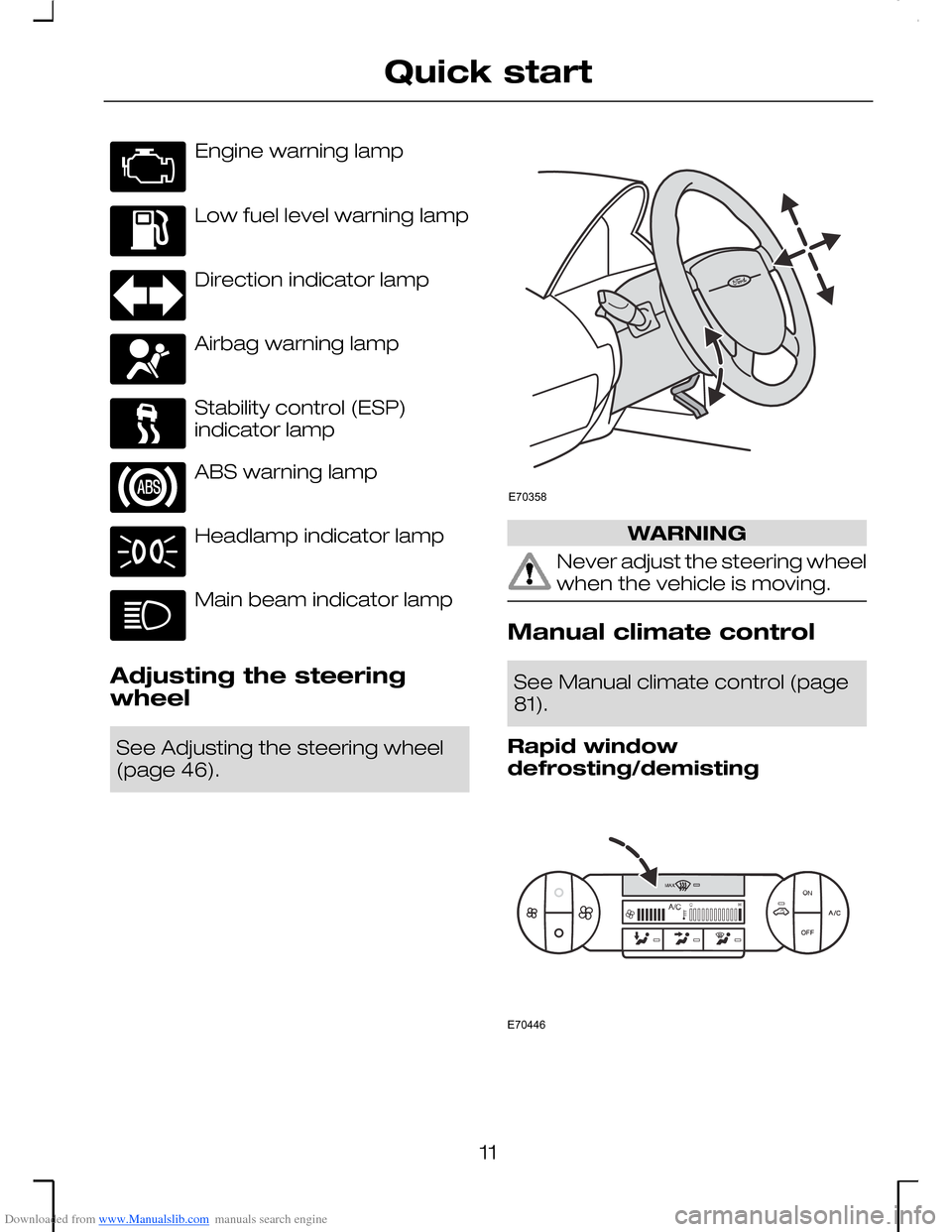
Downloaded from www.Manualslib.com manuals search engine Engine warning lamp
Low fuel level warning lamp
Direction indicator lamp
Airbag warning lamp
Stability control (ESP)indicator lamp
ABS warning lamp
Headlamp indicator lamp
Main beam indicator lamp
Adjusting the steeringwheel
See Adjusting the steering wheel(page 46).
WARNING
Never adjust the steering wheelwhen the vehicle is moving.
Manual climate control
See Manual climate control (page81).
Rapid windowdefrosting/demisting
11
Quick start E70358 E70446
Page 20 of 198
Downloaded from www.Manualslib.com manuals search engine CHILD SEATS
WARNINGS
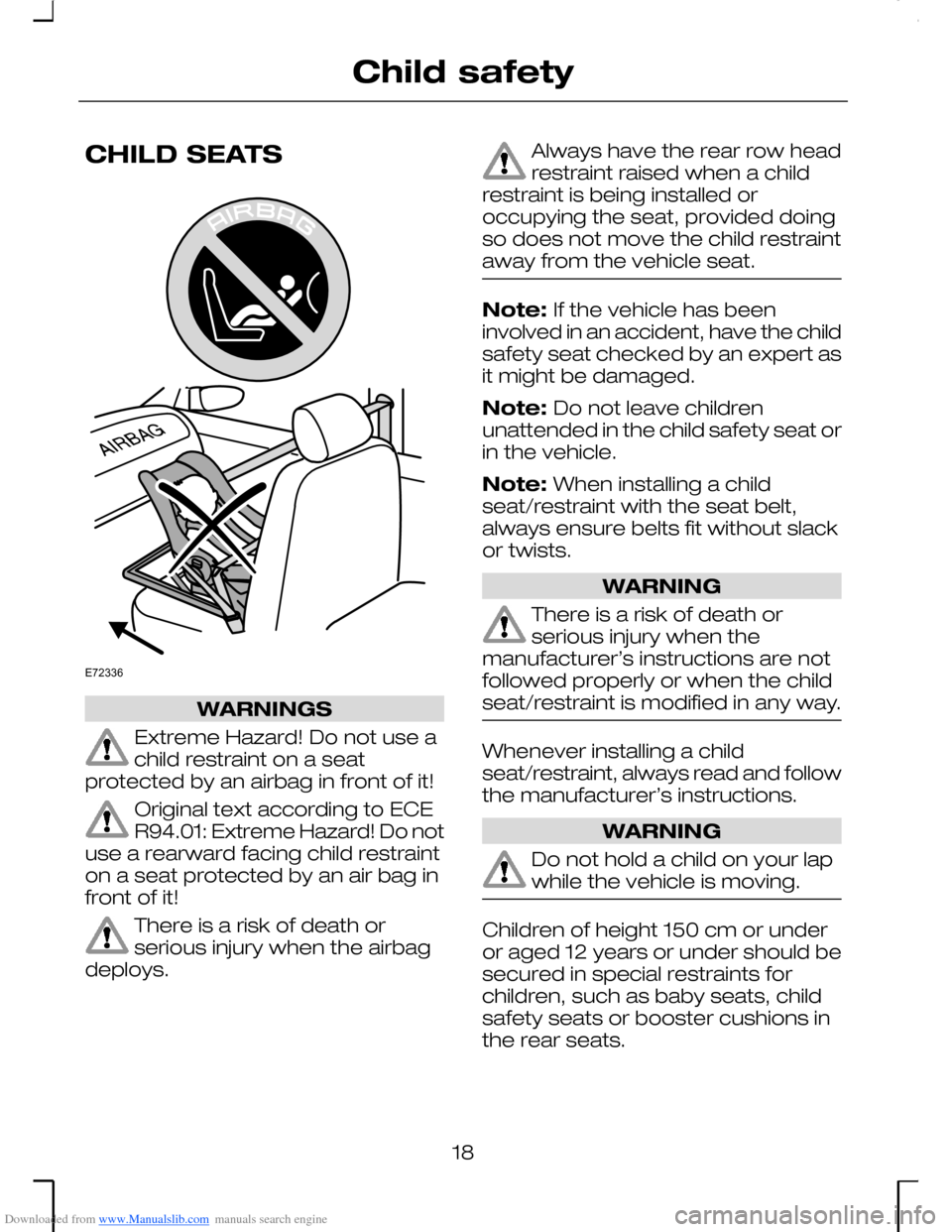
Extreme Hazard! Do not use achild restraint on a seatprotected by an airbag in front of it!
Original text according to ECER94.01: Extreme Hazard! Do notuse a rearward facing child restrainton a seat protected by an air bag infront of it!
There is a risk of death orserious injury when the airbagdeploys.
Always have the rear row headrestraint raised when a childrestraint is being installed oroccupying the seat, provided doingso does not move the child restraintaway from the vehicle seat.
Note: If the vehicle has beeninvolved in an accident, have the childsafety seat checked by an expert asit might be damaged.
Note: Do not leave childrenunattended in the child safety seat orin the vehicle.
Note: When installing a childseat/restraint with the seat belt,always ensure belts fit without slackor twists.
WARNING
There is a risk of death orserious injury when themanufacturer’s instructions are notfollowed properly or when the childseat/restraint is modified in any way.
Whenever installing a childseat/restraint, always read and followthe manufacturer’s instructions.
WARNING
Do not hold a child on your lapwhile the vehicle is moving.
Children of height 150 cm or underor aged 12 years or under should besecured in special restraints forchildren, such as baby seats, childsafety seats or booster cushions inthe rear seats.
18
Child safetyE72336
Page 21 of 198
Downloaded from www.Manualslib.com manuals search engine Such equipment must be suitableand government approved(depending on country).
A choice of ECE approved childrestraints is available at your FordDealer. Please ask for therecommended child seats. Togetherwith the adult seat belt, theserestraints help to provide maximumsecurity for the children.
Child restraints for differentmass groups
The correct restraint to be useddepends on the child’s age andweight:
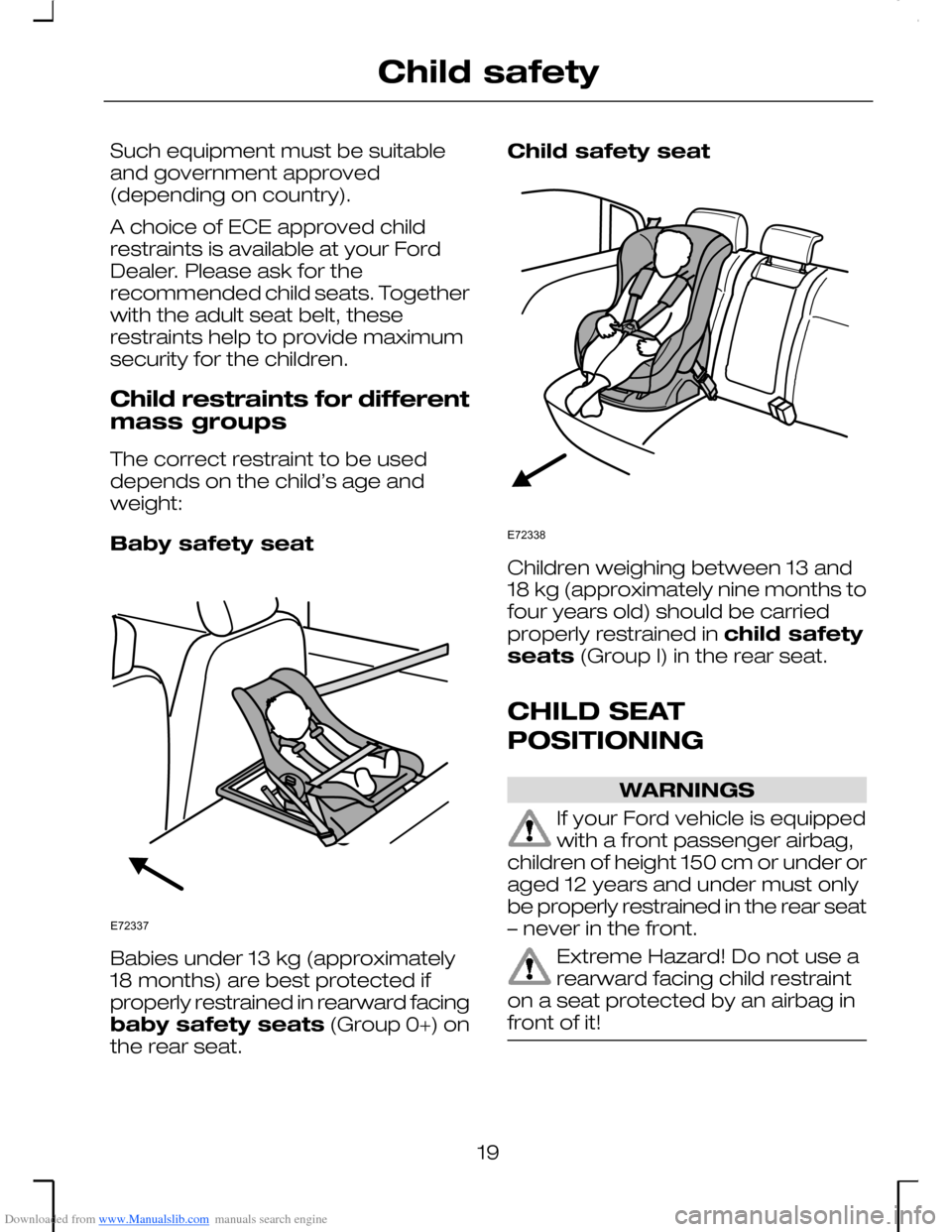
Baby safety seat
Babies under 13 kg (approximately18 months) are best protected ifproperly restrained in rearward facingbaby safety seats (Group 0+) onthe rear seat.
Child safety seat
Children weighing between 13 and18 kg (approximately nine months tofour years old) should be carriedproperly restrained in child safetyseats (Group I) in the rear seat.
CHILD SEAT
POSITIONING
WARNINGS
If your Ford vehicle is equippedwith a front passenger airbag,children of height 150 cm or under oraged 12 years and under must onlybe properly restrained in the rear seat– never in the front.
Extreme Hazard! Do not use arearward facing child restrainton a seat protected by an airbag infront of it!
19
Child safetyE72337 E72338
Page 23 of 198
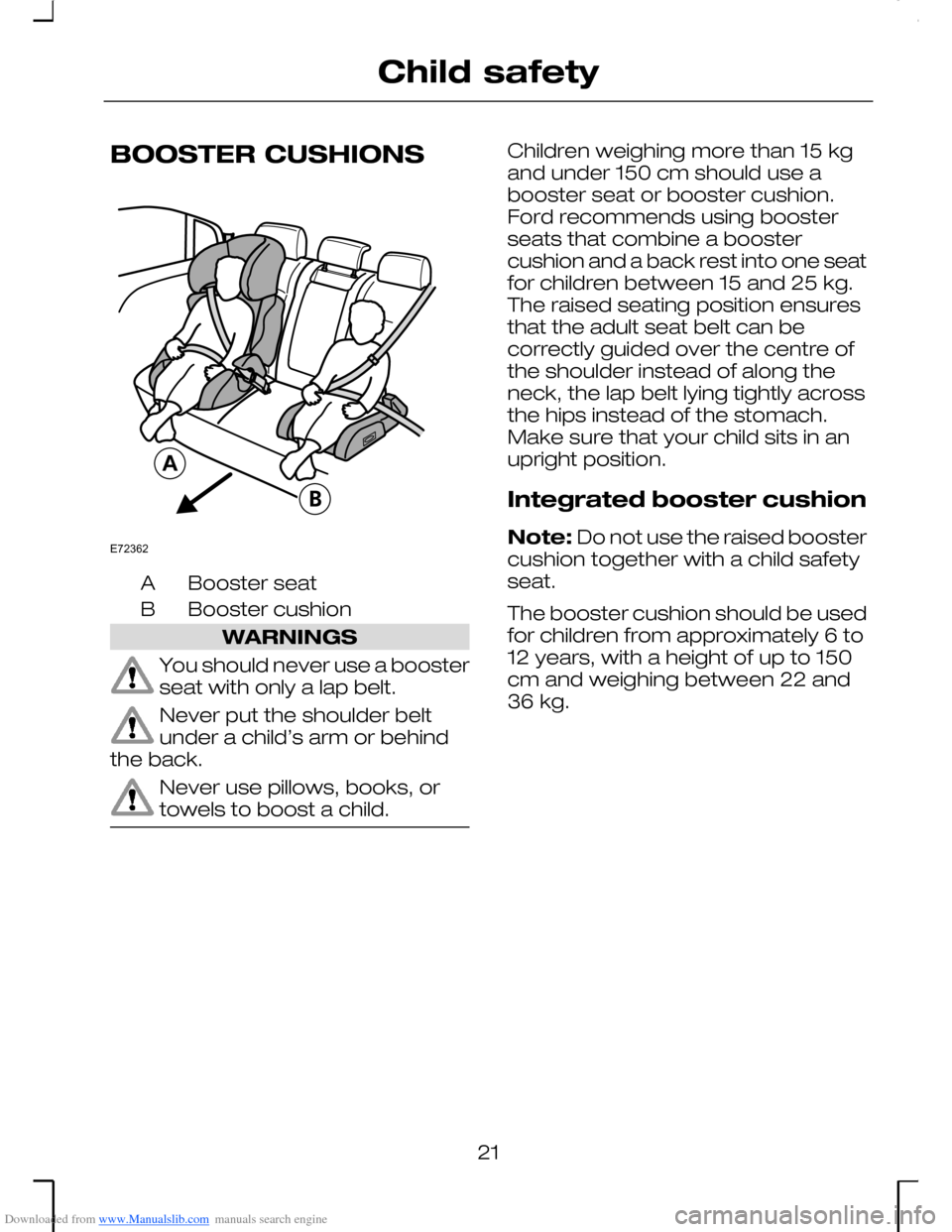
Downloaded from www.Manualslib.com manuals search engine BOOSTER CUSHIONS
Booster seatA
Booster cushionB
WARNINGS
You should never use a boosterseat with only a lap belt.
Never put the shoulder beltunder a child’s arm or behindthe back.
Never use pillows, books, ortowels to boost a child.
Children weighing more than 15 kgand under 150 cm should use abooster seat or booster cushion.Ford recommends using boosterseats that combine a boostercushion and a back rest into one seatfor children between 15 and 25 kg.The raised seating position ensuresthat the adult seat belt can becorrectly guided over the centre ofthe shoulder instead of along theneck, the lap belt lying tightly acrossthe hips instead of the stomach.Make sure that your child sits in anupright position.
Integrated booster cushion
Note: Do not use the raised boostercushion together with a child safetyseat.
The booster cushion should be usedfor children from approximately 6 to12 years, with a height of up to 150cm and weighing between 22 and36 kg.
21
Child safetyE72362
Page 26 of 198
Downloaded from www.Manualslib.com manuals search engine CHILD SAFETY LOCKS
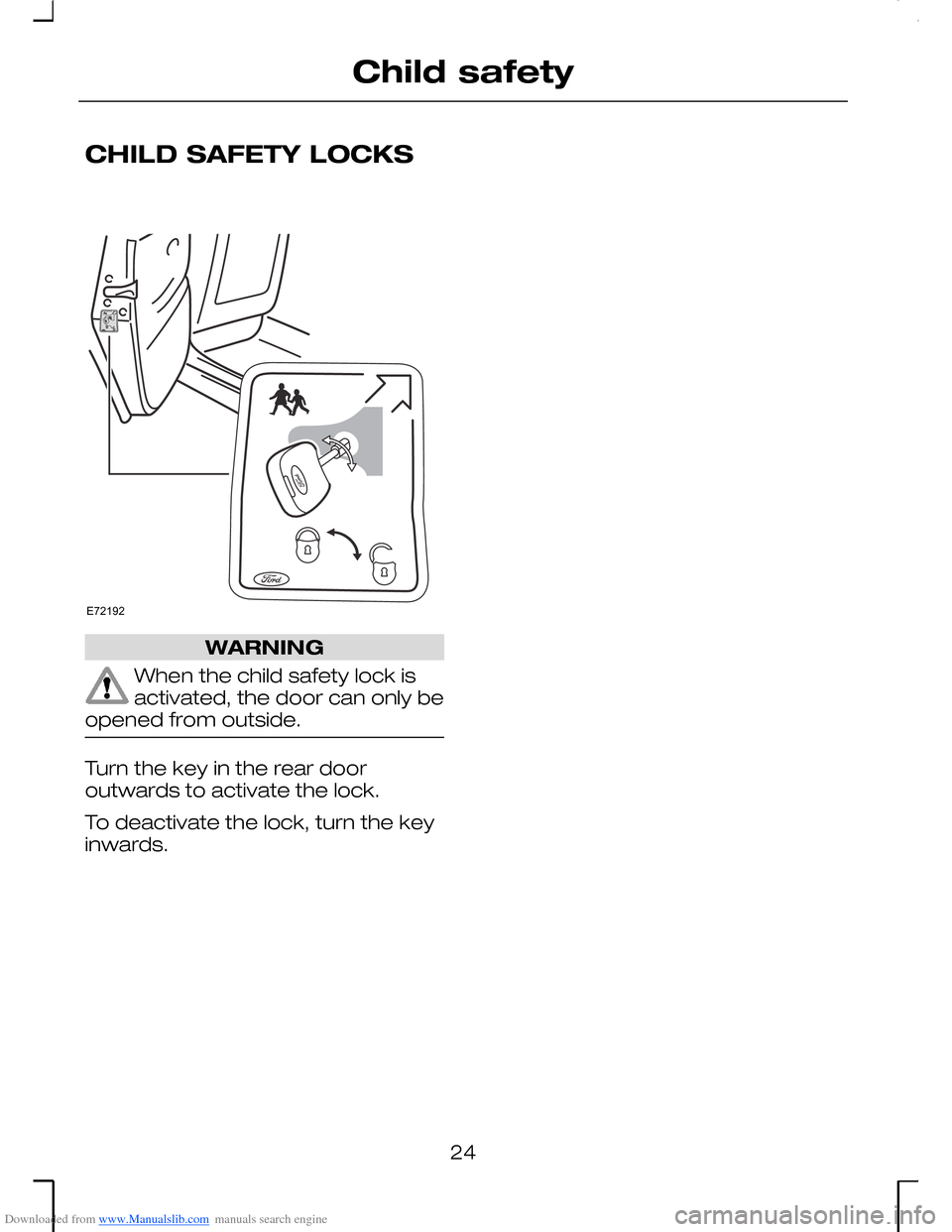
WARNING
When the child safety lock isactivated, the door can only beopened from outside.
Turn the key in the rear dooroutwards to activate the lock.
To deactivate the lock, turn the keyinwards.
24
Child safetyE72192
Page 27 of 198
Downloaded from www.Manualslib.com manuals search engine PRINCIPLE OF OPERATION
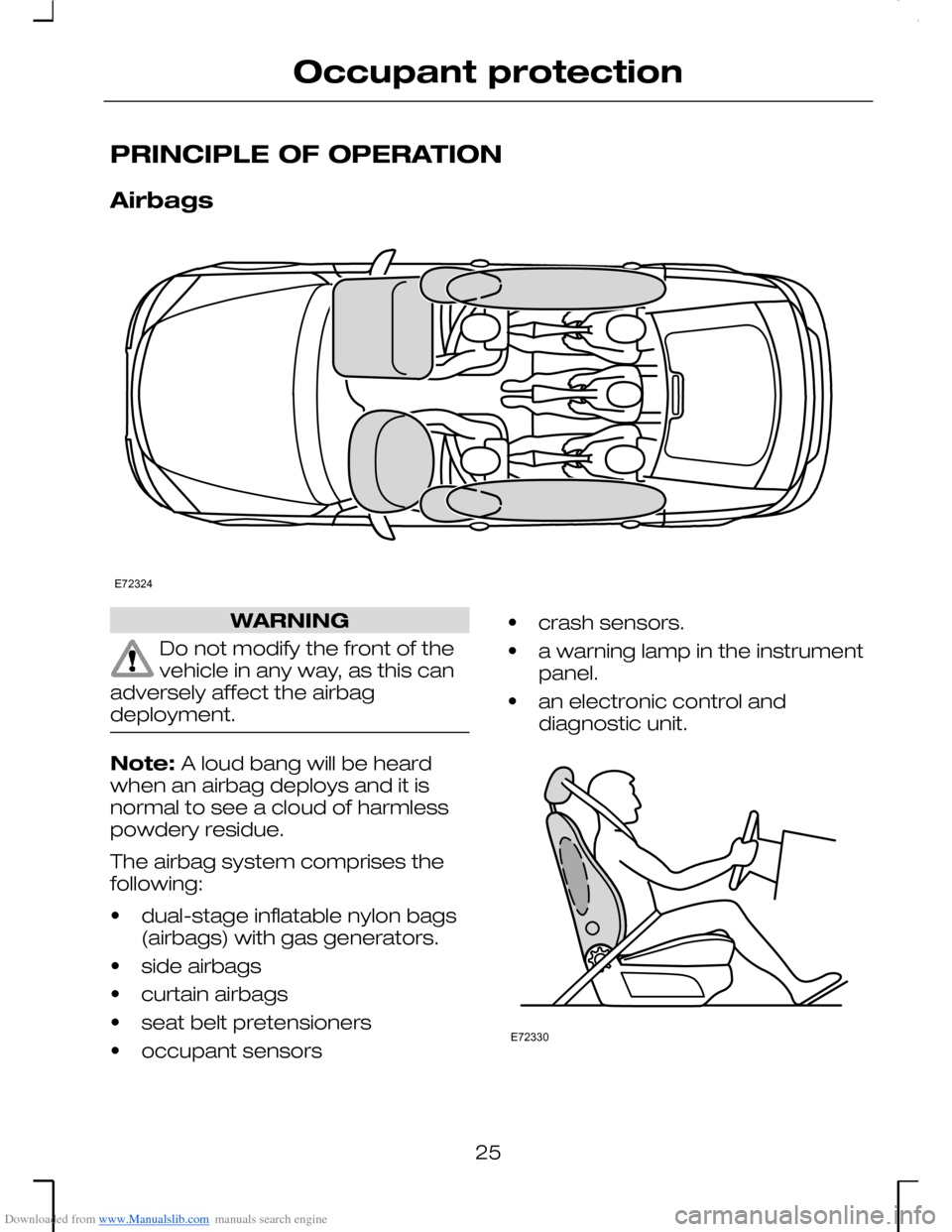
Airbags
WARNING
Do not modify the front of thevehicle in any way, as this canadversely affect the airbagdeployment.
Note: A loud bang will be heardwhen an airbag deploys and it isnormal to see a cloud of harmlesspowdery residue.
The airbag system comprises thefollowing:
•dual-stage inflatable nylon bags(airbags) with gas generators.
•side airbags
•curtain airbags
•seat belt pretensioners
•occupant sensors
•crash sensors.
•a warning lamp in the instrumentpanel.
•an electronic control anddiagnostic unit.
25
Occupant protectionE72324 E72330
Page 28 of 198
Downloaded from www.Manualslib.com manuals search engine WARNINGS
Repairs to either of the frontseat covers, the sensorsattached to the seats as well as tothe roof lining should only be carriedout by properly trained technicians.Injuries may result if the side airbagsare triggered inadvertently.
Do not block, obstruct or coverthe airbag because it mayprevent proper deployment. Do notpoke any sharp objects into the areaswhere airbags are fitted. This coulddamage the airbags.
Do not use any accessory seatcovers that are not specificallydesigned for seats with side airbags.These seat covers must be fitted byproperly trained technicians.
WARNING
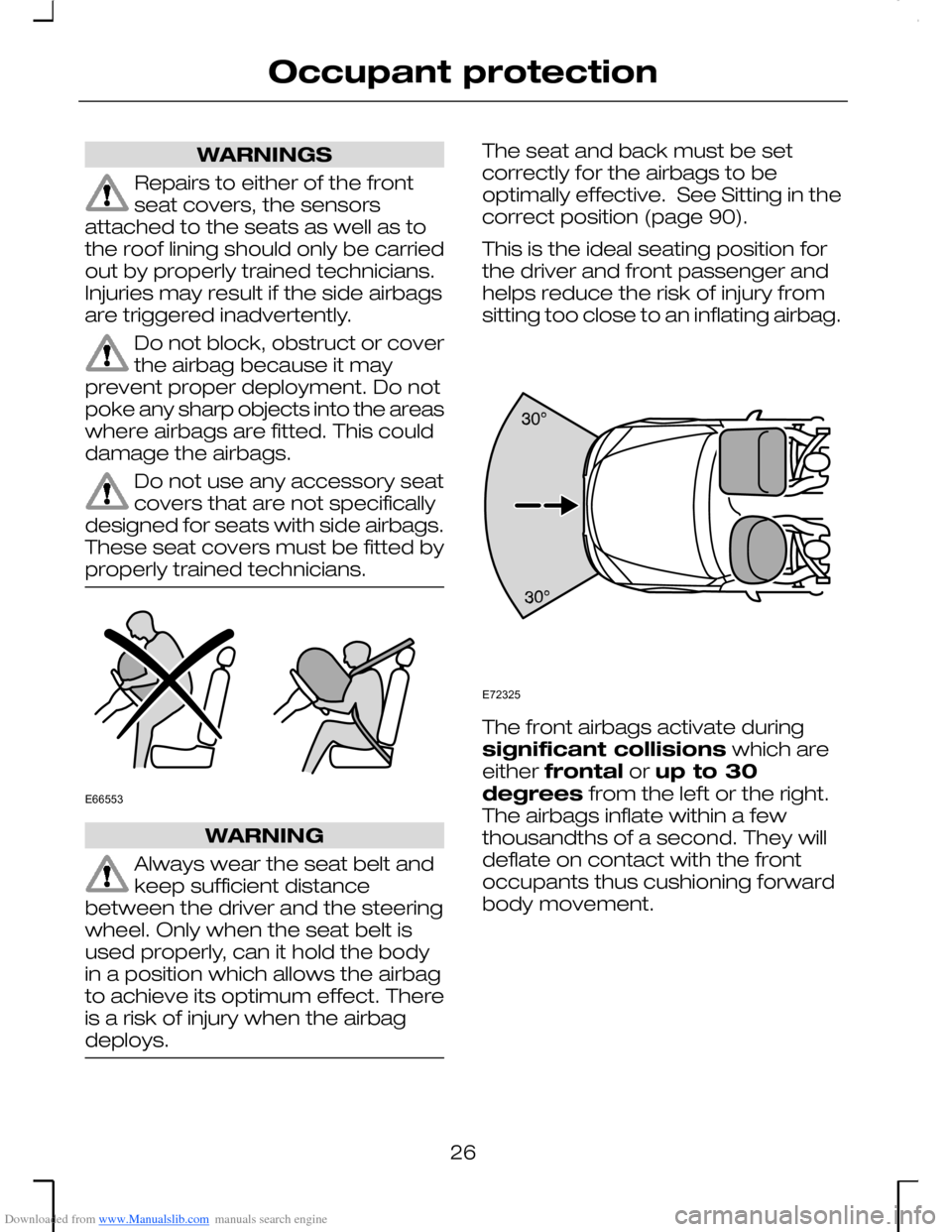
Always wear the seat belt andkeep sufficient distancebetween the driver and the steeringwheel. Only when the seat belt isused properly, can it hold the bodyin a position which allows the airbagto achieve its optimum effect. Thereis a risk of injury when the airbagdeploys.
The seat and back must be setcorrectly for the airbags to beoptimally effective. See Sitting in thecorrect position (page 90).
This is the ideal seating position forthe driver and front passenger andhelps reduce the risk of injury fromsitting too close to an inflating airbag.
The front airbags activate duringsignificant collisions which areeither frontal or up to 30degrees from the left or the right.The airbags inflate within a fewthousandths of a second. They willdeflate on contact with the frontoccupants thus cushioning forwardbody movement.
26
Occupant protectionE66553 E72325
Page 29 of 198
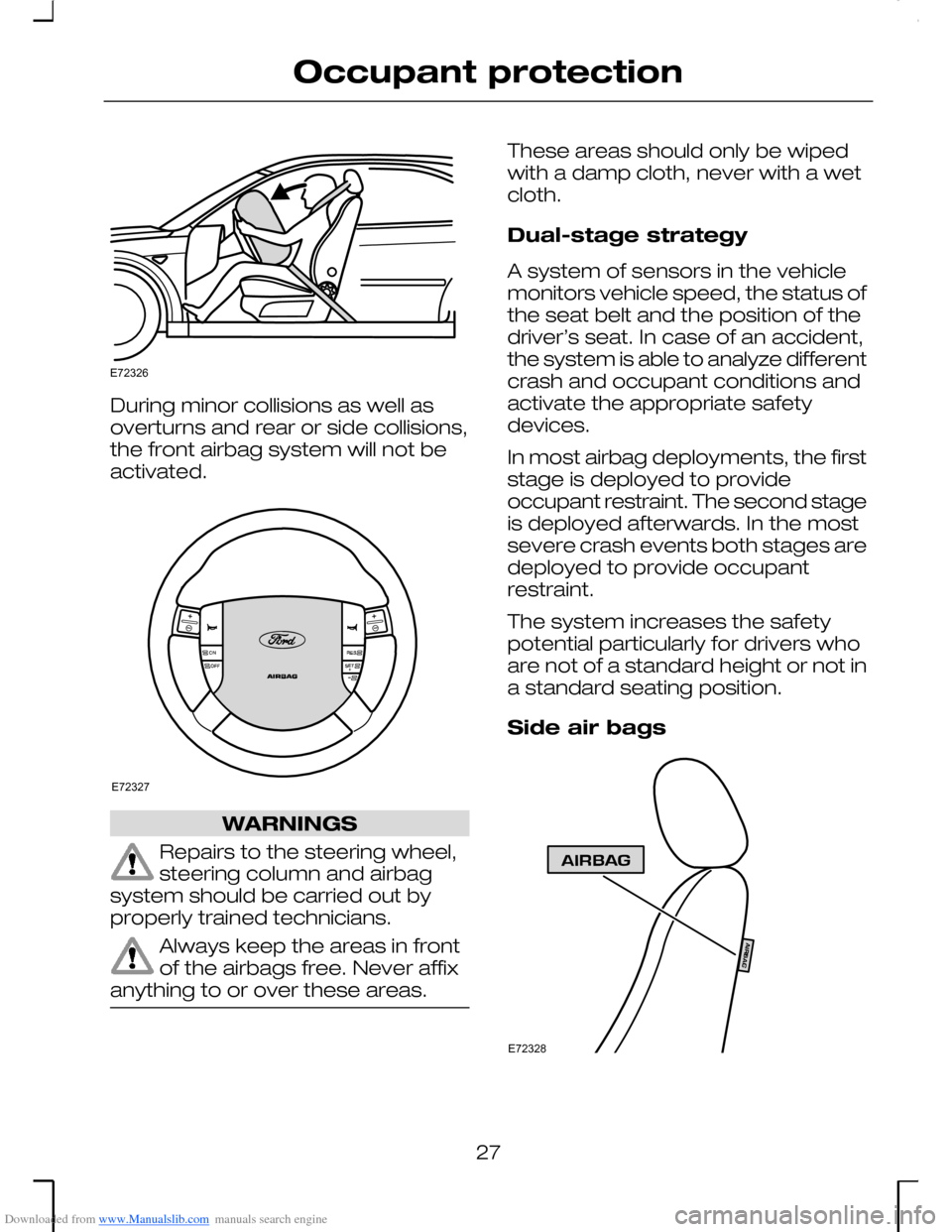
Downloaded from www.Manualslib.com manuals search engine During minor collisions as well asoverturns and rear or side collisions,the front airbag system will not beactivated.
WARNINGS
Repairs to the steering wheel,steering column and airbagsystem should be carried out byproperly trained technicians.
Always keep the areas in frontof the airbags free. Never affixanything to or over these areas.
These areas should only be wipedwith a damp cloth, never with a wetcloth.
Dual-stage strategy
A system of sensors in the vehiclemonitors vehicle speed, the status ofthe seat belt and the position of thedriver’s seat. In case of an accident,the system is able to analyze differentcrash and occupant conditions andactivate the appropriate safetydevices.
In most airbag deployments, the firststage is deployed to provideoccupant restraint. The second stageis deployed afterwards. In the mostsevere crash events both stages aredeployed to provide occupantrestraint.
The system increases the safetypotential particularly for drivers whoare not of a standard height or not ina standard seating position.
Side air bags
27
Occupant protectionE72326 E72327 E72328