2006 FORD FREESTYLE heating
[x] Cancel search: heatingPage 198 of 288
indicator light on the control will illuminate when the system is turned
off. If the indicator light illuminates when the RSS is not turned off, it
may indicate a failure in the RSS.
Keep the RSS sensors (located on the rear bumper/fascia) free
from snow, ice and large accumulations of dirt (do not clean the
sensors with sharp objects). If the sensors are covered, it will
affect the accuracy of the RSS.
If your vehicle sustains damage to the rear bumper/fascia, leaving
it misaligned or bent, the sensing zone may be altered causing
inaccurate measurement of obstacles or false alarms.
ALL WHEEL DRIVE (AWD) SYSTEM (IF EQUIPPED)
Your vehicle may be equipped with a full-time All Wheel Drive (AWD)
system. With the AWD option, power will be delivered to the front
wheels and distributed to the rear wheels as needed. The AWD system is
active all the time and requires no input from the operator.
All components of the AWD system are sealed for life and require no
maintenance.
If your vehicle is equipped with AWD, a spare tire of a different size
other than the tire provided should never be used. A dissimilar spare tire
size (other than the spare tire provided) or major dissimilar tire sizes
between the front and rear axles could cause the AWD system to stop
functioning and default to front wheel drive.
Note:Your AWD vehicle is not intended for off-road use. The AWD
feature gives your vehicle some limited off-road capabilities in which
driving surfaces are relatively level, obstruction-free and otherwise
similar to normal on-road driving conditions. Operating your vehicle
under other than those conditions could subject the vehicle to excessive
stress which might result in damage which is not covered under your
warranty.
Driving off-highway with AWD vehicles
AWD vehicles are specially equipped for driving on sand, snow, mud and
rough roads and have operating characteristics that are somewhat
different from conventional vehicles, both on and off the highway.
When driving at slow speeds off-highway under high outside
temperatures, use L (Low) gear when possible. L (Low) gear operation
will maximize the engine and transmission cooling capability.
Under severe operating conditions, the A/C may cycle on and off to
protect overheating of the engine.
2006 Freestyle(219)
Owners Guide (post-2002-fmt)
USA(fus)
Driving
198
Page 201 of 288
Do not use L (Low) gear when driving through sand.
Under severe operating conditions, the A/C may cycle on and off to
protect overheating of the engine.
Avoid excessive speed because vehicle momentum can work against you
and cause the vehicle to become stuck to the point that assistance may
be required from another vehicle. Remember, you may be able to back
out the way you came if you proceed with caution.
Mud and water
If you must drive through high water, drive slowly. Traction or brake
capability may be limited.
When driving through water, determine the depth; avoid water higher
than the bottom of the hubs (if possible) and proceed slowly. If the
ignition system gets wet, the vehicle may stall.
Once through water, always try the brakes. Wet brakes do not stop the
vehicle as effectively as dry brakes. Drying can be improved by moving
your vehicle slowly while applying light pressure on the brake pedal.
Be cautious of sudden changes in vehicle speed or direction when you
are driving in mud. Even AWD vehicles can lose traction in slick mud. As
when you are driving over sand, apply the accelerator slowly and avoid
spinning your wheels. If the vehicle does slide, steer in the direction of
the slide until you regain control of the vehicle.
If the transmission, AWD system components or axles are submerged in
water, their fluids should be checked and changed, if necessary.
Driving through deep water may damage the transmission.
If the front or rear axle is submerged in water, the axle lubricant and
PTU (Power Transfer Unit) lubricant should be checked and changed if
necessary.
After driving through mud, clean off residue stuck to rotating driveshafts
and tires. Excess mud stuck on tires and rotating driveshafts causes an
imbalance that could damage drive components.
“Tread Lightly” is an educational
program designed to increase public
awareness of land-use regulations
and responsibilities in our nations
wilderness areas. Ford Motor
Company joins the U.S. Forest Service and the Bureau of Land
Management in encouraging you to help preserve our national forest and
other public and private lands by “treading lightly.”
2006 Freestyle(219)
Owners Guide (post-2002-fmt)
USA(fus)
Driving
201
Page 202 of 288
Driving on hilly or sloping terrain
Although natural obstacles may make it necessary to travel diagonally up
or down a hill or steep incline, you should always try to drive straight up
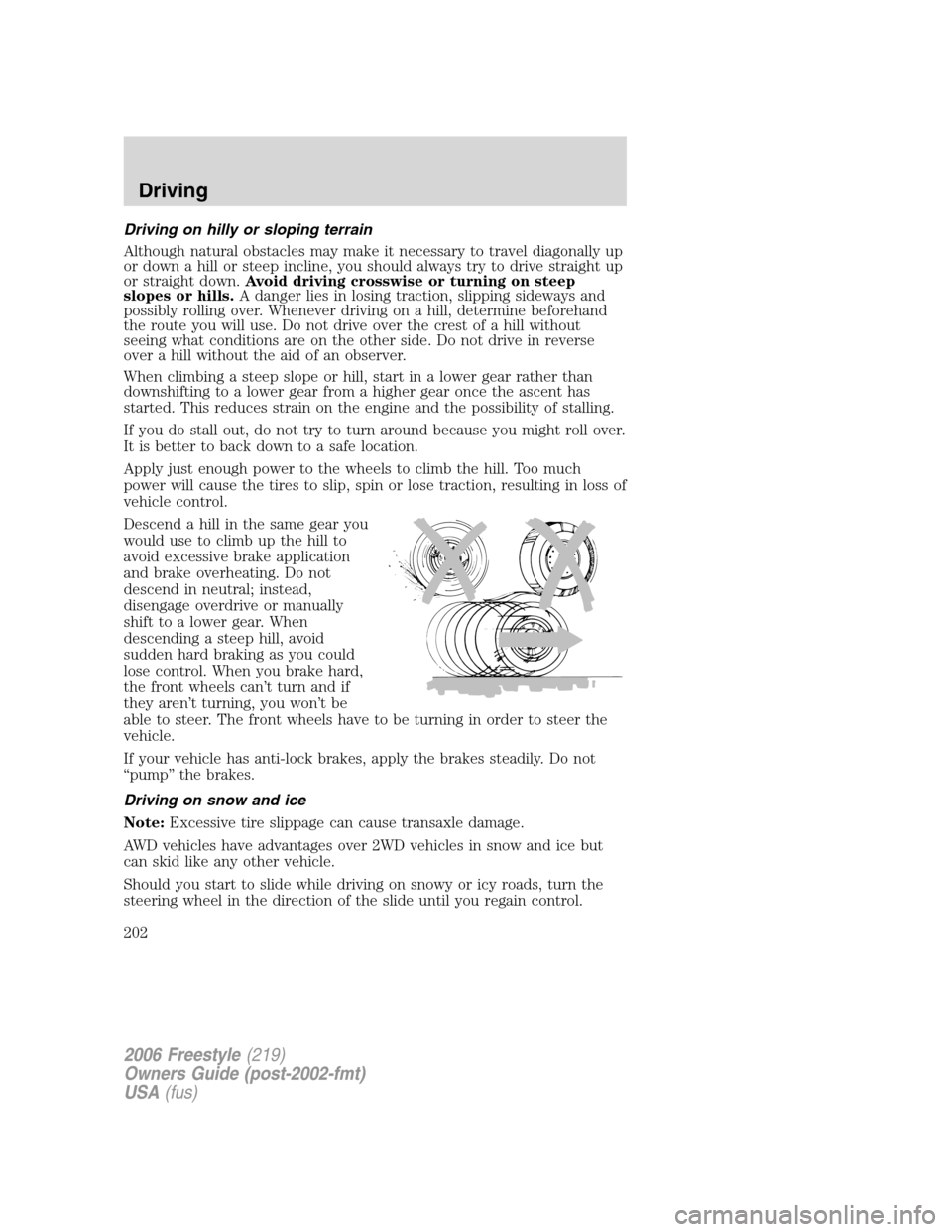
or straight down.Avoid driving crosswise or turning on steep
slopes or hills.A danger lies in losing traction, slipping sideways and
possibly rolling over. Whenever driving on a hill, determine beforehand
the route you will use. Do not drive over the crest of a hill without
seeing what conditions are on the other side. Do not drive in reverse
over a hill without the aid of an observer.
When climbing a steep slope or hill, start in a lower gear rather than
downshifting to a lower gear from a higher gear once the ascent has
started. This reduces strain on the engine and the possibility of stalling.
If you do stall out, do not try to turn around because you might roll over.
It is better to back down to a safe location.
Apply just enough power to the wheels to climb the hill. Too much
power will cause the tires to slip, spin or lose traction, resulting in loss of
vehicle control.
Descend a hill in the same gear you
would use to climb up the hill to
avoid excessive brake application
and brake overheating. Do not
descend in neutral; instead,
disengage overdrive or manually
shift to a lower gear. When
descending a steep hill, avoid
sudden hard braking as you could
lose control. When you brake hard,
the front wheels can’t turn and if
they aren’t turning, you won’t be
able to steer. The front wheels have to be turning in order to steer the
vehicle.
If your vehicle has anti-lock brakes, apply the brakes steadily. Do not
“pump” the brakes.
Driving on snow and ice
Note:Excessive tire slippage can cause transaxle damage.
AWD vehicles have advantages over 2WD vehicles in snow and ice but
can skid like any other vehicle.
Should you start to slide while driving on snowy or icy roads, turn the
steering wheel in the direction of the slide until you regain control.
2006 Freestyle(219)
Owners Guide (post-2002-fmt)
USA(fus)
Driving
202
Page 253 of 288
Do not add engine coolant when the engine is hot. Steam and
scalding liquids released from a hot cooling system can burn you
badly. Also, you can be burned if you spill coolant on hot engine parts.
Do not put engine coolant in the windshield washer fluid
container. If sprayed on the windshield, engine coolant could
make it difficult to see through the windshield.
•Add Motorcraft Premium Gold Engine Coolant
(yellow-colored), VC-7–A (U.S., except CA, OR and NM),
VC-7–B (CA, OR and NM),meeting Ford Specification
WSS-M97B51–A1.
Note:Use of Motorcraft Cooling System Stop Leak Pellets, VC-6, may
darken the color of Motorcraft Premium Gold Engine Coolant from
yellow to golden tan.
•Do not add/mix an orange-colored, extended life coolant such
as Motorcraft Specialty Orange Engine Coolant, VC-2 (US) or
CXC-209 (Canada), meeting Ford specification WSS-M97B44–D
with the factory-filled coolant.Mixing Motorcraft Specialty Orange
Engine Coolant or any orange-colored extended life product with your
factory filled coolant can result in degraded corrosion protection.
•A large amount of water without engine coolant may be added, in case
of emergency, to reach a vehicle service location. In this instance, the
cooling system must be drained and refilled with a 50/50 mixture of
engine coolant and distilled water as soon as possible. Water alone
(without engine coolant) can cause engine damage from corrosion,
overheating or freezing.
•Do not use alcohol, methanol, brine or any engine coolants
mixed with alcohol or methanol antifreeze (coolant).Alcohol
and other liquids can cause engine damage from overheating or
freezing.
•Do not add extra inhibitors or additives to the coolant.These
can be harmful and compromise the corrosion protection of the engine
coolant.
To reduce the risk of personal injury, make sure the engine is
cool before unscrewing the coolant pressure relief cap. The
cooling system is under pressure; steam and hot liquid can come out
forcefully when the cap is loosened slightly.
2006 Freestyle(219)
Owners Guide (post-2002-fmt)
USA(fus)
Maintenance and Specifications
253
Page 256 of 288
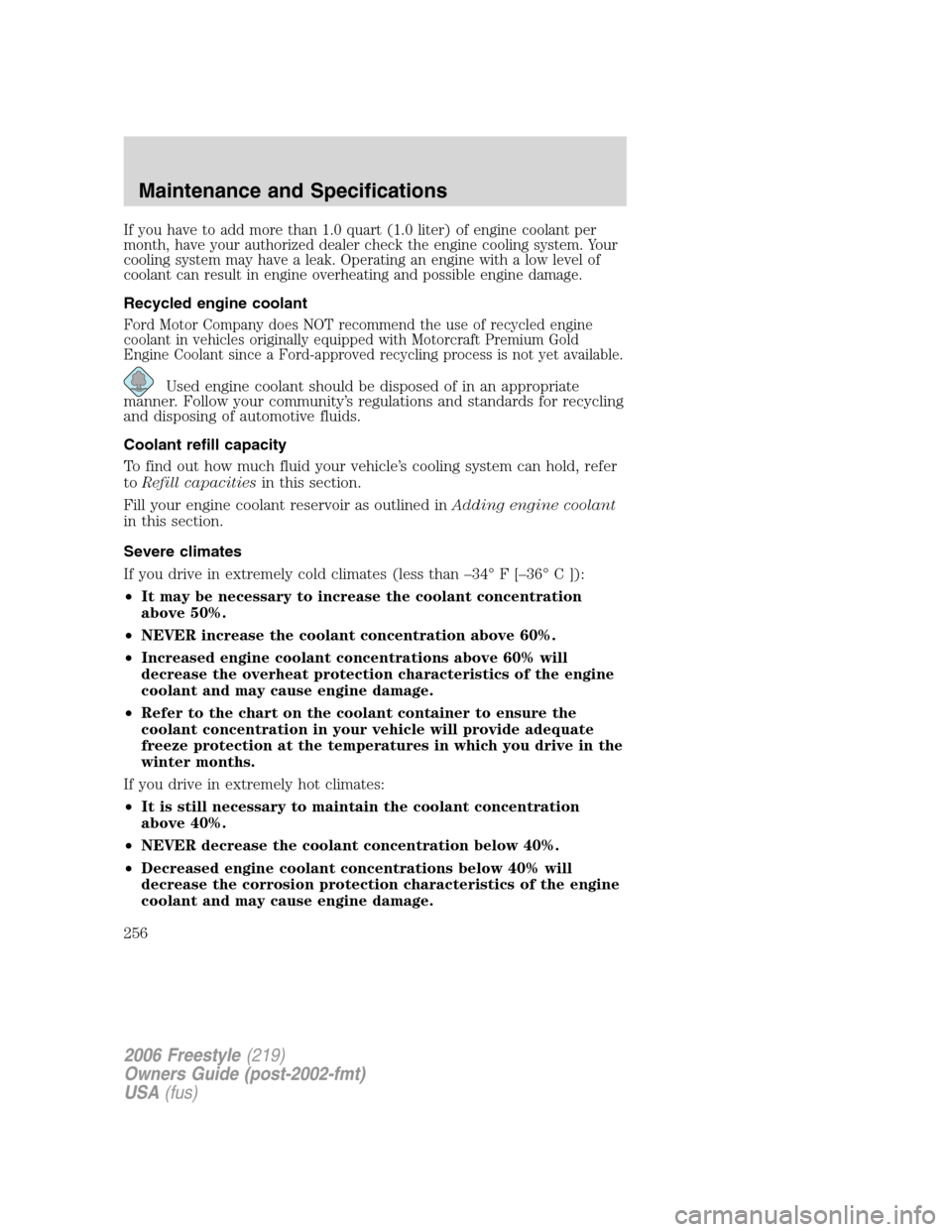
If you have to add more than 1.0 quart (1.0 liter) of engine coolant per
month, have your authorized dealer check the engine cooling system. Your
cooling system may have a leak. Operating an engine with a low level of
coolant can result in engine overheating and possible engine damage.
Recycled engine coolant
Ford Motor Company does NOT recommend the use of recycled engine
coolant in vehicles originally equipped with Motorcraft Premium Gold
Engine Coolant since a Ford-approved recycling process is not yet available.
Used engine coolant should be disposed of in an appropriate
manner. Follow your community’s regulations and standards for recycling
and disposing of automotive fluids.
Coolant refill capacity
To find out how much fluid your vehicle’s cooling system can hold, refer
toRefill capacitiesin this section.
Fill your engine coolant reservoir as outlined inAdding engine coolant
in this section.
Severe climates
If you drive in extremely cold climates (less than –34° F [–36° C ]):
•It may be necessary to increase the coolant concentration
above 50%.
•NEVER increase the coolant concentration above 60%.
•Increased engine coolant concentrations above 60% will
decrease the overheat protection characteristics of the engine
coolant and may cause engine damage.
•Refer to the chart on the coolant container to ensure the
coolant concentration in your vehicle will provide adequate
freeze protection at the temperatures in which you drive in the
winter months.
If you drive in extremely hot climates:
•It is still necessary to maintain the coolant concentration
above 40%.
•NEVER decrease the coolant concentration below 40%.
•Decreased engine coolant concentrations below 40% will
decrease the corrosion protection characteristics of the engine
coolant and may cause engine damage.
2006 Freestyle(219)
Owners Guide (post-2002-fmt)
USA(fus)
Maintenance and Specifications
256
Page 282 of 288
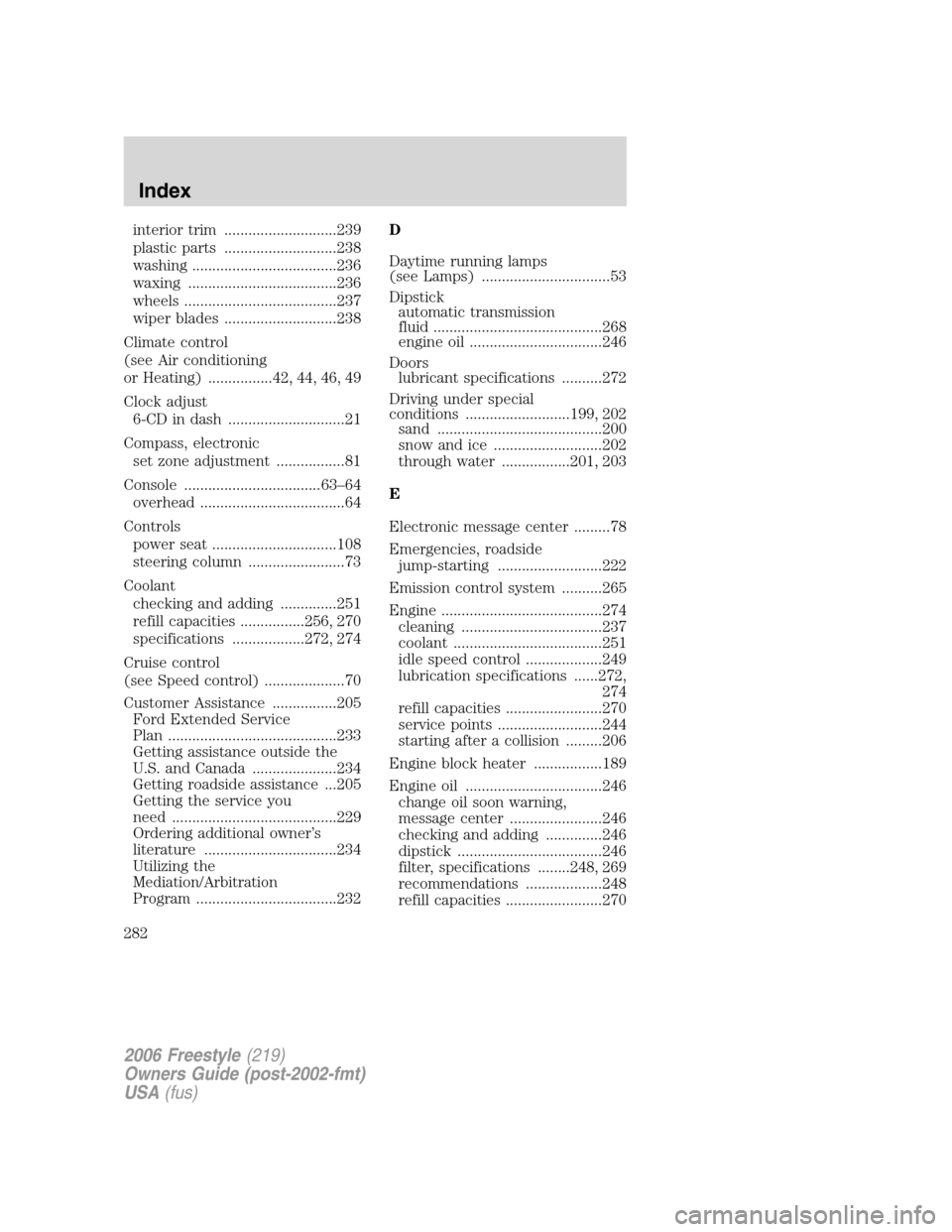
interior trim ............................239
plastic parts ............................238
washing ....................................236
waxing .....................................236
wheels ......................................237
wiper blades ............................238
Climate control
(see Air conditioning
or Heating) ................42, 44, 46, 49
Clock adjust
6-CD in dash .............................21
Compass, electronic
set zone adjustment .................81
Console ..................................63–64
overhead ....................................64
Controls
power seat ...............................108
steering column ........................73
Coolant
checking and adding ..............251
refill capacities ................256, 270
specifications ..................272, 274
Cruise control
(see Speed control) ....................70
Customer Assistance ................205
Ford Extended Service
Plan ..........................................233
Getting assistance outside the
U.S. and Canada .....................234
Getting roadside assistance ...205
Getting the service you
need .........................................229
Ordering additional owner’s
literature .................................234
Utilizing the
Mediation/Arbitration
Program ...................................232D
Daytime running lamps
(see Lamps) ................................53
Dipstick
automatic transmission
fluid ..........................................268
engine oil .................................246
Doors
lubricant specifications ..........272
Driving under special
conditions ..........................199, 202
sand .........................................200
snow and ice ...........................202
through water .................201, 203
E
Electronic message center .........78
Emergencies, roadside
jump-starting ..........................222
Emission control system ..........265
Engine ........................................274
cleaning ...................................237
coolant .....................................251
idle speed control ...................249
lubrication specifications ......272,
274
refill capacities ........................270
service points ..........................244
starting after a collision .........206
Engine block heater .................189
Engine oil ..................................246
change oil soon warning,
message center .......................246
checking and adding ..............246
dipstick ....................................246
filter, specifications ........248, 269
recommendations ...................248
refill capacities ........................270
2006 Freestyle(219)
Owners Guide (post-2002-fmt)
USA(fus)
Index
282
Page 283 of 288
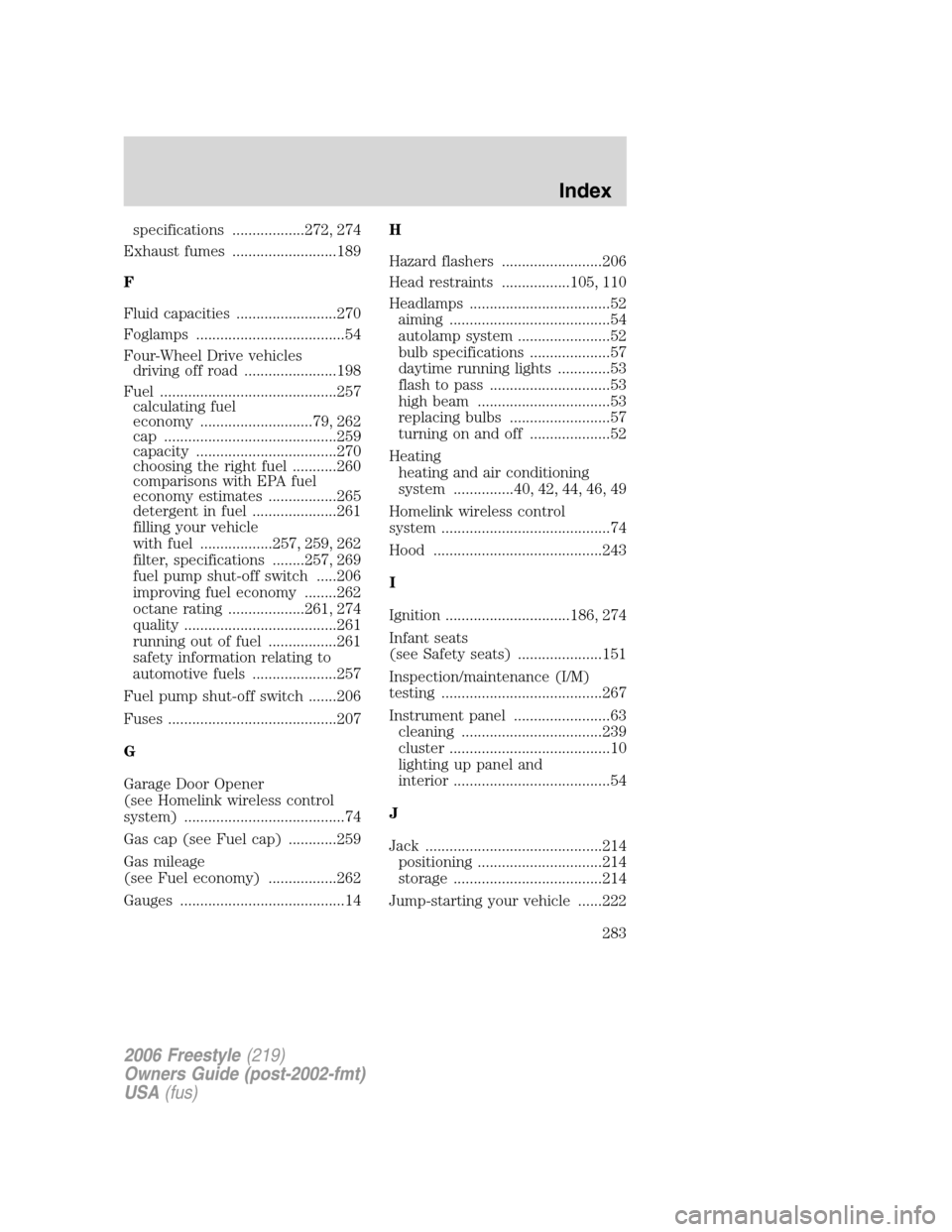
specifications ..................272, 274
Exhaust fumes ..........................189
F
Fluid capacities .........................270
Foglamps .....................................54
Four-Wheel Drive vehicles
driving off road .......................198
Fuel ............................................257
calculating fuel
economy ............................79, 262
cap ...........................................259
capacity ...................................270
choosing the right fuel ...........260
comparisons with EPA fuel
economy estimates .................265
detergent in fuel .....................261
filling your vehicle
with fuel ..................257, 259, 262
filter, specifications ........257, 269
fuel pump shut-off switch .....206
improving fuel economy ........262
octane rating ...................261, 274
quality ......................................261
running out of fuel .................261
safety information relating to
automotive fuels .....................257
Fuel pump shut-off switch .......206
Fuses ..........................................207
G
Garage Door Opener
(see Homelink wireless control
system) ........................................74
Gas cap (see Fuel cap) ............259
Gas mileage
(see Fuel economy) .................262
Gauges .........................................14H
Hazard flashers .........................206
Head restraints .................105, 110
Headlamps ...................................52
aiming ........................................54
autolamp system .......................52
bulb specifications ....................57
daytime running lights .............53
flash to pass ..............................53
high beam .................................53
replacing bulbs .........................57
turning on and off ....................52
Heating
heating and air conditioning
system ...............40, 42, 44, 46, 49
Homelink wireless control
system ..........................................74
Hood ..........................................243
I
Ignition ...............................186, 274
Infant seats
(see Safety seats) .....................151
Inspection/maintenance (I/M)
testing ........................................267
Instrument panel ........................63
cleaning ...................................239
cluster ........................................10
lighting up panel and
interior .......................................54
J
Jack ............................................214
positioning ...............................214
storage .....................................214
Jump-starting your vehicle ......222
2006 Freestyle(219)
Owners Guide (post-2002-fmt)
USA(fus)
Index
283