2006 FORD FREESTAR flat tire
[x] Cancel search: flat tirePage 236 of 320

Auxiliary relay box (cooling fans)
The relay box is located in the engine compartment by the radiator.
Fuse/Relay
locationFuse amp
ratingDescription
1 — Cooling fan relay #4
2 — Cooling fan relay #5
3 — Cooling fan relay #3
4 — Cooling fan relay #1
5 — Cooling fan relay #2
6 40A* Right-hand cooling fan motor (Vehicles with
trailer tow package only)
7 15A** Low-speed cooling fan circuit breaker
(Vehicles with trailer tow package only)
8 40A* Left-hand cooling fan motor (Vehicles with
trailer tow package)
10A** Low-speed cooling fan circuit breaker
(Vehicles without trailer tow package)
* Maxi fuse **Circuit breaker
CHANGING A FLAT TIRE
If you get a flat tire while driving:
•do not brake heavily.
•gradually decrease the vehicle’s speed.
•hold the steering wheel firmly.
•slowly move to a safe place on the side of the road.
•If your low tire warning light is on, refer toLow tire warningin this
chapter.
2006 Freestar(win)
Owners Guide (post-2002-fmt)
USA(fus)
Roadside Emergencies
236
Page 240 of 320
Have a flat tire serviced by an authorized dealer in order to prevent
damage to the TPMS sensor, refer toTire Pressure Monitoring System
(TPMS)in theTires, Wheels and Loadingchapter. Replace the spare
tire with a road tire as soon as possible.
The spare tire and tools for your vehicle are stowed in the following
locations:
Item Location
Spare tire Under the vehicle, just forward of
the rear bumper.
Jack Behind the access panel located
on the right rear quarter panel
interior trim.
Jack handle Attached to the jack with a clip.
Flat tire tether, wing screw Inside tire tether kit, next to jack.
Jack extension tool (cargo van
model only)Attached to the jack kit.
Removing the jack and tools
1. Locate the access panel on the interior trim. Rotate the panel
retaining clip and remove the panel.
2. Remove the jack and lug nut wrench by turning the thumbscrew
counterclockwise to relieve tension against the stowage bracket.
Removing the spare tire
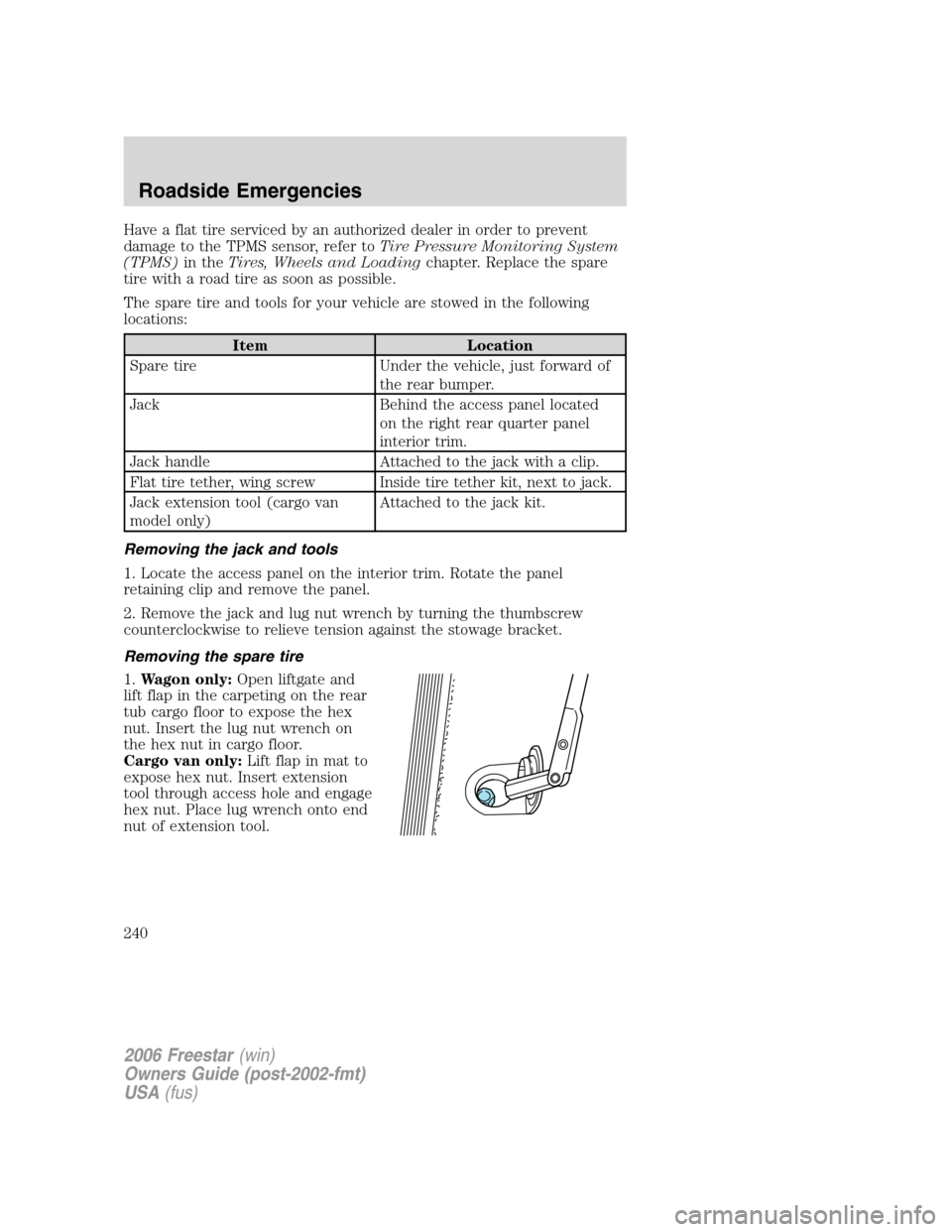
1.Wagon only:Open liftgate and
lift flap in the carpeting on the rear
tub cargo floor to expose the hex
nut. Insert the lug nut wrench on
the hex nut in cargo floor.
Cargo van only:Lift flap in mat to
expose hex nut. Insert extension
tool through access hole and engage
hex nut. Place lug wrench onto end
nut of extension tool.
2006 Freestar(win)
Owners Guide (post-2002-fmt)
USA(fus)
Roadside Emergencies
240
Page 241 of 320
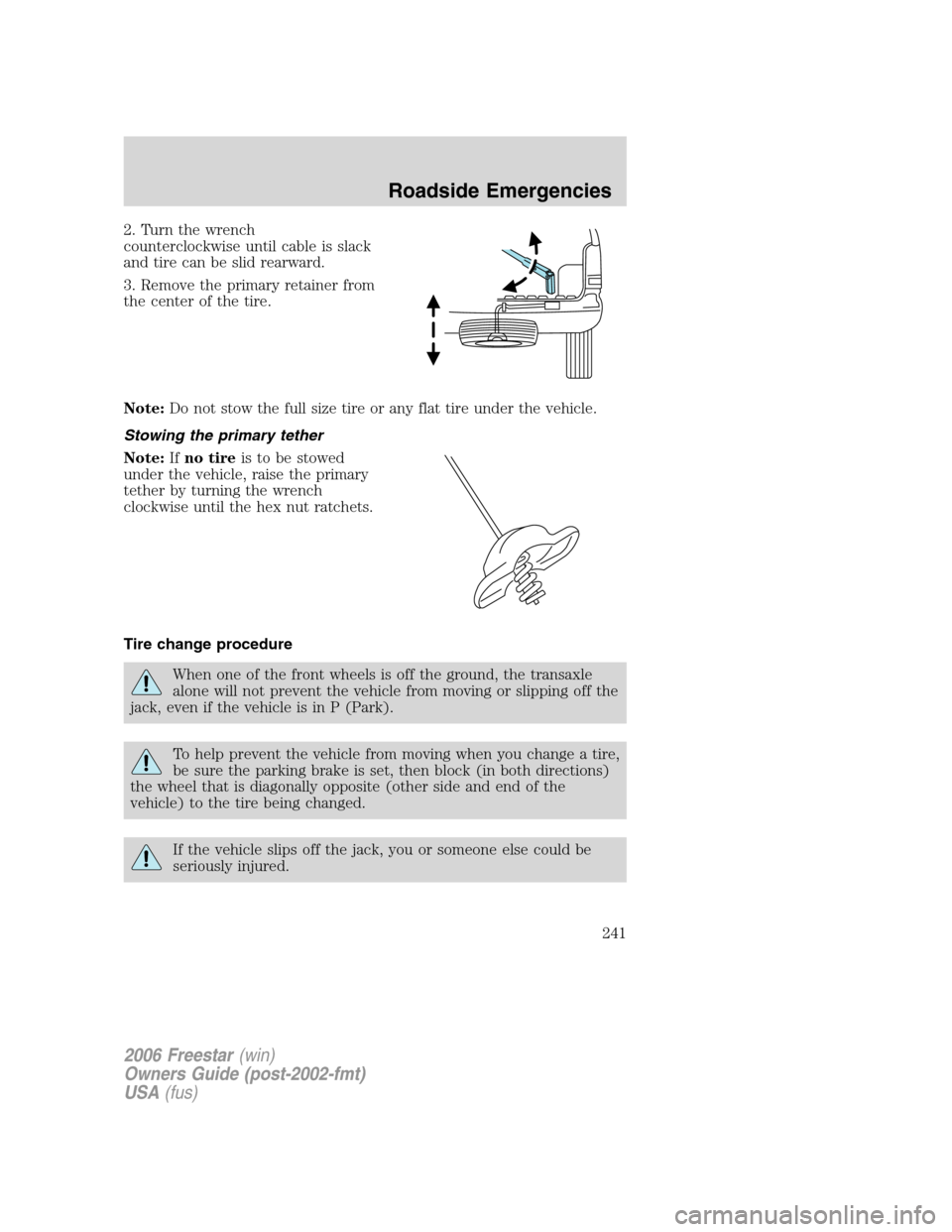
2. Turn the wrench
counterclockwise until cable is slack
and tire can be slid rearward.
3. Remove the primary retainer from
the center of the tire.
Note:Do not stow the full size tire or any flat tire under the vehicle.
Stowing the primary tether
Note:Ifno tireis to be stowed
under the vehicle, raise the primary
tether by turning the wrench
clockwise until the hex nut ratchets.
Tire change procedure
When one of the front wheels is off the ground, the transaxle
alone will not prevent the vehicle from moving or slipping off the
jack, even if the vehicle is in P (Park).
To help prevent the vehicle from moving when you change a tire,
be sure the parking brake is set, then block (in both directions)
the wheel that is diagonally opposite (other side and end of the
vehicle) to the tire being changed.
If the vehicle slips off the jack, you or someone else could be
seriously injured.
2006 Freestar(win)
Owners Guide (post-2002-fmt)
USA(fus)
Roadside Emergencies
241
Page 243 of 320
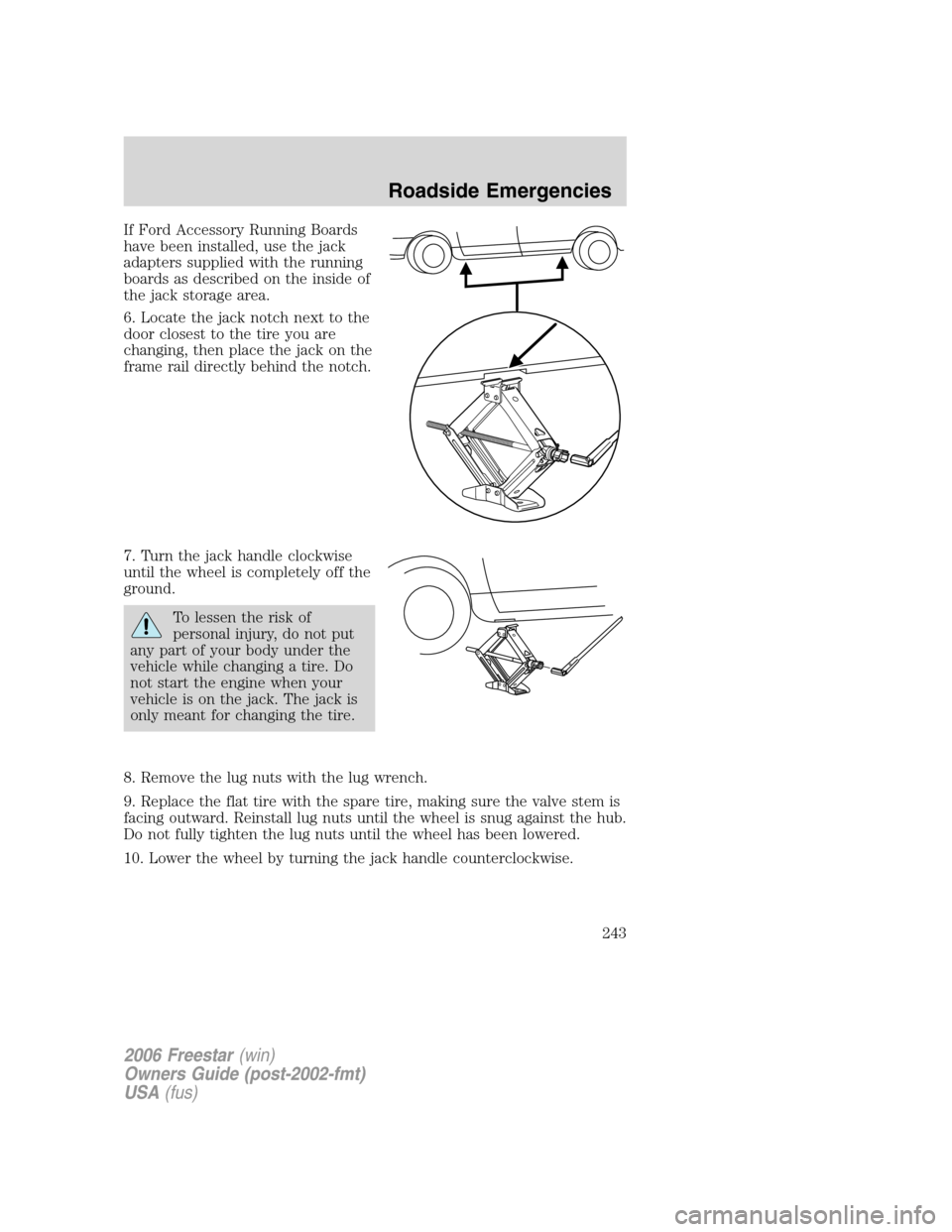
If Ford Accessory Running Boards
have been installed, use the jack
adapters supplied with the running
boards as described on the inside of
the jack storage area.
6. Locate the jack notch next to the
door closest to the tire you are
changing, then place the jack on the
frame rail directly behind the notch.
7. Turn the jack handle clockwise
until the wheel is completely off the
ground.
To lessen the risk of
personal injury, do not put
any part of your body under the
vehicle while changing a tire. Do
not start the engine when your
vehicle is on the jack. The jack is
only meant for changing the tire.
8. Remove the lug nuts with the lug wrench.
9. Replace the flat tire with the spare tire, making sure the valve stem is
facing outward. Reinstall lug nuts until the wheel is snug against the hub.
Do not fully tighten the lug nuts until the wheel has been lowered.
10. Lower the wheel by turning the jack handle counterclockwise.
2006 Freestar(win)
Owners Guide (post-2002-fmt)
USA(fus)
Roadside Emergencies
243
Page 244 of 320

11. Remove the jack and fully
tighten the lug nuts in the order
shown. Refer toWheel lug nut
torque specificationslater in this
chapter for the proper lug nut
torque specification.
12. Installing the optional wheel
cover or center ornament:
•If equipped with a bolted-on
wheel cover, install the wheel
cover and tighten the five plastic nuts until they click (do not use
power tools on these nuts).
•If equipped with the center ornament, install the center ornament by
snapping it back into place.
13. Put flat tire, jack and lug wrench away in the proper stowage
locations.
Stowing the flat and full-size tire
Failure to follow these instructions may result in personal injury.
Do not install the flat tire or any full size tire underneath the
vehicle.
Remove tether kit from the jack storage area.
Wagon only:
1. Place tire upright inside the vehicle near the rear of the vehicle with
the valve stem facing the front of the vehicle.
2. Pass the cable retainer through the center of the wheel.
3. Raise the tire and secure both ends of the cable with the wing nut
provided in the tether cable kit, by installing it on the luggage back panel
and turning the wing screw clockwise. You will hear an audible click
when the tire is properly secured.
4. Check that the flat tire is properly secured.
Cargo van only:
1. Remove the perforated section of the vinyl mat in the center floor
area in order to install the wing screw.
2. Using the tether cable kit located with the jack, pass the cable retainer
through center of the wheel.
1
4 3
2 5
2006 Freestar(win)
Owners Guide (post-2002-fmt)
USA(fus)
Roadside Emergencies
244
Page 245 of 320
3. Lay the tire flat and secure the cable with wing screw by installing it
on the wing screw retainer in the floor and turning the wing screw
clockwise. You will hear an audible click when the tire is properly
secured.
4. Check that the flat tire is properly secured.
Stowing the spare tire
1. Lay the spare, inflated tire on the ground with the valve stem facing
down.
2. Insert the primary wheel retainer through the center of the wheel.
3. Use the winch mechanism to pull, and raise the tire under the vehicle.
4.Wagon only:Raise the tire by turning the lug nut wrench clockwise
until the hex nut ratchets.
Cargo van only:Raise the tire by turning the jack extension tool
clockwise with the lug nut wrench until the hex nut ratchets.
The effort to turn the jack handle increases significantly and the spare
tire carrier ratchets or slips when the tire is raised to the maximum
tightness. Tighten to the best of your ability, to the point where the
ratchet/slip occurs, if possible. The spare tire carrier will not allow you to
overtighten. If the spare tire carrier ratchets or slips with little effort,
take the vehicle to your authorized dealer for assistance at your earliest
convenience.
5. Check that the tire lies flat against the frame and is properly
tightened. Try to push or pull, then turn the tire to be sure it will not
move. Loosen and retighten, if necessary. Failure to properly stow the
spare tire may result in failure of the winch cable and loss of the tire.
NOTE:Visually check to make sure the wheel plate is resting flat against
the tire.
6. Repeat this tightness check procedure when servicing the spare tire
pressure (every six months, perScheduled Maintenance Guide),or at
any time that the spare tire is disturbed through service of other
components.
2006 Freestar(win)
Owners Guide (post-2002-fmt)
USA(fus)
Roadside Emergencies
245
Page 246 of 320
WHEEL LUG NUT TORQUE SPECIFICATIONS
Retighten the lug nuts to the specified torque at 500 miles (800 km)
after any wheel disturbance (rotation, flat tire, wheel removal, etc.).
Bolt size Wheel lug nut torque*
lb.ft. N•m
12x 20 100 135
* Torque specifications are for nut and bolt threads free of dirt and
rust. Use only Ford recommended replacement fasteners.
When a wheel is installed, always remove any corrosion, dirt or
foreign materials present on the mounting surfaces of the wheel
or the surface of the wheel hub, brake drum or brake disc that
contacts the wheel. Ensure that any fasteners that attach the rotor to
the hub are secured so they do not interfere with the mounting
surfaces of the wheel. Installing wheels without correct metal-to-metal
contact at the wheel mounting surfaces can cause the wheel nuts to
loosen and the wheel to come off while the vehicle is in motion,
resulting in loss of control.
JUMP STARTING
The gases around the battery can explode if exposed to flames,
sparks, or lit cigarettes. An explosion could result in injury or
vehicle damage.
Batteries contain sulfuric acid which can burn skin, eyes and
clothing, if contacted.
Do not attempt to push-start your vehicle. Automatic
transmissions do not have push-start capability; doing so may
damage the catalytic converter.
Preparing your vehicle
When the battery is disconnected or a new battery is installed, the
transmission must relearn its shift strategy. As a result, the transmission
may have firm and/or soft shifts. This operation is considered normal and
will not affect function or durability of the transmission. Over time, the
adaptive learning process will fully update transmission operation.
1.Use only a 12–volt supply to start your vehicle.
2006 Freestar(win)
Owners Guide (post-2002-fmt)
USA(fus)
Roadside Emergencies
246
Page 292 of 320

•Revving the engine before turning it off may reduce fuel economy.
•Using the air conditioner or defroster may reduce fuel economy.
•You may want to turn off the speed control in hilly terrain if
unnecessary shifting between third and fourth gear occurs.
Unnecessary shifting of this type could result in reduced fuel
economy.
•Warming up a vehicle on cold mornings is not required and may
reduce fuel economy.
•Resting your foot on the brake pedal while driving may reduce fuel
economy.
•Combine errands and minimize stop-and-go driving.
Maintenance
•Keep tires properly inflated and use only recommended size.
•Operating a vehicle with the wheels out of alignment will reduce fuel
economy.
•Use recommended engine oil. Refer toLubricant specificationsin
this chapter.
•Perform all regularly scheduled maintenance items. Follow the
recommended maintenance schedule and owner maintenance checks
found inscheduled maintenance information.
Conditions
•Heavily loading a vehicle or towing a trailer may reduce fuel economy
at any speed.
•Carrying unnecessary weight may reduce fuel economy (approximately
1 mpg [0.4 km/L] is lost for every 400 lb [180 kg] of weight carried).
•Adding certain accessories to your vehicle (for example bug
deflectors, rollbars/light bars, running boards, ski/luggage racks) may
reduce fuel economy.
•Using fuel blended with alcohol may lower fuel economy.
•Fuel economy may decrease with lower temperatures during the first
8–10 miles (12–16 km) of driving.
•Driving on flat terrain offers improved fuel economy as compared to
driving on hilly terrain.
•Transmissions give their best fuel economy when operated in the top
cruise gear and with steady pressure on the gas pedal.
•Close windows for high speed driving.
2006 Freestar(win)
Owners Guide (post-2002-fmt)
USA(fus)
Maintenance and Specifications
292