2006 FIAT DUCATO light
[x] Cancel search: lightPage 15 of 258

14GETTING TO KNOW YOUR VEHICLE
Do not leave the key inserted in the
switch. Cover the keyhole with the
rubber cap to prevent dust and wa-
ter getting in.
Emergency keys should be left in the
car coupled with the switch.
HOW TO KNOW IF THE
ALARM HAS GONE OFF
After deactivating the system, led A-
fig. 9will indicate the theft attempt
specifying also the cause of the alarm:
fixed light:remote control bat-
tery down
1 blink:right-hand door
2 blinks:left-hand door
5 blinks:volumetric sensors
(indicate a movement
inside the passenger’s
compartment)
6 blinks:bonnet To cut off the alarm before this,
press the remote control button; if
this is unsuccessful, turn the emer-
gency key to OFF(see next paragraph
“How to turn the alarm off”)
HOW TO TURN
THE ALARM OFF
If the remote control batteries run
down, or the car alarm system is
faulty, the electronic alarm can be cut
out by using one of the two emer-
gency keys supplied set on the system
deactivation control unit (that is
housed in the fuse box on the right
side of the dashboard).
To do this, open the fuse box, take
off the switch rubber cap, insert the
key and turn it counterclockwise
(OFFposition); the system is now de-
activated.
To turn the system back on, turn the
key clockwise (ONposition).7 blinks:load
compartment
8 blinks:tampering with
ignition switch
9 blinks:alarm wires cut
10 blinks:at least three causes
of alarm.
The led goes off when turning the
key to MAR or after about 2 minutes
blinking.
Since the electronic car
alarm absorbs electricity,
if you will not be using
your car for more than a month,
switch the system off with the re-
mote control and turn the emer-
gency key to OFF.
Page 24 of 258

23GETTING TO KNOW YOUR VEHICLE
Over 1.50 m in height, from the
point of view of restraint systems, chil-
dren are considered as adults and
wear the seat belts normally.
We recommend using Lineaccessori
Fiat child restraint systems for each
weight group. These systems were
specifically designed and tested for Fi-
at vehicles.
fig. 21
F0D0006m
With passenger’s air bag
active, never place child’s
seats with the cradle facing back-
wards since the air bag activation
could cause to the child serious in-
juries, even mortal, regardless of the
seriousness of the crash that trig-
gered it. You are advised to carry
children always with proper re-
straint systems on the rear seats, as
this is the most protected position
in the case of a crash.
WARNING
SERIOUS DANGER If it is
absolutely necessary to car-
ry a child on the front pas-
senger seat with the cradle
child’s seat facing back-
wards, the front passenger’s air bag
must be deactivated using the key
switch. In this case it is absolutely
necessary to check the warning
light
F(see paragraph “Passen-
ger’s front air bag”) to make sure
that deactivation has actually tak-
en place.
WARNING
Page 28 of 258

27GETTING TO KNOW YOUR VEHICLE
IMPORTANTFor foreign markets
(Italy excluded), the cabs of vehicles
for carrying goods are suitable for fit-
ting child restraint systems of the
“Universal” category, according to Eu-
ropean Standard ECE-R44 for the tab-
ulated groups.
IMPORTANTFor Italian market
only (foreign countries excluded), the
cabs of vehicle for carrying passengers
(combi and panorama), are suitable for
fitting child restraint systems of the
“Universal” category, according to Eu-
ropean Standard ECE-R44 for the tab-
ulated groups.
Below is a summary of the rules
of safety to be followed for car-
rying children:
1) The recommended position for
installing child’s seat is on the rear seat,
as it is the most protected in the case
of a crash;2) In vehicles fitted with passenger
airbag, neverplace child’s restraint
systems on the front seat.
3) If the passenger’s airbag is deac-
tivated always check the warning light
Fon the instrument panel to make
sure that it has actually been deacti-
vated.
4) Attain to the instructions for fas-
tening the specific child restraint sys-
tem which you are using. These in-
structions must be provided by the
manufacturer. Keep the child restraint
system installation instructions with
the vehicle documents and with this
Handbook. Never use a child restraint
system without installation instruc-
tions.
5) Always check the seat belt is well
fastened by pulling the webbing.
6) Only one child is to be strapped
to each retaining system.
7) Always check the seat belts do
not fit around the child’s throat.8) While travelling, do not let the
child sit incorrectly or release the
belts.
9)Passengers should never carry
children on their laps. No-one, how-
ever strong they are, can hold a child
in the event of a crash.
10) Replace the child restraint sys-
tem after an accident.
With passenger’s air bag
active, never place child’s
seats with the cradle facing back-
wards since the air bag activation
could cause to the child serious in-
juries, even mortal, regardless of the
seriousness of the crash that trig-
gered it. You are advised to carry
children always with proper re-
straint systems on the rear seats, as
this is the most protected position
in the case of a crash.
WARNING
Page 29 of 258

28GETTING TO KNOW YOUR VEHICLE
IGNITION SWITCH
The key can be turned to four dif-
ferent positions fig. 26.
STOP:engine off, key can be re-
moved, steering column locked.
MAR:drive position. All electrical
devices can be used.
AVV:to start the engine.
PARK:engine off, parking lights on,
key can be removed, steering column
locked. To turn the key to PARK,
press button A.STEERING COLUMN LOCK
To engage the lock: remove the ig-
nition key at STOPor PARK, and
turn the steering wheel until it locks.
To release the lock: rock the steer-
ing wheel slightly as you turn the igni-
tion key to MAR.
fig. 26
F0D0052m
If the ignition switch has
been tampered with (e.g.
someone has tried to steal your ve-
hicle), get a Fiat Dealership to make
sure it is still functioning properly
before you start driving again.
WARNING
When you get out of the
vehicle, always remove the
ignition key. This will prevent any-
one from accidentally working the
controls. Remember to apply the
handbrake and, if the vehicle is
faced up on a steep slope engage
the first gear. If it is facing down,
engage the reverse gear. Never
leave children in the vehicle by
themselves.
WARNING
Never remove the ignition
key while the vehicle is
moving. The steering wheel will au-
tomatically lock as soon as you try
to turn it. This also applies when
the vehicle is being towed.
WARNING
It is absolutely forbidden to
carry out whatever after-
market operation involving steering
system or steering column modifi-
cations (e.g.: installation of anti-
theft Device) that could badly af-
fect performance and safety, cause
the lapse of warranty and also re-
sult in non-compliance of the car
with homologation requirements.
WARNING
Page 31 of 258

30GETTING TO KNOW YOUR VEHICLE
INSTRUMENTS
ENGINE COOLANT
TEMPERATURE
GAUGE fig. 29
Under normal conditions, the needle
should hover around the middle of the
scale.
If it approaches the red section, it
means that the engine is being over-
taxed and you should reduce your de-
mand on it.
Also travelling too slowly when the
outside temperature is very hot can
cause the needle to approach the red
sector. In this case, it is better to stop
and turn the engine off. After a few
moments you can start the engine
again and accelerate slightly.SPEEDOMETER
fig. 30- left-hand drive versions
fig. 31- right-hand drive versions.
REV COUNTER fig. 32
IMPORTANT The electronic sys-
tem progressively blocks fuel flow to
prevent engine from overrevving. This
will lead to a progressive loss of en-
gine power. If the situation persists
even after the measures
you have taken, turn off
the engine and have the vehicle
seen at a Fiat Dealership.
fig. 29
F0D0150m
fig. 30
F0D0149m
fig. 31
F0D0153m
fig. 32
F0D0151m
Page 32 of 258

31GETTING TO KNOW YOUR VEHICLE
fig. 35 - total kilometres
F0A0011m
fig. 36 - trip kilometres
F0A0012m
FUEL LEVEL GAUGE
When the fuel reserve warning light
A-fig. 33comes on it means that
there are approximately 8 - 10 litres
of fuel left in the tank.
Do not travel with the fuel tank al-
most empty: the gaps in fuel delivery
could damage the catalyst.ODOMETER
The following indications are shown
alternately on the display when press-
ing button E - fig. 34:
fig. 35- total kilometres
fig. 36- trip kilometres
fig. 33
F0D0152m
fig. 34
F0D0155m
There is only one switch E-fig. 34to
zero the partial kilometres and to se-
lect the total/partial mileage:
– when total kilometres are dis-
played, press the button for less than
2 seconds (impulse) to have the par-
tial rate (when releasing the button);
– when trip kilometres are displayed,
press the button for less than 2 sec-
onds (impulse) to have the total rate
(when releasing the button). Press the
button for more than 2 seconds for
zero setting (when releasing the but-
ton).
Page 34 of 258
33GETTING TO KNOW YOUR VEHICLE
4)If the engine is started while mea-
surement is being performed, the
gauge will display total or partial km
run and time.
Press button E-fig. 34to stop mea-
suring; in this case kilometres run and
the time will be displayed.
SERVICE INDICATOR
Scheduled Servicing provides vehicle
servicing every 30.000/20.000/15.000
kilometres or once a year. For Coun-
tries / markets where applicable,
Scheduled Servicing provides vehicle
servicing every 18.600 / 12.500 / 9.300
miles (instead of kilometres) or once
a year.
This indication will be displayed au-
tomatically when turning the ignition
key to MAR, through servicing indica-
tor 1-fig. 43or 1-fig.44and through
kilometre indicator 2-fig. 43or daily
indicator 2-fig. 44when 2.000 km (or
1.200 mi) or 30 days are left before the
next service operation deadline and it
is proposed again every 200 km (or
200 mi) or every three days.
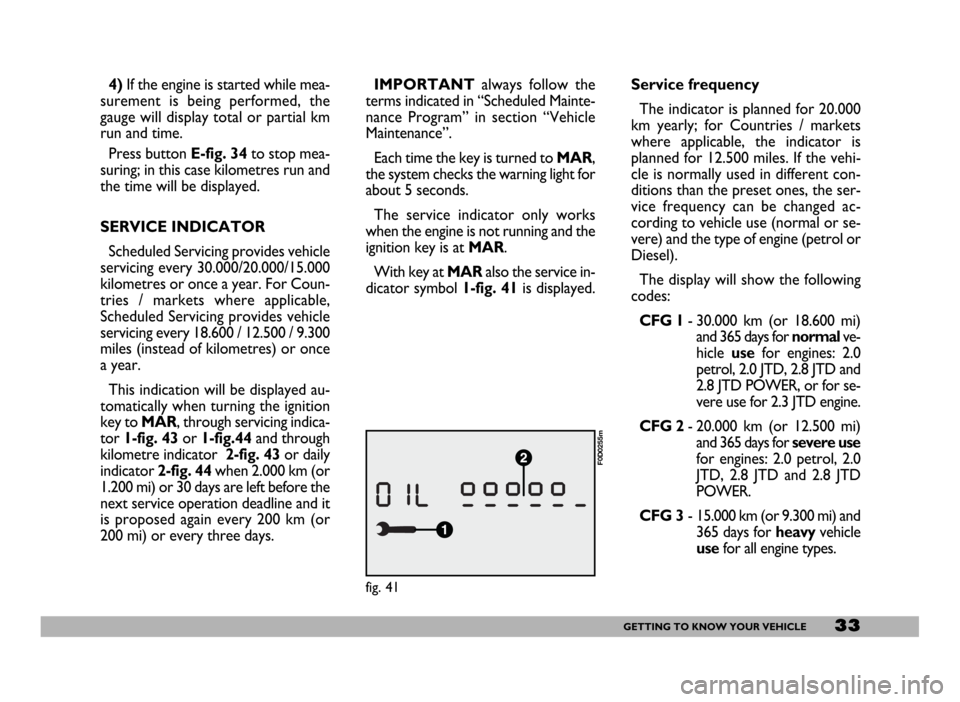
fig. 41
F0D0255m
IMPORTANTalways follow the
terms indicated in “Scheduled Mainte-
nance Program” in section “Vehicle
Maintenance”.
Each time the key is turned to MAR,
the system checks the warning light for
about 5 seconds.
The service indicator only works
when the engine is not running and the
ignition key is at MAR.
With key at MARalso the service in-
dicator symbol 1-fig. 41is displayed.Service frequency
The indicator is planned for 20.000
km yearly; for Countries / markets
where applicable, the indicator is
planned for 12.500 miles. If the vehi-
cle is normally used in different con-
ditions than the preset ones, the ser-
vice frequency can be changed ac-
cording to vehicle use (normal or se-
vere) and the type of engine (petrol or
Diesel).
The display will show the following
codes:
CFG 1- 30.000 km (or 18.600 mi)
and 365 days for normalve-
hicle usefor engines: 2.0
petrol, 2.0 JTD, 2.8 JTD and
2.8 JTD POWER, or for se-
vere use for 2.3 JTD engine.
CFG 2- 20.000 km (or 12.500 mi)
and 365 days for severe use
for engines: 2.0 petrol, 2.0
JTD, 2.8 JTD and 2.8 JTD
POWER.
CFG 3- 15.000 km (or 9.300 mi) and
365 days for heavyvehicle
usefor all engine types.
Page 36 of 258

35GETTING TO KNOW YOUR VEHICLE
WARNING LIGHTS
The warning lights come on in the
following circumstances:
BATTERY NOT
RECHARGING
PROPERLY (red)
When there is a fault in the current
generating system. The light comes on
when you turn the ignition key to
MARand should go out as soon as
the engine starts.
A delay in the light going out is ac-
ceptable only when the engine is idling.
Contact a Fiat Dealershipas soon
as possible to prevent draining the bat-
tery.
w
IMPORTANTYou should contact
a Fiat Dealershipas soon as prob-
lems arise without waiting for the next
service deadline.
At next startings, wrench 1-fig. 43
will come on with fixed light for 5 sec-
onds and the display will show again
time and km or mi.
At zero km (or zero miles)
Turning the ignition key to MARin-
dicator 1-fig. 41will flash for 5 sec-
onds with the number of kilometres
or miles (0 km or 0 mi) 2-fig. 45left
before the next service operation.
After these 5 seconds, the odome-
ter will return to normal operation
and display 2 will show either the to-
tal or partial kilometres or total or
partial miles.At next startings, both wrench 1-
fig. 45and km (or miles) 2-fig. 45will
flash for five seconds, then the display
will show again time and km or miles,
where provided.
This situation will subsist until service
frequency is reset by entering code
“CFG 1” or “CFG 2” or “CFG 3”.
fig. 45
F0D0222m