Page 254 of 440

NOTE:The transfer case Neutral (N) position is to be
used for recreational towing only. See Recreational Tow-
ing section for specific procedures on shifting into and
out of Neutral (N).
Transfer Case Position Indicator Lights
Transfer case position indicator lights are located on the
instrument cluster. If there are no indicator lights on or
flashing the transfer case position is All-Wheel Drive
(AWD) and indicate the current and desired transfer case
selection (4HI⇔4LOCK).
The “SVC 4WD” warning light monitors the electric shift
4WD system. If this light remains on after engine start up
or illuminates during driving, it means that the 4WD
system is not functioning properly and that service is
required.
WARNING!
Always engage the parking brake when powering
down the vehicle if the�Service 4WD�light is
illuminated. Not engaging the parking brake may
allow the vehicle to roll which may cause personal
injury.
NOTE:Do not attempt to make a shift while only the
front or rear wheels are spinning. The NV 244 Generation
II transfer case is not equipped with a synchronizer and
therefore the front and rear driveshaft speeds must be
equal for the shift to take place. Shifting while only the
front or rear wheels are spinning can cause damage to the
transfer case.
254 STARTING AND OPERATING
Page 256 of 440

4LOCK
Four-Wheel-Drive LOCK - Locks the transfer case inter-
axle differential. Forces front and rear wheels to rotate at
the same speed. Additional traction for loose, slippery
road surfaces only.
4LO
Four-Wheel-Drive Low Range - Low speed 4 wheel
drive. Locks the transfer case inter-axle differential.
Forces the front and rear wheels to rotate at the same
speed. Additional traction and maximum pulling power
for loose, slippery road surfaces only. Do not exceed 25
mph (40 km/h).
N
Neutral - Disengages both the front and rear driveshafts
from the powertrain. To be used for flat towing behind
another vehicle. See Recreational Towing for more infor-
mation.Shifting Procedure - NV 244 Generation II
Transfer Case
NOTE:The 4x4 system will not allow shifts between
AWD/ 4LOCK if the rear wheels are spinning (no
traction). In this situation a position indicator light will
flash and the original position indicator light will remain
ON. At this time, reduce speed and stop spinning the
256 STARTING AND OPERATING
Page 257 of 440

wheels to complete the shift. There may be a delay up to
13 seconds for the shift to complete after the wheels have
stopped spinning.
NOTE:Delayed shifting out of the 4LOCK position may
be experienced due to uneven tire wear, low tire pressure,
or excessive loading.
NOTE:When shifting into or out of 4LO some gear
noise may be heard. This noise is normal and is not
detrimental to the vehicle or occupants.
Shifting can be performed with the vehicle rolling 2 to 3
mph (3 to 5 km/h) or completely stopped. USE EITHER
OF THE FOLLOWING PROCEDURES:
Preferred Procedure
1. With the engine RUNNING, slow vehicle to 2 to 3
mph (3 to 5 km/h).
2. Shift the transmission into NEUTRAL.3. While still rolling, rotate the transfer case control
switch to the desired position.
4. After the position indicator light has stopped flashing,
shift the transmission back into gear.
Alternate Procedure
1. Bring the vehicle to complete stop.
2. With the key ON and the engine either OFF or
RUNNING, shift the transmission into NEUTRAL.
3. Rotate the transfer case control switch to the desired
position.
4. After the position indicator light has stopped flashing,
shift the transmission back into gear.
NOTE:The ignition key must be ON for a shift to take
place and for the position indicator lights to be operable.
If the key is not ON then the shift will not take place and
no position indicator lights will be on or flashing.
STARTING AND OPERATING 257
5
Page 258 of 440
NOTE:If any of the requirements to select a new
transfer case position have not been met, the transfer case
will not shift. The indicator light will flash and the
current transfer case position will be maintained. To retry
the selection, turn the control knob back to the current
position, wait five (5) seconds, and retry the shift.
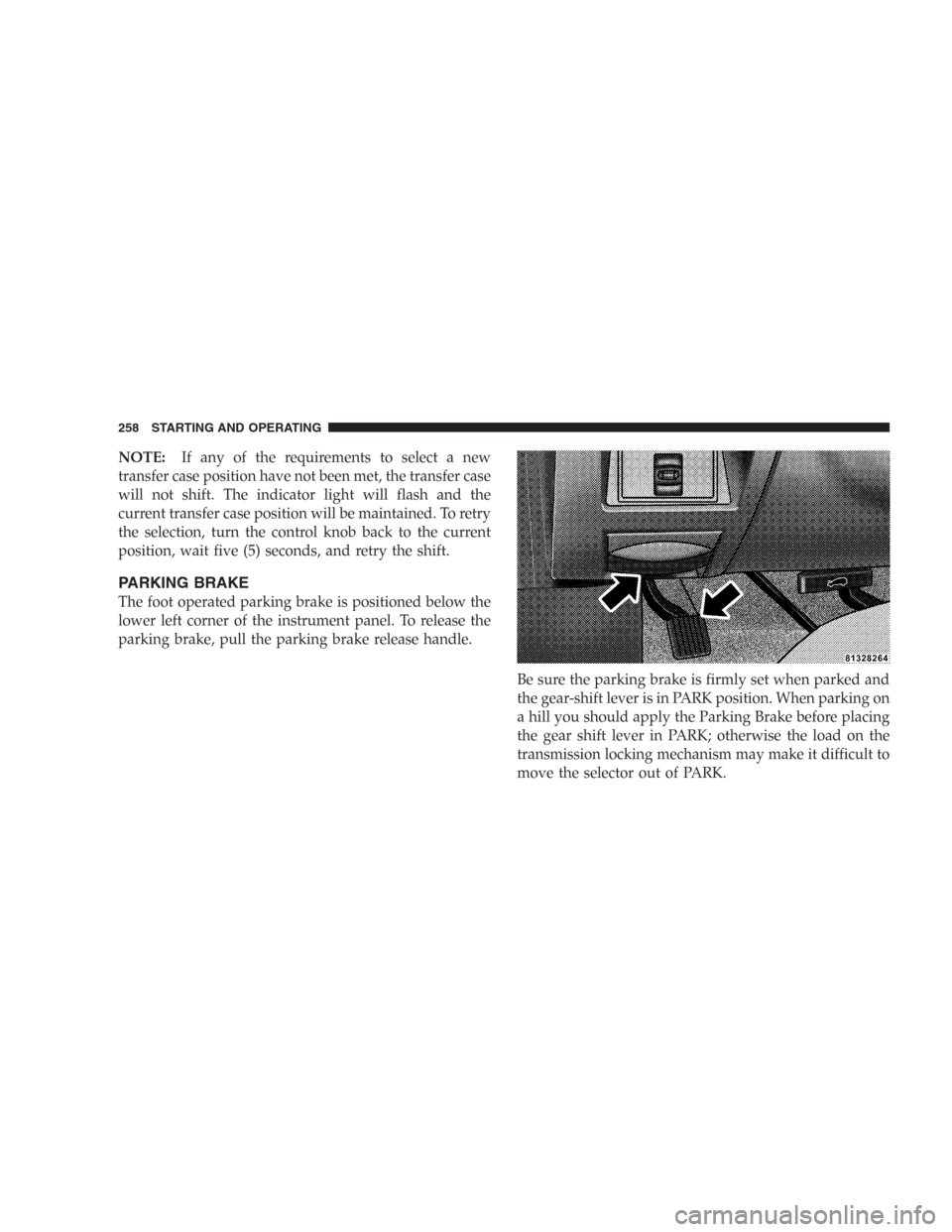
PARKING BRAKE
The foot operated parking brake is positioned below the
lower left corner of the instrument panel. To release the
parking brake, pull the parking brake release handle.
Be sure the parking brake is firmly set when parked and
the gear-shift lever is in PARK position. When parking on
a hill you should apply the Parking Brake before placing
the gear shift lever in PARK; otherwise the load on the
transmission locking mechanism may make it difficult to
move the selector out of PARK.
258 STARTING AND OPERATING
Page 259 of 440

NOTE:The instrument cluster brake warning light
indicates only that the parking brake is applied. You must
be sure the parking brake is fully applied before leaving
the vehicle.
When parking on a hill, turn the front wheels toward the
curb on a downhill grade and away from the curb on an
uphill grade.
The parking brake should be applied whenever the
driver is not in the vehicle.WARNING!
•Always fully apply the parking brake when leav-
ing your vehicle, or vehicle may roll and cause
damage or injury. Also be certain to leave an
automatic transmission in Park. Failure to do so
may cause the vehicle to roll and cause damage or
injury.
•Be sure the parking brake is fully disengaged
before driving, failure to do so can lead to brake
failure and an accident.
•Leaving children in a vehicle unattended is dan-
gerous for a number of reasons. A child or others
could be injured. Children should be warned not
to touch the parking brake or the gear selector
lever. Don’t leave the key in the ignition. A child
could operate power windows, other controls, or
move the vehicle.
STARTING AND OPERATING 259
5
Page 260 of 440

BRAKE SYSTEM
In the event power assist is lost for any reason, (for
example, repeated brake applications with the engine
off), the brakes will still function. The effort required to
brake the vehicle will be significantly increased over that
required with the power system operating.
If either the front or rear hydraulic systems lose normal
capability, the remaining system will still function with
some loss of braking effectiveness. This will be evident by
increased pedal travel during application, greater pedal
force required to slow or stop, and activation of the Brake
Warning Lamp and the ABS Lamp during brake use.
Four-Wheel Anti-Lock Brake System (ABS)
The Anti-Lock Brake System (ABS) is designed to aid the
driver in maintaining vehicle control under adverse
braking conditions. The system operates with a separate
computer to modulate hydraulic pressure to prevent
wheel lock-up and help avoid skidding on slipperysurfaces. All vehicle wheels and tires must be the same
size and type and tires must be properly inflated to
produce accurate signals for the computer.
WARNING!
Significant over or under inflation of tires, or mixing
sizes of tires or wheels on the vehicle can lead to loss
of braking effectiveness.
The Anti-Lock Brake System conducts a low-speed self-
test at about 12 mph (20 km/h). If you have your foot
lightly on the brake while this test is occurring you may
feel slight pedal movement. The movement can be more
apparent on ice and snow. This is normal. The Anti-Lock
Brake System pump motor runs during the self-test at 12
mph (20 km/h) and during an ABS stop. The pump
motor makes a low humming noise during operation,
which is normal.
260 STARTING AND OPERATING
Page 261 of 440

At the instant one of the wheels is about to lock up, a
slight pulsation can be felt in the brake pedal, indicating
that the ABS is in the regulating mode. Keep firm and
steady pressure on the brake pedal while experiencing
the pulsation. Continuous, steady brake pedal pressure
results in optimal braking power while maintaining the
ability to steer the vehicle. In the case of an emergency
brake maneuver, keep continuous full pressure on the
brake pedal. In this manner only can the ABS be most
effective. On slippery road surfaces, the ABS will respond
even with light brake pedal pressure because of the
increased likelihood of locking wheels. The pulsating
brake pedal can be an indication of hazardous road
conditions and functions as a reminder to take extra care
while driving.WARNING!
Anti-Lock Brake Systems contain sophisticated elec-
tronic equipment. It may be susceptible to interfer-
ence caused by improperly installed or high output
radio transmitting equipment. This interference can
cause possible loss of anti-lock braking capability.
Installation of such equipment should be done by
qualified professionals.
WARNING!
Pumping of the Anti-Lock Brakes will diminish
their effectiveness and may lead to an accident.
Pumping makes the stopping distance longer. Just
press firmly on your brake pedal when you need to
slow down or stop.
STARTING AND OPERATING 261
5
Page 264 of 440
ROCKING THE VEHICLE
If vehicle becomes stuck in snow, sand, or mud, it can
often be moved by a rocking motion. Move the gear
selector rhythmically between FIRST and REVERSE,
while applying slight pressure to the accelerator.
The least amount of accelerator pedal pressure to main-
tain the rocking motion without spinning the wheels or
racing the engine is most effective. Allow the engine to
idle with the transmission selector in NEUTRAL for at
least one minute after every five rocking-motion cycles.
This will minimize overheating and reduce the risk of
transmission failure during prolonged efforts to free a
stuck vehicle.
TIRE SAFETY INFORMATION
Tire Markings
NOTE:
•P (Passenger)-Metric tire sizing is based on U.S. design
standards. P-Metric tires have the letter “P” molded
into the sidewall preceding the size designation. Ex-
ample: P215/65R15 95H.
264 STARTING AND OPERATING