2006 CHEVROLET IMPALA service indicator
[x] Cancel search: service indicatorPage 254 of 394

Additives
To provide cleaner air, all gasolines in the United States
are now required to contain additives that will help
prevent engine and fuel system deposits from forming,
allowing your emission control system to work
properly. In most cases, you should not have to add
anything to your fuel. However, some gasolines contain
only the minimum amount of additive required to
meet U.S. Environmental Protection Agency regulations.
To help keep fuel injectors and intake valves clean,
or if your vehicle experiences problems due to
dirty injectors or valves, look for gasoline that is
advertised as TOP TIER Detergent Gasoline. Also,
your GM dealer has additives that will help correct and
prevent most deposit-related problems.
Gasolines containing oxygenates, such as ethers and
ethanol, and reformulated gasolines may be available in
your area. General Motors recommends that you use
these gasolines if they comply with the specications
described earlier. However, E85 (85% ethanol) and other
fuels containing more than 10% ethanol must not be used
in vehicles that were not designed for those fuels.
Notice:Your vehicle was not designed for fuel that
contains methanol. Do not use fuel containing
methanol. It can corrode metal parts in your fuel
system and also damage the plastic and rubber
parts. That damage would not be covered under
your warranty.Some gasolines that are not reformulated for low
emissions may contain an octane-enhancing additive
called methylcyclopentadienyl manganese tricarbonyl
(MMT); ask the attendant where you buy gasoline
whether the fuel contains MMT. General Motors
recommends against the use of such gasolines. Fuels
containing MMT can reduce the life of spark plugs
and the performance of the emission control system may
be affected. The malfunction indicator lamp may turn
on. If this occurs, return to your authorized GM dealer
for service.
Fuel E85 (85% Ethanol)
The 8th digit of your Vehicle Identication Number (VIN)
shows the code letter or number that identies your
engine. You will nd the VIN at the top left of the
instrument panel. SeeVehicle Identication Number
(VIN) on page 5-92.
If your vehicle has the 3.5L V6 engine (VIN Code K
only), you may use either regular unleaded gasoline
or ethanol fuel containing up to 85% ethanol (E85); also
seeFuel on page 5-4. In all other engines, including
the 3.5L V6 (VIN Code N), use only regular unleaded
gasoline.
5-6
Page 290 of 394

Brake Wear
Your vehicle has four-wheel disc brakes.
Disc brake pads have built-in wear indicators that make
a high-pitched warning sound when the brake pads
are worn and new pads are needed. The sound
may come and go or be heard all the time your vehicle
is moving, except when you are pushing on the
brake pedal rmly.
{CAUTION:
The brake wear warning sound means that
soon the brakes will not work well. That could
lead to an accident. When you hear the brake
wear warning sound, have your vehicle
serviced.
Notice:Continuing to drive with worn-out brake
pads could result in costly brake repair.
Some driving conditions or climates may cause a brake
squeal when the brakes are rst applied or lightly
applied. This does not mean something is wrong with
your brakes.Properly torqued wheel nuts are necessary to help
prevent brake pulsation. When tires are rotated, inspect
brake pads for wear and evenly tighten wheel nuts in
the proper sequence to GM torque specications.
Brake linings should always be replaced as complete
axle sets.
Brake Pedal Travel
See your dealer if the brake pedal does not return
to normal height, or if there is a rapid increase in pedal
travel. This could be a sign of brake trouble.
Brake Adjustment
Every time you apply the brakes, with or without the
vehicle moving, your brakes adjust for wear.
Replacing Brake System Parts
The braking system on a vehicle is complex. Its many
parts have to be of top quality and work well together
if the vehicle is to have really good braking. Your
vehicle was designed and tested with top-quality GM
brake parts. When you replace parts of your braking
system — for example, when your brake linings
wear down and you need new ones put in — be
sure you get new approved GM replacement parts. If
you do not, your brakes may no longer work properly.
5-42
Page 310 of 394

failure. Under-ination also reduces fuel efficiency and
tire tread life, and may affect the vehicle’s handling
and stopping ability.
Please note that the TPMS is not a substitute for proper
tire maintenance, and it is the driver’s responsibility to
maintain correct tire pressure, even if under-ination has
not reached the level to trigger illumination of the
TPMS low tire pressure telltale.
When a low tire pressure condition is detected, the
TPMS will illuminate the low tire pressure warning
symbol on the instrument panel cluster, and at the same
time a message to check the pressure in a specic
tire will appear on the Driver Information Center (DIC)
display. The low tire pressure warning symbol on
the instrument panel cluster and the check tire pressure
message will appear at each ignition cycle until the
tires are inated to the correct ination pressure. Using
the DIC, tire pressure levels can be viewed by the
driver. For additional information and details about the
DIC operation and displays seeDIC Operation and
Displays on page 3-39andDIC Warnings and Messages
on page 3-45.
The tire pressure warning light may come on in cool
weather when the vehicle is rst started, and then
turn off as you start to drive. This may be an early
indicator that the air pressure in the tire(s) are getting
low and need to be inated to the proper pressure.A tire and Loading Information label, attached to your
vehicle, shows the size of your vehicle’s original
equipment tires and the correct ination pressure for
your vehicle’s tires when they are cold. SeeLoading
Your Vehicle on page 4-29, for an example of the
tire information label and its location on your vehicle.
Also seeInation - Tire Pressure on page 5-60.
Your vehicle’s TPMS system can warn you about a low
tire pressure condition but it does not replace normal
tire maintenance. SeeTire Inspection and Rotation
on page 5-64andTires on page 5-54.
Notice:Do not use a tire sealant if your vehicle
has Tire Pressure Monitors. The liquid sealant can
damage the tire pressure monitor sensors.
The TPMS will not function properly if one or more of
the TPMS sensors are missing or inoperable. If the
system detects a missing or inoperable sensor, an error
message SERVICE TIRE MONITOR SYSTEM will be
shown on the DIC display. If you have replaced a
tire/wheel assembly without transferring the TPMS
sensors, the error message will be displayed. Once you
re-install the TPMS sensors, the error message
should go off. See your GM dealer for service if all
TPMS sensors are installed and the error message
comes on and stays on.
5-62
Page 388 of 394
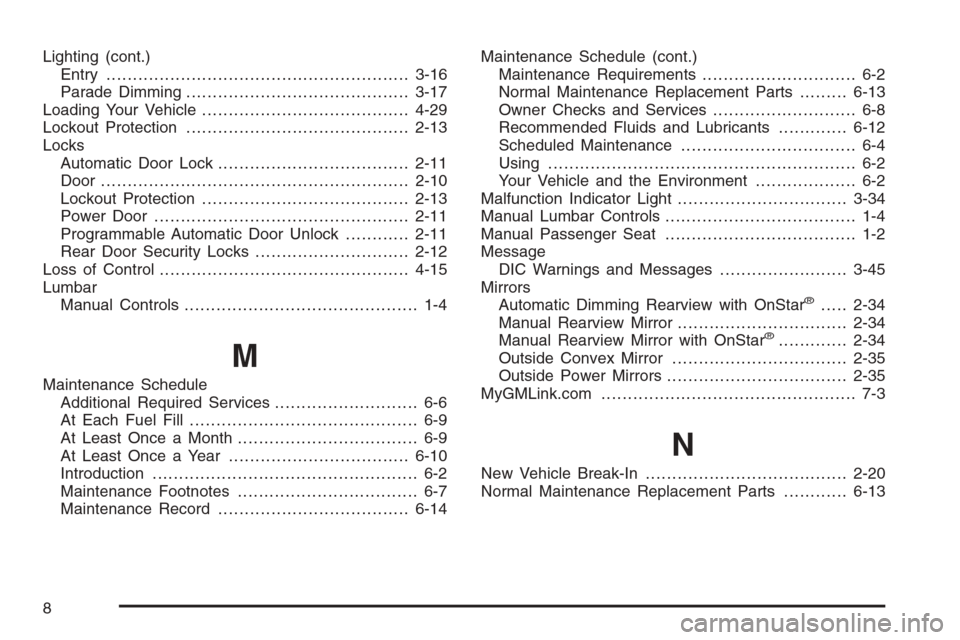
Lighting (cont.)
Entry.........................................................3-16
Parade Dimming..........................................3-17
Loading Your Vehicle.......................................4-29
Lockout Protection..........................................2-13
Locks
Automatic Door Lock....................................2-11
Door ..........................................................2-10
Lockout Protection.......................................2-13
Power Door ................................................2-11
Programmable Automatic Door Unlock............2-11
Rear Door Security Locks.............................2-12
Loss of Control...............................................4-15
Lumbar
Manual Controls............................................ 1-4
M
Maintenance Schedule
Additional Required Services........................... 6-6
At Each Fuel Fill........................................... 6-9
At Least Once a Month.................................. 6-9
At Least Once a Year..................................6-10
Introduction.................................................. 6-2
Maintenance Footnotes.................................. 6-7
Maintenance Record....................................6-14Maintenance Schedule (cont.)
Maintenance Requirements............................. 6-2
Normal Maintenance Replacement Parts.........6-13
Owner Checks and Services........................... 6-8
Recommended Fluids and Lubricants.............6-12
Scheduled Maintenance................................. 6-4
Using.......................................................... 6-2
Your Vehicle and the Environment................... 6-2
Malfunction Indicator Light................................3-34
Manual Lumbar Controls.................................... 1-4
Manual Passenger Seat.................................... 1-2
Message
DIC Warnings and Messages........................3-45
Mirrors
Automatic Dimming Rearview with OnStar
®.....2-34
Manual Rearview Mirror................................2-34
Manual Rearview Mirror with OnStar
®.............2-34
Outside Convex Mirror.................................2-35
Outside Power Mirrors..................................2-35
MyGMLink.com................................................ 7-3
N
New Vehicle Break-In......................................2-20
Normal Maintenance Replacement Parts............6-13
8
Page 389 of 394

O
Odometer......................................................3-26
Off-Road Recovery..........................................4-13
Oil
Engine.......................................................5-17
Pressure Light.............................................3-36
Oil, Engine Oil Life System..............................5-20
Older Children, Restraints................................1-32
Online Owner Center........................................ 7-3
OnStar
®System, see OnStar®Manual...............2-36
Other Warning Devices...................................... 3-6
Outlet Adjustment............................................3-22
Outlet(s), Accessory Power...............................3-17
Outside
Convex Mirror.............................................2-35
Power Mirrors.............................................2-35
Overheated Engine Protection
Operating Mode..........................................5-31
Owner Checks and Services.............................. 6-8
Owners, Canadian............................................... ii
P
Paint, Damage...............................................5-90
Parade Dimming.............................................3-17Park (P)
Shifting Into................................................2-29
Shifting Out of............................................2-31
Parking
Brake........................................................2-28
Over Things That Burn.................................2-32
Passenger Airbag Status Indicator.....................3-28
Passenger Compartment Air Filter.....................3-23
Passenger Sensing System..............................1-63
Passing.........................................................4-13
PASS-Key
®III+..............................................2-18
PASS-Key®III+ Operation................................2-19
Power
Accessory Outlet(s)......................................3-17
Door Locks.................................................2-11
Eight-Way Seats........................................... 1-3
Electrical System.........................................5-94
Retained Accessory (RAP)............................2-22
Six-Way Seats.............................................. 1-2
Steering Fluid.............................................5-38
Windows....................................................2-16
Pressure Cap.................................................5-28
Pretensioners, Safety Belt................................1-31
Programmable Automatic Door Unlock...............2-11
Q
Questions and Answers About Safety Belts.........1-16
9
Page 393 of 394
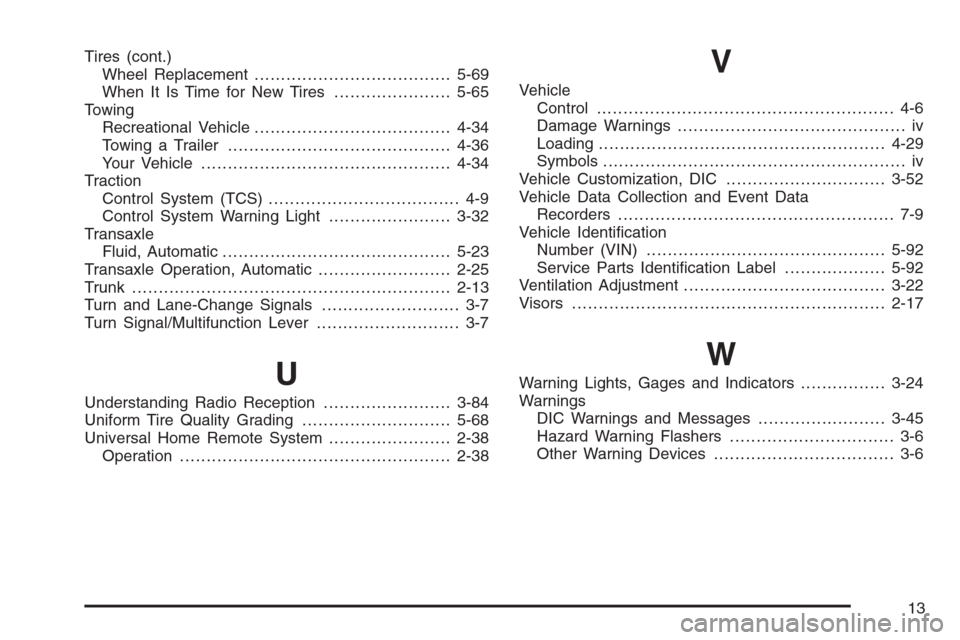
Tires (cont.)
Wheel Replacement.....................................5-69
When It Is Time for New Tires......................5-65
Towing
Recreational Vehicle.....................................4-34
Towing a Trailer..........................................4-36
Your Vehicle...............................................4-34
Traction
Control System (TCS).................................... 4-9
Control System Warning Light.......................3-32
Transaxle
Fluid, Automatic...........................................5-23
Transaxle Operation, Automatic.........................2-25
Trunk............................................................2-13
Turn and Lane-Change Signals.......................... 3-7
Turn Signal/Multifunction Lever........................... 3-7
U
Understanding Radio Reception........................3-84
Uniform Tire Quality Grading............................5-68
Universal Home Remote System.......................2-38
Operation...................................................2-38
V
Vehicle
Control........................................................ 4-6
Damage Warnings........................................... iv
Loading......................................................4-29
Symbols......................................................... iv
Vehicle Customization, DIC..............................3-52
Vehicle Data Collection and Event Data
Recorders.................................................... 7-9
Vehicle Identication
Number (VIN).............................................5-92
Service Parts Identication Label...................5-92
Ventilation Adjustment......................................3-22
Visors...........................................................2-17
W
Warning Lights, Gages and Indicators................3-24
Warnings
DIC Warnings and Messages........................3-45
Hazard Warning Flashers............................... 3-6
Other Warning Devices.................................. 3-6
13