2006 CHEVROLET EPICA brake light
[x] Cancel search: brake lightPage 255 of 368
Brakes
Brake Fluid
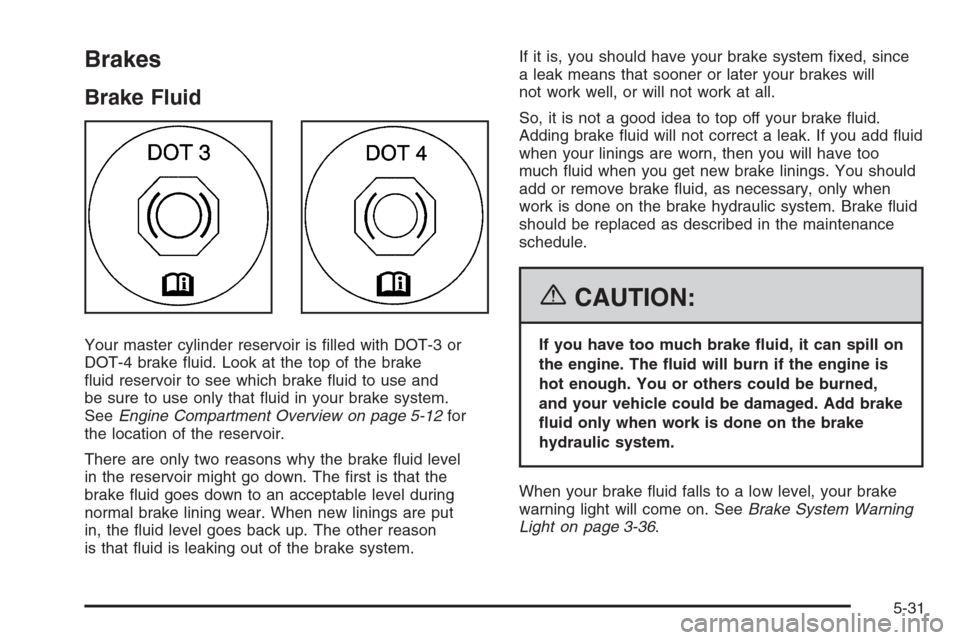
Your master cylinder reservoir is filled with DOT-3 or
DOT-4 brake fluid. Look at the top of the brake
fluid reservoir to see which brake fluid to use and
be sure to use only that fluid in your brake system.
SeeEngine Compartment Overview on page 5-12for
the location of the reservoir.
There are only two reasons why the brake fluid level
in the reservoir might go down. The first is that the
brake fluid goes down to an acceptable level during
normal brake lining wear. When new linings are put
in, the fluid level goes back up. The other reason
is that fluid is leaking out of the brake system.If it is, you should have your brake system fixed, since
a leak means that sooner or later your brakes will
not work well, or will not work at all.
So, it is not a good idea to top off your brake fluid.
Adding brake fluid will not correct a leak. If you add fluid
when your linings are worn, then you will have too
much fluid when you get new brake linings. You should
add or remove brake fluid, as necessary, only when
work is done on the brake hydraulic system. Brake fluid
should be replaced as described in the maintenance
schedule.
{CAUTION:
If you have too much brake uid, it can spill on
the engine. The uid will burn if the engine is
hot enough. You or others could be burned,
and your vehicle could be damaged. Add brake
uid only when work is done on the brake
hydraulic system.
When your brake fluid falls to a low level, your brake
warning light will come on. SeeBrake System Warning
Light on page 3-36.
5-31
Page 257 of 368
{CAUTION:
The brake wear warning sound means that soon
your brakes will not work well. That could lead
to an accident. When you hear the brake wear
warning sound, have your vehicle serviced.
Notice:Continuing to drive with worn-out brake
pads could result in costly brake repair.
Some driving conditions or climates may cause a
brake squeal when the brakes are first applied or
lightly applied. This does not mean something is
wrong with your brakes.
Properly torqued wheel nuts are necessary to help
prevent brake pulsation. When tires are rotated, inspect
brake pads for wear and evenly tighten wheel nuts
in the proper sequence to GM torque specifications.
Brake linings should always be replaced as complete
axle sets.
SeeBrake System Inspection on page 6-24.
Brake Pedal Travel
See your dealer if the brake pedal does not return
to normal height, or if there is a rapid increase in pedal
travel. This could be a sign of brake trouble.
Brake Adjustment
Every time you apply the brakes, with or without the
vehicle moving, your brakes adjust for wear.
Replacing Brake System Parts
The braking system on a vehicle is complex. Its many
parts have to be of top quality and work well together
if the vehicle is to have really good braking. Your
vehicle was designed and tested with top-quality
GM brake parts. When you replace parts of your braking
system — for example, when your brake linings wear
down and you need new ones put in — be sure you
get new approved GM replacement parts. If you do
not, your brakes may no longer work properly.
For example, if someone puts in brake linings that are
wrong for your vehicle, the balance between your
front and rear brakes can change — for the worse.
The braking performance you have come to expect
can change in many other ways if someone puts in
the wrong replacement brake parts.
5-33
Page 259 of 368
Jump Starting
If your battery has run down, you may want to use
another vehicle and some jumper cables to start your
vehicle. Be sure to use the following steps to do it safely.
{CAUTION:
Batteries can hurt you. They can be dangerous
because:
They contain acid that can burn you.
They contain gas that can explode or
ignite.
They contain enough electricity to burn you.
If you do not follow these steps exactly, some
or all of these things can hurt you.
Notice:Ignoring these steps could result in costly
damage to your vehicle that would not be covered
by your warranty.
Trying to start your vehicle by pushing or pulling it
will not work, and it could damage your vehicle.
1. Check the other vehicle. It must have a 12-volt
battery with a negative ground system.Notice:If the other vehicle’s system is not a 12-volt
system with a negative ground, both vehicles can
be damaged. Only use vehicles with 12-volt systems
with negative grounds to jump start your vehicle.
2. Get the vehicles close enough so the jumper cables
can reach, but be sure the vehicles are not touching
each other. If they are, it could cause a ground
connection you do not want. You would not be able
to start your vehicle, and the bad grounding
could damage the electrical systems.
To avoid the possibility of the vehicles rolling, set
the parking brake firmly on both vehicles involved
in the jump start procedure. Put an automatic
transaxle in PARK (P) or a manual transaxle in
NEUTRAL before setting the parking brake.
Notice:If you leave your radio or other accessories
on during the jump starting procedure, they could
be damaged. The repairs would not be covered
by your warranty. Always turn off your radio and
other accessories when jump starting your vehicle.
3. Turn off the ignition on both vehicles. Unplug
unnecessary accessories plugged into the cigarette
lighter or the accessory power outlet. Turn off
the radio and all lamps that are not needed.
This will avoid sparks and help save both batteries.
And it could save the radio!
5-35
Page 280 of 368
Different Size Tires and Wheels
If you add wheels or tires that are a different size than
your original equipment wheels and tires, this may
affect the way your vehicle performs, including its
braking, ride and handling characteristics, stability and
resistance to rollover. Additionally, if your vehicle
has electronic systems such as, anti-lock brakes,
traction control, and electronic stability control, the
performance of these systems can be affected.
{CAUTION:
If you add different sized wheels, your
vehicle may not provide an acceptable level
of performance and safety if tires not
recommended for those wheels are selected.
You may increase the chance that you will
crash and suffer serious injury. Only use
GM specic wheel and tire systems developed
for your vehicle, and have them properly
installed by a GM certied technician.
SeeBuying New Tires on page 5-55andAccessories
and Modifications on page 5-3for additional information.
Uniform Tire Quality Grading
Quality grades can be found where applicable on the
tire sidewall between tread shoulder and maximum
selection width. For example:
Treadwear 200 Traction AA Temperature A
The following information relates to the system
developed by the Unites States National Highway Traffic
Safety Administration, which grades tires by treadwear,
traction and temperature performance. (This applies
only to vehicles sold in the United States.) The grades
are molded on the sidewalls of most passenger car
tires. The Uniform Tire Quality Grading system does not
apply to deep tread, winter-type snow tires, space-saver
or temporary use spare tires, tires with nominal rim
diameters of 10 to 12 inches (25 to 30 cm), or to some
limited-production tires.
While the tires available on General Motors passenger
cars and light trucks may vary with respect to these
grades, they must also conform to federal safety
requirements.
5-56
Page 303 of 368
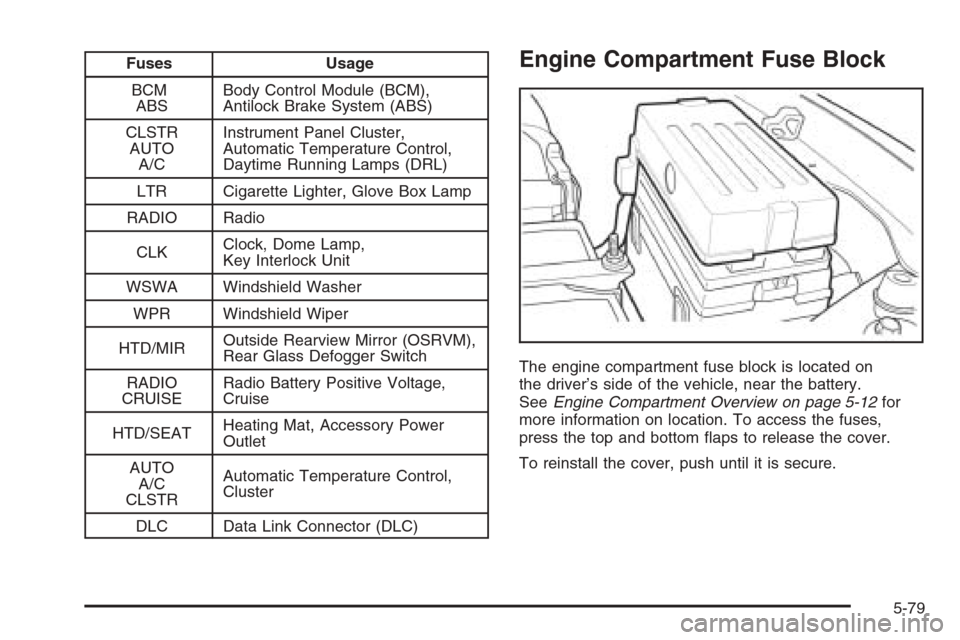
Fuses Usage
BCM
ABSBody Control Module (BCM),
Antilock Brake System (ABS)
CLSTR
AUTO
A/CInstrument Panel Cluster,
Automatic Temperature Control,
Daytime Running Lamps (DRL)
LTR Cigarette Lighter, Glove Box Lamp
RADIO Radio
CLKClock, Dome Lamp,
Key Interlock Unit
WSWA Windshield Washer
WPR Windshield Wiper
HTD/MIROutside Rearview Mirror (OSRVM),
Rear Glass Defogger Switch
RADIO
CRUISERadio Battery Positive Voltage,
Cruise
HTD/SEATHeating Mat, Accessory Power
Outlet
AUTO
A/C
CLSTRAutomatic Temperature Control,
Cluster
DLC Data Link Connector (DLC)Engine Compartment Fuse Block
The engine compartment fuse block is located on
the driver’s side of the vehicle, near the battery.
SeeEngine Compartment Overview on page 5-12for
more information on location. To access the fuses,
press the top and bottom flaps to release the cover.
To reinstall the cover, push until it is secure.
5-79
Page 305 of 368
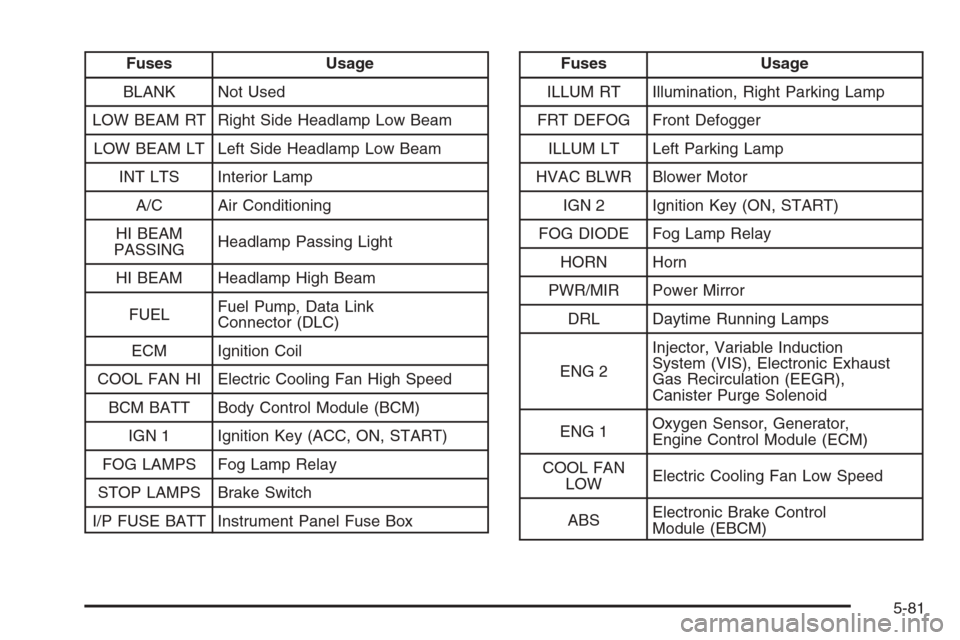
Fuses Usage
BLANK Not Used
LOW BEAM RT Right Side Headlamp Low Beam
LOW BEAM LT Left Side Headlamp Low Beam
INT LTS Interior Lamp
A/C Air Conditioning
HI BEAM
PASSINGHeadlamp Passing Light
HI BEAM Headlamp High Beam
FUELFuel Pump, Data Link
Connector (DLC)
ECM Ignition Coil
COOL FAN HI Electric Cooling Fan High Speed
BCM BATT Body Control Module (BCM)
IGN 1 Ignition Key (ACC, ON, START)
FOG LAMPS Fog Lamp Relay
STOP LAMPS Brake Switch
I/P FUSE BATT Instrument Panel Fuse BoxFuses Usage
ILLUM RT Illumination, Right Parking Lamp
FRT DEFOG Front Defogger
ILLUM LT Left Parking Lamp
HVAC BLWR Blower Motor
IGN 2 Ignition Key (ON, START)
FOG DIODE Fog Lamp Relay
HORN Horn
PWR/MIR Power Mirror
DRL Daytime Running Lamps
ENG 2Injector, Variable Induction
System (VIS), Electronic Exhaust
Gas Recirculation (EEGR),
Canister Purge Solenoid
ENG 1Oxygen Sensor, Generator,
Engine Control Module (ECM)
COOL FAN
LOWElectric Cooling Fan Low Speed
ABSElectronic Brake Control
Module (EBCM)
5-81
Page 355 of 368
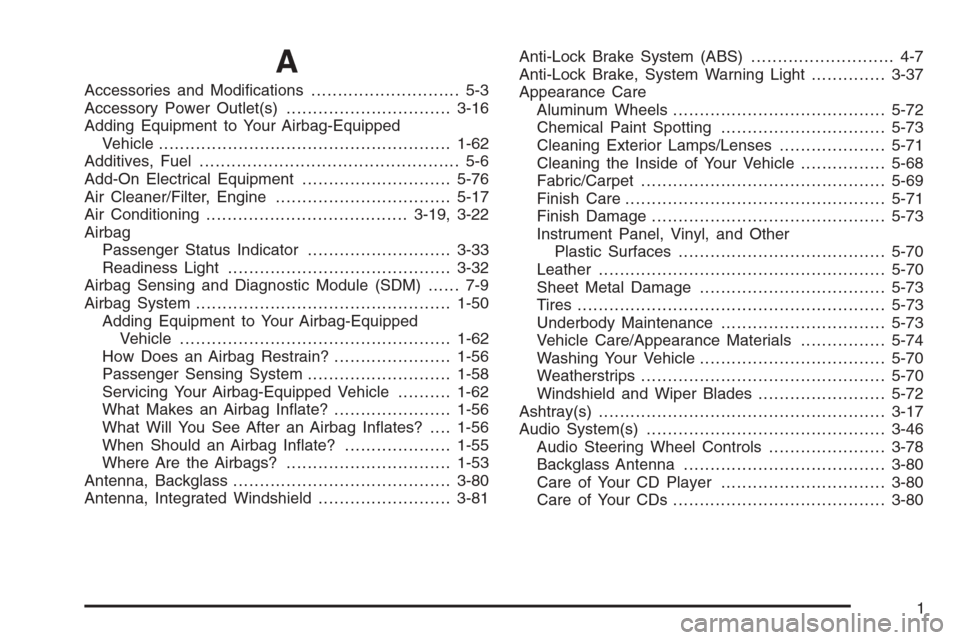
A
Accessories and Modifications............................ 5-3
Accessory Power Outlet(s)...............................3-16
Adding Equipment to Your Airbag-Equipped
Vehicle.......................................................1-62
Additives, Fuel................................................. 5-6
Add-On Electrical Equipment............................5-76
Air Cleaner/Filter, Engine.................................5-17
Air Conditioning......................................3-19, 3-22
Airbag
Passenger Status Indicator...........................3-33
Readiness Light..........................................3-32
Airbag Sensing and Diagnostic Module (SDM)...... 7-9
Airbag System................................................1-50
Adding Equipment to Your Airbag-Equipped
Vehicle...................................................1-62
How Does an Airbag Restrain?......................1-56
Passenger Sensing System...........................1-58
Servicing Your Airbag-Equipped Vehicle..........1-62
What Makes an Airbag Inflate?......................1-56
What Will You See After an Airbag Inflates?....1-56
When Should an Airbag Inflate?....................1-55
Where Are the Airbags?...............................1-53
Antenna, Backglass.........................................3-80
Antenna, Integrated Windshield.........................3-81Anti-Lock Brake System (ABS)........................... 4-7
Anti-Lock Brake, System Warning Light..............3-37
Appearance Care
Aluminum Wheels........................................5-72
Chemical Paint Spotting...............................5-73
Cleaning Exterior Lamps/Lenses....................5-71
Cleaning the Inside of Your Vehicle................5-68
Fabric/Carpet..............................................5-69
Finish Care.................................................5-71
Finish Damage............................................5-73
Instrument Panel, Vinyl, and Other
Plastic Surfaces.......................................5-70
Leather......................................................5-70
Sheet Metal Damage...................................5-73
Tires..........................................................5-73
Underbody Maintenance...............................5-73
Vehicle Care/Appearance Materials................5-74
Washing Your Vehicle...................................5-70
Weatherstrips..............................................5-70
Windshield and Wiper Blades........................5-72
Ashtray(s)......................................................3-17
Audio System(s).............................................3-46
Audio Steering Wheel Controls......................3-78
Backglass Antenna......................................3-80
Care of Your CD Player...............................3-80
Care of Your CDs ........................................3-80
1
Page 356 of 368
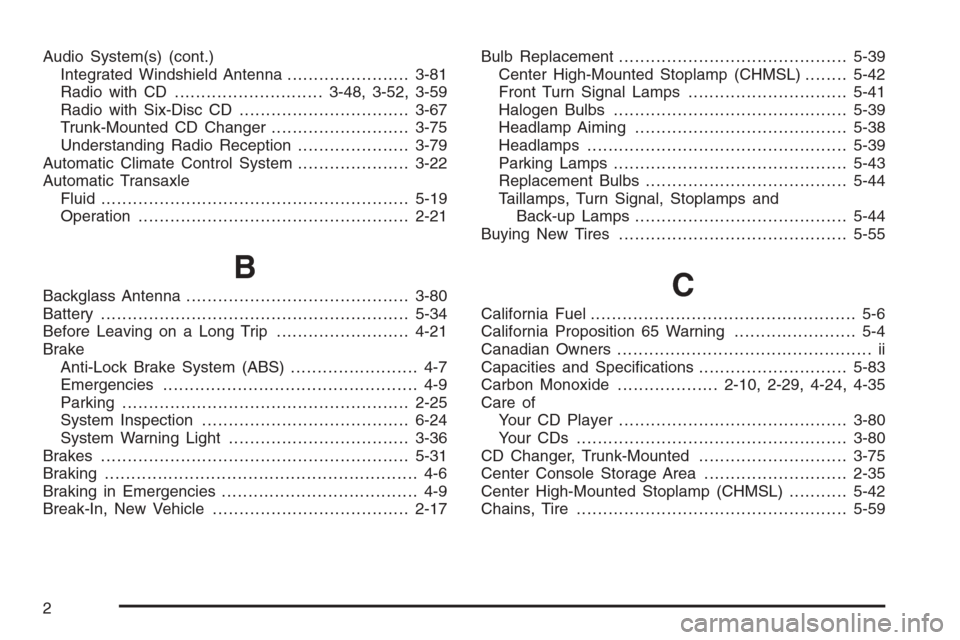
Audio System(s) (cont.)
Integrated Windshield Antenna.......................3-81
Radio with CD............................3-48, 3-52, 3-59
Radio with Six-Disc CD................................3-67
Trunk-Mounted CD Changer..........................3-75
Understanding Radio Reception.....................3-79
Automatic Climate Control System.....................3-22
Automatic Transaxle
Fluid..........................................................5-19
Operation...................................................2-21
B
Backglass Antenna..........................................3-80
Battery..........................................................5-34
Before Leaving on a Long Trip.........................4-21
Brake
Anti-Lock Brake System (ABS)........................ 4-7
Emergencies................................................ 4-9
Parking......................................................2-25
System Inspection.......................................6-24
System Warning Light..................................3-36
Brakes..........................................................5-31
Braking........................................................... 4-6
Braking in Emergencies..................................... 4-9
Break-In, New Vehicle.....................................2-17Bulb Replacement...........................................5-39
Center High-Mounted Stoplamp (CHMSL)........5-42
Front Turn Signal Lamps..............................5-41
Halogen Bulbs............................................5-39
Headlamp Aiming........................................5-38
Headlamps.................................................5-39
Parking Lamps............................................5-43
Replacement Bulbs......................................5-44
Taillamps, Turn Signal, Stoplamps and
Back-up Lamps........................................5-44
Buying New Tires...........................................5-55C
California Fuel.................................................. 5-6
California Proposition 65 Warning....................... 5-4
Canadian Owners................................................ ii
Capacities and Specifications............................5-83
Carbon Monoxide...................2-10, 2-29, 4-24, 4-35
Care of
Your CD Player...........................................3-80
Your CDs ...................................................3-80
CD Changer, Trunk-Mounted............................3-75
Center Console Storage Area...........................2-35
Center High-Mounted Stoplamp (CHMSL)...........5-42
Chains, Tire...................................................5-59
2