2006 CHEVROLET CORVETTE warning
[x] Cancel search: warningPage 197 of 426
SERVICE ACTIVE HANDLING SYSTEM:If the
SERVICE ACTIVE HANDLING SYSTEM message is
displayed, there is a problem with your Active Handling
System and your vehicle needs service. See your
GM dealer. The instrument cluster light will also be
on and a chime will sound. When this message
is displayed, the system is not working. Adjust your
driving accordingly. SeeActive Handling System
on page 4-10for more information.
SERVICE AIR CONDITIONING:This message
displays when the electronic sensors that control the
air conditioning and heating systems are no longer
working. Have the climate control system serviced by
your GM dealer if you notice a drop in heating and
air conditioning efficiency.
SERVICE ANTILOCK BRAKES:If the SERVICE
ANTILOCK BRAKES message is displayed when you
are driving, stop as soon as possible and turn the
ignition off. Then start the engine again to reset the
system. If the message stays on, or comes back
on again while you are driving, your vehicle is in need
of service. See your GM dealer. If the anti-lock
brake system warning light is on and the regular brake
system warning light is not on, you still have brakes,
but do not have anti-lock brakes. If the regular
brake system light is also on, you do not have anti-lock
brakes and there is a problem with your brakes. See
Anti-Lock Brake System Warning Light on page 3-39
andBrake System Warning Light on page 3-38.If the SERVICE ANTILOCK BRAKES message is being
displayed, your Traction Control System and the
Active Handling System will also be disabled. The Driver
Information Center will scroll three messages: SERVICE
ANTILOCK BRAKES, SERVICE TRACTION SYSTEM,
and SERVICE ACTIVE HANDLING, and the instrument
cluster lights will be illuminated along with a chime.
The driver can acknowledge these messages by
pressing the RESET button. When the service message
is displayed the computer controlled systems will not
assist the driver and you should have the system
repaired by your GM dealer as soon as possible.
Adjust your driving accordingly.
SERVICE CHARGING SYSTEM:Press the RESET
button to acknowledge that you have read the message
and to remove it from the display. The message will
reappear every 10 minutes until this condition changes.
You will hear multiple chimes when this message is
displayed.
If this message comes on while you are driving, you
may have a problem with the electrical charging system.
It could indicate that you have a loose or broken drive
belt or another electrical problem. Have it checked
right away by your GM dealer. Driving while this warning
message is on could drain your battery.
If you must drive a short distance with the message on,
be certain to turn off your accessories, such as the
radio and air conditioner.
3-61
Page 198 of 426
SERVICE ELECTRICAL SYSTEM:This message
displays if an electrical problem has occurred within the
Powertrain Control Module (PCM). Have your vehicle
serviced by your GM dealer.
SERVICE FUEL SYSTEM:This message displays if
the Powertrain Control Module (PCM) has detected
a problem within the fuel system. Have your vehicle
serviced by your GM dealer. This message will also
be displayed when the cluster is not getting fuel
information from the PCM.
SERVICE RIDE CONTROL:This message is used to
indicate to the driver that the Selective Ride Control
system has detected a malfunction and that the system
must be serviced. See your GM dealer. If a fault is
present in the Selective Ride Control system which
causes the shocks to be in their full soft condition, the
SERVICE RIDE CONTROL, SHOCKS INOPERATIVE,
and MAXIMUM SPEED 80 MPH (129 km/h) will
display together.
SERVICE TIRE MONITOR:If this message comes
on, a part on the Tire Pressure Monitor (TPM) is
not working properly. If you drive your vehicle while
any of the four sensors are missing or inoperable, the
warning will come on in about 60 minutes. A sensor
would be missing, for example, if you put different
wheels on your vehicle without transferring the sensors.
If the warning comes on and stays on, there may be
a problem with the TPM. See your GM dealer.SERVICE TRACTION SYSTEM:If the SERVICE
TRACTION SYSTEM message is displayed when you
are driving, there is a problem with your Traction Control
System and your vehicle is in need of service. See
your GM dealer. When this message is displayed, the
system will not limit wheel spin. Adjust your driving
accordingly.
The instrument cluster car icon will also be illuminated
and a chime will sound. The driver can acknowledge
both messages by pressing the RESET button two
times. When the service messages are displayed, the
computer controlled systems will not assist the driver
in controlling the vehicle. Have the system repaired
by your GM dealer as soon as possible. Adjust
your driving accordingly.
SERVICE TRANSMISSION:If this message appears,
there is a problem with the transmission. See your
GM dealer for service.
SERVICE VEHICLE SOON:If this message appears
on the DIC along with a chime, there may be an
electrical or another system problem with your vehicle.
Have your vehicle checked by your GM dealer if
this message keeps appearing.
3-62
Page 199 of 426
SET PARK BRAKE FOR SEAT RECALL:If you have
a manual transmission vehicle, this message displays
if you try to recall the memory positions when the ignition
is on and the parking brake is not set. If the vehicle is
on, you must set the parking brake in order for the
memory positions to recall. SeeMemory on page 2-72
for more information.
SET PARK BRAKE TO MOVE TOP:If you have a
manual transmission vehicle, this message will display
and a chime will sound if you try to operate the
power convertible top without rst setting the parking
brake. Set the parking brake before trying to operate the
power convertible top. SeeConvertible Top (Manual)
on page 2-60orConvertible Top (Power) on page 2-67
for more information.
SHIFT TO PARK:If you have an automatic
transmission vehicle, this message indicates that the
vehicle is not in PARK (P) when the engine is being
turned off. The vehicle will be in ACCESSORY. Once
the shifter is moved to PARK (P), the vehicle will turn off.
The vehicle will remain in ACCESSORY, without the
20 minute time-out period, until the shifter is moved
to PARK (P) or until the driver presses the pushbutton
to restart the vehicle. SeeIgnition Positions on
page 2-22for more information.SHIFT TO PARK OR SET PARK BRAKE FOR TOP:
If you have an automatic transmission vehicle, this
message will display and a chime will sound if you try
to operate the power convertible top without rst shifting
into PARK (P) or setting the parking brake. Either
shift the vehicle into PARK (P) or set the parking brake
before trying to operate the power convertible top.
SeeConvertible Top (Manual) on page 2-60or
Convertible Top (Power) on page 2-67for more
information.
SHOCKS INOPERATIVE:To acknowledge that you
have read the message and to remove it from the
display, press the RESET button. The message will
reappear every 10 minutes until this condition changes.
This message indicates that a malfunction is present
in the Selective Ride Control system which is causing
the shocks to be in their full soft mode. This is a warning
to the driver that the vehicle handling may be affected.
Have your vehicle serviced by your GM dealer as
soon as possible.
3-63
Page 200 of 426
TIRE FLAT:You will hear two chimes when this
message is displayed followed by the message
MAXIMUM SPEED 55 MPH (90 km/h). Also, the tire
pressure light on the instrument panel cluster will come
on. SeeTire Pressure Light on page 3-42. If this
message appears, do not drive your vehicle above
this limit. The next message to appear is REDUCED
HANDLING. The active handling system will intervene
more quickly when a at tire has been detected.
Adjust your driving accordingly. To acknowledge these
warnings, press the RESET button. After you press
the RESET button, a message will reappear every
10 minutes until this condition changes. This message
indicates that the pressure in one of your tires is
lower than 10 psi (68 kPa). Next to the TIRE FLAT
message, you can see either LEFT FRONT, RIGHT
FRONT, LEFT REAR, or RIGHT REAR to indicate
to you which tire is at. You can receive more than
one tire pressure message at a time. To read other
messages that may have been sent at the same time,
press the RESET button. If a tire pressure message
appears on the DIC, stop as soon as you can. Have
the tire pressures checked and set to those shown on
your Tire Loading Information Label. SeeExtended
Mobility Tires on page 5-62andInation - Tire Pressure
on page 5-64.
{CAUTION:
When the LOW TIRE PRESSURE or TIRE FLAT
message is displayed on the Driver Information
Center, your vehicle’s handling capabilities will
be reduced during severe maneuvers. If you
drive too fast, you could lose control of your
vehicle. You or others could be injured. Don’t
drive over 55 mph (90 km/h) when the LOW
TIRE PRESSURE or TIRE FLAT message is
displayed. Drive cautiously and check your tire
pressures as soon as you can.
TOO COLD TO MOVE TOP:This message displays
and a chime sounds when the power convertible
top button is pressed and the power convertible top
pump motor temperature is below -4°F (-20°C). Wait
for the power convertible top pump motor to warm
up before using the power convertible top.
TOP MOTOR OVER TEMPERATURE:This message
displays and a chime sounds when the power convertible
top button is pressed and the power convertible top pump
motor temperature is over 221°F (105°C). Wait for the
power convertible top pump motor to cool down before
using the power convertible top.
3-64
Page 201 of 426
TOP NOT SECURE:This message displays and a
chime sounds when the power convertible top button
is released before the top open or close operation
is complete or if the top is closed without the header
latch engaged. Press and hold the convertible top button
to fully open or close the top, and make sure that the
header latch is engaged after the top is closed.
TRACTION SYSTEM AND ACTIVE
HANDLING – OFF:By pressing the Active Handling
System console button for ve seconds, the driver can
turn the Traction Control and Active Handling Systems
off. The message TRACTION SYSTEM AND ACTIVE
HANDLING – OFF will be displayed in the DIC, the
instrument panel cluster light will be on and a chime will
sound. You can acknowledge this message by pressing
the RESET button. The anti-lock brake systems remains
on with the Traction Control and Active Handling Systems
off. You should adjust your driving accordingly.
TRACTION SYSTEM AND ACTIVE HANDLING ON:
If the Traction Control and Active Handling Systems are
off, pressing the Active Handling System console button
momentarily will turn both systems on. The message
TRACTION SYSTEM AND ACTIVE HANDLING – ON will
be displayed temporarily in the DIC, the instrument panel
cluster light will be off and a chime will sound.TRACTION SYSTEM ACTIVE:When your Traction
Control System is limiting wheel spin, the TRACTION
SYSTEM ACTIVE message will be displayed. Slippery
road conditions may exist if this message is displayed,
so adjust your driving accordingly. The message
will stay on for a few seconds after the Traction Control
System stops limiting wheel spin.
TRACTION SYSTEM – OFF:You will hear a single
quick tone when this message is displayed and the
traction control system warning light on the instrument
panel cluster will come on. SeeTraction Control System
(TCS) Warning Light on page 3-40. This message comes
on and stays on when the Active Handling System
console button is pressed to turn the system off. To
acknowledge this message, press the RESET button.
TRACTION SYSTEM – ON:You will hear a single quick
tone when this message is displayed. This message
is displayed when you decide to turn on the Traction
Control System by pressing the Active Handling System
console button on the console. This message will
shut off automatically on its own.
3-65
Page 202 of 426
TRANSMISSION HOT IDLE ENGINE:You will hear
four chimes when this message is displayed. To
acknowledge this warning, press the RESET button.
After you press the RESET button, the message will be
displayed every 10 minutes until the condition changes.
If you do not press the RESET button, the message
remains on the display until the condition changes.
If the transmission uid temperature rises above
270°F (132°C) or rises rapidly, this message is displayed.
The transmission may shift gears or apply the torque
converter clutch to reduce the uid temperature. Driving
aggressively or driving on long hills can cause the
transmission uid temperature to be higher than normal.
If this message appears, you may continue to drive
at a slower speed. You should also monitor the
transmission uid temperature and allow it to cool to at
least 230°F (110°C). The transmission uid temperature
can be monitored with the gages button on the DIC.
SeeAutomatic Transmission Fluid on page 5-28. You
should also check the engine coolant temperature. If it is
also hot, seeEngine Overheating on page 5-32.If the TRANSMISSION HOT IDLE ENGINE message is
displayed during normal vehicle operation on at roads,
your vehicle may need service. See your GM dealer for
an inspection.
If driving in a performance or competitive manner, the use
of (S) Sport Automatic Mode or (S) Sport Manual Paddle
Shift gear selection is recommended. SeeAutomatic
Transmission Operation on page 2-26for more
information.
TURN SIGNAL ON:If a turn signal is left on for
three-quarters of a mile (1.2 km), this message will
appear on the display and you will hear a chime. Move
the turn signal/multifunction lever to the off position.
To acknowledge this message, press the RESET button.
UNLATCH HEADER TO MOVE TOP:This message
will display and a chime will sound if you try to lower
the convertible top without rst unlocking the top. Move
the latch handle to unlock the convertible top. See
Convertible Top (Manual) on page 2-60orConvertible
Top (Power) on page 2-67.
3-66
Page 244 of 426
Control of a Vehicle
You have three systems that make your vehicle go where
you want it to go. They are the brakes, the steering, and
the accelerator. All three systems have to do their work at
the places where the tires meet the road.
Sometimes, as when you are driving on snow or ice, it is
easy to ask more of those control systems than the tires
and road can provide. That means you can lose control of
your vehicle. SeeTraction Control System (TCS) on
page 4-9andActive Handling System on page 4-10.
Adding non-GM accessories can affect your vehicle’s
performance. SeeAccessories and Modications
on page 5-3.
Braking
SeeBrake System Warning Light on page 3-38.
Braking action involves perception time and
reaction time.First, you have to decide to push on the brake pedal.
That is perception time. Then you have to bring up your
foot and do it. That is reaction time.
Average reaction time is about three-fourths of a
second. But that is only an average. It might be less
with one driver and as long as two or three seconds or
more with another. Age, physical condition, alertness,
coordination, and eyesight all play a part. So do alcohol,
drugs, and frustration. But even in three-fourths of a
second, a vehicle moving at 60 mph (100 km/h) travels
66 feet (20 m). That could be a lot of distance in an
emergency, so keeping enough space between
your vehicle and others is important.
And, of course, actual stopping distances vary greatly
with the surface of the road, whether it is pavement
or gravel; the condition of the road, whether it is
wet, dry, or icy; tire tread; the condition of your brakes;
the weight of the vehicle; and the amount of brake
force applied.
4-6
Page 245 of 426
Avoid needless heavy braking. Some people drive
in spurts — heavy acceleration followed by heavy
braking — rather than keeping pace with traffic. This is
a mistake. Your brakes may not have time to cool
between hard stops. Your brakes will wear out much
faster if you do a lot of heavy braking. If you keep pace
with the traffic and allow realistic following distances,
you will eliminate a lot of unnecessary braking.
That means better braking and longer brake life.
If your engine ever stops while you are driving, brake
normally but do not pump your brakes. If you do,
the pedal may get harder to push down. If your engine
stops, you will still have some power brake assist.
But you will use it when you brake. Once the power
assist is used up, it may take longer to stop and
the brake pedal will be harder to push.
Under certain weather or operating conditions,
occasional brake squeak, squeal, or other noise may
be heard with your performance braking system.
This brake system is designed for superior fade
resistance and consistent operation using high
performance brake pads. Brake noise is normal and
does not affect system performance.
Adding non-GM accessories can affect your vehicle’s
performance. SeeAccessories and Modications
on page 5-3.Anti-Lock Brake System (ABS)
Your vehicle has the Anti-Lock Brake System (ABS),
an advanced electronic braking system that will
help prevent a braking skid.
When you start your engine and begin to drive away,
ABS will check itself. You may hear a momentary motor
or clicking noise while this test is going on, and you
may even notice that your brake pedal moves a
little. This is normal.
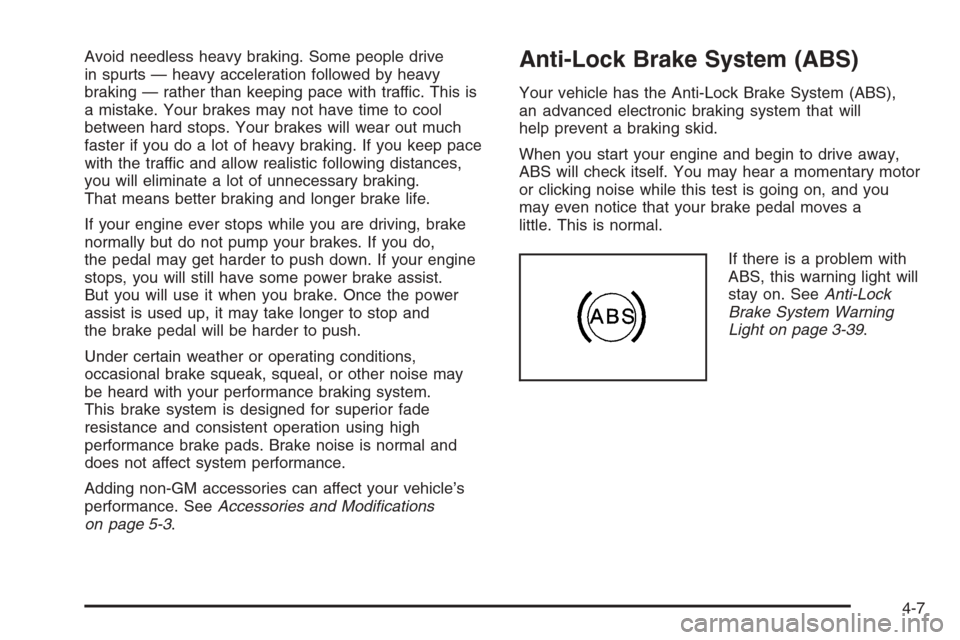
If there is a problem with
ABS, this warning light will
stay on. SeeAnti-Lock
Brake System Warning
Light on page 3-39.
4-7