Page 361 of 480

Your vehicle has a remote negative (−) ground
location, as shown in the illustration. It is located
between the battery and the underhood fuse block.
You should always use this remote ground location,
instead of the terminal on the battery.
Notice:If you connect a negative cable to the ECM,
ECM mounting bracket, or any cables that attach to
the ECM bracket, you may damage the ECM. Always
attach the negative cable to your vehicle’s remote
negative ground location, instead of the ECM, ECM
bracket, or any cables attached to the ECM bracket.
{CAUTION:
An electric fan can start up even when the
engine is not running and can injure you. Keep
hands, clothing and tools away from any
underhood electric fan.
{CAUTION:
Using a match near a battery can cause
battery gas to explode. People have been
hurt doing this, and some have been blinded.
Use a ashlight if you need more light.
Be sure the battery has enough water. You do
not need to add water to the battery installed
in your new vehicle. But if a battery has ller
caps, be sure the right amount of uid is there.
If it is low, add water to take care of that rst.
If you do not, explosive gas could be present.
Battery uid contains acid that can burn you.
Do not get it on you. If you accidentally get it
in your eyes or on your skin, ush the place
with water and get medical help immediately.
5-47
Page 362 of 480
{CAUTION:
Fans or other moving engine parts can injure
you badly. Keep your hands away from moving
parts once the engine is running.
5. Check that the jumper cables do not have loose
or missing insulation. If they do, you could get a
shock. The vehicles could be damaged too.
Before you connect the cables, here are some
basic things you should know. Positive (+) will go
to positive (+) or to a remote positive (+) terminal
if the vehicle has one. Negative (−) will go to a
heavy, unpainted metal engine part or to a remote
negative (−) terminal if the vehicle has one.
Do not connect positive (+) to negative (−)oryou
will get a short that would damage the battery
and maybe other parts too. And do not connect the
negative (−) cable to the negative (−) terminal on
the dead battery because this can cause sparks.6. Connect the red positive (+) cable to the positive (+)
terminal of the dead battery. Use a remote
positive (+) terminal if the vehicle has one.
5-48
Page 363 of 480

7. Do not let the other end touch metal. Connect it to
the positive (+) terminal of the good battery. Use a
remote positive (+) terminal if the vehicle has one.
8. Now connect the black negative (−) cable to the
negative terminal of the good battery. Use a
remote negative (−) terminal if the vehicle has one.
Do not let the other end touch anything until the
next step. The other end of the negative (−) cable
does not go to the dead battery. It goes to a
heavy, unpainted metal engine part or to a remote
negative (−) terminal on the vehicle with the
dead battery.9. Connect the other end of the negative (−) cable at
least 18 inches (45 cm) away from the dead battery,
but not near engine parts that move. The electrical
connection is just as good there, and the chance
of sparks getting back to the battery is much less.
Use a remote negative (−) terminal if the vehicle has
one. Your vehicle’s remote negative (−) ground
location is for this purpose.
10. Now start the vehicle with the good battery and run
the engine for a while.
11. Try to start the vehicle that had the dead battery.
If it will not start after a few tries, it probably needs
service.
5-49
Page 364 of 480

Notice:If the jumper cables are connected or
removed in the wrong order, electrical shorting may
occur and damage the vehicle. The repairs would
not be covered by your warranty. Always connect
and remove the jumper cables in the correct
order, making sure that the cables do not touch
each other or other metal.
A. Heavy, Unpainted Metal Engine Part or Remote
Negative (−) Terminal
B. Good Battery or Remote Positive (+) and Remote
Negative (−) Terminals
C. Dead Battery or Remote Positive (+) TerminalTo disconnect the jumper cables from both vehicles,
do the following:
1. Disconnect the black negative (−) cable from the
vehicle that had the dead battery.
2. Disconnect the black negative (−) cable from the
vehicle with the good battery.
3. Disconnect the red positive (+) cable from the
vehicle with the good battery.
4. Disconnect the red positive (+) cable from the
other vehicle.
All-Wheel Drive
If your vehicle is equipped with all-wheel-drive, this is an
additional system that needs lubrication.
Transfer Case
When to Check Lubricant
It is not necessary to regularly check the transfer case
uid unless you suspect there is a leak or you hear
an unusual noise. A uid loss could indicate a problem.
Have it inspected and repaired. Jumper Cable Removal
5-50
Page 424 of 480
Rear Underseat Fuse Block
Removing the Rear Seat Cushion
Notice:If you touch the exposed wires with the
metal on the seat cushion, you could cause a short
that could damage the battery and or wires. Avoid
contact between the rear seat and the fuse center
whenever you remove or reinstall the rear seat. Do
not remove covers from any of the covered parts,
and do not store anything under the seats.
To remove the rear seat cushion, do the following:
1. Pull up on the front of the cushion to release the
front hooks.
2. Pull the cushion up and out toward the front of
the vehicle.To reinstall the rear seat cushion, do the following:
5-110
Page 428 of 480
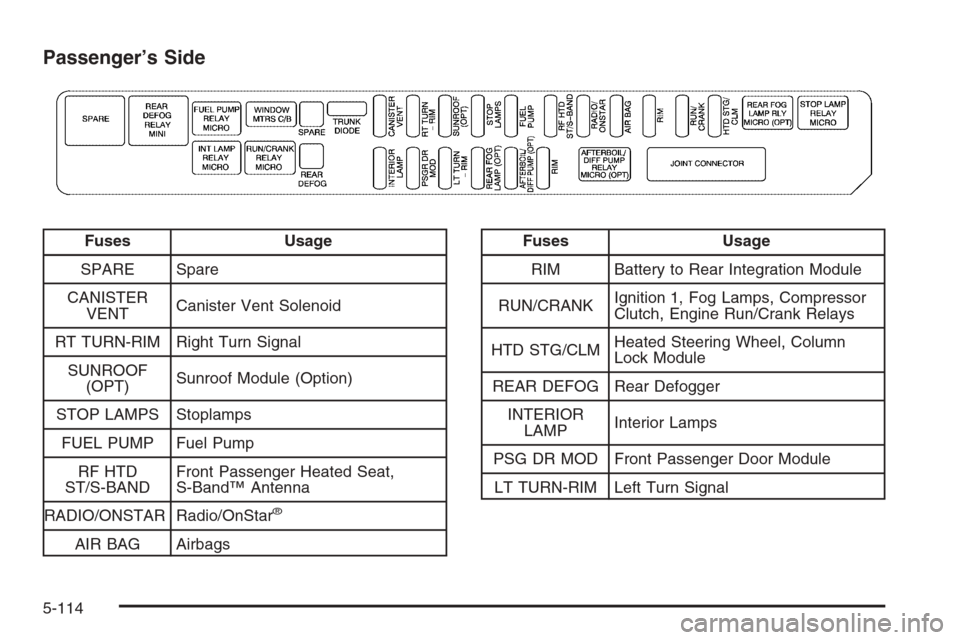
Passenger’s Side
Fuses Usage
SPARE Spare
CANISTER
VENTCanister Vent Solenoid
RT TURN-RIM Right Turn Signal
SUNROOF
(OPT)Sunroof Module (Option)
STOP LAMPS Stoplamps
FUEL PUMP Fuel Pump
RF HTD
ST/S-BANDFront Passenger Heated Seat,
S-Band™ Antenna
RADIO/ONSTAR Radio/OnStar
®
AIR BAG Airbags
Fuses Usage
RIM Battery to Rear Integration Module
RUN/CRANKIgnition 1, Fog Lamps, Compressor
Clutch, Engine Run/Crank Relays
HTD STG/CLMHeated Steering Wheel, Column
Lock Module
REAR DEFOG Rear Defogger
INTERIOR
LAMPInterior Lamps
PSG DR MOD Front Passenger Door Module
LT TURN-RIM Left Turn Signal
5-114
Page 456 of 480

Cadillac Owner Privileges™
Roadside Service provides several Cadillac Owner
Privileges™ at “no charge,” throughout yourCadillac
Warranty Period — 48 months/50,000 miles (80 000 km).
Emergency Road Service is performed on site for the
following situations:
Towing Service
Battery Jump Starting
Lock Out Assistance
Fuel Delivery
Flat Tire Change (Covers change only)
Trip Interruption — If your trip is interrupted due
to a warranty failure, incidental expenses may
be reimbursed during the 48 months/50,000 miles
(80 000 km) warranty period. Items covered
are hotel, meals, and rental car.
Roadside Service Availability
Wherever you drive in the United States or Canada, an
advisor is available to assist you over the phone. A dealer
technician, if available, can travel to your location within
a 30 mile (50 km) radius of a participating Cadillac
dealership. If beyond this radius, we will arrange to have
your car towed to the nearest Cadillac dealership.
Reaching Roadside Service
Dial the toll-free Roadside Service number:
1-800-882-1112. A Roadside Service Advisor will assist
you and request the following information:
A description of the problem
Name, home address, home telephone number
Location of your Cadillac and number you are
calling from
The model year, Vehicle Identication Number
(VIN), mileage, and date of delivery
Roadside Service for the Hearing or
Speech Impaired
Roadside Service is prepared to assist owners who
have hearing difficulties or are speech impaired.
Cadillac has installed special telecommunication devices
called Text Telephone (TTY) in the Roadside Service
Center.
Any customer who has access to a (TTY) or a
conventional teletypewriter can communicate with
Cadillac by dialing from the United States or Canada
1-888-889-2438— daily, 24 hours.
7-6
Page 468 of 480

Audio System(s) (cont.)
Care of Your CDs ......................................3-121
Diversity Antenna System............................3-122
Navigation/Radio System, see Navigation
Manual.................................................3-115
Audio Systems
Radio Personalization.................................3-115
Audio System(s)
Radio with CD............................................3-96
Setting the Time..........................................3-95
Theft-Deterrent Feature...............................3-119
Understanding Radio Reception...................3-120
XM™ Satellite Radio Antenna System...........3-122
Automatic Transmission
Fluid..........................................................5-26
Operation...........................................2-28, 2-32
B
Battery..........................................................5-44
Exterior Lighting Battery Saver......................3-38
Inadvertent Power Saver..............................3-40
Load Management.......................................3-40
Before Leaving on a Long Trip.........................4-24
Brake
Anti-Lock Brake System (ABS)........................ 4-7
Emergencies................................................ 4-9
Panic Assist................................................4-12Brake (cont.)
Parking......................................................2-35
System Warning Light..................................3-64
Brakes..........................................................5-41
Braking........................................................... 4-6
Braking in Emergencies..................................... 4-9
Break-In, New Vehicle.....................................2-24
Bulb Replacement...........................................5-53
Back-Up Lamps...........................................5-54
Halogen Bulbs............................................5-53
High Intensity Discharge (HID) Lighting...........5-53
Replacement Bulbs......................................5-54
Buying New Tires...........................................5-72
C
Calibration...............................................1-7, 2-42
California Fuel.................................................. 5-6
California Proposition 65 Warning....................... 5-3
Canadian Owners................................................ ii
Capacities and Specications..........................5-116
Carbon Monoxide...................2-14, 2-39, 4-27, 4-40
Care of
Safety Belts................................................5-97
Your CD Player.........................................3-122
Your CDs .................................................3-121
Center Console Storage Area...........................2-51
2