2006 BMW M3 COUPE wheel
[x] Cancel search: wheelPage 115 of 170

115
Those grades represent the tire's ability
to stop on wet pavement as measured
under controlled conditions on speci-
fied government test surfaces of
asphalt and concrete. A tire marked C
may have poor traction performance.
The traction grade assigned to
this tire is based on straight-
ahead braking traction tests, and does
not include acceleration, cornering,
hydroplaning, or peak traction charac-
teristics.
tire's resistance to the generation of
heat and its ability to dissipate heat
when tested under controlled condi-
tions on a specified indoor laboratory
test wheel.
Sustained high temperature can cause
the material of the tire to degenerate
and reduce tire life, and excessive tem-
perature can lead to sudden tire failure.
The grade C corresponds to a level of
performance which all passenger car
tires must meet under the Federal
Motor Vehicle Safety Standard No. 109.
Grades B and A represent higher levels
of performance on the laboratory test
wheel than the minimum required by
law.
The temperature grade for this tire
is established for a tire that is
properly inflated and not overloaded.
Excessive speed, under-inflation, or
excessive loading, either separately or
in combination, can cause heat buildup
and possible tire failure.
summer tires.
Tire conditionWheel/tire damageInspect your tires frequently for signs of
damage, foreign objects and tread
wear, and check tread depth.
Due to low-profile tires, please
note that wheels, tires and sus-
pension parts are more susceptible to
road hazard and consequential dam-
ages.
Unusual vibrations encountered during
normal vehicle operation can indicate
tire failure or some other vehicle defect.
This type of problem can be caused by
contact with curbs, etc. This is also true
for irregularities in the vehicle's han-
dling characteristics, such as a pro-
nounced tendency to pull to the left or
right.
Should this occur, respond by immedi-
ately reducing your speed. Proceed
carefully to the nearest BMW center or
professional tire center, or have the
vehicle towed there. Tire damage, up to
and including blowouts, can endanger
the lives of both the vehicle occupants
and other road users.<
Tire code
OverviewControlsMaintenanceRepairsDataIndex
Page 116 of 170
116
Tire treadTread depth should not be allowed to
go below 1/8 in / 3 mm, even though
European legislation, for example,
requires a mimimum tread depth of only
1/16 in / 1.6 mm. Below 1/8 in / 3 mm
tread depth, there is a great risk of
hydroplaning, even at relatively moder-
ate speeds and with only small amounts
of water on the road.
At tread depths below approx.
3/16 in / 4 mm, tire performance under
winter driving conditions deteriorates
noticeably. Worn tires should therefore
be replaced for safety considerations.
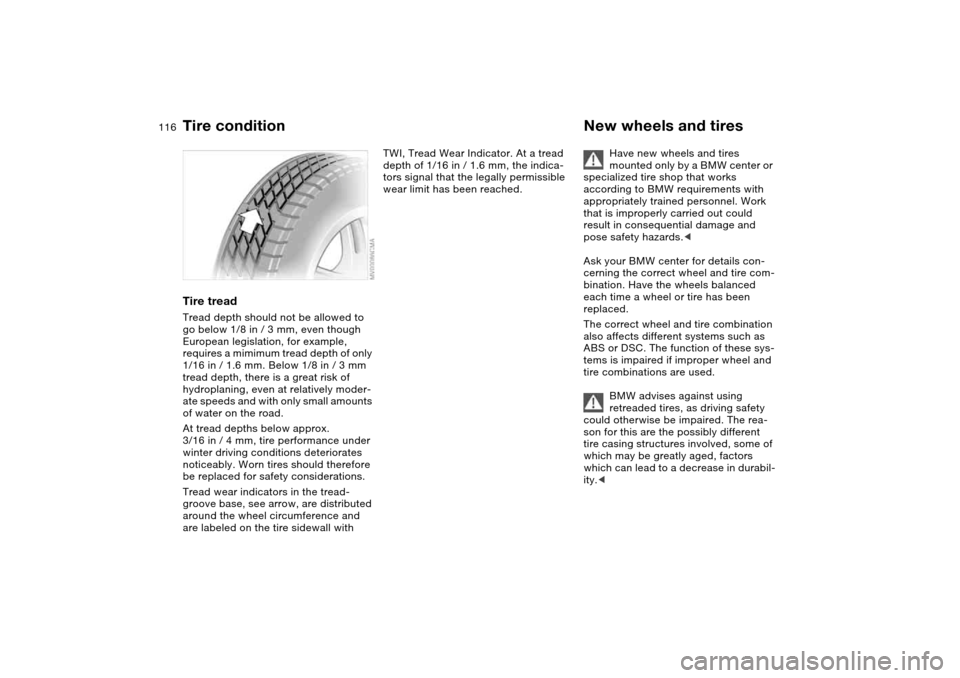
Tread wear indicators in the tread-
groove base, see arrow, are distributed
around the wheel circumference and
are labeled on the tire sidewall with
TWI, Tread Wear Indicator. At a tread
depth of 1/16 in / 1.6 mm, the indica-
tors signal that the legally permissible
wear limit has been reached.
New wheels and tires
Have new wheels and tires
mounted only by a BMW center or
specialized tire shop that works
according to BMW requirements with
appropriately trained personnel. Work
that is improperly carried out could
result in consequential damage and
pose safety hazards.<
Ask your BMW center for details con-
cerning the correct wheel and tire com-
bination. Have the wheels balanced
each time a wheel or tire has been
replaced.
The correct wheel and tire combination
also affects different systems such as
ABS or DSC. The function of these sys-
tems is impaired if improper wheel and
tire combinations are used.
BMW advises against using
retreaded tires, as driving safety
could otherwise be impaired. The rea-
son for this are the possibly different
tire casing structures involved, some of
which may be greatly aged, factors
which can lead to a decrease in durabil-
ity.<
Tire condition
Page 117 of 170
117
The correct wheels and tires
BMW recommends using only
wheels and tires that have been
tested and approved by BMW for the
particular vehicle model, as otherwise
body contact and serious accidents can
result despite the use of the same nom-
inal size, e.g. due to manufacturing tol-
erances. If non-approved wheels and
tires are used, BMW cannot evaluate
their suitability, and therefore cannot be
held liable for driving safety.<
To maintain good handling and vehicle
response, use only tires of a single
brand and tread configuration. After a
flat tire, have the previous wheel and
tire combination restored as soon as
possible.
Recommended tire sizes and
brandsFor each tire size, certain tire brands
have been tested, classified as road-
safe and approved by BMW. You can
find out about these from a professional
tire center, preferably your BMW cen-
ter. Observe any country-specific regu-
lations, e.g. on making a corresponding
entry in the vehicle documents.
The factory-approved radial belt tires
are matched to your vehicle and pro-
vide optimum safety and driving com-
fort when used properly.Special characteristics of winter
tiresBMW recommends the use of winter
tires for operation under winter road
conditions. While all-season tires with
M+S designation provide better winter
traction than summer tires, they gener-
ally do not achieve the full performance
of winter tires.Observing speed ratings
Never exceed the maximum
speed for which the winter tires
are rated. Unprofessional attempts by
laymen to service tires can lead to dam-
age and accidents. Have this work per-
formed by skilled professionals only.
The technicians at your BMW center
will be glad to assist you with the
required professional knowledge and
specialized equipment.<
StorageAlways store tires in a cool, dry place.
Store them away from light whenever
possible. Protect the tires against con-
tact with oil, grease and fuel. Do not
exceed the maximum tire inflation pres-
sures specified on the tire sidewall.
New wheels and tires
OverviewControlsMaintenanceRepairsDataIndex
Page 118 of 170

118
Snow chains*Only certain snow chains have been
tested by BMW and determined and
approved as roadworthy. Consult your
BMW center for more information.
BMW recommends using only these
approved fine-link snow chains. Use
them in pairs on winter tires, but only on
both rear wheels.
Comply with all manufacturer's safety
precautions when mounting the chains.
Do not exceed a maximum speed of
30 mph / 50 km/h when using snow
chains.
After mounting or removing snow
chains, always reinitialize the sequential
M gearbox with Drivelogic, refer to
page 70.
It is not possible to mount snow
chains on tires with 18-inch and
19-inch wheels.
Deactivate the Flat Tire Monitor when
using snow chains. Malfunction warn-
ings and undetected losses in pressure
are a possibility when driving with snow
chains.
When driving with snow chains, it may
be useful to deactivate DSC, refer to
page 83.<
Page 137 of 170
137
Tire repair with the M Mobility system
Precautions in case of a flat tire:
Stop the vehicle as far as possible
from passing traffic and position it on a
firm surface. Turn on the hazard warn-
ing flashers.
Turn the steering wheel to the straight-
ahead position and engage the steering
lock. Engage the parking brake and
shift into 1st or reverse gear.
All passengers should be outside the
vehicle and well away from your imme-
diate working area – behind a guardrail,
for instance.
If necessary, set up your warning trian-
gle or portable hazard warning lamp on
the roadside at an appropriate distance
from the rear of the vehicle. Comply
with all local safety guidelines and reg-
ulations.<
You will find an M Mobility system in the
BMW M3 for repairing flat tires. With
this system you can apply a sealant to
the inside of the tire, thus seal off the
damaged point, then reinflate the tire
and continue driving.
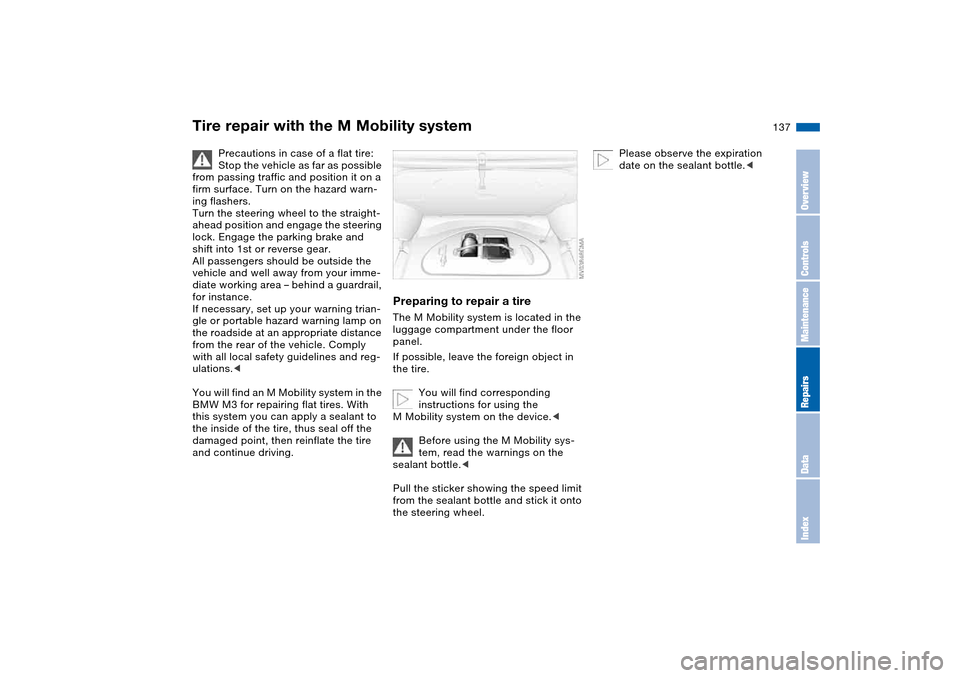
Preparing to repair a tireThe M Mobility system is located in the
luggage compartment under the floor
panel.
If possible, leave the foreign object in
the tire.
You will find corresponding
instructions for using the
M Mobility system on the device.<
Before using the M Mobility sys-
tem, read the warnings on the
sealant bottle.<
Pull the sticker showing the speed limit
from the sealant bottle and stick it onto
the steering wheel.
Please observe the expiration
date on the sealant bottle.<
OverviewControlsMaintenanceRepairsDataIndex
Page 138 of 170
138
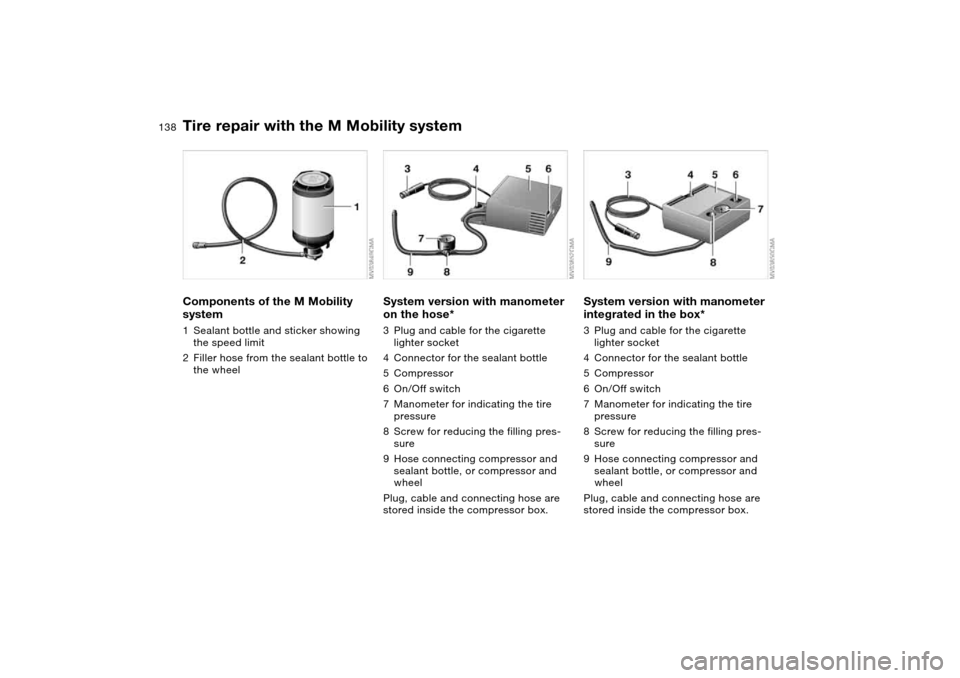
Components of the M Mobility
system1Sealant bottle and sticker showing
the speed limit
2Filler hose from the sealant bottle to
the wheel
System version with manometer
on the hose*3Plug and cable for the cigarette
lighter socket
4Connector for the sealant bottle
5Compressor
6On/Off switch
7Manometer for indicating the tire
pressure
8Screw for reducing the filling pres-
sure
9Hose connecting compressor and
sealant bottle, or compressor and
wheel
Plug, cable and connecting hose are
stored inside the compressor box.
System version with manometer
integrated in the box*3Plug and cable for the cigarette
lighter socket
4Connector for the sealant bottle
5Compressor
6On/Off switch
7Manometer for indicating the tire
pressure
8Screw for reducing the filling pres-
sure
9Hose connecting compressor and
sealant bottle, or compressor and
wheel
Plug, cable and connecting hose are
stored inside the compressor box.
Tire repair with the M Mobility system
Page 139 of 170
139
Using the M Mobility systemTo repair a flat tire using the M Mobility
system, proceed as follows:
>Fill with sealant, refer to page 139
>Distribute the sealant, refer to
page 139
>Restore tire inflation pressure, refer
to page 139.
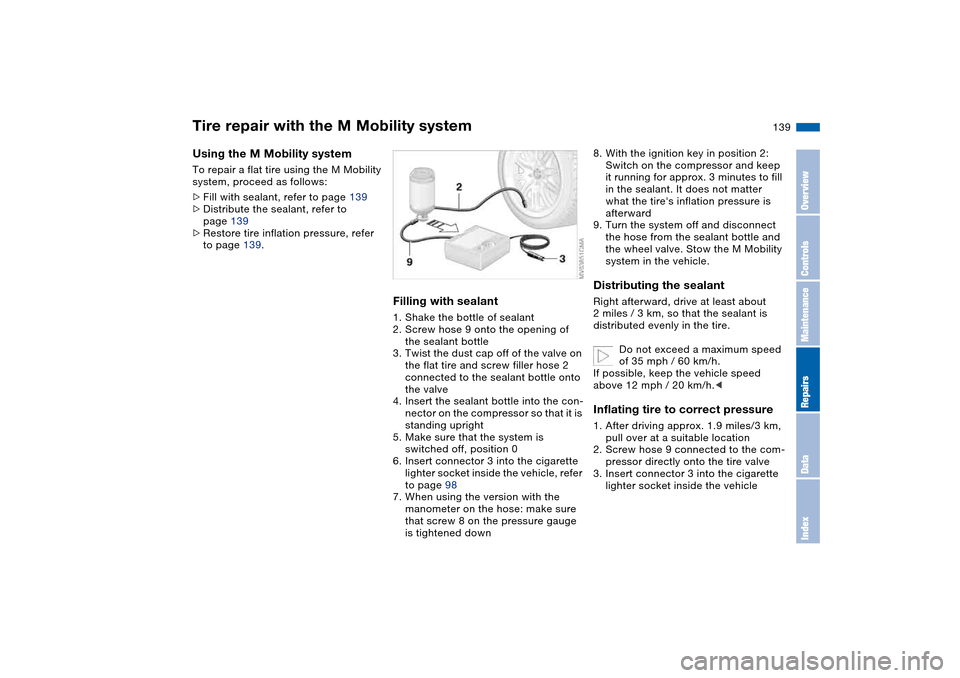
Filling with sealant1. Shake the bottle of sealant
2. Screw hose 9 onto the opening of
the sealant bottle
3. Twist the dust cap off of the valve on
the flat tire and screw filler hose 2
connected to the sealant bottle onto
the valve
4. Insert the sealant bottle into the con-
nector on the compressor so that it is
standing upright
5. Make sure that the system is
switched off, position 0
6. Insert connector 3 into the cigarette
lighter socket inside the vehicle, refer
to page 98
7. When using the version with the
manometer on the hose: make sure
that screw 8 on the pressure gauge
is tightened down
8. With the ignition key in position 2:
Switch on the compressor and keep
it running for approx. 3 minutes to fill
in the sealant. It does not matter
what the tire's inflation pressure is
afterward
9. Turn the system off and disconnect
the hose from the sealant bottle and
the wheel valve. Stow the M Mobility
system in the vehicle.Distributing the sealantRight afterward, drive at least about
2 miles / 3 km, so that the sealant is
distributed evenly in the tire.
Do not exceed a maximum speed
of 35 mph / 60 km/h.
If possible, keep the vehicle speed
above 12 mph / 20 km/h.
2. Screw hose 9 connected to the com-
pressor directly onto the tire valve
3. Insert connector 3 into the cigarette
lighter socket inside the vehicle
Tire repair with the M Mobility system
OverviewControlsMaintenanceRepairsDataIndex
Page 157 of 170

Everything from A to Z
157
Blower
automatic climate
control 92
BMW Maintenance
System 126
BMW sports seat 44
Bore, refer to Engine
data 150
Bottle holders, see Bever-
age holders 96, 97
Brake fluid 125
indicator lamp 18, 125
level 125
Brake force display 86
Brake lamps
bulb replacement 135
indicator lamp, defective
lamp 77
Brake lamps, refer to Brake
force display 86
Brake pads
brake fluid level 18, 125
breaking in 108
Brake rotors
breaking in 108
Brake system
brake pads, indicator
lamp 19
Brake wear warning
indicator lamp 19Brakes
ABS 111
brake fluid 125
brake force display 86
brake pads 110
breaking in 108
driving notes 109
indicator/warning
lamp 18, 19
parking brake 64
Break-in procedures 108
Bridging, refer to Jump-
starting 143
Bulb replacement 133
Bulb replacement, refer to
Lamps and bulbs 133
Buttons in steering wheel 22
C
California Proposition 65
warning 6
Can holders, see Beverage
holders 96, 97
Capacities 153
Car battery 140
Car care, refer to the Caring
for your vehicle brochure
Car keys, refer to Keys 28
Car phone hookup
microphone 97
Car radio, refer to the
Owner's Manual for RadioCar telephone, refer to the
separate Owner's Manual
Car vacuum cleaner, con-
necting 98
Car wash, refer to the Caring
for your vehicle brochure
Caring for headlamp cov-
ers, refer to the Caring for
your vehicle brochure 133
Carpet care, refer to the
Caring for your vehicle
brochure
Cassette operation, refer to
the Owner's Manual for
Radio/Onboard Computer
CBC Cornering Brake Con-
trol 111
warning lamp 19
CD changer, refer to the
Owner's Manual for
Radio/Onboard Computer
CD operation, refer to the
Owner's Manual for
Radio/Onboard Computer
Center high-mount brake
lamp
bulb replacement 136
Central locking system 28
button 33
passenger
compartment 33
Charge indicator lamp 18Check Control 77
Check Gas Cap
indicator lamp 19
Child seats, refer to Child-
restraint systems 55
Child-restraint systems 55
Cigarette lighter 98
Cleaning chrome parts, refer
to the Caring for your vehi-
cle brochure
Cleaning light alloy wheels,
refer to the Caring for your
vehicle brochure
Cleaning the vehicle, refer to
the Caring for your vehicle
brochure
Cleaning windshield 73
Clock 78
12-/24-hour mode 78
setting, refer also to the
Owner's Manual for
Radio/Onboard Computer
Closing
from inside 33
from outside 29
Clothes hooks 99
Clutch
breaking in 108
Cockpit 14
Code, refer to the Owner's
Manual for Radio/Onboard
Computer
OverviewControlsMaintenanceRepairsDataIndex