2006 BMW 325XI TOURING airbag off
[x] Cancel search: airbag offPage 33 of 160
Reference
At a glance
Controls
Driving tips
Mobility
31
Adjustments
Sitting safely
The ideal sitting position can make a vital con-
tribution to relaxed, fatigue-free driving. In con-
junction with the safety belts, the head
restraints and the airbags, the seated position
has a major influence on your safety in the event
of an accident. To ensure that the safety sys-
tems operate with optimal efficiency, we
strongly urge you to observe the instructions
contained in the following section.
For additional information on transporting chil-
dren safely, refer to page39.
Airbags
Always maintain an adequate distance
between yourself and the airbags. Always
grip the steering wheel on the rim, with your
hands in the 3 o'clock and 9 o'clock positions,
to minimize the risk of injury to the hands or
arms in the event of the airbag being triggered
off.
No one and nothing is to come between the air-
bags and the seat occupant.
Do not use the cover of the front airbag on the
front passenger side as a storage area. Make
sure that the front passenger is sitting correctly,
e.g. not resting feet or legs on the instrument
panel, otherwise leg injuries can occur if the
front airbag is triggered.
Make sure that passengers do not lean their
heads against the side or head airbags, other-
wise serious injuries could result if the side air-
bags suddenly deployed.<
Even if you follow all the instructions, injuries
resulting from contact with airbags cannot be
fully excluded, depending on the circum-
stances. The ignition and inflation noise may
provoke a mild hearing loss in extremely sensi-
tive individuals. This effect is usually only tem-
porary.
For airbag locations and additional information
on airbags, refer to page71.
Head restraint
A correctly adjusted head restraint reduces the
risk of neck injury in the event of an accident.
Adjust the head restraint in such a way
that its center is at approx. ear level. Oth-
erwise, there is an increased risk of injury in the
event of an accident.<
Head restraints, refer to page33.
Safety belt
Before every drive, make sure that all occupants
wear their safety belts. Airbags complement the
safety belt as an additional safety device, but
they do not represent a substitute.
Never allow more than one person to
wear a single safety belt. Never allow
infants or small children to ride in a passenger's
lap.
Expectant mothers should also wear the safety
belt, making sure that the strap in the pelvic
area is well down on the hips and does not press
against the abdominal region of the body.
Do not route the belt across your neck, or run it
across sharp edges. Be sure that the belt does
not become caught or jammed. The safety belt
should not be twisted and must be positioned
firmly over the pelvis and shoulder, as close to
the body as possible. It should not pass over
hard or fragile objects, otherwise the belt in the
pelvic area could slide over the hips in the event
of a head-on collision and injure the lower abdo-
men. Avoid wearing bulky clothing and regularly
pull the belt in the upper-body area taut, other-
wise its restraining effect could be impaired.<
Safety belts, refer to page36.
Seats
Note before adjusting
Never attempt to adjust your seat while
the vehicle is moving. The seat could
respond with unexpected movement, and the
Page 38 of 160
Adjustments
36
Convenience mode
1.Unlock and open the driver's door or switch
on radio readiness, refer to page42.
2.Briefly press the desired memory button1
or 2.
The adjusting procedure is immediately halted
when you touch a seat adjustment switch or
one of the MEMORY buttons.
Safety feature
1.Close the driver's door and switch the igni-
tion on or off, refer to page42.
2.Press the desired memory button1 or2
and maintain pressure until the adjustment
process has been completed.
If the button was pressed accidentally:
press the button again; the LED goes out.
Safety belts
Observe the adjustment instructions on
page31 to ensure the best possible per-
sonal protection.<
Before every drive, make sure that all occupants
wear their safety belts. Airbags complement the
safety belt as an additional safety device, but
they do not represent a substitute.
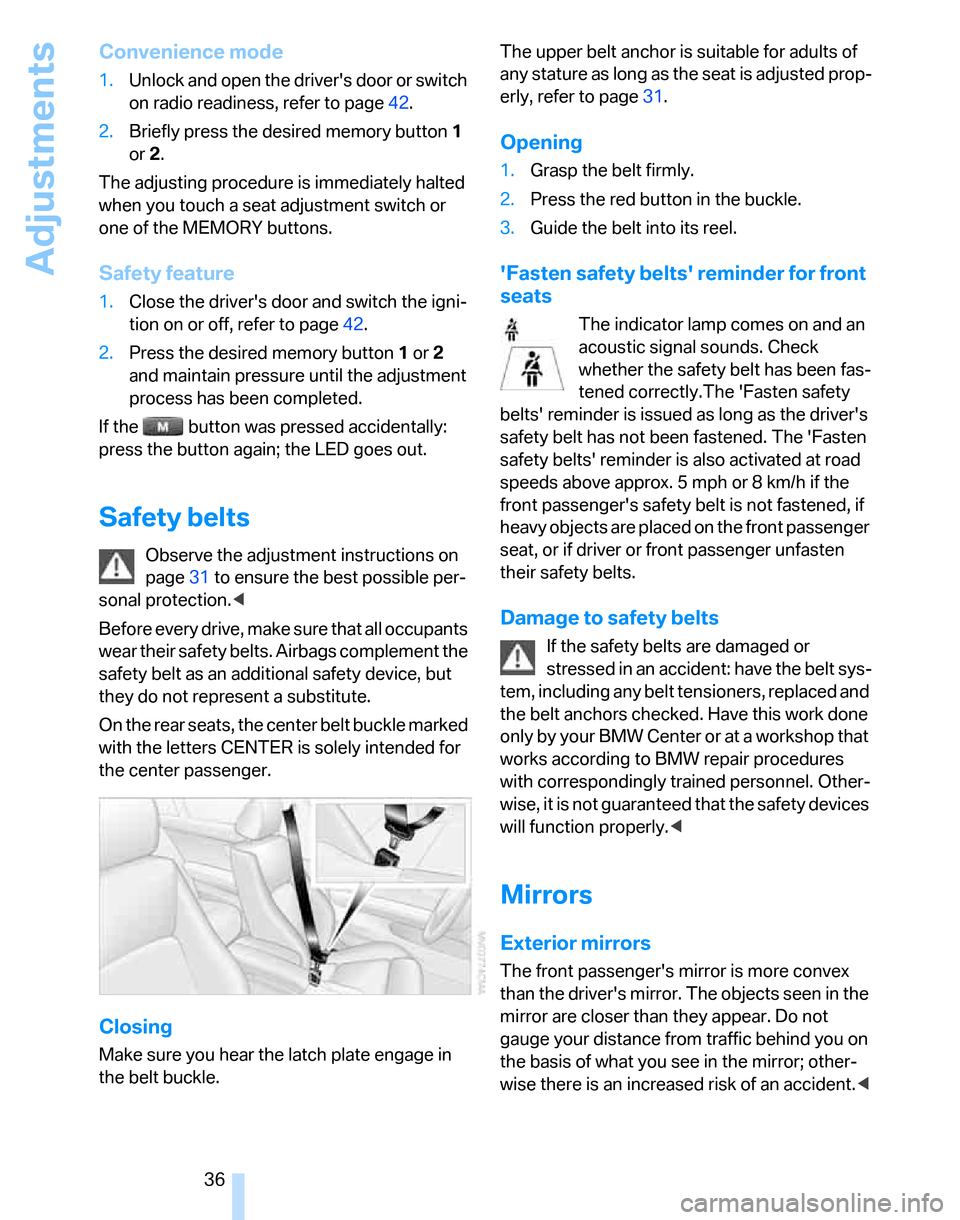
On the rear seats, the center belt buckle marked
with the letters CENTER is solely intended for
the center passenger.
Closing
Make sure you hear the latch plate engage in
the belt buckle.The upper belt anchor is suitable for adults of
any stature as long as the seat is adjusted prop-
erly, refer to page31.
Opening
1.Grasp the belt firmly.
2.Press the red button in the buckle.
3.Guide the belt into its reel.
'Fasten safety belts' reminder for front
seats
The indicator lamp comes on and an
acoustic signal sounds. Check
whether the safety belt has been fas-
tened correctly.The 'Fasten safety
belts' reminder is issued as long as the driver's
safety belt has not been fastened. The 'Fasten
safety belts' reminder is also activated at road
speeds above approx. 5 mph or 8 km/h if the
front passenger's safety belt is not fastened, if
heavy objects are placed on the front passenger
seat, or if driver or front passenger unfasten
their safety belts.
Damage to safety belts
If the safety belts are damaged or
stressed in an accident: have the belt sys-
tem, including any belt tensioners, replaced and
the belt anchors checked. Have this work done
only by your BMW Center or at a workshop that
works according to BMW repair procedures
with correspondingly trained personnel. Other-
wise, it is not guaranteed that the safety devices
will function properly.<
Mirrors
Exterior mirrors
The front passenger's mirror is more convex
than the driver's mirror. The objects seen in the
mirror are closer than they appear. Do not
gauge your distance from traffic behind you on
the basis of what you see in the mirror; other-
wise there is an increased risk of an accident.<
Page 41 of 160

Reference
At a glance
Controls
Driving tips
Mobility
39
Transporting children safely
The right place for children
Do not leave children unattended in the
vehicle, otherwise they could endanger
themselves and/or other persons by opening
the doors, for example.<
The rear center seat is not suitable for installing
universal child-restraint systems for all age
groups, approved for the age group in question.
Children always in the rear
Accident research has shown that the safest
place for children is on the rear seats.
Children under the age of 13 or smaller
than 5 ft/150 cm may be transported only
in the rear in suitable child-restraint systems
appropriate for their age, weight and size. Oth-
erwise there is an increased risk of injury in the
event of an accident.<
Children 13 years of age or older must be buck-
led in with a safety belt as soon as there no
longer is any child-restraint system that is
appropriate for their age, size and weight.
All rear seats in your vehicle meet the recom-
mendations of the SAE J1819 standard for
safely mounting child-restraint systems in
motor vehicles.
Exception for front passenger seat
Should it be necessary to use a child-
restraint system on the front passenger
seat, the front and side airbags must be deacti-
vated. Otherwise, a child traveling on that seat
will be at an increased risk of injury if the airbags
are triggered off, even with a child-restraint sys-
tem. Your BMW Center will be glad to advise
you.<
For more information on automatic deactivation
of the front passenger airbags refer to page72.
Installing child-restraint
systems
Observe the child-restraint system man-
ufacturer's instructions for selecting,
installing and using child-restraint systems.
Otherwise the protective effect may be dimin-
ished.<
Standard child-restraint systems are designed
to be secured with a lap belt or with the lap-belt
section of a lap-and-shoulder belt. Incorrectly
or improperly installed child-restraint systems
can increase the risk of injury to children.
Always follow the installation instructions for
the system with the greatest care.
On the front passenger's seat
Before installing a child-restraint system
on the front passenger's seat, make sure
that the front and side airbags for the front pas-
senger are deactivated, otherwise there is an
increased risk of injury if the airbags deploy.<
Seat height
Before installing a universal child-restraint sys-
tem, move the front passenger's seat up as far
as it will go to ensure that the safety belt will be
ideally positioned. Do not change the seat
height afterward.
Backrest width
The backrest width of the front passenger
seat must be adjusted to its widest set-
ting, otherwise the stability of the child seat on
the front passenger seat is limited.<
1.Adjust the backrest width to its widest set-
ting, refer to page33.
2.Install the child seat.
Page 73 of 160

Reference
At a glance
Controls
Driving tips
Mobility
71
intervention is simultaneously deactivated
when DSC is switched off, refer to page66.
Malfunction
The warning lamps come on. Active
steering is no longer operational. At
low speeds, greater steering wheel
movements are required, whereas at
higher speeds the vehicle reacts more sensi-
tively to steering wheel movements. Drive cau-
tiously and think well ahead. Have the system
checked.
If the warning lamp lights up during the first
engine starting following a power supply inter-
ruption, the system must be activated by being
initialized.
Brake Force Display*
The brake lamps light up in two stages,
depending on how sharply you apply the
brakes.
>Normal braking:
The brake lamps and the center brake lamp
light up.
>Sharp braking:
The illuminated surface of the brake lamps
is enlarged, as long as the rear fog light is
not switched on.
Airbags
The following airbags are located under the
marked covers:
1Front airbags
2Head airbags
3Side airbags
Protective action
Observe the adjustment instructions on
page31 to ensure the best possible per-
sonal protection.<
The front airbags help protect the driver and
front passenger by responding to frontal impacts in which safety belts alone cannot pro-
vide adequate restraint. When needed, the
head and side airbags help provide protection in
the event of side impact. The relevant side air-
bag supports the side upper body area. The
head air bag supports the head.
The airbags will purposely not be activated by
every collision, e.g. not by more minor acci-
dents, certain roll-over situations and rear-end
collisions.
Do not apply adhesive materials to the
cover panels of the airbags, cover them or
modify them in any other way. Do not attach
Page 133 of 160
Reference
At a glance
Controls
Driving tips
Mobility
131
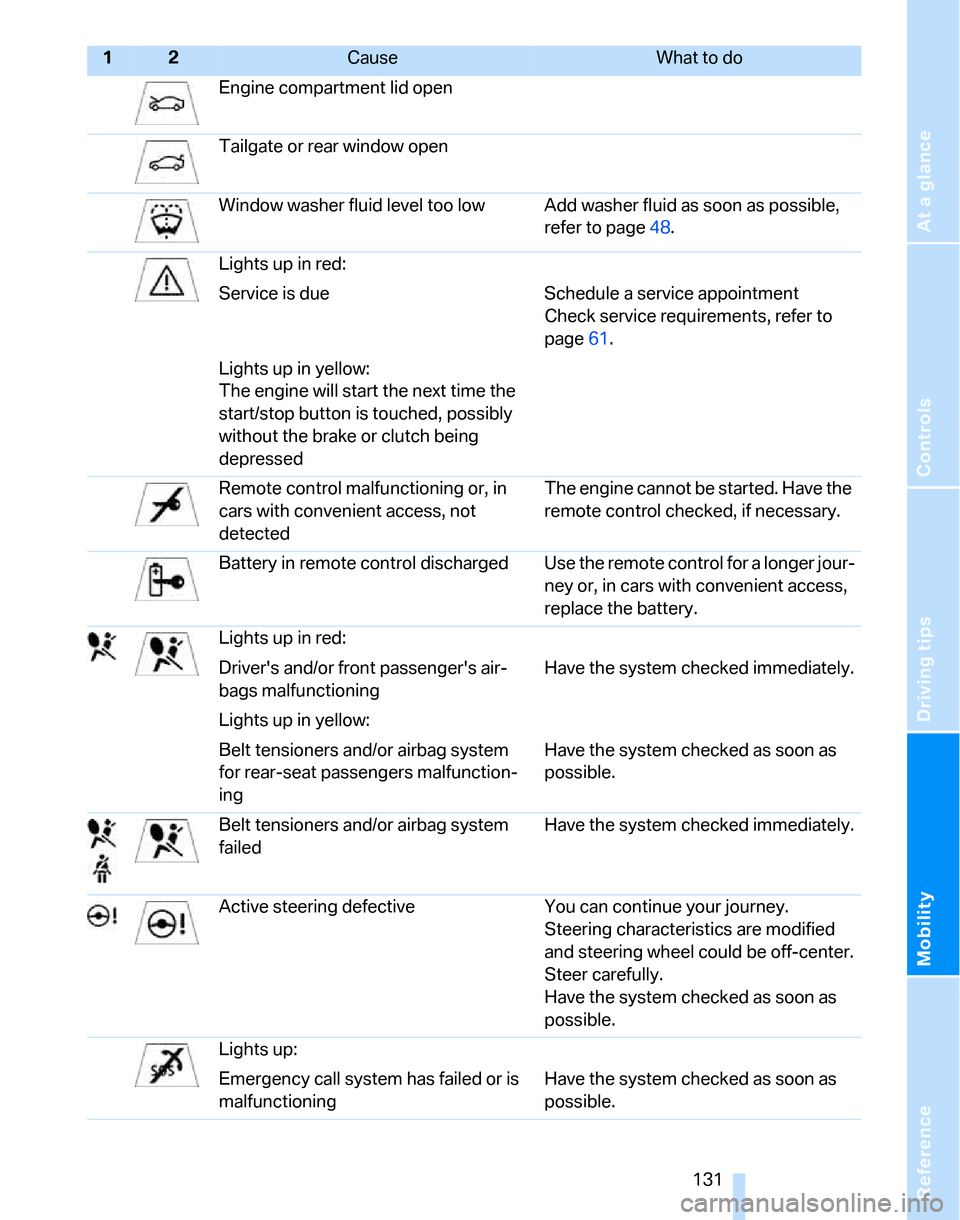
Engine compartment lid open
Tailgate or rear window open
Window washer fluid level too low Add washer fluid as soon as possible,
refer to page48.
Lights up in red:
Service is due Schedule a service appointment
Check service requirements, refer to
page61.
Lights up in yellow:
The engine will start the next time the
start/stop button is touched, possibly
without the brake or clutch being
depressed
Remote control malfunctioning or, in
cars with convenient access, not
detectedThe engine cannot be started. Have the
remote control checked, if necessary.
Battery in remote control discharged Use the remote control for a longer jour-
ney or, in cars with convenient access,
replace the battery.
Lights up in red:
Driver's and/or front passenger's air-
bags malfunctioningHave the system checked immediately.
Lights up in yellow:
Belt tensioners and/or airbag system
for rear-seat passengers malfunction-
ingHave the system checked as soon as
possible.
Belt tensioners and/or airbag system
failedHave the system checked immediately.
Active steering defective You can continue your journey.
Steering characteristics are modified
and steering wheel could be off-center.
Steer carefully.
Have the system checked as soon as
possible.
Lights up:
Emergency call system has failed or is
malfunctioningHave the system checked as soon as
possible.
12Cause What to do
Page 148 of 160

Everything from A to Z
146
Everything from A to Z
Index
A
ABS Antilock Brake
System66
ACC, refer to Active cruise
control50
Accessories, refer to The
individual vehicle5
Activated-charcoal filter for
automatic climate control83
Active cruise control50
– indicator lamps53
– malfunction54
– selecting distance52
– sensor54
Active steering70
– warning lamp71
Adapter for spare key18
Adaptive Head Light75
Additives
– coolant115
Adjusting temperature inside
the car, refer to Air
conditioner79
Adjusting temperature inside
the car, refer to Automatic
climate control81
Airbags71
– sitting safely31
– warning lamp73
Air conditioner78
Air conditioning mode
– air conditioner79
– automatic climate control81
– ventilation80,83
Air distribution
– automatic82
– individual79
– manual79
Air flow rate79,82
Airing, refer to
Ventilation80,83Air outlets, refer to Air
vents78
Air pressure, tires106
Air recirculation, refer to
Recirculated-air
mode79,82
Air supply
– air conditioner79
– automatic climate control81
– ventilation80,83
Air vents78
AKI, refer to Fuel
specifications105
Alarm system25
– avoiding unintentional
alarms25
– interior motion sensor25
– switching off an alarm25
– tilt alarm sensor25
All-season tires, refer to
Winter tires111
Ambient air, refer to
Recirculated-air
mode79,82
Antifreeze
– coolant115
– washer fluid48
Anti-theft alarm system, refer
to Alarm system25
Anti-theft system19
Anti-trapping mechanism
– windows28
Approved axle loads, refer to
Weights144
Approved gross vehicle
weight, refer to Weights144
Armrest, refer to Center
armrest87
Ashtray
– front88
– rear89Assistance systems, refer to
Dynamic Stability Control
DSC66
AUC Automatic recirculated-
air control82
Audio device, external87
Automatic
– air distribution82
– air flow rate82
– cruise control48,50
– headlamp control74
Automatic climate control78
– automatic air distribution82
Automatic curb monitor37
Automatic recirculated-air
control AUC82
Automatic transmission with
Steptronic44
– interlock44,45
– overriding selector lever
lock46
– shiftlock45
– sport program45
AUTO program for automatic
climate control82
AUX-IN
– port87
Average fuel consumption58
– setting the units60
Average speed58
Avoiding unintentional
alarms25
Axle loads, refer to
Weights144
B
Backrests, refer to Seats31
Backrest width adjustment33
Back seats
– refer to Rear seats
Backup lamps
– replacing bulbs122
Page 155 of 160

Reference
At a glance
Controls
Driving tips
Mobility
153
Pollen
– refer to Microfilter/activated-
charcoal filter for automatic
climate control83
– refer to Microfilter for air
conditioner80
Power failure123
Power windows28
– safety switch28
Power windows, refer to
Windows27
Pressure, tires106
Pressure monitoring, tires69
– Flat Tire Monitor69
Protection function, refer to
Anti-trapping mechanism
– windows28
Providing medical assistance,
refer to First add pouch125
Puncture
– Flat Tire Monitor69
R
Radio key, refer to Integrated
key/Remote control18
Radio position, refer to Radio
readiness42
Radio readiness42
– switched off42
– switched on42
Rain sensor47
Reading lamps77
Rear lamps, refer to Tail
lamps122
– replacing bulbs122
Rear seat back, folding90
Rear seats
– adjusting head restraints34
– folding head restraint down
and up34
– folding the backrests90
Rear turn signals
– replacing bulbs122
Rear ventilation83
Rearview mirror, refer to
Mirrors36
Rear window defroster79,83Rear window roller blind, refer
to Roller sun blinds86
Rear window safety switch28
Rechargeable flashlight87
Recirculated-air mode79,82
Recirculation of air, refer to
Recirculated-air
mode79,82
Reclining seat, refer to
Backrest32
Refueling104
Releasing
– hood112
Remaining distance, refer to
Cruising range58
Remote control18
– battery renewal27
– convenient access26
– garage door opener84
– malfunctions21,27
– service data117
– tailgate21
Replacement remote
control18
Replacing bulbs, refer to
Lamps and bulbs119
Replacing tires, refer to New
wheels and tires110
Reporting an accident, refer to
Initiating an emergency
call125
Reporting safety defects6
Reserve warning, refer to Fuel
gauge58
Reservoir for washer
systems48
Residual heat mode82
Restraint systems
– for children39
– refer to Safety belts36
Reverse gear
– automatic transmission with
Steptronic45
– manual transmission44
Roadside Assistance125
Roadside parking lamps76
– replacing bulbs121
Roadworthiness test, refer to
Service requirements61Roller blind
– sun blinds86
Roof load capacity144
Roof-mounted luggage
rack99
Rope, refer to Tow-starting,
towing away128
RSC Runflat System
Component, refer to Run-
Flat Tires110
Runflat System Component
RSC, refer to Run-Flat
Tires110
Run-Flat Tires110
– continuing driving with a
damaged tire70
– flat tire70
– new tires110
– replacing tires110
– tire pressures106
– winter tires111
Runflat Tyres, refer to Run-
Flat Tires110
S
Safety-belt height
adjustment36
Safety belts36
– damage36
– indicator lamp36
– reminder36
– sitting safely31
Safety systems
– airbags71
– Antilock Brake System
ABS66
– Dynamic Stability Control
DSC66
– safety belts36
Safety tires, refer to Run-Flat
Tires110
Screw thread for tow
fitting127
Seat adjustment
– electric32
– mechanical32
Seat and mirror memory34
Page 156 of 160

Everything from A to Z
154 Seat belt reminder, refer to
'Fasten safety belts'
reminder36
Seats31
– adjusting the seats32
– heating34
– sitting safely31
Securing cargo92
Securing the vehicle
– from inside22
– from outside20
Selecting distance for active
cruise control52
Selector lever
– automatic transmission with
Steptronic45
Selector lever lock, refer to
Shiftlock
– automatic transmission with
Steptronic45
Selector lever positions
– automatic transmission with
Steptronic45
Sequential manual gearbox
SMG
– tow-starting128
Service, refer to Roadside
Assistance125
Service car, refer to Roadside
Assistance125
Service data in the remote
control117
Service Interval Display, refer
to Condition Based Service
CBS117
Service requirement display,
refer to Condition Based
Service CBS117
Service requirements61
Settings
– clock, 12h/24h mode60
Shifting gears
– automatic transmission with
Steptronic45
Shiftlock
– automatic transmission,
refer to Changing selector
lever positions45
Side airbags71Side-mounted turn signals
– replacing bulbs121
Side window blind, refer to
Roller sun blinds86
Side windows, refer to
Windows27
Signal horn, refer to Horn10
Sitting safely31
– airbags31
– safety belt31
– with head restraint31
Ski bag92
Ski sack, refer to Ski bag92
Sliding/tilt sunroof
– refer to Panorama glass
roof28
Slot for remote control42
Smokers' package, refer to
Ashtray89
Snap-in adapter, refer to
Center armrest storage
compartment87
Socket, refer to Connecting
electrical appliances89
Socket for On-Board
Diagnosis OBD118
Spare fuses124
Spare fuses, refer to
Fuses124
Spare key18
– adapter18
Spark plugs, refer to Service
requirements61
Speed
– with winter tires111
Speedometer12
Split rear seat back, refer to
Expanding the cargo area90
Sports seat33
Stability control, refer to
Driving stability control
systems66
Start/stop button42
– starting the engine43
– switching off the engine43
Starting
– difficulties, temperature43
Starting, refer to Starting the
engine43Starting assistance, refer to
Jump starting126
Starting the engine
– start/stop button42
Status of this Owner's Manual
at time of printing5
Steering wheel38
– adjustment38
– buttons on steering
wheel11
– lock42
Steering with variable ratio,
refer to Active steering70
Steptronic, refer to Automatic
transmission with
Steptronic44
Storage compartments88
Storing seat positions, refer to
Seat and mirror memory34
Storing tires111
Stowage, refer to Storage
compartments88
Summer tires, refer to Wheels
and tires106
Sun blinds86
Switches, refer to Cockpit10
Switching off
– engine43
Switching off the engine
– start/stop button42
Switching the cooling function
on and off83
Symbols4
T
Tachometer57
Tailgate23
– convenient access26
– emergency operation, refer
to Opening manually24
– opening and closing23
– opening from inside23
– opening from outside23
– opening manually24
– unlocking with remote
control21
Tail lamps122
– replacing bulbs122