Page 46 of 400
2-9�
Always follow proper procedures for going
down hills and for braking on hills as described
in this manual. Check the terrain carefully be-
fore you start down any hill. Shift your weight
backward. Never go down a hill at high speed.
Avoid going down a hill at an angle that would
cause the vehicle to lean sharply to one side.
Go straight down the hill where possible.
�
Always follow proper procedures for crossing
the side of a hill as described in this manual.
Avoid hills with excessively slippery or loose
surfaces. Shift your weight to the uphill side of
the ATV. Never attempt to turn the ATV around
on any hill until you have mastered the turning
technique described in this manual on level
ground. Avoid crossing the side of a steep hill if
possible.
U5UH61.book Page 9 Tuesday, April 20, 2004 10:10 AM
Page 194 of 400
7-25
Exhaust system
The exhaust system on the ATV is very hot during
and following operation. To prevent burns, avoid
touching the exhaust system. Park the ATV in a
place where pedestrians or children are not likely
to touch it. Dry grass or brush or other combustible
material accumulated around the engine area
could catch fire.
WARNING
_ Do not touch the hot exhaust system. Do not
park the ATV during or after operation in a
place where others might be likely to touch it.
Keep the engine area free of dry grass, brush,
or other combustible material. Do not operate,
idle, or park the ATV in dry grass or other dry
ground cover. _
U5UH61.book Page 25 Tuesday, April 20, 2004 10:10 AM
Page 206 of 400
7-37
With the engine idling, return the starter (choke) to
the closed position, shift the drive select lever into
the forward position, and then release the parking
brake. Apply the throttle slowly and smoothly. The
centrifugal clutch will engage and you will start to
accelerate. If the throttle is applied too abruptly,
the front wheels may lift off the ground resulting in
a loss of directional control. Avoid higher speeds
until you are thoroughly familiar with the operation
of your ATV.
When slowing down or stopping, release the throt-
tle and apply the brakes smoothly and evenly. Im-
proper use of the brakes can cause the tires to
lose traction, reducing control and increasing the
possibility of an accident.
U5UH61.book Page 37 Tuesday, April 20, 2004 10:10 AM
Page 214 of 400
7-45
CLIMBING UPHILL
Use proper riding techniques to avoid vehicle
overturns on hills. Be sure that you can maneuver
your ATV well on flat ground before attempting any
incline and then practice riding first on gentle
slopes. Try more difficult climbs only after you
have developed your skill. In all cases avoid in-
clines with slippery or loose surfaces, or obstacles
that might cause you to lose control.
WARNING
_ Never operate the ATV on hills too steep for
the ATV or for your abilities. The vehicle can
overturn more easily on extremely steep hills
than on level surfaces or small hills. Practice
on smaller hills before attempting large hills. _It is important when climbing a hill to make sure
that your weight is transferred forward on the ATV.
This can be accomplished by leaning forward and,
on steeper inclines, standing on the footboards
and leaning forward over the handlebars.
U5UH61.book Page 45 Tuesday, April 20, 2004 10:10 AM
Page 218 of 400
7-49
If you are climbing a hill and you find that you have
not properly judged your ability to make it to the
top, you should turn the ATV around while you still
have forward motion (provided you have the room
to do so) and go down the hill.
WARNING
_ Never attempt to turn the ATV around on any
hill until you have mastered the turning tech-
nique as described in the Owner’s Manual on
level ground. Be very careful when turning on
any hill.
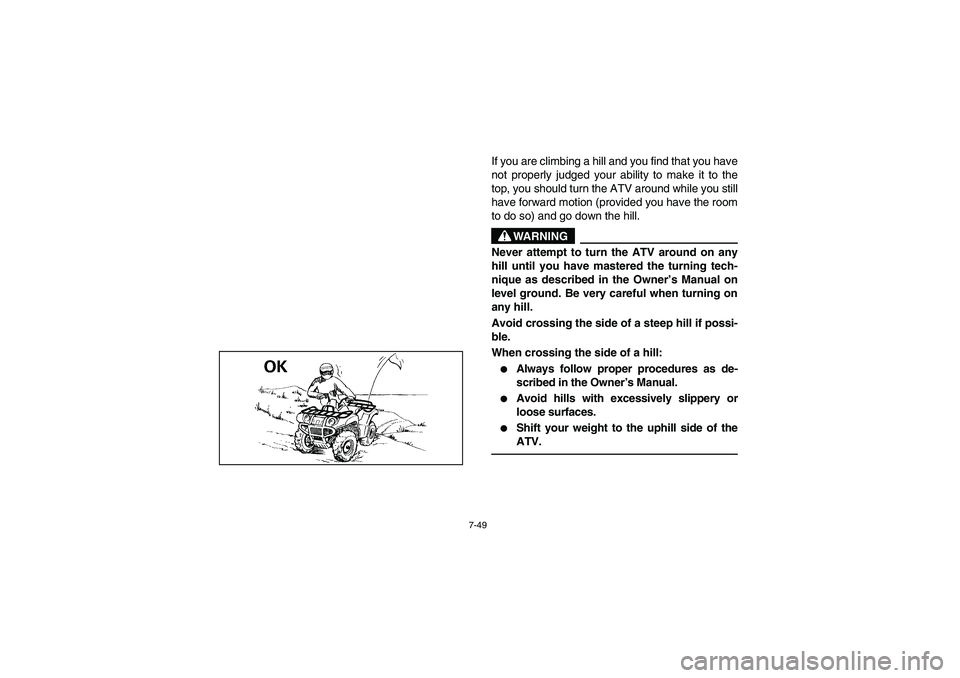
Avoid crossing the side of a steep hill if possi-
ble.
When crossing the side of a hill: �
Always follow proper procedures as de-
scribed in the Owner’s Manual.
�
Avoid hills with excessively slippery or
loose surfaces.
�
Shift your weight to the uphill side of the
ATV.
_
U5UH61.book Page 49 Tuesday, April 20, 2004 10:10 AM
Page 220 of 400

7-51
If your ATV has stalled or stopped and you believe
you can continue up the hill, restart carefully to
make sure you do not lift the front wheels which
could cause you to lose control. If you are unable
to continue up the hill, dismount the ATV on the
uphill side. Physically turn the ATV around and
then descend the hill.
If you start to roll backwards, DO NOT apply either
brake abruptly. If you are in 2WD, apply only the
front brake. When this ATV is in 4WD, all wheels
(front and rear) are interconnected by the drive
train. This means that applying either the front
brake or the rear brake will brake all wheels. When
descending hills, using either brake lever or the
brake pedal will brake the wheels on the downhill
side. Avoid sudden application of either the front or
rear brake because the wheels on the uphill side
could come off the ground. The ATV could easily
tip over backwards. Apply both the front and rear
brakes gradually, or dismount the ATV immediate-
ly on the uphill side.
U5UH61.book Page 51 Tuesday, April 20, 2004 10:10 AM
Page 224 of 400

7-55
RIDING DOWNHILL
When riding your ATV downhill, shift your weight
as far to the rear and uphill side of the ATV as pos-
sible. Move back on the seat and sit with your
arms straight. Engine compression will do most of
the braking for you. For maximum engine com-
pression braking effect, change to 4WD before be-
ginning to descend the hill. Improper braking may
cause a loss of traction.
Use caution while descending a hill with loose or
slippery surfaces. Braking ability and traction may
be adversely affected by these surfaces. Improper
braking may also cause a loss of traction.
When this ATV is in 4WD, all wheels (front and
rear) are interconnected by the drive train. This
means that applying either the front brake or the
rear brake will brake all wheels. When descending
hills, using either brake lever or the brake pedal
will brake the wheels on the downhill side. Avoid
sudden application of either the front or rear brake
because the wheels on the uphill side could come
off the ground. Apply both the front and rear
brakes gradually.
U5UH61.book Page 55 Tuesday, April 20, 2004 10:10 AM
Page 228 of 400
7-59
CROSSING A SLOPE
Traversing a sloping surface on your ATV requires
you to properly position your weight to maintain
proper balance. Be sure that you have learned the
basic riding skills on flat ground before attempting
to cross a sloping surface. Avoid slopes with slip-
pery surfaces or rough terrain that may upset your
balance.
As you travel across a slope, lean your body in the
uphill direction. It may be necessary to correct the
steering when riding on loose surfaces by pointing
the front wheels slightly uphill. When riding on
slopes be sure not to make sharp turns either up or
down hill.
U5UH61.book Page 59 Tuesday, April 20, 2004 10:10 AM