2005 VOLVO XC90 ECO mode
[x] Cancel search: ECO modePage 106 of 263
: Press this button when approaching the car at night to light up the
interior courtesy light, parking lights, license plate lights and the li\
ghts in th")
2005 VOLVO XC90
Button 3 (Approach lighting): Press this button when approaching the car at night to light up the
interior courtesy light, parking lights, license plate lights and the li\
ghts in the sideview mirrors.
Button 4 (Panic): See
page 82 for more information on this function.
Button 5 (Tailgate unlock): Press this button twice within 3 seconds to unlock the tailgate (witho\
ut
unlocking the other doors).
Button 6 (Unlock): Press this button once to unlock the driver's door only. Wait for at le\
ast 1 second
and press the button again (within 10 seconds) to unlock all doors, an\
d the tailgate.
NOTE:
l Airbag deployment will automatically unlock the doors.
l The keys may also be used to lock and unlock the doors, and to activate \
and deactivate the alarm
system.
l To avoid leaving your keys in the vehicle, make a habit of always lockin\
g the vehicle with the remote
control.
Automatic re-locking If the doors are unlocked, the locks will automatically reengage (re-l\
ock) and the
alarm will rearm after 2 minutes unless a door or the tailgate has been \
opened.
Automatic locking (option)
The doors lock automatically when the vehicle's speed exceeds approximat\
ely 5 mph (7 km/h) and
remain locked a door is opened from the inside or until the car is unloc\
ked with the remote.
pg. 78 Locks and Alarms
l FCC ID:LQNP2T-APU This device complies with part 15 of the FCC rules. Op\
eration is subject to
the following conditions: (1) This device may not cause harmful interf\
erence, and (2) this device must
accept any interference received, including interference that may cause \
undesired operation.
l Canadian 2306104388 Model 504 2927 by Donnelly Operation is subject to t\
he following conditions:
(1) this device may not cause interference, and (2) this device must\
accept any interference, including
interference that may cause undesired operation of the device.
l Canadian 2306104388A Model 509 977 by Connaught Electronics Operation is\
subject to the
following conditions: (1) this device may not cause interference, and \
(2) this device must accept any
interference, including interference that may cause undesired operation \
of the device.
file:///K|/ownersdocs/2005/2005_XC90/05xc90_05.htm (5 of 13)12/30/2006\
4:42:32 PM
Page 120 of 263

2005 VOLVO XC90
3. Without touching the accelerator pedal, turn the ignition key* to the\
starting position. Allow the
starter to operate for up to 10 seconds. Release the key as soon as the \
engine starts. If the engine fails to
start, repeat this step.
NOTE:
- On certain models, when the vehicle is started, idle speed may be noti\
ceably higher than normal for a
short period, depending on the temperature of the engine.
This has been done to help bring components in the emission control syst\
em to their normal operating
temperature as quickly as possible, which enables them to function norma\
lly.
- For cold starts at altitudes above 6000 ft (1800 meters), depress th\
e accelerator pedal halfway and turn
the key to the starting position. Release the pedal slowly when the engi\
ne starts.
4. To release the gear selector from the (P)ark position, the engine must be running (or the ignition key
must be in position II) and the brake pedal must be depressed.
5. Select the desired gear. The gear engages after a very slight delay w\
hich is especially noticeable when
selecting R.
NOTE: Your vehicle is equipped with a Keylock system. When the engine is switc\
hed off, the gear
selector must be in the (P)ark position before the key can be removed from the ignition switch.
When starting in cold weather, the transmission may shift up at slightly\
higher engine speeds than
normal until the automatic transmission fluid reaches normal operating t\
emperature.
Do not race a cold engine immediately after starting. Oil flow may not r\
each some lubrication points fast
enough to prevent engine damage.
* If two of the keys to your vehicle are close together, e.g., on the sa\
me key ring, when you try to start
the vehicle, this could cause interference in the immobilizer system and\
result in the vehicle not starting.
If this should occur, remove one of the keys from the key ring before tr\
ying to start the vehicle again.
file:///K|/ownersdocs/2005/2005_XC90/05xc90_06a.htm (6 of 16)12/30/200\
6 4:42:33 PM
Page 123 of 263
ark position (automatic transmission).
** Please be aware that leaving the key in this position will increase b\
attery drain.
pg. 91 Starting")
2005 VOLVO XC90
* The gear selector must be in the (P)ark position (automatic transmission).
** Please be aware that leaving the key in this position will increase b\
attery drain.
pg. 91 Starting and driving
General information
Economical driving conserves natural resources
Better driving economy may be obtained by thinking ahead, avoiding rapid\
starts and stops and
adjusting the speed of your vehicle to immediate traffic conditions. Obs\
erve the following rules:
l Bring the engine to normal operating temperature as soon as possible by \
driving with a light foot on
the accelerator pedal for the first few minutes of operation. A cold eng\
ine uses more fuel and is subject
to increased wear.
l Whenever possible, avoid using the vehicle for driving short distances. \
This does not allow the engine
to reach normal operating temperature.
l Drive carefully and avoid rapid acceleration and hard braking.
l Use the transmission's (D)rive position as often as possible and avoid using "kickdown" to help
improve fuel economy.
l Do not exceed posted speed limits.
l Avoid carrying unnecessary items (extra load) in the vehicle.
l Maintain correct tire pressure. Check tire pressure regularly (when tir\
es are cold).
l Remove snow tires when threat of snow or ice has ended.
l Note that roof racks, ski racks, etc, increase air resistance and also f\
uel consumption.
l At highway driving speeds, fuel consumption will be lower with the air c\
onditioning on and the
windows closed than with the air conditioning off and the windows open. \
l Using the onboard trip computer's fuel consumption modes can help you le\
arn how to drive more
economically.
Other factors that decrease gas mileage are:
l Dirty air cleaner
l Dirty engine oil and clogged oil filter
l Dragging brakes
l Incorrect front end alignment
Some of the above mentioned items and others are checked at the standard\
Maintenance intervals.
Weight distribution affects handling
At the specified curb weight your vehicle has a tendency to understeer, \
which means that the steering
wheel has to be turned more than might seem appropriate for the curvatur\
e of a bend. This ensures good
stability and reduces the risk of rear wheel skid. Remember that these p\
roperties can alter with the
vehicle load. The heavier the load in the cargo area, the less the tende\
ncy to understeer.
file:///K|/ownersdocs/2005/2005_XC90/05xc90_06a.htm (9 of 16)12/30/200\
6 4:42:33 PM
Page 125 of 263

2005 VOLVO XC90
NOTE: Avoid driving on steep inclines if the fuel tank is nearly empty. If the\
flow of fuel to the engine
is interrupted due to the vehicle's angle of inclination, this could res\
ult in damage to the three-way
catalytic converter. We recommend keeping the fuel tank at least half fu\
ll when driving on steep inclines.
Driving through water
l The vehicle should not be driven through water that is deeper than 18 in\
ches (48 cm). Driving through
deeper water could result in damage to transmission components or the di\
fferential, or to the engine if
excess water is drawn in through the air intake system.
l Drive slowly and avoid stopping when driving through water.
l After having driven through water, apply the brakes lightly several time\
s to remove water, mud, etc
from the brake discs.
l Never allow the vehicle to stand in water above the door sills. This cou\
ld result in damage to the
electrical system.
Conserving electrical current
Keep the following in mind to help minimize battery drain:
l When the engine is not running, avoid turning the ignition key to positi\
on II (see page 90). Many
electrical systems (the audio system, the optional infotainment/navigat\
ion systems, power windows, etc)
will function with the ignition key in position I. This position reduces\
drain on the battery.
l Please keep in mind that using systems, accessories, etc that consume a \
great deal of current when the
engine is not running could result in the battery being completely drain\
ed.
NOTE: A warning message will be displayed in the text window in the instrument\
panel when the
battery charge is low.
pg. 93 Starting and driving
Automatic transmission with Geartronic
5-cylinder turbo models
file:///K|/ownersdocs/2005/2005_XC90/05xc90_06a.htm (11 of 16)12/30/20\
06 4:42:33 PM
Page 126 of 263
2005 VOLVO XC90
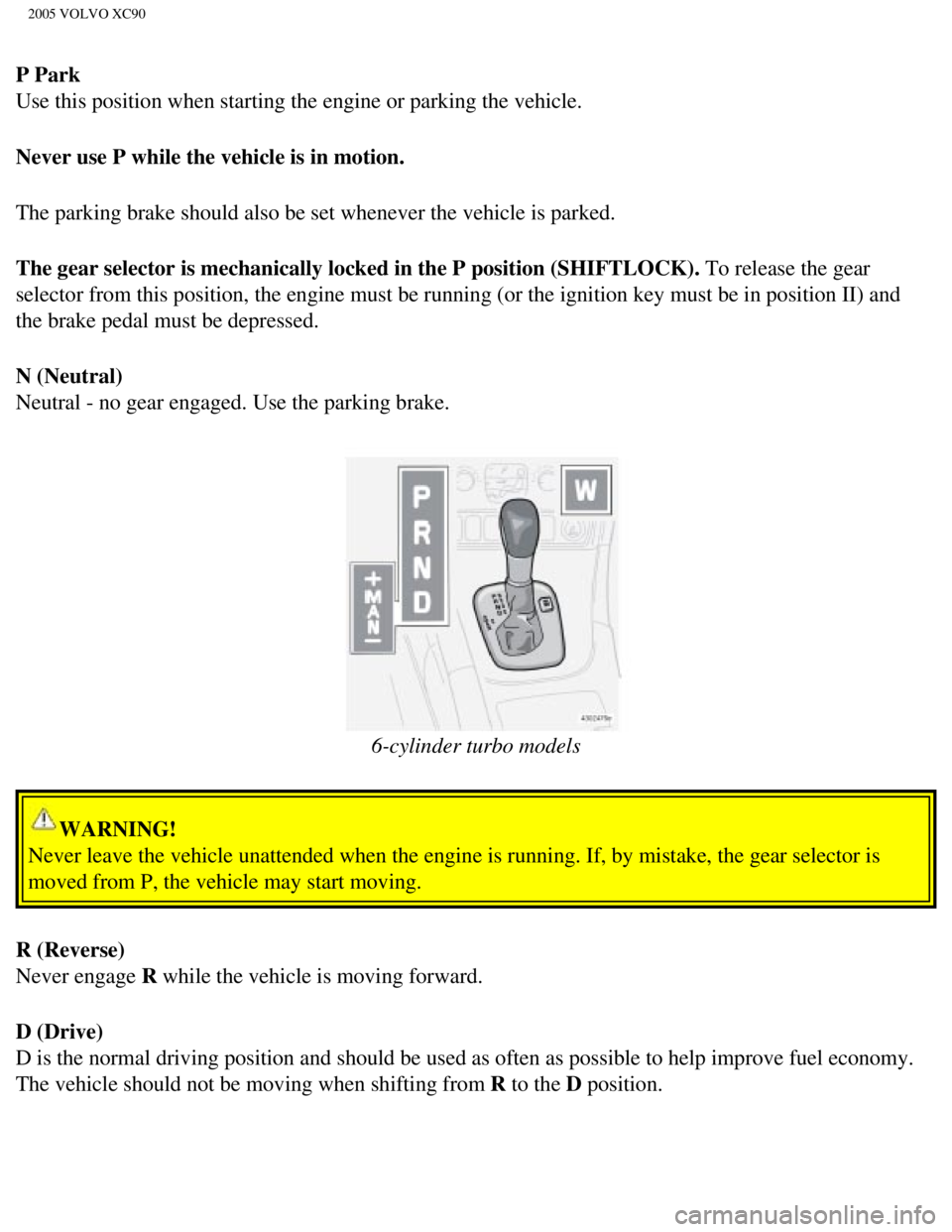
P Park
Use this position when starting the engine or parking the vehicle.
Never use P while the vehicle is in motion.
The parking brake should also be set whenever the vehicle is parked.
The gear selector is mechanically locked in the P position (SHIFTLOCK)\
. To release the gear
selector from this position, the engine must be running (or the ignitio\
n key must be in position II) and
the brake pedal must be depressed.
N (Neutral)
Neutral - no gear engaged. Use the parking brake.
6-cylinder turbo models
WARNING!
Never leave the vehicle unattended when the engine is running. If, by mi\
stake, the gear selector is
moved from P, the vehicle may start moving.
R (Reverse)
Never engage R while the vehicle is moving forward.
D (Drive)
D is the normal driving position and should be used as often as possible\
to help improve fuel economy.
The vehicle should not be moving when shifting from R to the D position.
file:///K|/ownersdocs/2005/2005_XC90/05xc90_06a.htm (12 of 16)12/30/20\
06 4:42:33 PM
Page 129 of 263
2005 VOLVO XC90
6-cylinder turbo models
pg. 96 Starting and driving
All Wheel Drive
All Wheel Drive (AWD) - general information
Your Volvo can be equipped with permanent All Wheel Drive (option), wh\
ich means that power is
distributed automatically between the front and rear wheels. Under norma\
l driving conditions, most of
the engine's power is directed to the front wheels. However, if there is\
any tendency for the front wheels
to spin, an electronically controlled coupling distributes power to the \
wheels that have the best traction.
Tire dimensions
Volvo recommends that you always drive on tires of the same brand, size,\
construction (radial), tread
pattern, load-, speed-, traction-, temperature-, and treadwear rating. N\
ever drive on mixed tires, except
for brief periods when the temporary spare tire is in use.
Always use properly inflated tires of correct dimensions. Tire size and \
inflation pressures are shown on
the tire inflation pressure placards, located on the driver's side B-pil\
lar (the structural member at the side
of the vehicle, at the rear of the driver's door opening), or on the in\
side of the fuel filler door on
Canadian models.
Temporary Spare
The temporary spare tire is for temporary, lowspeed, short-distance use \
only. Replace it with a full-sized
tire as soon as possible. Do not drive on the temporary spare at speeds \
above 50 m.p.h. (80km/h) or for
distances greater than 50 miles (80 km).
Never install snow chains on a temporary spare.
file:///K|/ownersdocs/2005/2005_XC90/05xc90_06a.htm (15 of 16)12/30/20\
06 4:42:33 PM
Page 142 of 263

2005 VOLVO XC90
Max. trailer
hitch tongue
load400 lbs
(180 kg)
400 lbs
(180 kg)400 lbs
(180 kg)400 lbs
(180 kg)370 lbs
(165 kg)250 lbs (115
kg)
140 lbs (65 kg)
NOTE:
l Recommended hitch tongue load: not more than 10% of the trailer's weight\
.
The trailer load should be positioned so that it does not shift and the \
tongue load should be 10% of the
trailer's weight. However, the tongue load should not exceed the maximum\
permissible weights
indicated in the table above.
l When towing trailers without brakes, the maximum permissible trailer wei\
ght is 1,700 lbs (750 kg).
l If necessary, redistribute the weight of any cargo in the trailer to avo\
id excessive weight on the trailer
hitch.
l The maximum trailer weight listed in the table for All Wheel Drive model\
s, 5,000 lbs (2250 kg) is
only applicable when there are not more than two occupants in the vehicl\
e, in the front seats, with a
combined weight of 300 lbs (135 kg), with no other cargo in the vehicl\
e.
pg. 106 Starting and driving
Towing a trailer (contd)
l The maximum weight listed for Front Wheel Drive models, 4,000 lbs (1800\
kg) is only applicable
when there are not more than four occupants in the vehicle, in the front\
seats and second row of seats,
with a combined weight of 600 lbs (270 kg), with no other cargo in the\
vehicle.
l Please be aware that the load on the trailer hitch is part of the vehicl\
e's total load carrying capacity.
The amount of cargo in the vehicle and the trailer must be limited so th\
at the gross vehicle weight and
maximum permissible rear axle weight
(see page 165) are not exceeded.
l Vehicles used for towing a trailer on a regular basis, or for long-dista\
nce highway towing should be
equipped with an automatic transmission oil cooler and Volvo's automatic\
self-leveling system for the
rear suspension. Consult your Volvo retailer.
l Volvo recommends the use of Volvo trailer hitches that are specially des\
igned for the vehicle.
l All Volvo models are equipped with energy-absorbing shock-mounted bumper\
s. Trailer hitch
installation should not interfere with the proper operation of this bump\
er system.
l Increase tire pressure to recommended full inflation pressure. See chapt\
er "Wheels and tires."
l When your vehicle is new, avoid towing heavy trailers during the first 6\
20 miles (1,000 km).
l Engine and transmission are subject to increased loads. Therefore, engin\
e coolant temperature should
be closely watched when driving in hot climates or hilly terrain. Use a \
lower gear and turn off the air
conditioner if the temperature gauge needle enters the red range.
l If the automatic transmission begins to overheat, a message will be disp\
layed in the text window.
l Hauling a trailer affects handling, durability, and economy.
l It is necessary to balance trailer brakes with the towing vehicle brakes\
to provide a safe stop (check
and observe state/local regulations).
file:///K|/ownersdocs/2005/2005_XC90/05xc90_06b.htm (12 of 18)12/30/20\
06 4:42:35 PM
Page 147 of 263

2005 VOLVO XC90
are used more often. Moreover, the capacity of the battery decreases as \
the temperature drops. In very
cold weather, a poorly charged battery can freeze and be damaged. It is \
therefore advisable to check the
state of charge more frequently and spray an antirust oil on the battery\
posts.
l Volvo recommends the use of snow tires on all four wheels for winter driving - see section "Wheels
and tires."
l To prevent the washer fluid reservoir from freezing, add washer solvents containing antifreeze (see
page 140 for the location of the washer fluid reservoir).
This is important since dirt is often splashed on the windshield during \
winter driving, requiring the
frequent use of the washers and wipers. Volvo Washer Solvent should be d\
iluted as follows:
Down to 14° F (-10° C): 1 part washer solvent and 4 parts water \
Down to 5° F (-15° C): 1 part washer solvent and 3 parts water
Down to 0° F (-18° C): 1 part washer solvent and 2 parts water
Down to -18° F (-28° C): 1 part washer solvent and 1 part water \
l Use Volvo Teflon Lock Spray in the locks.
NOTE: Avoid the use of de-icing sprays as they can cause damage to the locks.
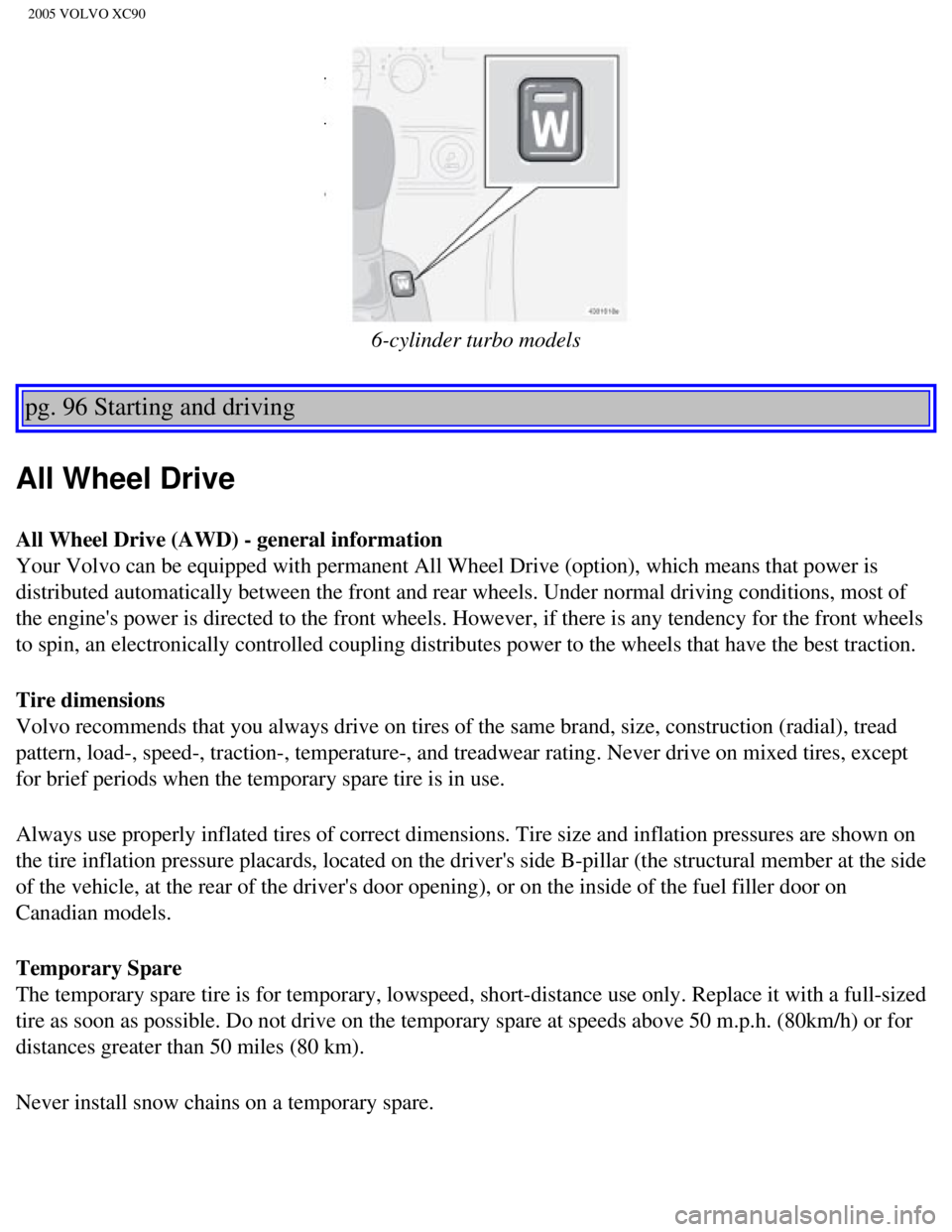
W Winter/Wet driving mode-enhanced vehicle traction
l Mode W will only function if the gear selector is in the (D)rive position.
l Press the button at the base of the gear selector to engage/disengage th\
is driving mode.
l An LED in the button will light up to indicate that W is engaged and thi\
s will also be displayed in the
instrument panel (see
page 26).
l This mode may be selected for starting/moving off on slippery roads.
* Synthetic oil is not used when the oil is changed at the normal mainte\
nance intervals except at owner request and at additional
charge. Please consult your Volvo retailer.
pg. 110 Starting and driving
Before a long distance trip
It is always worthwhile to have your vehicle checked at a Volvo retailer\
before driving long distances.
Your retailer will also be able to supply you with bulbs, fuses, spark p\
lugs and wiper blades for your use
in the event that problems occur.
As a minimum, the following items should be checked before any long trip\
:
l Check that engine runs smoothly and that fuel consumption is normal.
l Check for fuel, oil, and fluid leakage
l Check transmission oil level*.
l Check condition of drive belts.
l Check state of the battery's charge.
file:///K|/ownersdocs/2005/2005_XC90/05xc90_06b.htm (17 of 18)12/30/20\
06 4:42:35 PM