2005 VOLVO S40 seats
[x] Cancel search: seatsPage 10 of 127
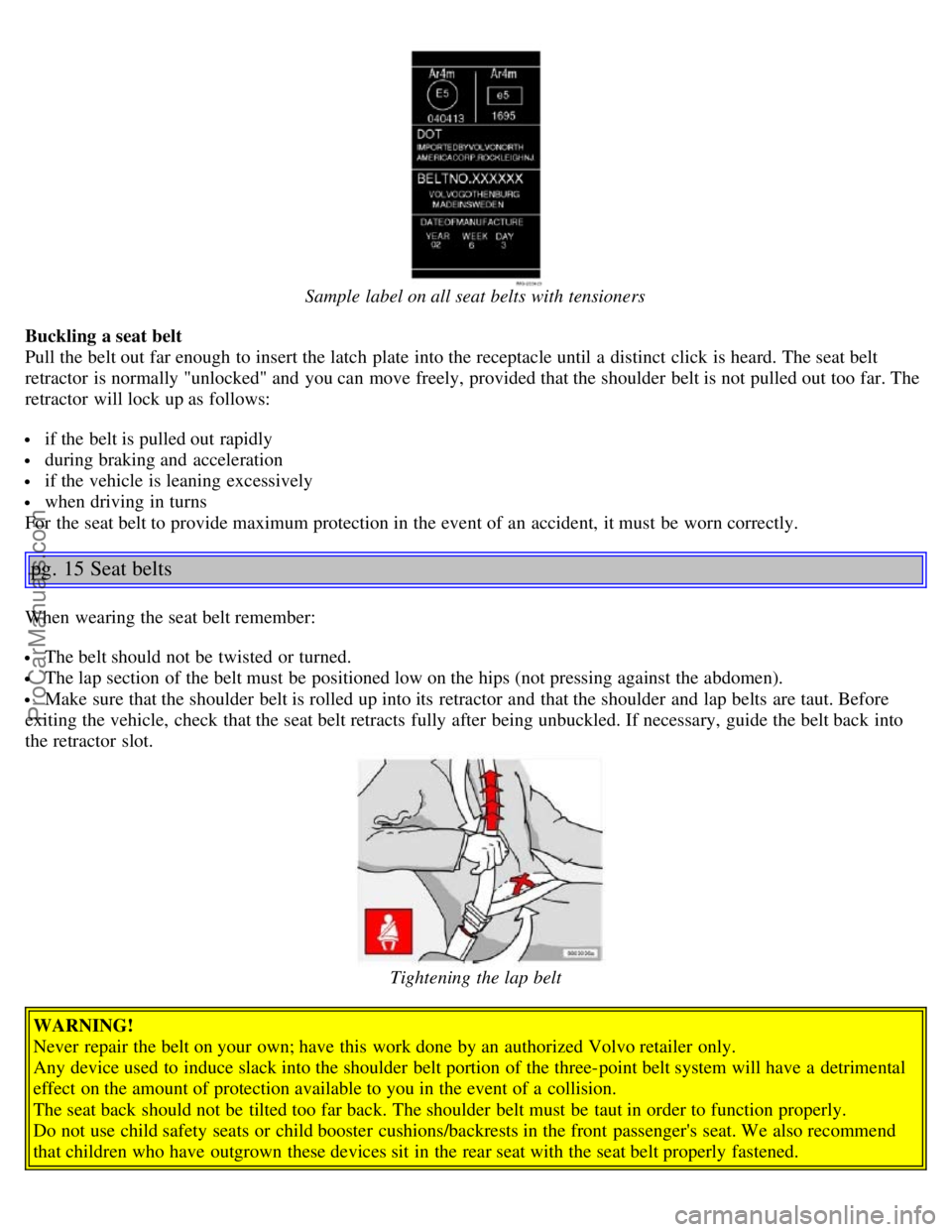
Sample label on all seat belts with tensioners
Buckling a seat belt
Pull the belt out far enough to insert the latch plate into the receptacle until a distinct click is heard. The seat belt
retractor is normally "unlocked" and you can move freely, provided that the shoulder belt is not pulled out too far. The
retractor will lock up as follows:
if the belt is pulled out rapidly
during braking and acceleration
if the vehicle is leaning excessively
when driving in turns
For the seat belt to provide maximum protection in the event of an accident, it must be worn correctly.
pg. 15 Seat belts
When wearing the seat belt remember:
The belt should not be twisted or turned.
The lap section of the belt must be positioned low on the hips (not pressing against the abdomen).
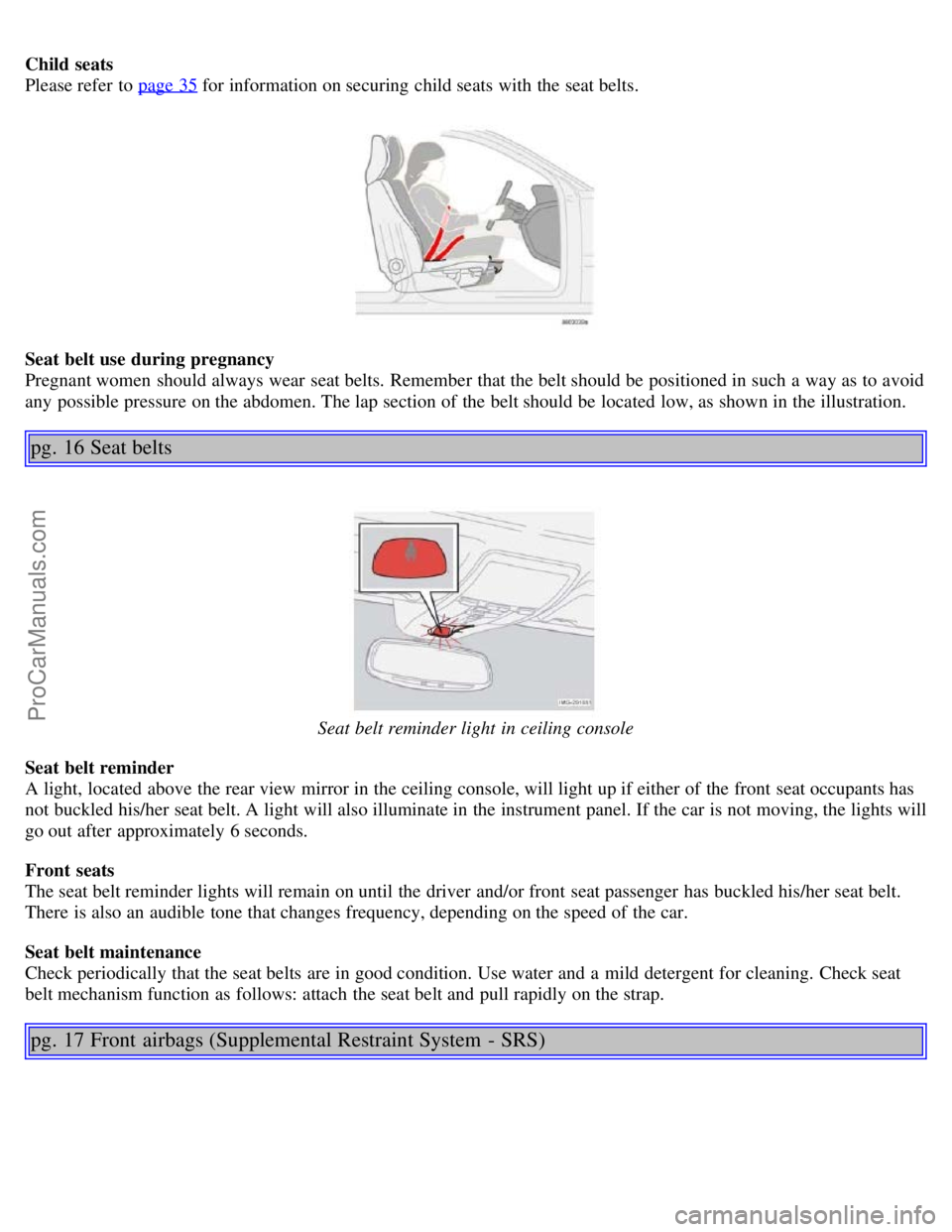
Make sure that the shoulder belt is rolled up into its retractor and that the shoulder and lap belts are taut. Before
exiting the vehicle, check that the seat belt retracts fully after being unbuckled. If necessary, guide the belt back into
the retractor slot.
Tightening the lap belt
WARNING!
Never repair the belt on your own; have this work done by an authorized Volvo retailer only.
Any device used to induce slack into the shoulder belt portion of the three-point belt system will have a detrimental
effect on the amount of protection available to you in the event of a collision.
The seat back should not be tilted too far back. The shoulder belt must be taut in order to function properly.
Do not use child safety seats or child booster cushions/backrests in the front passenger's seat. We also recommend
that children who have outgrown these devices sit in the rear seat with the seat belt properly fastened.
ProCarManuals.com
Page 11 of 127
Child seats
Please refer to page 35
for information on securing child seats with the seat belts.
Seat belt use during pregnancy
Pregnant women should always wear seat belts. Remember that the belt should be positioned in such a way as to avoid
any possible pressure on the abdomen. The lap section of the belt should be located low, as shown in the illustration.
pg. 16 Seat belts
Seat belt reminder light in ceiling console
Seat belt reminder
A light, located above the rear view mirror in the ceiling console, will light up if either of the front seat occupants has
not buckled his/her seat belt. A light will also illuminate in the instrument panel. If the car is not moving, the lights will
go out after approximately 6 seconds.
Front seats
The seat belt reminder lights will remain on until the driver and/or front seat passenger has buckled his/her seat belt.
There is also an audible tone that changes frequency, depending on the speed of the car.
Seat belt maintenance
Check periodically that the seat belts are in good condition. Use water and a mild detergent for cleaning. Check seat
belt mechanism function as follows: attach the seat belt and pull rapidly on the strap.
pg. 17 Front airbags (Supplemental Restraint System - SRS)
ProCarManuals.com
Page 12 of 127

Components in the SRS system
Front airbags
Your Volvo is equipped with a Supplemental Restraint System (SRS), which consists of front airbags that enhance the
three-point seat belt system. The Volvo SRS system includes gas generators (1) surrounded by the airbags (2) and front
seat belt tensioners for both of the front seats. To deploy the system, the sensor (3) activates the gas generators causing
the airbags to be inflated with nitrogen gas.
As the movement of the seats' occupants compresses the airbags, some of the gas is expelled at a controlled rate to
provide better cushioning. Both seat belt tensioners also deploy, minimizing seat belt slack. The entire process,
including inflation and deflation of the airbags, takes approximately one fifth of a second.
Location of the passenger's side front airbag
The system is designed to supplement the protection provided by the three-point seat belt system. The outboard rear
seat belts are also equipped with tensioners. The SRS system is indicated by the "SRS" embossed on the steering wheel
pad and above the glove compartment, and by decals on both sun visors and on the front and far right side of the dash.
The airbags are folded and located in the steering wheel hub and above the glove compartment.
Seat belts - the heart of the Volvo safety system
The heart of the Volvo safety system is the three-point seat belt (a Volvo invention)! In order for the SRS system to
provide the protection intended, seat belts must be worn at all times by everyone in the vehicle. The SRS system is a
supplement to the seat belts.
pg. 18 Front airbags (Supplemental Restraint System - SRS)
WARNING!
As its name implies, SRS is designed to be a SUPPLEMENT to - not a replacement for - the three-point belt system.
For maximum protection, wear seat belts at all times. Be aware that no system can prevent all possible injuries that
may occur in an accident.
Never drive an SRS-equipped vehicle with your hands on the steering wheel pad/ airbag housing.
SRS is designed to help prevent serious injury. Deployment occurs very quickly and with considerable able force.
During normal deployment and depending on variables such as seating position, one may experience abrasions,
ProCarManuals.com
Page 15 of 127

Have the vehicle towed to an authorized Volvo retailer. Never drive with the airbags deployed.
Have an authorized Volvo retailer replace the SRS system components.
Use only new, Genuine Volvo Parts when replacing SRS components (airbags, seat belts, tensioners, etc.).
NOTE:
Deployment of SRS components occurs only one time during an accident. In a collision where deployment occurs,
the airbags and seat belt tensioners activate. Some noise occurs and a small amount of powder is released. The release
of the powder may appear as smoke-like matter. This is a normal characteristic and does not indicate fire.
Volvo's dual-threshold, dual-stage front airbags use special sensors that are integrated with the front seat buckles.
The point at which the airbag deploys is determined by whether or not the seat belt is being used, as well as the
severity of the collision. Collisions can occur where only one of the airbags deploys. If the impact is less severe, but
severe enough to present a clear injury risk, the dual-stage airbags are triggered at 70% of their total capacity. If the
impact is more severe, the dual-stage airbags are triggered at full capacity.
WARNING!
Do not use child safety seats or child booster cushions/backrests in the front passenger's seat. We also recommend
that occupants under 4 feet 7 inches (140 cm) in height who have outgrown these devices sit in the rear seat with the
seat belt fastened.
Never drive with the airbags deployed. The fact that they hang out can impair the steering of your vehicle. Other
safety systems can also be damaged.
The smoke and dust formed when the airbags are deployed can cause skin and eye irritation in the event of
prolonged exposure.
When do the front airbags not deploy?
Not all frontal collisions activate the SRS system. If the collision involves a nonrigid object (e.g., a snow drift or
bush), or a rigid, fixed object at a low speed, the SRS system will not necessarily deploy. Front airbags do not
normally deploy in a side impact collision, in a collision from the rear or in a rollover situation. The amount of
damage to the bodywork does not reliably indicate if the airbags should have deployed or not.
pg. 22 Front airbags (Supplemental Restraint System - SRS)
Safety system warning light in the instrument panel
A self -diagnostic system incorporated in the sensor monitors certain safety system components. A check is performed
on components such as seat belt locks, SRS, SIPS, OWS, and/or the VIC system. If a fault is detected, the warning
light will illuminate. The light is included in the warning/indicator light cluster in the instrument panel. Normally, the
safety system warning lamp should light up when the ignition key is turned to positions I, II or III and should go out
after approximately 7 seconds or when the engine is started. Check that this light is functioning properly every time the
ProCarManuals.com
Page 22 of 127

pg. 41 Symbols on the right side of the instrument panel
Symbols - right side of instrument panel
1. Turn signal indicator for trailer (certain models)
If you are towing a trailer, this light will flash simultaneously with the turn signals on the trailer. If the light
does not flash when signaling, one of the turn signals on the trailer or on the car are not functioning properly.
2. Parking brake applied
This light is on when the parking brake (hand brake) is applied. The parking brake lever is situated between
the front seats.
Canadian models are equipped with this symbol
.
3. Safety system warning light
If this light comes on while the car is being driven, or remains on for longer than approximately 10 seconds
after the car has been started, the safety system's diagnostic functions have detected a fault in a seat belt lock, SRS,
SIPS, and/or VIC system. Drive to an authorized Volvo retailer to have the system(s) inspected.
4. Oil pressure warning light
If the light comes on while driving, stop the car, stop the engine immediately, and check the engine oil level.
See if the oil level is normal and the light stays on after restart, have the car towed to the nearest authorized Volvo
retailer. After hard driving, the light may come on occasionally when the engine is idling. This is normal, provided it
goes off when the engine speed is increased.
5. Seat belt reminder
This symbol (and the seat belt reminder light above the rear view mirror) will light up if either front seat
occupant has not buckled his/her seat belt. If the car is not moving, the symbols will go out after approximately 6
seconds.
ProCarManuals.com
Page 37 of 127
The air is not recirculated.
pg. 71 Manual climate control
4. Airflow controls
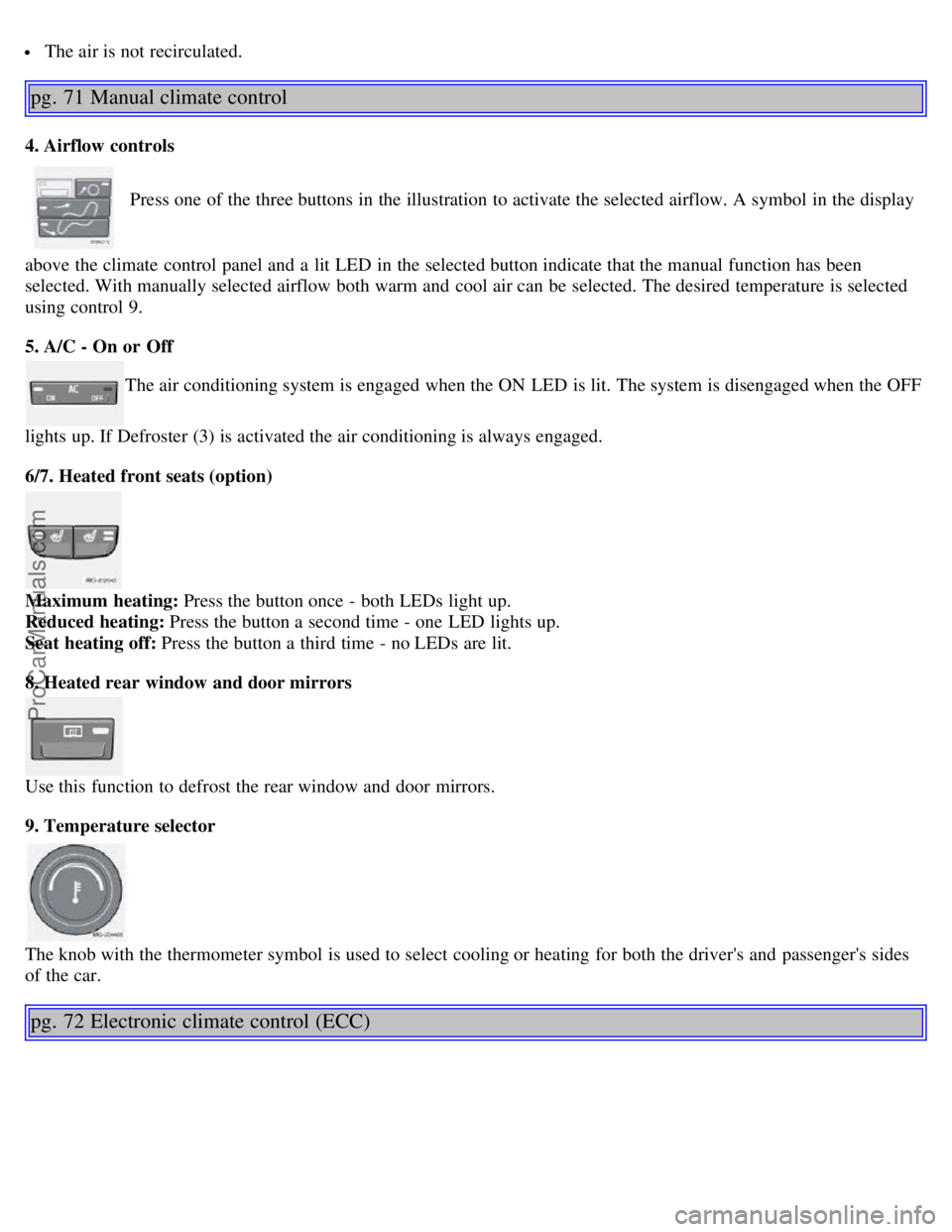
Press one of the three buttons in the illustration to activate the selected airflow. A symbol in the display
above the climate control panel and a lit LED in the selected button indicate that the manual function has been
selected. With manually selected airflow both warm and cool air can be selected. The desired temperature is selected
using control 9.
5. A/C - On or Off
The air conditioning system is engaged when the ON LED is lit. The system is disengaged when the OFF
lights up. If Defroster (3) is activated the air conditioning is always engaged.
6/7. Heated front seats (option)
Maximum heating: Press the button once - both LEDs light up.
Reduced heating: Press the button a second time - one LED lights up.
Seat heating off: Press the button a third time - no LEDs are lit.
8. Heated rear window and door mirrors
Use this function to defrost the rear window and door mirrors.
9. Temperature selector
The knob with the thermometer symbol is used to select cooling or heating for both the driver's and passenger's sides
of the car.
pg. 72 Electronic climate control (ECC)
ProCarManuals.com
Page 39 of 127
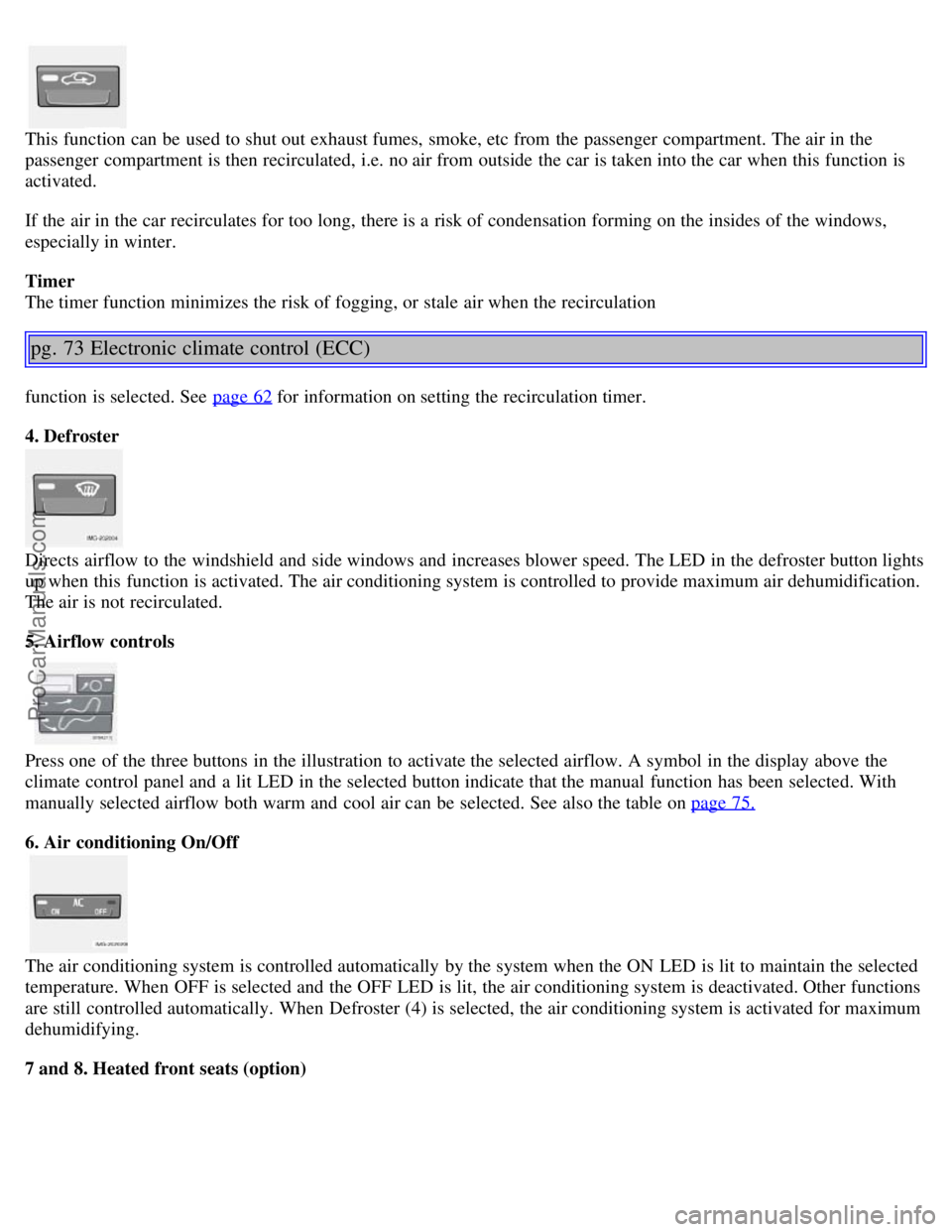
This function can be used to shut out exhaust fumes, smoke, etc from the passenger compartment. The air in the
passenger compartment is then recirculated, i.e. no air from outside the car is taken into the car when this function is
activated.
If the air in the car recirculates for too long, there is a risk of condensation forming on the insides of the windows,
especially in winter.
Timer
The timer function minimizes the risk of fogging, or stale air when the recirculation
pg. 73 Electronic climate control (ECC)
function is selected. See page 62 for information on setting the recirculation timer.
4. Defroster
Directs airflow to the windshield and side windows and increases blower speed. The LED in the defroster button lights
up when this function is activated. The air conditioning system is controlled to provide maximum air dehumidification.
The air is not recirculated.
5. Airflow controls
Press one of the three buttons in the illustration to activate the selected airflow. A symbol in the display above the
climate control panel and a lit LED in the selected button indicate that the manual function has been selected. With
manually selected airflow both warm and cool air can be selected. See also the table on page 75.
6. Air conditioning On/Off
The air conditioning system is controlled automatically by the system when the ON LED is lit to maintain the selected
temperature. When OFF is selected and the OFF LED is lit, the air conditioning system is deactivated. Other functions
are still controlled automatically. When Defroster (4) is selected, the air conditioning system is activated for maximum
dehumidifying.
7 and 8. Heated front seats (option)
ProCarManuals.com
Page 42 of 127
2 0 0 5
VOLVO S40
Chapter 5 - Interior
pg. 77 Interior
Front seats78
Interior lighting81
Storage compartments82
Rear seat84
Trunk86
pg. 78 Front seats
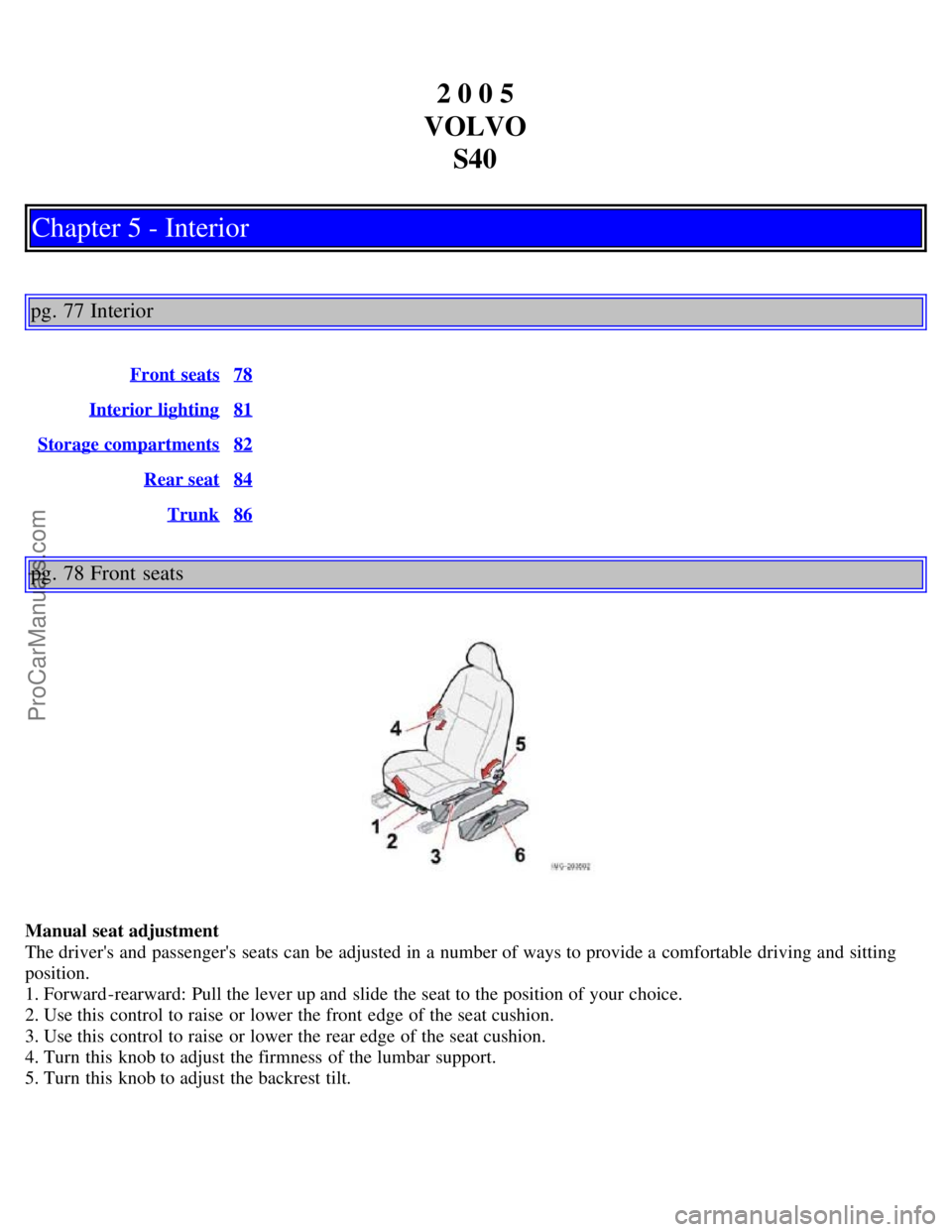
Manual seat adjustment
The driver's and passenger's seats can be adjusted in a number of ways to provide a comfortable driving and sitting
position.
1. Forward-rearward: Pull the lever up and slide the seat to the position of your choice.
2. Use this control to raise or lower the front edge of the seat cushion.
3. Use this control to raise or lower the rear edge of the seat cushion.
4. Turn this knob to adjust the firmness of the lumbar support.
5. Turn this knob to adjust the backrest tilt.
ProCarManuals.com