2005 VOLVO S40 width
[x] Cancel search: widthPage 75 of 127
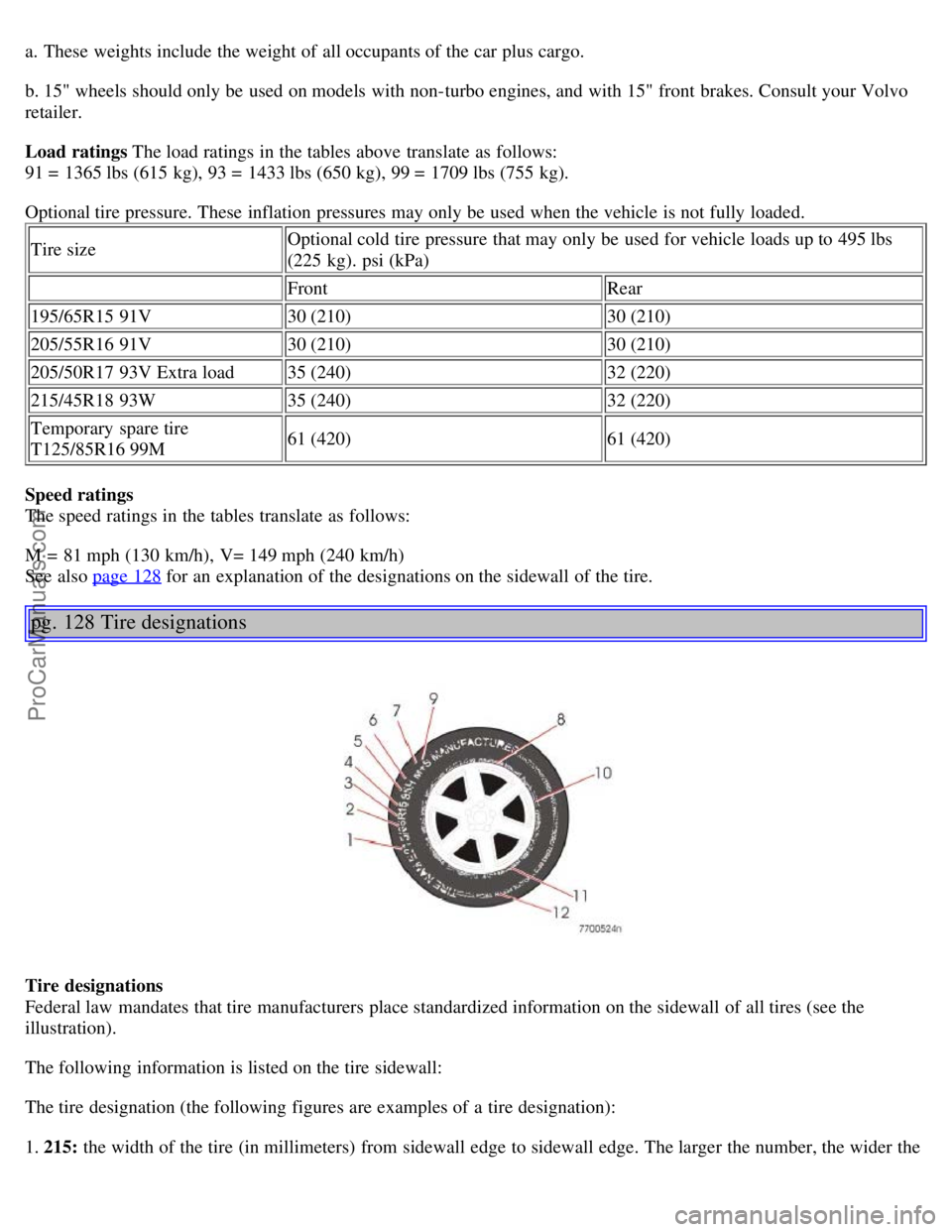
a. These weights include the weight of all occupants of the car plus cargo.
b. 15" wheels should only be used on models with non-turbo engines, and with 15" front brakes. Consult your Volvo
retailer.
Load ratings The load ratings in the tables above translate as follows:
91 = 1365 lbs (615 kg), 93 = 1433 lbs (650 kg), 99 = 1709 lbs (755 kg).
Optional tire pressure. These inflation pressures may only be used when the vehicle is not fully loaded.Tire size Optional cold tire pressure that may only be used for vehicle loads up to 495 lbs
(225 kg). psi (kPa)
Front
Rear
195/65R15 91V 30 (210) 30 (210)
205/55R16 91V 30 (210) 30 (210)
205/50R17 93V Extra load 35 (240) 32 (220)
215/45R18 93W 35 (240) 32 (220)
Temporary spare tire
T125/85R16 99M 61 (420)
61 (420)
Speed ratings
The speed ratings in the tables translate as follows:
M = 81 mph (130 km/h), V= 149 mph (240 km/h)
See also page 128
for an explanation of the designations on the sidewall of the tire.
pg. 128 Tire designations
Tire designations
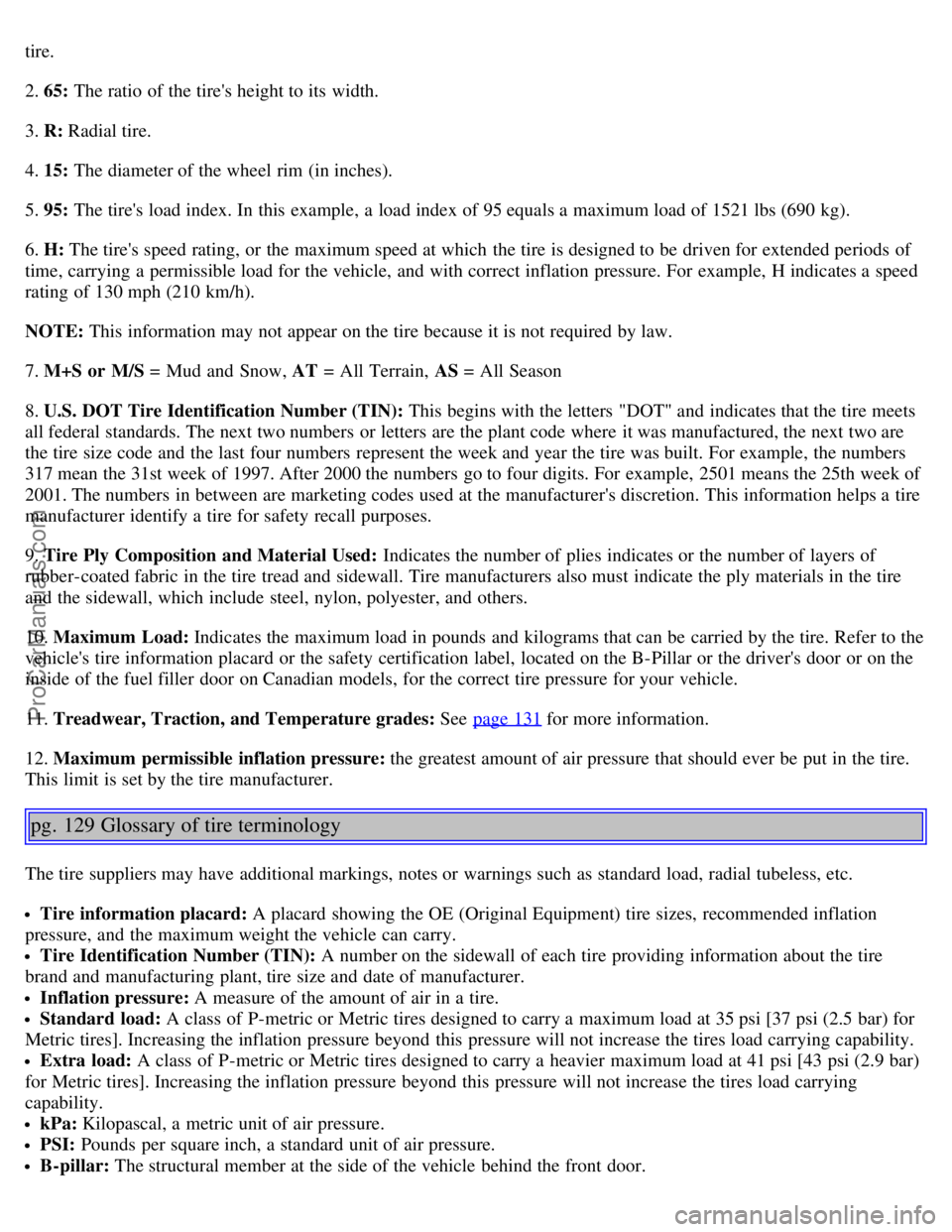
Federal law mandates that tire manufacturers place standardized information on the sidewall of all tires (see the
illustration).
The following information is listed on the tire sidewall:
The tire designation (the following figures are examples of a tire designation):
1. 215: the width of the tire (in millimeters) from sidewall edge to sidewall edge. The larger the number, the wider the
ProCarManuals.com
Page 76 of 127
tire.
2. 65: The ratio of the tire's height to its width.
3. R: Radial tire.
4. 15: The diameter of the wheel rim (in inches).
5. 95: The tire's load index. In this example, a load index of 95 equals a maximum load of 1521 lbs (690 kg).
6. H: The tire's speed rating, or the maximum speed at which the tire is designed to be driven for extended periods of
time, carrying a permissible load for the vehicle, and with correct inflation pressure. For example, H indicates a speed
rating of 130 mph (210 km/h).
NOTE: This information may not appear on the tire because it is not required by law.
7. M+S or M/S = Mud and Snow, AT = All Terrain, AS = All Season
8. U.S. DOT Tire Identification Number (TIN): This begins with the letters "DOT" and indicates that the tire meets
all federal standards. The next two numbers or letters are the plant code where it was manufactured, the next two are
the tire size code and the last four numbers represent the week and year the tire was built. For example, the numbers
317 mean the 31st week of 1997. After 2000 the numbers go to four digits. For example, 2501 means the 25th week of
2001. The numbers in between are marketing codes used at the manufacturer's discretion. This information helps a tire
manufacturer identify a tire for safety recall purposes.
9. Tire Ply Composition and Material Used: Indicates the number of plies indicates or the number of layers of
rubber-coated fabric in the tire tread and sidewall. Tire manufacturers also must indicate the ply materials in the tire
and the sidewall, which include steel, nylon, polyester, and others.
10. Maximum Load: Indicates the maximum load in pounds and kilograms that can be carried by the tire. Refer to the
vehicle's tire information placard or the safety certification label, located on the B-Pillar or the driver's door or on the
inside of the fuel filler door on Canadian models, for the correct tire pressure for your vehicle.
11. Treadwear, Traction, and Temperature grades: See page 131
for more information.
12. Maximum permissible inflation pressure: the greatest amount of air pressure that should ever be put in the tire.
This limit is set by the tire manufacturer.
pg. 129 Glossary of tire terminology
The tire suppliers may have additional markings, notes or warnings such as standard load, radial tubeless, etc.
Tire information placard: A placard showing the OE (Original Equipment) tire sizes, recommended inflation
pressure, and the maximum weight the vehicle can carry.
Tire Identification Number (TIN): A number on the sidewall of each tire providing information about the tire
brand and manufacturing plant, tire size and date of manufacturer.
Inflation pressure: A measure of the amount of air in a tire.
Standard load: A class of P-metric or Metric tires designed to carry a maximum load at 35 psi [37 psi (2.5 bar) for
Metric tires]. Increasing the inflation pressure beyond this pressure will not increase the tires load carrying capability.
Extra load: A class of P-metric or Metric tires designed to carry a heavier maximum load at 41 psi [43 psi (2.9 bar)
for Metric tires]. Increasing the inflation pressure beyond this pressure will not increase the tires load carrying
capability.
kPa: Kilopascal, a metric unit of air pressure.
PSI: Pounds per square inch, a standard unit of air pressure.
B-pillar: The structural member at the side of the vehicle behind the front door.
ProCarManuals.com
Page 78 of 127
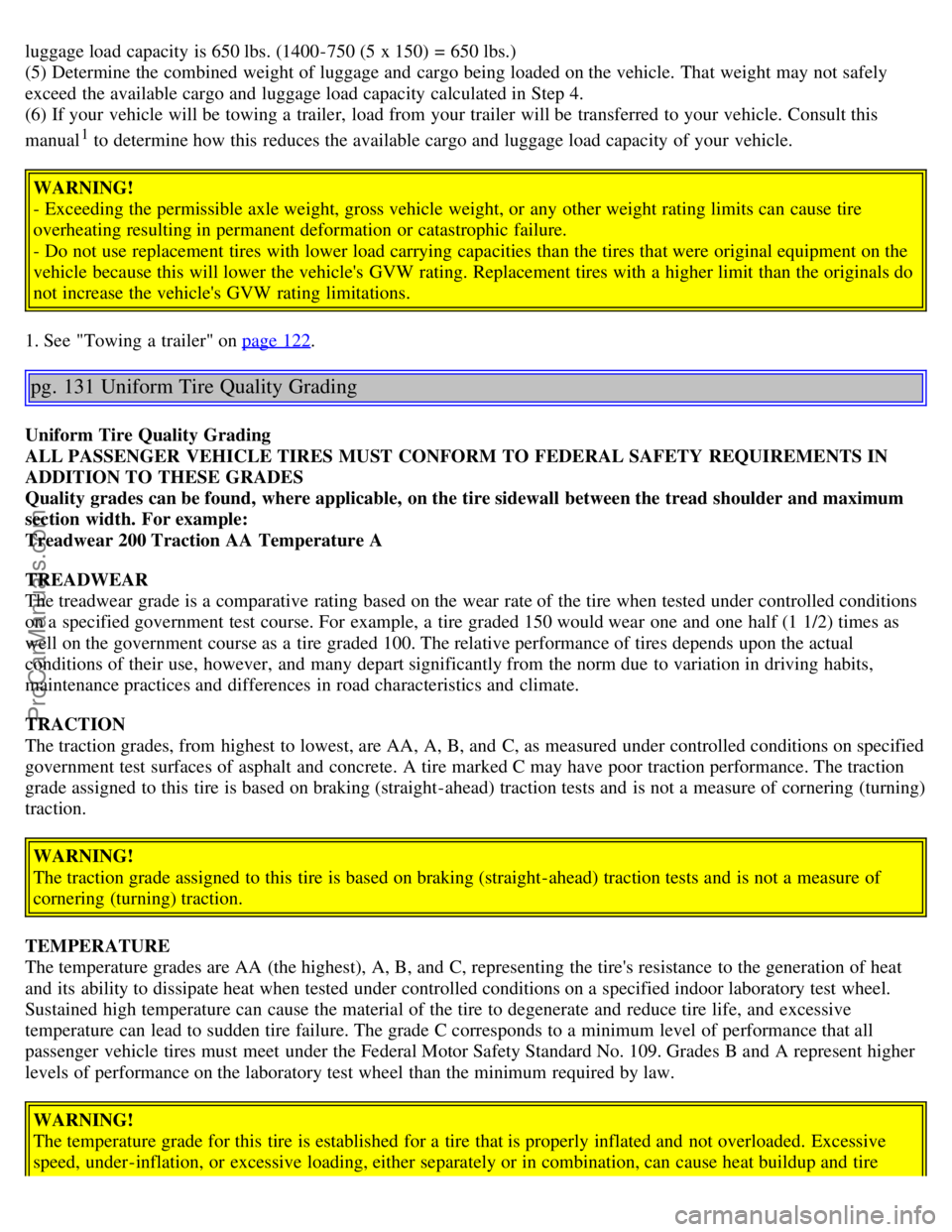
luggage load capacity is 650 lbs. (1400-750 (5 x 150) = 650 lbs.)
(5) Determine the combined weight of luggage and cargo being loaded on the vehicle. That weight may not safely
exceed the available cargo and luggage load capacity calculated in Step 4.
(6) If your vehicle will be towing a trailer, load from your trailer will be transferred to your vehicle. Consult this
manual
1 to determine how this reduces the available cargo and luggage load capacity of your vehicle.
WARNING!
- Exceeding the permissible axle weight, gross vehicle weight, or any other weight rating limits can cause tire
overheating resulting in permanent deformation or catastrophic failure.
- Do not use replacement tires with lower load carrying capacities than the tires that were original equipment on the
vehicle because this will lower the vehicle's GVW rating. Replacement tires with a higher limit than the originals do
not increase the vehicle's GVW rating limitations.
1. See "Towing a trailer" on page 122
.
pg. 131 Uniform Tire Quality Grading
Uniform Tire Quality Grading
ALL PASSENGER VEHICLE TIRES MUST CONFORM TO FEDERAL SAFETY REQUIREMENTS IN
ADDITION TO THESE GRADES
Quality grades can be found, where applicable, on the tire sidewall between the tread shoulder and maximum
section width. For example:
Treadwear 200 Traction AA Temperature A
TREADWEAR
The treadwear grade is a comparative rating based on the wear rate of the tire when tested under controlled conditions
on a specified government test course. For example, a tire graded 150 would wear one and one half (1 1/2) times as
well on the government course as a tire graded 100. The relative performance of tires depends upon the actual
conditions of their use, however, and many depart significantly from the norm due to variation in driving habits,
maintenance practices and differences in road characteristics and climate.
TRACTION
The traction grades, from highest to lowest, are AA, A, B, and C, as measured under controlled conditions on specified
government test surfaces of asphalt and concrete. A tire marked C may have poor traction performance. The traction
grade assigned to this tire is based on braking (straight-ahead) traction tests and is not a measure of cornering (turning)
traction. WARNING!
The traction grade assigned to this tire is based on braking (straight-ahead) traction tests and is not a measure of
cornering (turning) traction.
TEMPERATURE
The temperature grades are AA (the highest), A, B, and C, representing the tire's resistance to the generation of heat
and its ability to dissipate heat when tested under controlled conditions on a specified indoor laboratory test wheel.
Sustained high temperature can cause the material of the tire to degenerate and reduce tire life, and excessive
temperature can lead to sudden tire failure. The grade C corresponds to a minimum level of performance that all
passenger vehicle tires must meet under the Federal Motor Safety Standard No. 109. Grades B and A represent higher
levels of performance on the laboratory test wheel than the minimum required by law. WARNING!
The temperature grade for this tire is established for a tire that is properly inflated and not overloaded. Excessive
speed, under-inflation, or excessive loading, either separately or in combination, can cause heat buildup and tire
ProCarManuals.com
Page 113 of 127

Codes for color and upholstery, etc. The label is located on the passenger's side center door pillar.
3. Loads and Tire Pressures
(on inside of fuel filler door): Canadian models only.
4. Child safety lock
This information is stamped on the rear inside edges of the doors.
5. Federal Motor Vehicle Safety Standards (FMVSS) specifications (USA) and Ministry of Transport (CMVSS)
standards (Canada)
Your Volvo is designed to meet all applicable safety standards, as evidenced by the certification label on the facing
side of the driver's door. For further information regarding these regulations, please consult your Volvo retailer.
6. Loads and Tire Pressures U.S. models only
Certain models will only have one decal, depending on the specifications of the vehicle.
7. Vehicle Identification Number (VIN)
1
The VIN plate is located on the top left surface of the dashboard. The VIN is also stamped on the right hand door
pillar.
8. Vehicle Emission Control Information
Your Volvo is designed to meet all applicable emission standards, as evidenced by the certification label on the
underside of the hood. For further information regarding these regulations, please consult your Volvo retailer.
1. The Vehicle Identification Number (VIN) should always be quoted in correspondence concerning your vehicle with the retailer and when
ordering parts.
pg. 185 Dimensions and weights
Dimensions and weights
DimensionsLength 175.9 in. (447 cm)
Width 69.7 in. (177 cm)
Height 57.2 in. (145 cm)
Wheelbase 103.9 in. (264 cm)
Front track 60.4/60.9 in. (154/155 cm)
Rear track 60.3/60.8 in. (153/154 cm)
Turning circle 34.9 ft. (10.6 m)
Cargo capacity 15.5 cu. ft. (440 liters)
Category USACanada
Gross vehicle weight FWD
1: 4320 lbs
FWD Turbo: 4320 lbs
AWD
2 Turbo: 4450 lbs 1960 kg
1960 kg
2020 kg
Capacity weight FWD: 800 lbs
AWD: 800 lbs365 kg
365 kg
Permissible axle weight, front FWD: 2380 lbs
FWD Turbo: 2380 lbs
AWD Turbo: 2420 lbs1080 kg
1080 kg
1100 kg
Permissible axle weight, rear FWD: 2130 lbs
FWD Turbo: 2130 lbs
970 kg
970 kg
ProCarManuals.com