2005 VOLVO S40 transmission
[x] Cancel search: transmissionPage 67 of 127
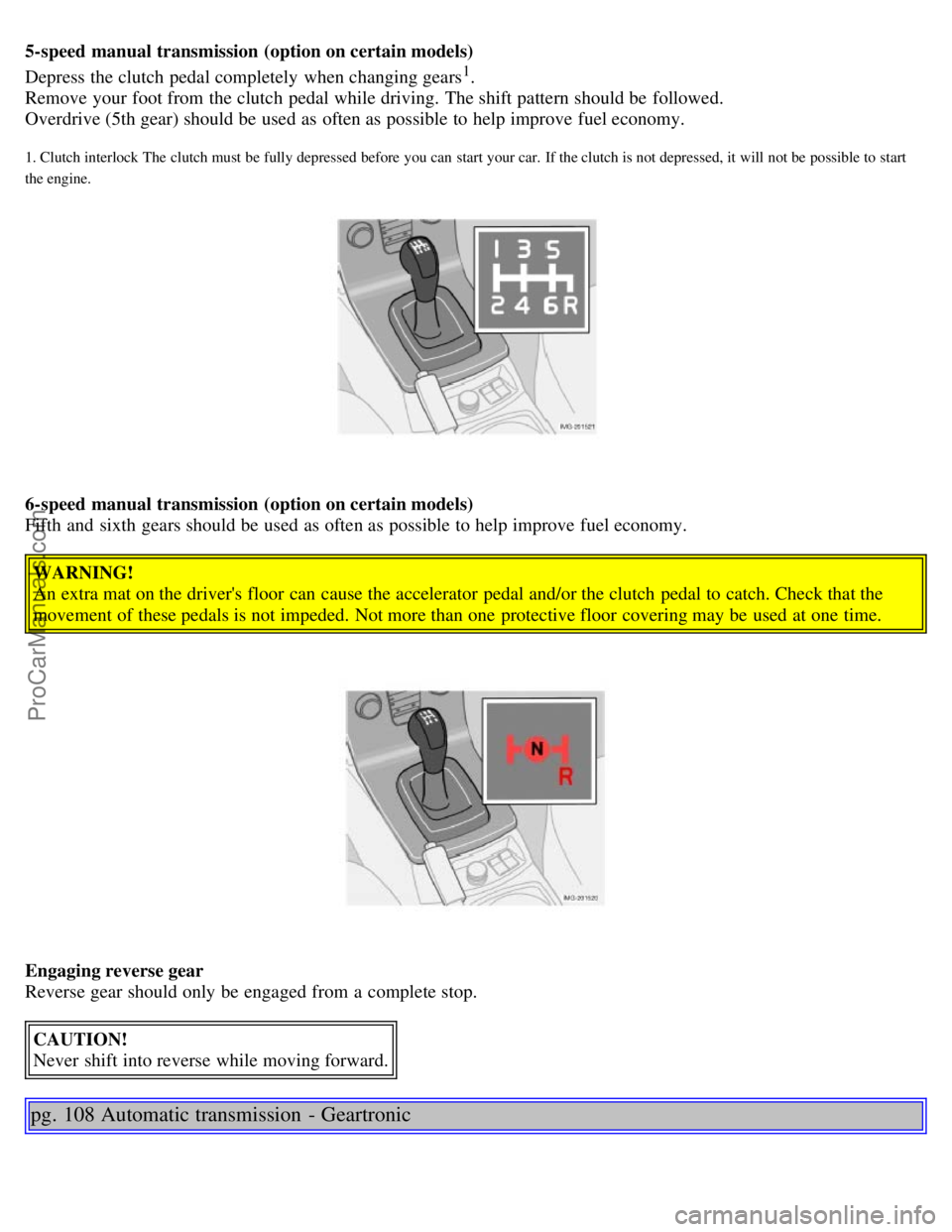
5-speed manual transmission (option on certain models)
Depress the clutch pedal completely when changing gears1.
Remove your foot from the clutch pedal while driving. The shift pattern should be followed.
Overdrive (5th gear) should be used as often as possible to help improve fuel economy.
1. Clutch interlock The clutch must be fully depressed before you can start your car. If the clutch is not depressed, it will not be possible to start
the engine.
6-speed manual transmission (option on certain models)
Fifth and sixth gears should be used as often as possible to help improve fuel economy.
WARNING!
An extra mat on the driver's floor can cause the accelerator pedal and/or the clutch pedal to catch. Check that the
movement of these pedals is not impeded. Not more than one protective floor covering may be used at one time.
Engaging reverse gear
Reverse gear should only be engaged from a complete stop.CAUTION!
Never shift into reverse while moving forward.
pg. 108 Automatic transmission - Geartronic
ProCarManuals.com
Page 68 of 127
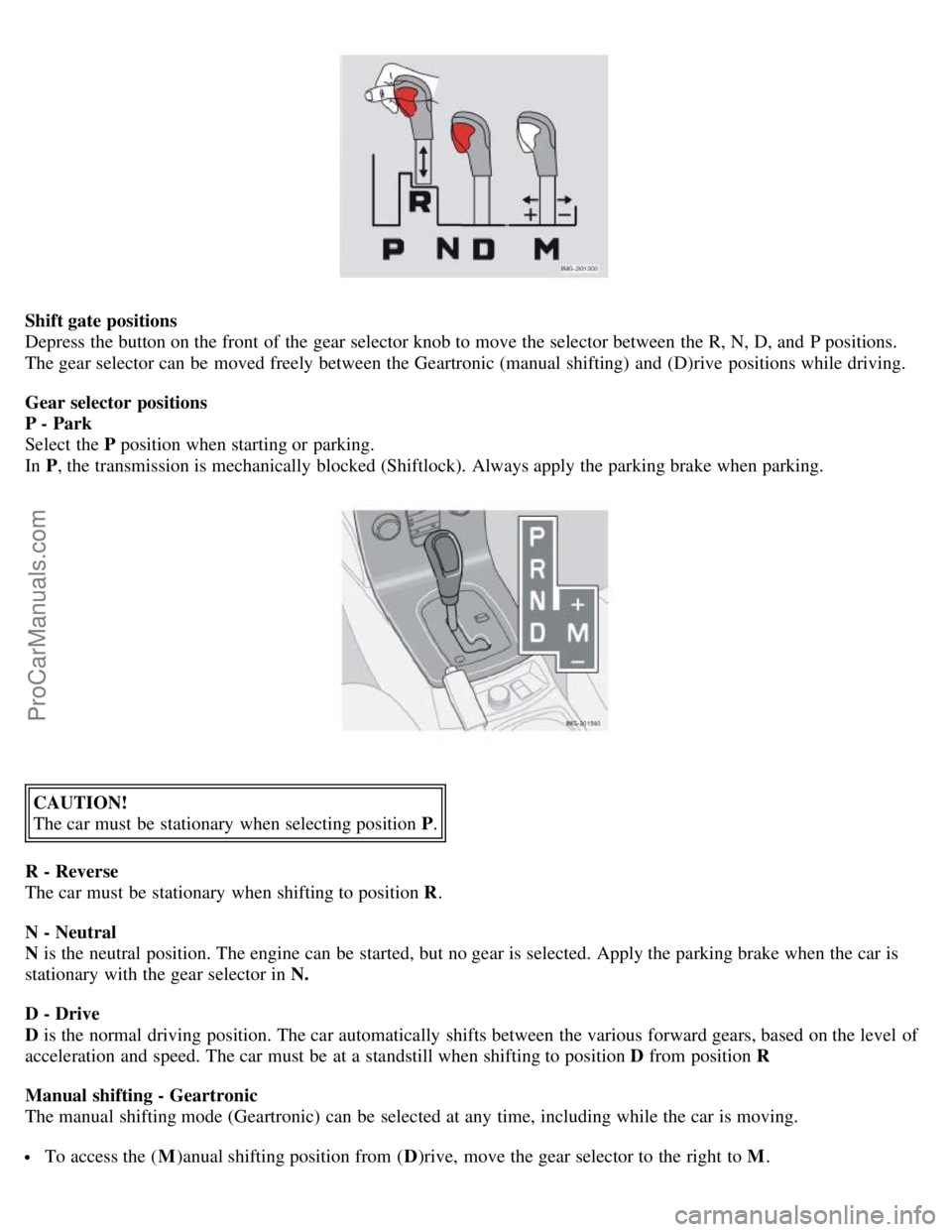
Shift gate positions
Depress the button on the front of the gear selector knob to move the selector between the R, N, D, and P positions.
The gear selector can be moved freely between the Geartronic (manual shifting) and (D)rive positions while driving.
Gear selector positions
P - Park
Select the P position when starting or parking.
In P , the transmission is mechanically blocked (Shiftlock). Always apply the parking brake when parking.
CAUTION!
The car must be stationary when selecting position P .
R - Reverse
The car must be stationary when shifting to position R .
N - Neutral
N is the neutral position. The engine can be started, but no gear is selected. Apply the parking brake when the car is
stationary with the gear selector in N.
D - Drive
D is the normal driving position. The car automatically shifts between the various forward gears, based on the level of
acceleration and speed. The car must be at a standstill when shifting to position D from position R
Manual shifting - Geartronic
The manual shifting mode (Geartronic) can be selected at any time, including while the car is moving.
To access the ( M)anual shifting position from ( D)rive, move the gear selector to the right to M .
ProCarManuals.com
Page 69 of 127
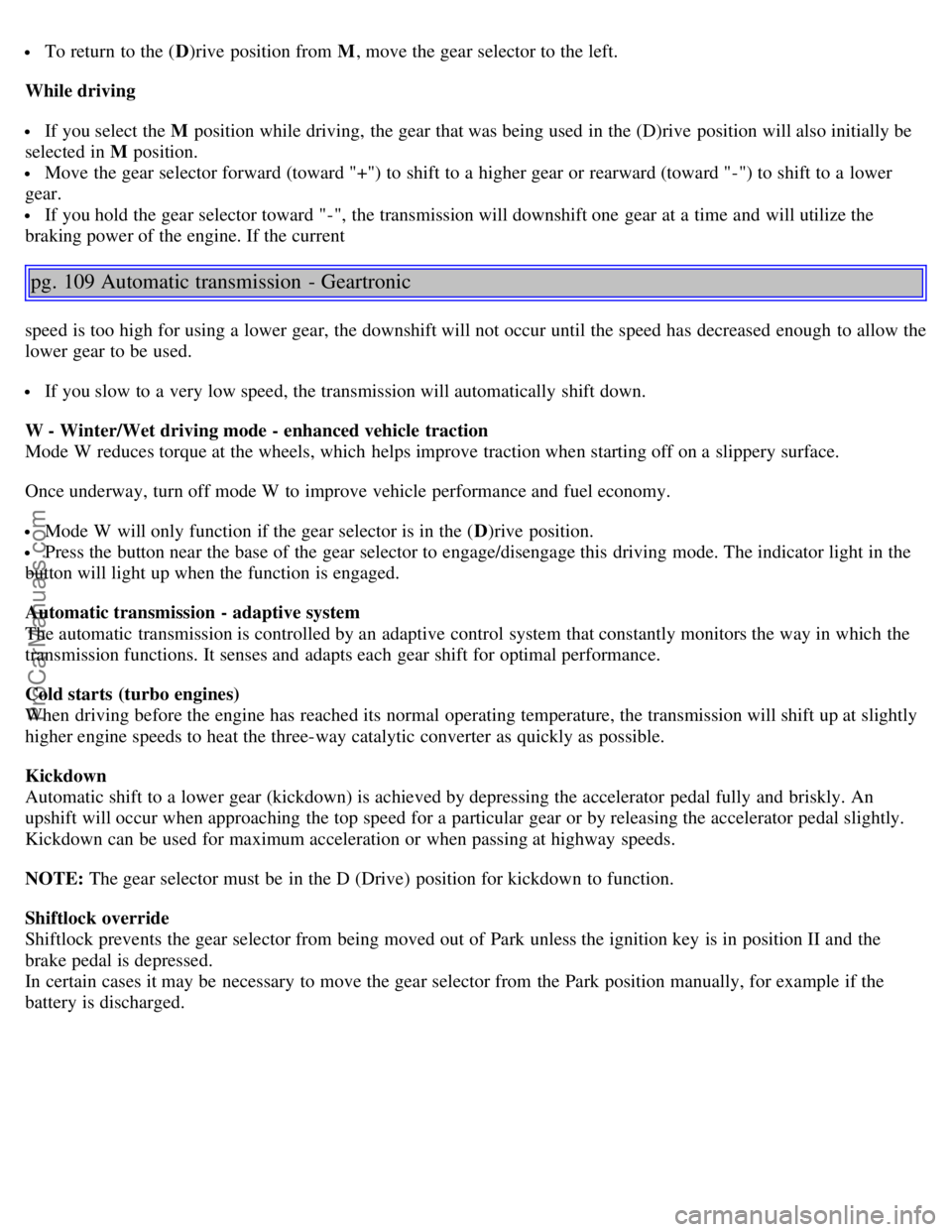
To return to the (D)rive position from M , move the gear selector to the left.
While driving
If you select the M position while driving, the gear that was being used in the (D)rive position will also initially be
selected in M position.
Move the gear selector forward (toward "+") to shift to a higher gear or rearward (toward "-") to shift to a lower
gear.
If you hold the gear selector toward "-", the transmission will downshift one gear at a time and will utilize the
braking power of the engine. If the current
pg. 109 Automatic transmission - Geartronic
speed is too high for using a lower gear, the downshift will not occur until the speed has decreased enough to allow the
lower gear to be used.
If you slow to a very low speed, the transmission will automatically shift down.
W - Winter/Wet driving mode - enhanced vehicle traction
Mode W reduces torque at the wheels, which helps improve traction when starting off on a slippery surface.
Once underway, turn off mode W to improve vehicle performance and fuel economy.
Mode W will only function if the gear selector is in the ( D)rive position.
Press the button near the base of the gear selector to engage/disengage this driving mode. The indicator light in the
button will light up when the function is engaged.
Automatic transmission - adaptive system
The automatic transmission is controlled by an adaptive control system that constantly monitors the way in which the
transmission functions. It senses and adapts each gear shift for optimal performance.
Cold starts (turbo engines)
When driving before the engine has reached its normal operating temperature, the transmission will shift up at slightly
higher engine speeds to heat the three-way catalytic converter as quickly as possible.
Kickdown
Automatic shift to a lower gear (kickdown) is achieved by depressing the accelerator pedal fully and briskly. An
upshift will occur when approaching the top speed for a particular gear or by releasing the accelerator pedal slightly.
Kickdown can be used for maximum acceleration or when passing at highway speeds.
NOTE: The gear selector must be in the D (Drive) position for kickdown to function.
Shiftlock override
Shiftlock prevents the gear selector from being moved out of Park unless the ignition key is in position II and the
brake pedal is depressed.
In certain cases it may be necessary to move the gear selector from the Park position manually, for example if the
battery is discharged.
ProCarManuals.com
Page 80 of 127
Recommended tire pressure (see the placard on the B-pillar or on the fuel filler door) should be maintained irrespective
of which position on the car the temporary spare tire is used on.
In the event of damage to this tire, a new one can be purchased from your Volvo retailer.WARNING!
Current legislation prohibits the use of the "temporary spare" tire other than as a temporary replacement for a
punctured tire. It must be replaced as soon as possible by a standard tire. Road holding and handling may be affected
with the "temporary spare" in use. Do not exceed 50 m.p.h. (80 km/h). Do not drive farther than 50 miles (80 km) on
a temporary spare tire.
CAUTION!
The car must not be driven with wheels of different dimensions or with a spare tire other than the one that came with
the car. The use of different size wheels can seriously damage your car's transmission.
pg. 134 Wheel nuts
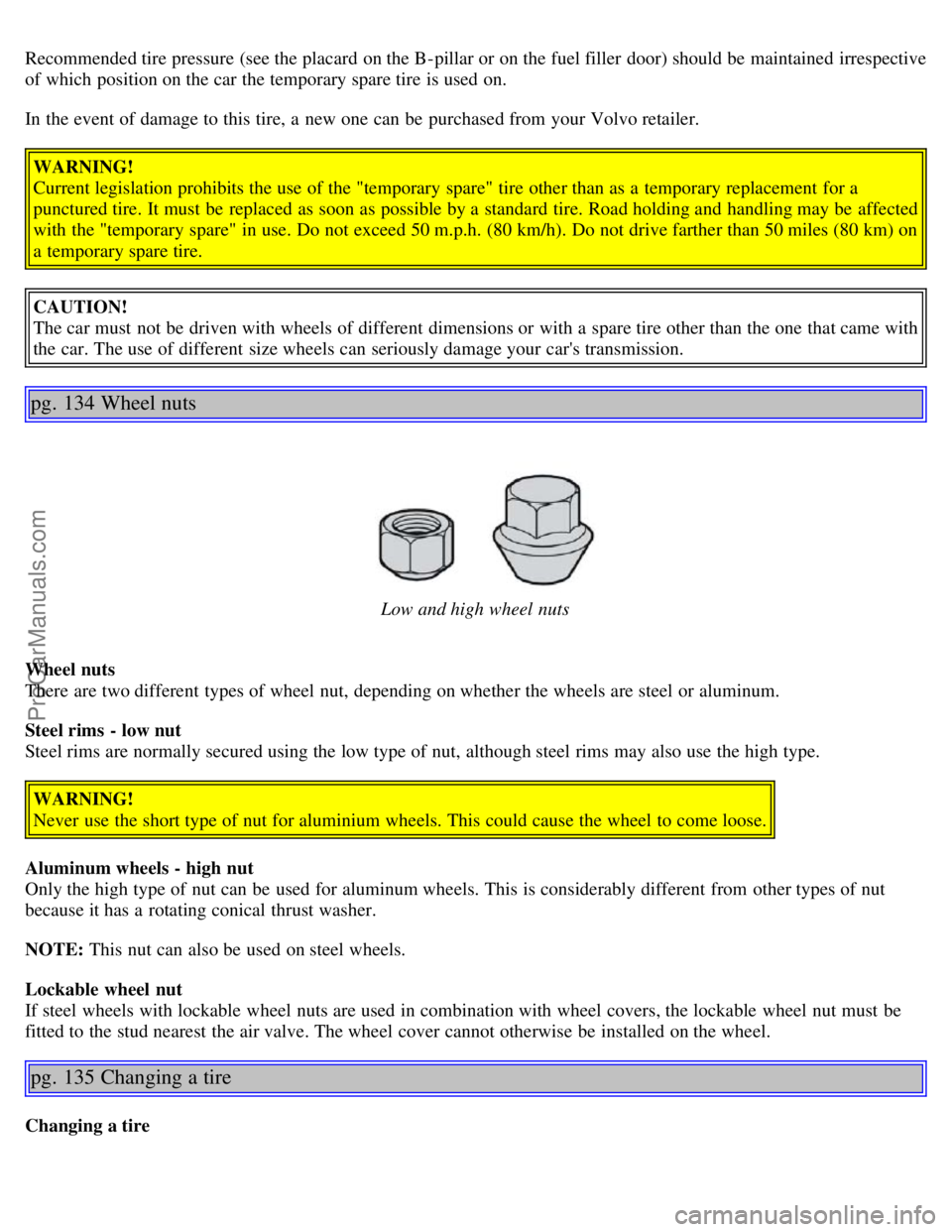
Low and high wheel nuts
Wheel nuts
There are two different types of wheel nut, depending on whether the wheels are steel or aluminum.
Steel rims - low nut
Steel rims are normally secured using the low type of nut, although steel rims may also use the high type. WARNING!
Never use the short type of nut for aluminium wheels. This could cause the wheel to come loose.
Aluminum wheels - high nut
Only the high type of nut can be used for aluminum wheels. This is considerably different from other types of nut
because it has a rotating conical thrust washer.
NOTE: This nut can also be used on steel wheels.
Lockable wheel nut
If steel wheels with lockable wheel nuts are used in combination with wheel covers, the lockable wheel nut must be
fitted to the stud nearest the air valve. The wheel cover cannot otherwise be installed on the wheel.
pg. 135 Changing a tire
Changing a tire
ProCarManuals.com
Page 114 of 127
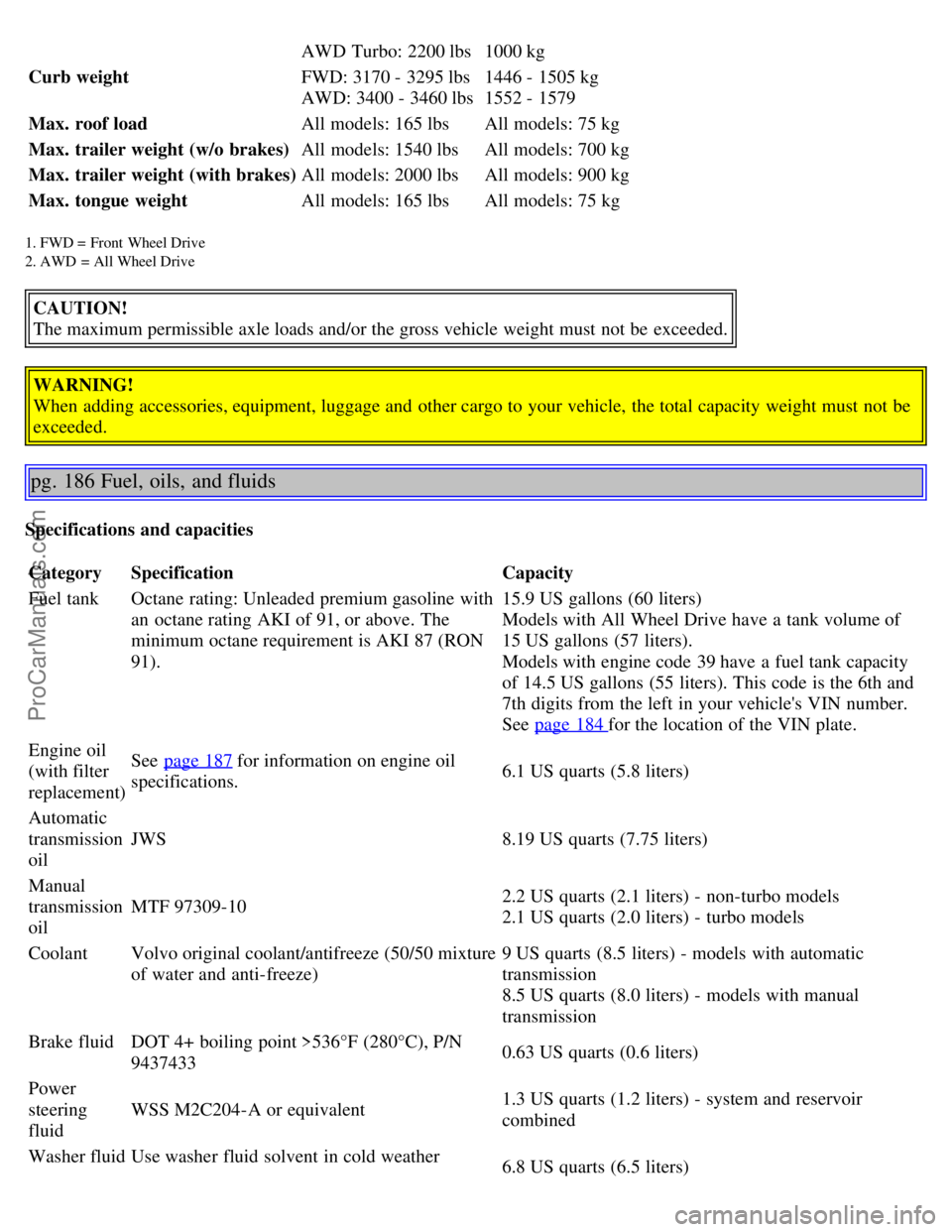
AWD Turbo: 2200 lbs1000 kg
Curb weight FWD: 3170 - 3295 lbs
AWD: 3400 - 3460 lbs1446 - 1505 kg
1552 - 1579
Max. roof load All models: 165 lbsAll models: 75 kg
Max. trailer weight (w/o brakes) All models: 1540 lbsAll models: 700 kg
Max. trailer weight (with brakes) All models: 2000 lbsAll models: 900 kg
Max. tongue weight All models: 165 lbsAll models: 75 kg
1. FWD = Front Wheel Drive
2. AWD = All Wheel Drive
CAUTION!
The maximum permissible axle loads and/or the gross vehicle weight must not be exceeded.
WARNING!
When adding accessories, equipment, luggage and other cargo to your vehicle, the total capacity weight must not be
exceeded.
pg. 186 Fuel, oils, and fluids
Specifications and capacities
Category Specification Capacity
Fuel tank Octane rating: Unleaded premium gasoline with
an octane rating AKI of 91, or above. The
minimum octane requirement is AKI 87 (RON
91). 15.9 US gallons (60 liters)
Models with All Wheel Drive have a tank volume of
15 US gallons (57 liters).
Models with engine code 39 have a fuel tank capacity
of 14.5 US gallons (55 liters). This code is the 6th and
7th digits from the left in your vehicle's VIN number.
See page 184
for the location of the VIN plate.
Engine oil
(with filter
replacement) See page 187
for information on engine oil
specifications. 6.1 US quarts (5.8 liters)
Automatic
transmission
oil JWS
8.19 US quarts (7.75 liters)
Manual
transmission
oil MTF 97309-10
2.2 US quarts (2.1 liters) - non-turbo models
2.1 US quarts (2.0 liters) - turbo models
Coolant Volvo original coolant/antifreeze (50/50 mixture
of water and anti-freeze) 9 US quarts (8.5 liters) - models with automatic
transmission
8.5 US quarts (8.0 liters) - models with manual
transmission
Brake fluid DOT 4+ boiling point >536°F (280°C), P/N
9437433 0.63 US quarts (0.6 liters)
Power
steering
fluid WSS M2C204-A or equivalent
1.3 US quarts (1.2 liters) - system and reservoir
combined
Washer fluid Use washer fluid solvent in cold weather
6.8 US quarts (6.5 liters)
ProCarManuals.com
Page 119 of 127
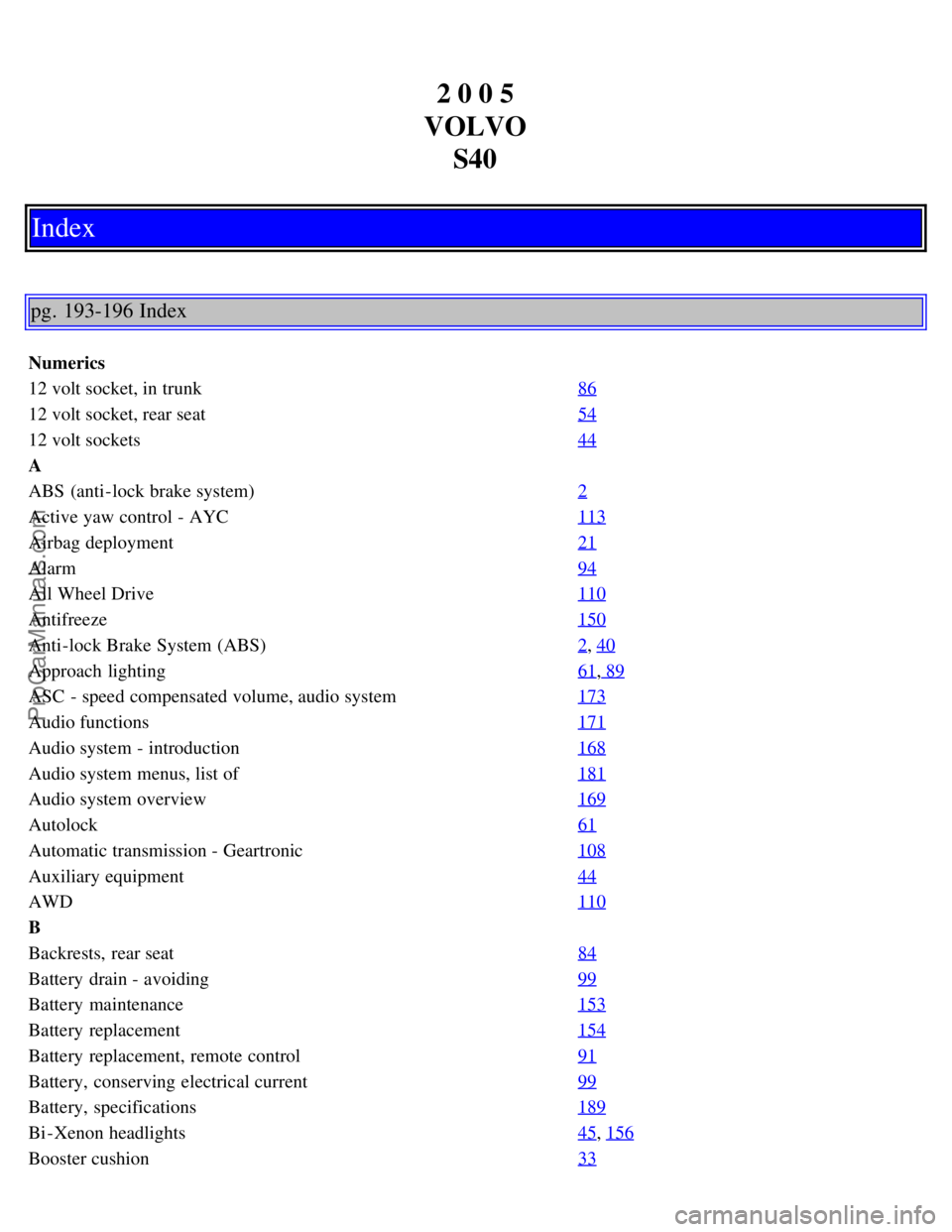
2 0 0 5
VOLVO S40
Index
pg. 193-196 Index
Numerics
12 volt socket, in trunk 86
12 volt socket, rear seat54
12 volt sockets44
A
ABS (anti-lock brake system)2
Active yaw control - AYC113
Airbag deployment21
Alarm94
All Wheel Drive110
Antifreeze150
Anti-lock Brake System (ABS)2, 40
Approach lighting61, 89
ASC - speed compensated volume, audio system173
Audio functions171
Audio system - introduction168
Audio system menus, list of181
Audio system overview169
Autolock61
Automatic transmission - Geartronic108
Auxiliary equipment44
AWD110
B
Backrests, rear seat84
Battery drain - avoiding99
Battery maintenance153
Battery replacement154
Battery replacement, remote control91
Battery, conserving electrical current99
Battery, specifications189
Bi -Xenon headlights45, 156
Booster cushion33
ProCarManuals.com
Page 122 of 127

Inflation pressure tables127
Information display38
Information display, messages in43
Information symbol38, 39
Instrument overview8
Instrument panel38
Instrument panel lighting45
Interior lighting81
ISOFIX/LATCH anchors32
J
Jack, positioning correctly136
Jump starting118
K
Key blade90
Key blade, locking and unlocking the car90
Keylock2, 104
Kickdown109
L
Label information184
LATCH anchors33
License plate lighting, replacing159
Lighting panel45
Loading the vehicle130
Long distance trips100
Low beam bulb, replacing156
M
Maintenance146
Malfunction indicator light40
Manual front seat adjustment78
Manual shifting (Geartronic)108
Manual transmission107
Mirror, rearview57
Mirrors, door-mounted58
Moonroof59
O
Occupant safety12
Occupant Weight Sensor (OWS), disabling front passenger's side airbag19
Octane rating101
Oil pressure warning light41
Oil, changing149
On Call Roadside Assistance191
Opening the hood148
P
Paint touch up143
ProCarManuals.com
Page 124 of 127

Safety system warning light22, 41
Seat belt maintenance16
Seat belt reminder16, 41
Seat belts14
SEE MANUAL43
SERVICE REQUIRED43
Shiftlock2
Side impact protection (SIPS) airbags25
Side marker light, replacing158
Speedometer38
Spin control - SC113
SRS warning light22
Stability44
Stability system113
Stability system STC or DSTC44
Start inhibitor (immobilizer)88
Starting the vehicle104
Station formats176
STC44, 113
Steering wheel adjustment53
Steering wheel keypad, audio system170
Steering wheel lock106
Stone chips, paint touch-up143
STOP ENGINE43
STOP SAFELY43
Storage compartments82
Subwoofer172
Sunroof (moonroof)59
Supplemental Restraint System - SRS17
T
Tachometer38
Tail light bulb holder, removing159
Technician certification191
Temperature gauge38
Three-way catalytic converter190
TIME FOR REGULAR SERVICE43
Tire inflation pressure tables127
Tires, changing135
Tires, general information124
Traction control - TC113
Transmission, automatic108
Tread wear indicator124
Trip computer47
Trip odometer38
ProCarManuals.com