Page 236 of 268

2282005 ECHO from Aug. ’04 Prod. (OM52636U)
SU72022a
Ty p e B
Keep your tire inflation pressures
at the proper level.
The recommended cold tire inflation
pressures, tire sizes and the com-
bined weight of occupants and cargo
(vehicle capacity weight) are de-
scribed on page 248 and 251. They
are also described on the tire and
loading information label. Either type
A or type B of the tire and loading
information label is affixed on your ve-
hicle as shown.
You should check the tire inflation
pressures every two weeks, or at
least once a month. And do not forget
the spare!
The following instructions for
checking tire inflation pressure
should be observed:
� The pressure s hould be
checked only when the tires are
cold. If your vehicle has been
parked for at least 3 hours and has
not been driven for more than 1.5
km or 1 mile since, you will get
an accurate cold tire inflation pres-
sure reading. �
Always use a tire pressure
gauge. The appearance of a tire
can be misleading. Besides, tire
inflation pressures that are even
just a few pounds off can degrade
ride and handling.
� Take special care when adding
air to the compact spare tire.
The smaller tire size can gain
pressure very qu ickly. Add com-
pressed air in small quantities and
check the pressure often until it
reaches the specified pressure.
� Do not bleed or reduce tire
inflation pressure after driving.
It is normal for the tire inflation
pressure to be higher after driving.
� Never exceed the vehicle capac-
ity weight. Passenger and lug-
gage weight should be located so
that the vehicle is balanced.
Page 237 of 268
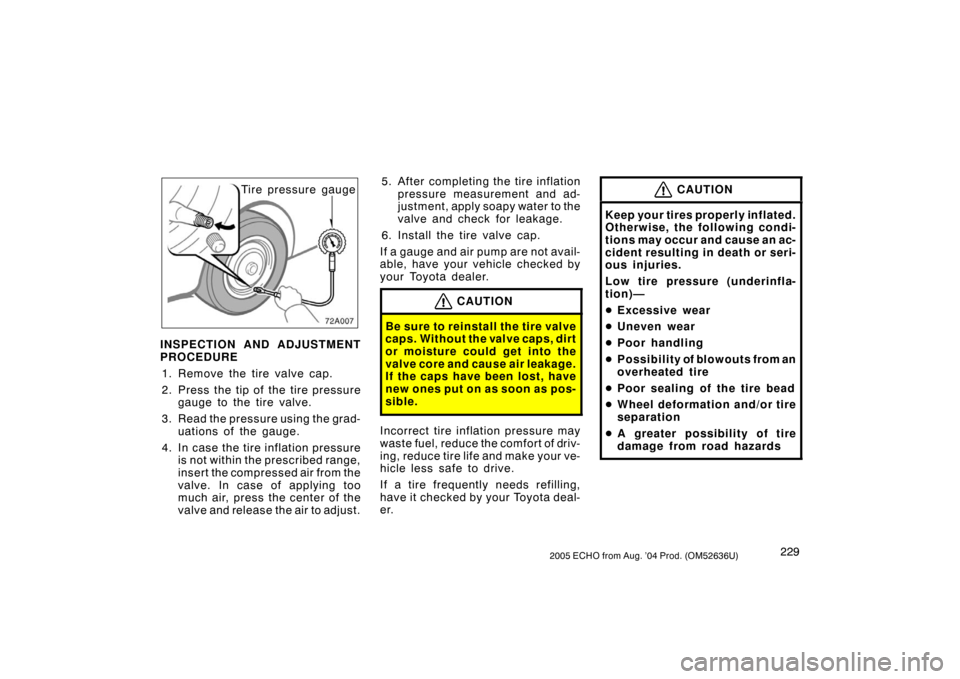
2292005 ECHO from Aug. ’04 Prod. (OM52636U)
Tire pressure gauge
INSPECTION AND ADJUSTMENT
PROCEDURE 1. Remove the tire valve cap.
2. Press the tip of the tire pressure gauge to the tire valve.
3. Read the pressure using the grad- uations of the gauge.
4. In case the tire inflation pressure
is not within the prescribed range,
insert the compressed air from the
valve. In case of applying too
much air, press the center of the
valve and release the air to adjust. 5. After completing the tire inflation
pressure measurement and ad-
justment, apply soapy water to the
valve and check for leakage.
6. Install the tire valve cap.
If a gauge and air pump are not avail-
able, have your vehicle checked by
your Toyota dealer.
CAUTION
Be sure to reinstall the tire valve
caps. Without the valve caps, dirt
or moisture could get into the
valve core and cause air leakage.
If the caps have been lost, have
new ones put on as soon as pos-
sible.
Incorrect tire infl ation pressure may
waste fuel, reduce the comfort of driv-
ing, reduce tire life and make your ve-
hicle less safe to drive.
If a tire frequently needs refilling,
have it checked by your Toyota deal-
er.
CAUTION
Keep your tires properly inflated.
Otherwise, the following condi-
tions may occur and cause an ac-
cident resulting in death or seri-
ous injuries.
Low tire pressure ( underinfla-
tion)—
� Excessive wear
� Uneven wear
� Poor handling
� Possibility of blowouts from an
overheated tire
� Poor sealing of the tire bead
� Wheel deformation and/or tire
separation
� A greater possibility of tire
damage from road hazards
Page 239 of 268

2312005 ECHO from Aug. ’04 Prod. (OM52636U)
If air loss occurs while driving, do not
continue driving. Driving even a short
distance can damage a tire beyond
repair.
An y ti res wh i ch are over 6 years
old must be checked by a qualified
technician even if damage is not
obvious.
Tires deteriorate with age even if they
have never or seldom been used.
This applies also to the spare tire and
tires stored for future use.
REPLACING YOUR TIRES
When replacing a tire, use a tire of
the same size and construction,
and the same or greater load ca-
pacity as the originally installed
tires.
Using any other size or type of tire
may seriously affect handling, ride,
speedometer/odometer calibration,
ground clearance, and clearance be-
tween the body and tires or snow
chains.Check that the maximum load of the
replaced tire is greater than 1/2 of the
Gross Axle Weight Ratings (GAWR)
of either the front axle or the rear
axle, whichever is greater. As for the
maximum load of the tire, see the load
limit at maximum cold tire inflation
pressure mentioned on the sidewall
of the tire, and as for the Gross Axle
Weight Ratings (GAWR), see the Cer-
tification Label. For details about the
sidewall of the tire and the Certifica-
tion Label, see pages 157 and 155.
CAUTION
Observe the following instruc-
tions. Otherwise, an accident
may occur resulting in death or
serious injuries.
�
Do not mix radial, bias belted,
or biasply tires on your ve-
hicle, as this may cause dan-
gerous handling characteris-
tics resulting in loss of control.
�Do not use tires other than the
manufacturer’s recommended
size, as this may cause danger-
ous handling characteristics
resulting in loss of control.
Toyota recommends all four tires,
or at least both of the front or rear
tires be replaced at a time as a set.
S ee “I f you hav e a fl at tire” in Section
4 for tire change procedure.
When a tire is replaced, the wheel
should always be balanced.
An unbalanced wheel may affect ve-
hicle handling and tire life. Wheels
can get out of balance with regular
use and should therefore be balanced
occasionally.
When replacing a tubeless tire, the
air valve should also be repl aced
w i t h a new on e.
Page 259 of 268
2512005 ECHO from Aug. ’04 Prod. (OM52636U)
Tires
Tire size and cold tire inflation pressure:
Except spare tirekPa (kgf/cm
2 or bar, psi)
Ti r e siz e
FrontRearWheel size
P175/65R14 81S220 (2.2, 32)220 (2.2, 32)14 x 5 1/ 2J , 14 x 5 1/ 2J J
P185/60R15 84T220 (2.2, 32)220 (2.2, 32)15 x 5J
Spare tire Ti r e siz e
Tire inflation pressure kPa (kgf/cm2 or bar, psi)Wheel size
T115/70D14∗1420 (4.2, 60)14 x 4T
T125/70D16∗2420 (4.2, 60)16 x 4T
∗1: With P175/65R14 81S tires∗2: With P185/60R15 84T tires
Wheel nut torque, N·m (kgf·m, ft·Ibf): 103 (10.5, 76)
NOTE: For a complete information on tires (e.g. replacing ti res or replacing wheels), see “Checking tire inflation pres-
sure” through “Aluminum wheel precautions”, page 227 through 235 in Section 7 −2.
Page 265 of 268

2005 ECHO from Aug. ’04 Prod. (OM52636U)
Publication No. OM52636U
Part No. 01999-52636
Printed in Japan 01−0408 −00
U 6
I
Quick index
� If a service reminder indicator or warning buzzer comes on 90 . . . . . . . .
� If your vehicle will not start 180 . . . . . . . . . . . . . . . . . . . . . . . . . . . . . . . . . . . . .\
.
� If your engine stalls while driving 183 . . . . . . . . . . . . . . . . . . . . . . . . . . . . . . . . .
� If your vehicle overheats 183 . . . . . . . . . . . . . . . . . . . . . . . . . . . . . . . . . . . . .\
. . . .
� If you have a flat tire 184 . . . . . . . . . . . . . . . . . . . . . . . . . . . . . . . . . . . . .\
. . . . . . .
� If your vehicle needs to be towed 195 . . . . . . . . . . . . . . . . . . . . . . . . . . . . . . . .
� Tips for driving during break-in period 146 . . . . . . . . . . . . . . . . . . . . . . . . . . . . .
� How to start the engine 172 . . . . . . . . . . . . . . . . . . . . . . . . . . . . . . . . . . . . .\
. . . . .
� General maintenance 209 . . . . . . . . . . . . . . . . . . . . . . . . . . . . . . . . . . . . .\
. . . . . . . .
� Complete index NO TAG . . . . . . . . . . . . . . . . . . . . . . . . . . . . . . . . . . . . .\
. . . . . . . . .
Gas station information
Fuel type:
UNLEADED gasoline, Octane Rating 87 (Research Octane Number 91)
or higher
See page 146 for detailed information.
Fuel tank capacity:
45 L (11.9 gal., 9.9 lmp.gal.)
Engine oil:
API grade SL “Energy −Conserving” or ILSAC
multigrade engine oil is recommended.
See page 222 for detailed information.
Tire information: See pages 227 through 235.
Tire inflation pressure: See page 251.