Page 273 of 426

’05 4Runner_U (L/O 0504)
263
6. Repeat steps 2 through 5 for each re-
maining HomeLink� button to program
another device.
Programming a rolling code system
If your device is “Rolling Code”
equipped, it is necessary to follow
steps 1 through 4 under the heading
“Programming the HomeLink
�” before
proceeding with the steps listed below.
1. Locate the “training” button on the ceil- ing mounted garage door opener motor.
The exact location and color of the
button may vary by brand of garage
door opener. Refer to the owner ’s
guide supplied by the garage door
opener manufacturer for the location of
this “training” button.
2. Press the “training” button on the ceil- ing mounted garage door opener motor.
Following this step, you have 30 seconds
in which to initiate step 3 below. 3. Press and release the vehicle’s pro- grammed HomeLink
� button twice. The
garage door may open. If the door
does open, the programming process is
complete. If the door does not open,
press and release the button a third
time. This third press and release will
complete the programming process by
opening the garage door. The ceiling mounted garage door opener
motor should now recognize the
HomeLink
� unit and be able activate the
garage door up/down.
4. Repeat steps 1 through 3 for each re- maining HomeLink
� button to program
another rolling code system.
Programming an entrance gate/program-
ming all devices in the Canadian market 1. Decide which of the 3 HomeLink
� but-
tons you want to program.
2. Place your hand −held gate/device
transmitter 25 to 75 mm (1 to 3 in.)
away from the surface of the
HomeLink
�.
Keep the indicator light on the HomeLink
�
in view while programming. 3. Press and hold the selected HomeLink
� button.
4. Continuously press and release ( cycle)
the hand− held gate/device transmitter
button every two seconds until step 5
is complete.
5. When the indicator light on the HomeLink
� changes from a slow to a
rapid flash after 20 seconds, you can
release both buttons. 6. Test the operation of the HomeLink
� by
pressing the newly programmed button.
Check to see if the gate/device oper-
ates correctly.
7. Repeat steps 1 through 6 for each re- maining HomeLink
� button to program
another device.
Programming other devices
To program other devices such as home
security systems, home door locks or
lighting, contact your authorized Toyota
dealer for assistance.
Reprogramming a button
Individual HomeLink
� buttons cannot be
erased, however, to reprogram a single
button, follow the procedure “Programming
the HomeLink
�”.
(b) Operating the HomeLink
�
To operate the HomeLink�, press the
appropriate HomeLink� button to activate
the programmed device. The HomeLink�
indicator light should come on. The
HomeLink� continues to send the signal
for up to 20 seconds as long as the
button is pressed.
Page 277 of 426
’05 4Runner_U (L/O 0504)
267
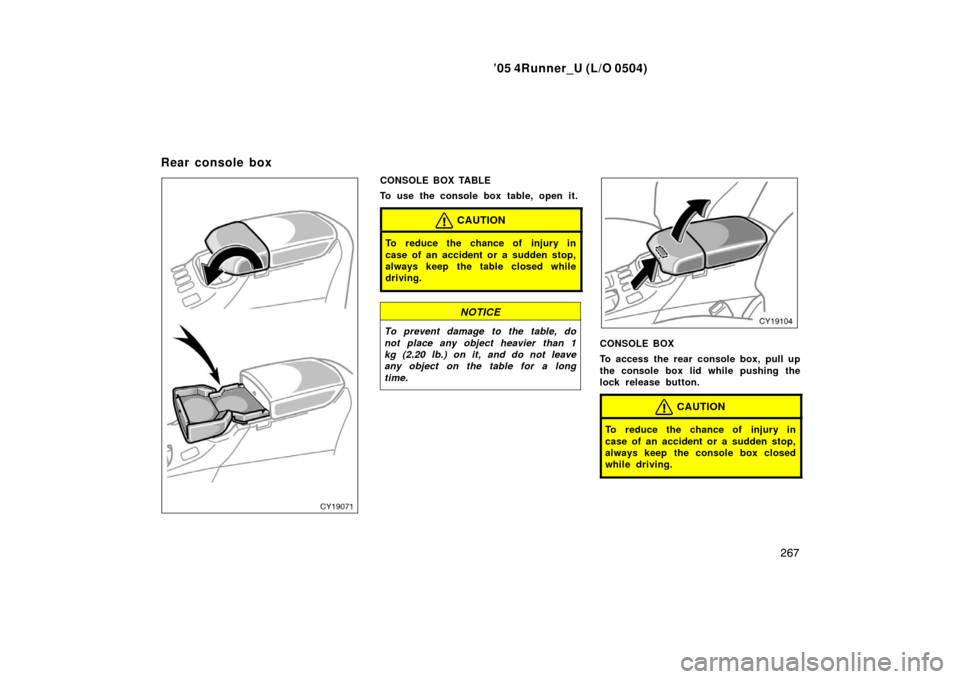
CONSOLE BOX TABLE
To use the console box table, open it.
CAUTION
To reduce the chance of injury in
case of an accident or a sudden stop,
always keep the table closed while
driving.
NOTICE
To prevent damage to the table, do
not place any object heavier than 1
kg (2.20 lb.) on it, and do not leave
any object on the table for a long
time.
CONSOLE BOX
To access the rear console box, pull up
the console box lid while pushing the
lock release button.
CAUTION
To reduce the chance of injury in
case of an accident or a sudden stop,
always keep the console box closed
while driving.
Rear console box
Page 278 of 426
’05 4Runner_U (L/O 0504)
268
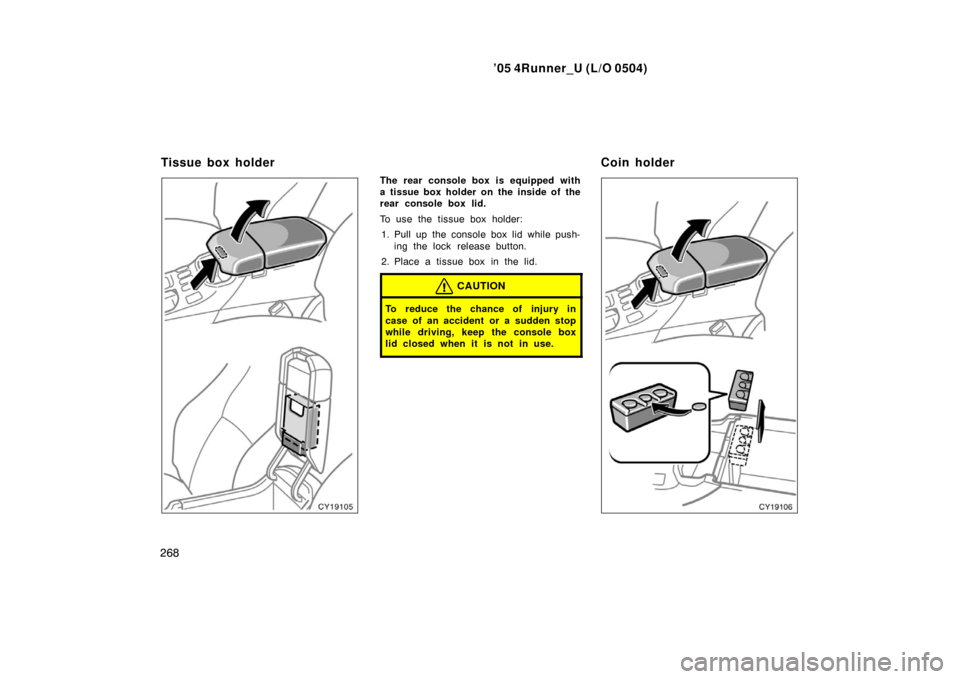
The rear console box is equipped with
a tissue box holder on the inside of the
rear console box lid.
To use the tissue box holder:
1. Pull up the console box lid while push- ing the lock release button.
2. Place a tissue box in the lid.
CAUTION
To reduce the chance of injury in
case of an accident or a sudden stop
while driving, keep the console box
lid closed when it is not in use.
Tissue box holder Coin holder
Page 279 of 426
’05 4Runner_U (L/O 0504)
269
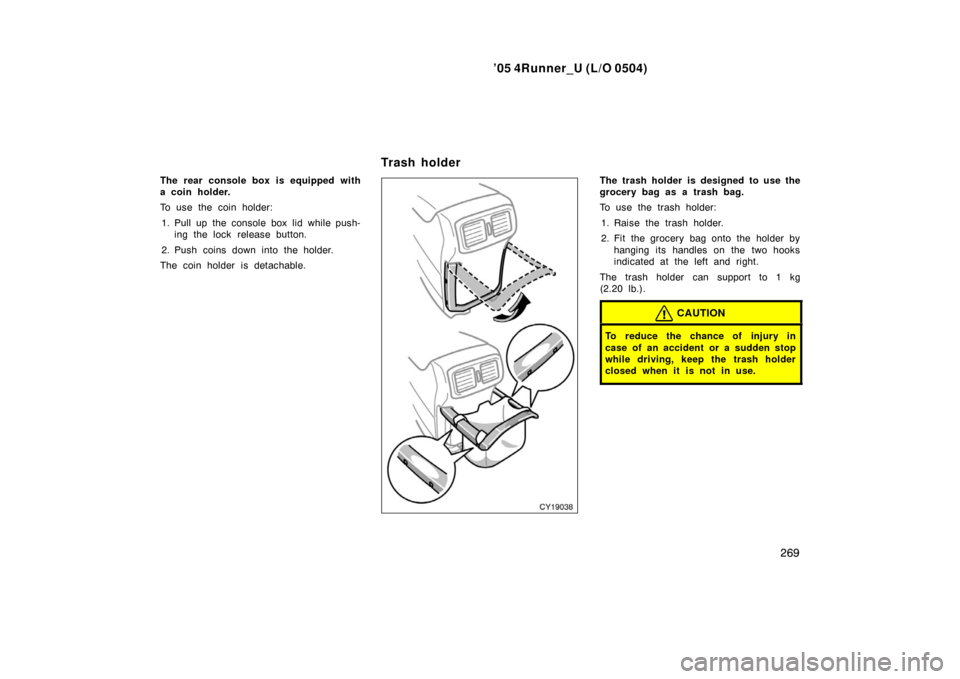
The rear console box is equipped with
a coin holder.
To use the coin holder:
1. Pull up the console box lid while push- ing the lock release button.
2. Push coins down into the holder.
The coin holder is detachable.The trash holder is designed to use the
grocery bag as a trash bag.
To use the trash holder:
1. Raise the trash holder.
2. Fit the grocery bag onto the holder by hanging its handles on the two hooks
indicated at the left and right.
The trash holder can support to 1 kg
(2.20 lb.).
CAUTION
To reduce the chance of injury in
case of an accident or a sudden stop
while driving, keep the trash holder
closed when it is not in use.
Trash holder
Page 286 of 426
’05 4Runner_U (L/O 0504)
276
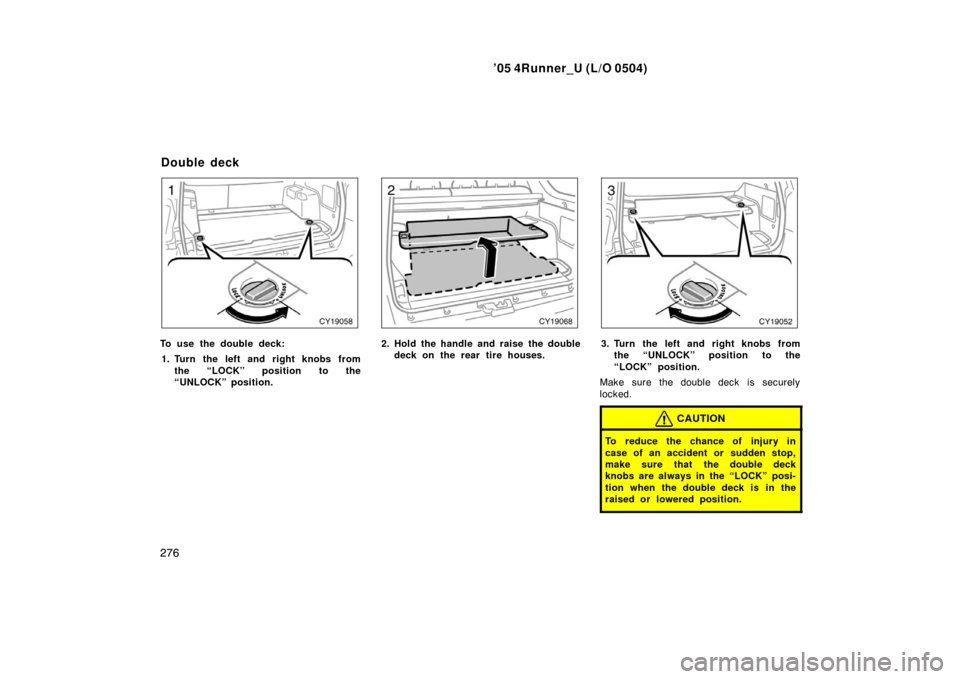
To use the double deck:
1. Turn the left and right knobs from the “LOCK” position to the
“UNLOCK” position.2. Hold the handle and raise the doubledeck on the rear tire houses.3. Turn the left and right knobs fromthe “UNLOCK” position to the
“LOCK” position.
Make sure the double deck is securely
locked.
CAUTION
To reduce the chance of injury in
case of an accident or sudden stop,
make sure that the double deck
knobs are always in the “LOCK” posi-
tion when the double deck is in the
raised or lowered position.
Double deck
Page 287 of 426
’05 4Runner_U (L/O 0504)
277
NOTICE
When using the double deck at the
raised position, do not place any ob-
ject heavier than 30 kg (66 lb.).
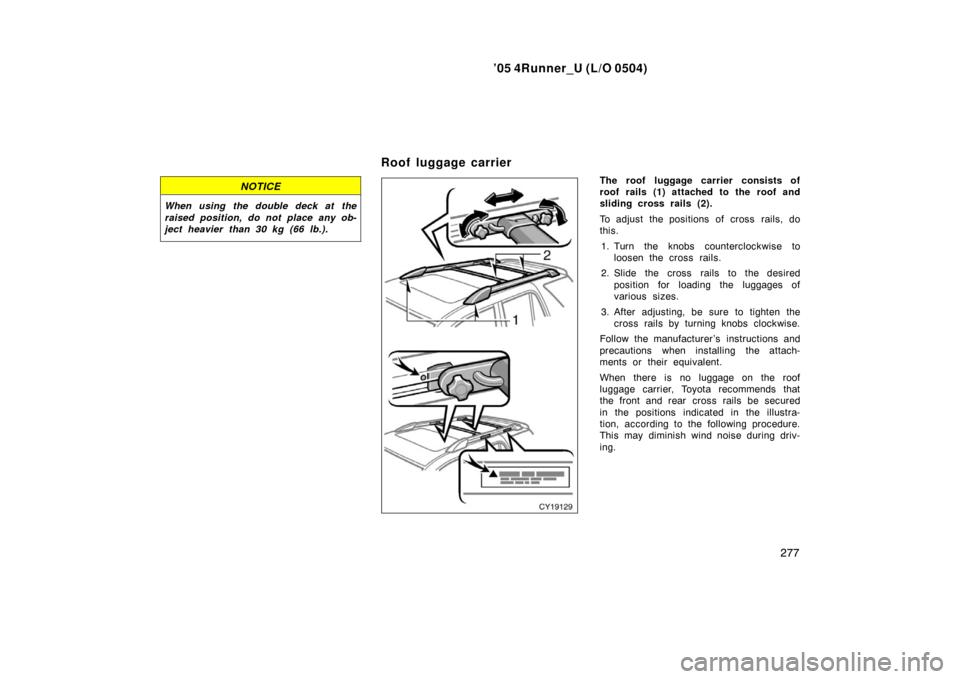
The roof luggage carrier consists of
roof rails (1) attached to the roof and
sliding cross rails (2).
To adjust the positions of cross rails, do
this.
1. Turn the knobs counterclockwise to loosen the cross rails.
2. Slide the cross rails to the desired position for loading the luggages of
various sizes.
3. After adjusting, be sure to tighten the cross rails by turning knobs clockwise.
Follow the manufacturer ’s instructions and
precautions when installing the attach-
ments or their equivalent.
When there is no luggage on the roof
luggage carrier, Toyota recommends that
the front and rear cross rails be secured
in the positions indicated in the illustra-
tion, according to the following procedure.
This may diminish wind noise during driv-
ing.
Roof luggage carrier
Page 288 of 426
’05 4Runner_U (L/O 0504)
278
CAUTION
When you load cargo on the roof lug-
gage carrier, observe the following:
�Place the cargo so that its weight
is distributed evenly between the
front and rear axles.
�If loading long or wide cargo, never
exceed the vehicle overall length or
width. (See “Dimensions and
weights” on page 402 in Section 8
for information on your vehicle
overall length and width.)
�Before driving, make sure the cargo
is securely fastened on the roof
luggage carrier.
�Loading cargo on the roof luggage
carrier will make the center of the
vehicle gravity higher. Avoid high
speeds, sudden starts, sharp turns,
sudden braking or abrupt maneu-
vers, otherwise it may result in loss
of control or vehicle rollover due to
failure to operate this vehicle cor-
rectly.
�If driving for a long distance, on
rough roads, or at high speeds,
stop the vehicle now and then dur-
ing the trip to make sure the cargo
remains in its place.
�Do not exceed 54 kg (120 lb.) cargo
weight on the roof luggage carrier.
NOTICE
When loading the luggages, be careful
not to scratch the surface of the
moon roof.
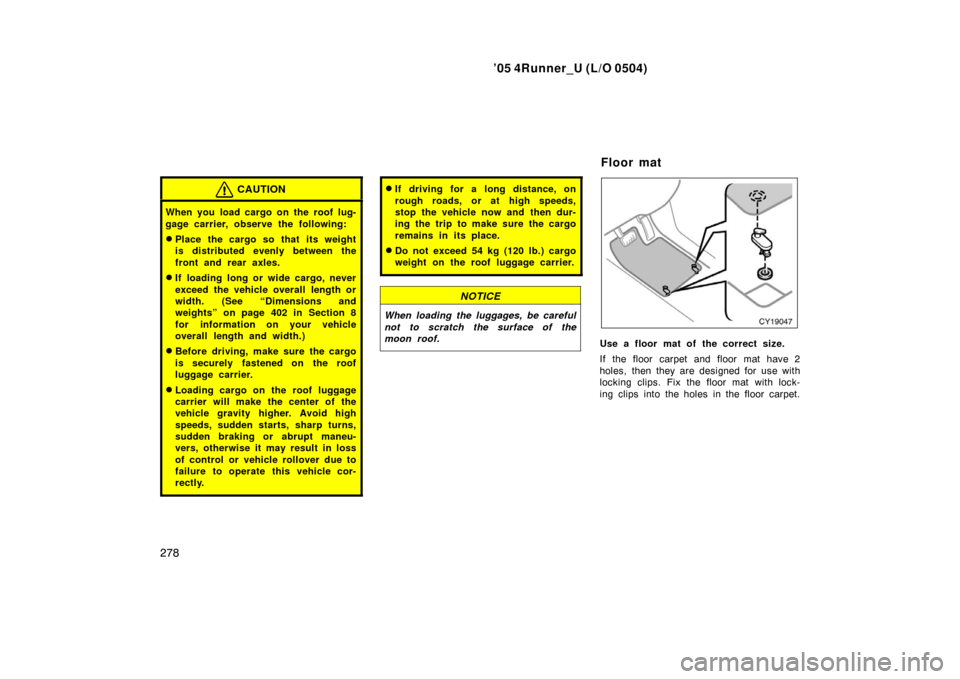
Use a floor mat of the correct size.
If the floor carpet and floor mat have 2
holes, then they are designed for use with
locking clips. Fix the floor mat with lock-
ing clips into the holes in the floor carpet.
Floor mat
Page 295 of 426
’05 4Runner_U (L/O 0504)
285
NOTICE
�Do not use gasohol other than
stated above. It will cause fuel sys-
tem damage or vehicle performance
problems.
� If driveab ility problems occur (poor
hot starting, vaporizing, engine
knock, etc.), discontinue the use.
� Take care not to spill gasohol dur-
ing refueling. Gasohol may cause
paint damage.
FUEL TANK CAPACITY
87 L (23.0 gal., 19.1 Imp. gal.) The fuel pump shut off system stops sup-
plying fuel to the engine to minimize the
risk of fuel leakage when the engine stalls
or an airbag inflates upon collision. To
restart the engine after the fuel pump shut
off system activates, turn the ignition
switch to “ACC” or “LOCK” once and start
it.
CAUTION
Inspect the ground under the vehicle
before restarting the engine. If you
find that liquid has leaked onto the
ground, it is the fuel system has
been damaged and it is in need of
repair. In this case, do not restart the
engine.
If you plan to drive your Toyota in
another country...
First,
comply with the vehicle registration
laws.
Second, confirm the availability of the cor-
rect fuel (unleaded and minimum octane
number).
Fuel pump shut off system Operation in foreign countries