Page 375 of 426

’05 4Runner_U (L/O 0504)
365
Doors and engine hood
Check that all doors including back door
operate smoothly and all latches lock se-
curely. Make sure the engine hood sec-
ondary latch secures the hood from open-
ing when the primary latch is released.
Tire inflation pressure
Check the pressure with a gauge ev-
ery two weeks, or at least once a
month. See page 381 in Section 7 −2
for additional information.
Tire surface and wheel nuts
Check the tires carefully for cuts,
damage or excessive wear. See page
384 in Section 7− 2 for additional in-
formation. When checking the tires,
make sure no nuts are missing, and
check the nuts for looseness. Tighten
them if necessary.
Tire rotation
Rotate the tires according to the
maintenance schedule. (For sched-
uled maintenance information, please
refer to the “Scheduled Maintenance
Guide” or “Owner ’s Manual Supple-
ment”.) See page 386 in Section 7 −2
for additional information.
Be on the alert for changes in perfor-
mance, sounds, and visual tip −offs that
indicate service is needed. Some impor-
tant clues are as follows:
�Engine missing, stumbling, or pinging
�Appreciable loss of power
�Strange engine noises
�A leak under the vehicle (however, wa-
ter dripping from the air conditioning
after use is normal.)
�Change in exhaust sound (This may
indicate a dangerous carbon monoxide
leak. Drive with the windows open and
have the exhaust system checked im-
mediately.)
�Flat −looking tire; excessive tire squeal
when cornering; uneven tire wear
�Vehicle pulls to one side when driving
straight on a level road
�Strange noises related to suspension
movement
�Loss of brake effectiveness; spongy
feeling brake pedal; pedal almost
touches floor; vehicle pulls to one side
when braking
�Engine coolant temperature continually
higher than normal If you notice any of these clues, take your
vehicle to your Toyota dealer as soon as
possible. It probably needs adjustment or
repair.
CAUTION
Do not continue driving with the ve-
hicle unchecked. It could result in se-
rious vehicle damage and possibly
personal injury.
Does your vehicle need
repairing?
Page 378 of 426
’05 4Runner_U (L/O 0504)
368
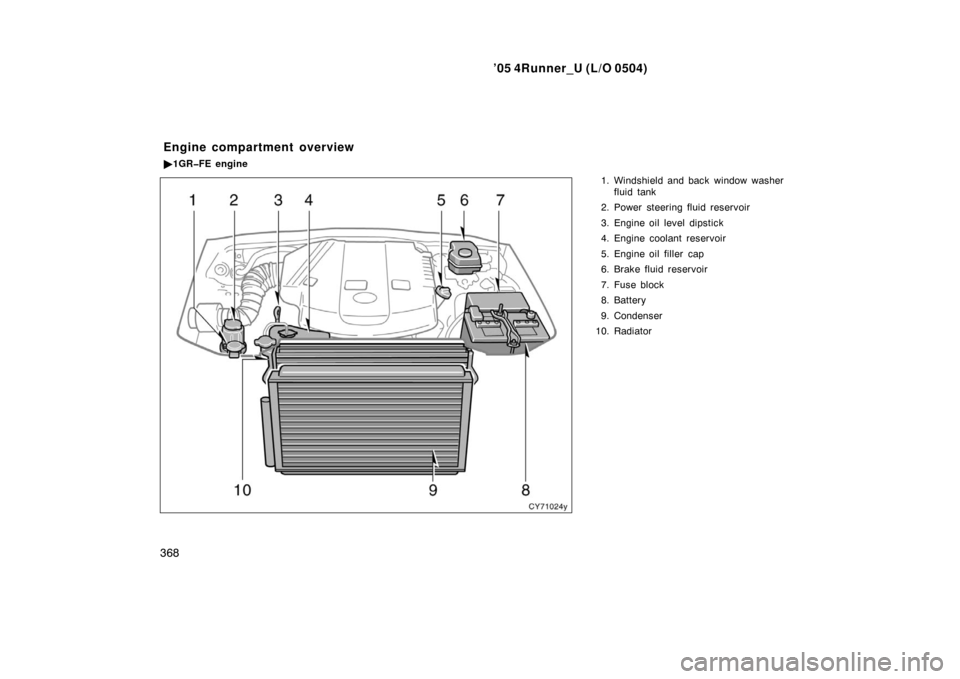
1. Windshield and back window washer
fluid tank
2. Power steering fluid reservoir
3. Engine oil level dipstick
4. Engine coolant reservoir
5. Engine oil filler cap
6. Brake fluid reservoir
7. Fuse block
8. Battery
9. Condenser
10. Radiator
Engine compartment overview
� 1GRFE engine
Page 379 of 426
’05 4Runner_U (L/O 0504)
369
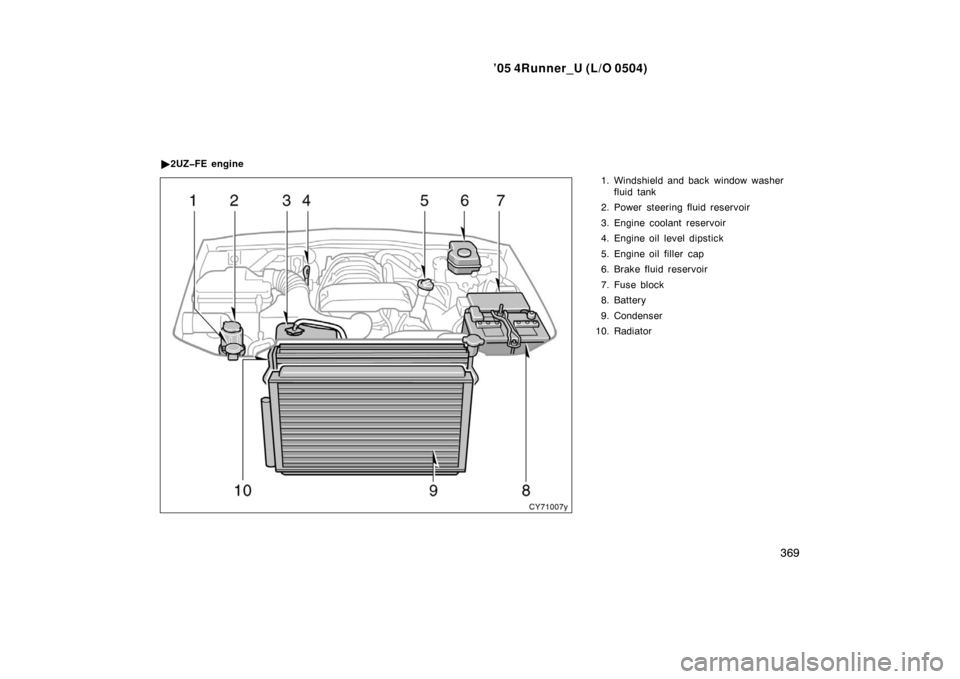
1. Windshield and back window washer
fluid tank
2. Power steering fluid reservoir
3. Engine coolant reservoir
4. Engine oil level dipstick
5. Engine oil filler cap
6. Brake fluid reservoir
7. Fuse block
8. Battery
9. Condenser
10. Radiator
�
2UZFE engine
Page 391 of 426

’05 4Runner_U (L/O 0504)
381
If cold O.K.
If hot O.K.
If cold
add If hot
add
Close
Open
Check the fluid level through the reser-
voir. If necessary, add automatic trans-
mission fluid DEXRON �II or III.
If the vehicle has been driven around 80
km/h (50 mph) for 20 minutes (a little
more in frigid temperatures), the fluid is
hot (60 �C—80 �C or 140 �F—175 �F). You
may also check the level when the fluid
is cold (about room temperature,
10 �C—30 �C or 50 �F—85 �F) if the engine
has not been run for about five hours. Clean all dirt from the outside of the res-
ervoir tank and look at the fluid level. If
the fluid is cold, the level should be in the
“COLD” range. Similarly, if it is hot, the
fluid level should be in the “HOT” range.
If the level is at the low side of either
range, add automatic transmission fluid
DEXRON
�II or III to bring the level within
the range.
To remove the reservoir cap, turn it coun-
terclockwise and lift up. To reinstall it,
turn it clockwise. After replacing the reser-
voir cap, visually check the steering box
case, vane pump and hose connections
for leaks or damage.
CAUTION
The reservoir tank may be hot so be
careful not to burn yourself.
NOTICE
Avoid overfilling, or the power steer-
ing could be damaged.
Checking power steering fluid Checking tire inflation
pressure
Page 397 of 426
’05 4Runner_U (L/O 0504)
387
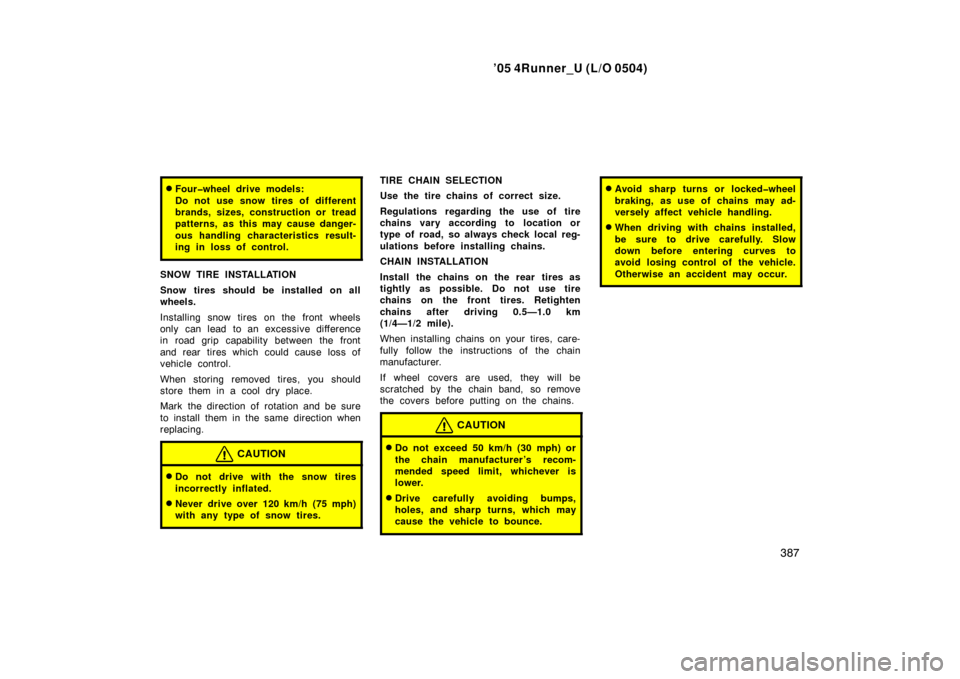
�Fourwheel drive models:
Do not use snow tires of different
brands, sizes, construction or tread
patterns, as this may cause danger-
ous handling characteristics result-
ing in loss of control.
SNOW TIRE INSTALLATION
Snow tires should be installed on all
wheels.
Installing snow tires on the front wheels
only can lead to an excessive difference
in road grip capability between the front
and rear tires which could cause loss of
vehicle control.
When storing removed tires, you should
store them in a cool dry place.
Mark the direction of rotation and be sure
to install them in the same direction when
replacing.
CAUTION
�Do not drive with the snow tires
incorrectly inflated.
�Never drive over 120 km/h (75 mph)
with any type of snow tires.
TIRE CHAIN SELECTION
Use the tire chains of correct size.
Regulations regarding the use of tire
chains vary according to location or
type of road, so always check local reg-
ulations before installing chains.
CHAIN INSTALLATION
Install the chains on the rear tires as
tightly as possible. Do not use tire
chains on the front tires. Retighten
chains after driving 0.5—1.0 km
(1/4—1/2 mile).
When installing chains on your tires, care-
fully follow the instructions of the chain
manufacturer.
If wheel covers are used, they will be
scratched by the chain band, so remove
the covers before putting on the chains.
CAUTION
�Do not exceed 50 km/h (30 mph) or
the chain manufacturer ’s recom-
mended speed limit, whichever is
lower.
�Drive carefully avoiding bumps,
holes, and sharp turns, which may
cause the vehicle to bounce.
�Avoid sharp turns or lockedwheel
braking, as use of chains may ad-
versely affect vehicle handling.
�When driving with chains installed,
be sure to drive carefully. Slow
down before entering curves to
avoid losing control of the vehicle.
Otherwise an accident may occur.
Page 406 of 426
’05 4Runner_U (L/O 0504)
396
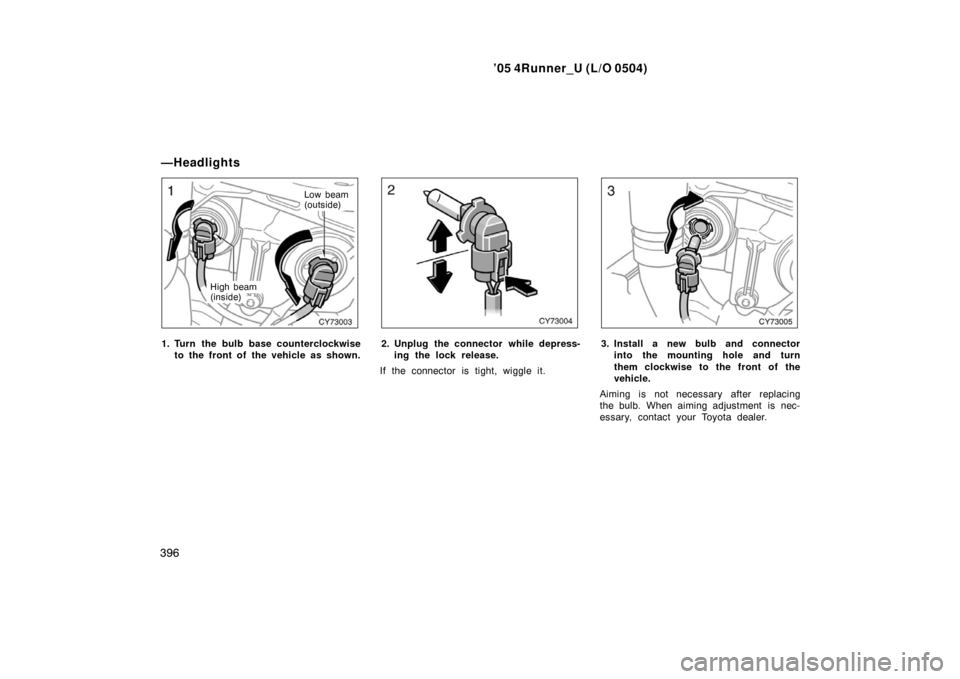
Low beam
(outside)
High beam
(inside)
1. Turn the bulb base counterclockwise to the front of the vehicle as shown.2. Unplug the connector while depress-ing the lock release.
If the connector is tight, wiggle it.3. Install a new bulb and connector into the mounting hole and turn
them clockwise to the front of the
vehicle.
Aiming is not necessary after replacing
the bulb. When aiming adjustment is nec-
essary, contact your Toyota dealer.
—Headlights
Page 407 of 426
’05 4Runner_U (L/O 0504)
397
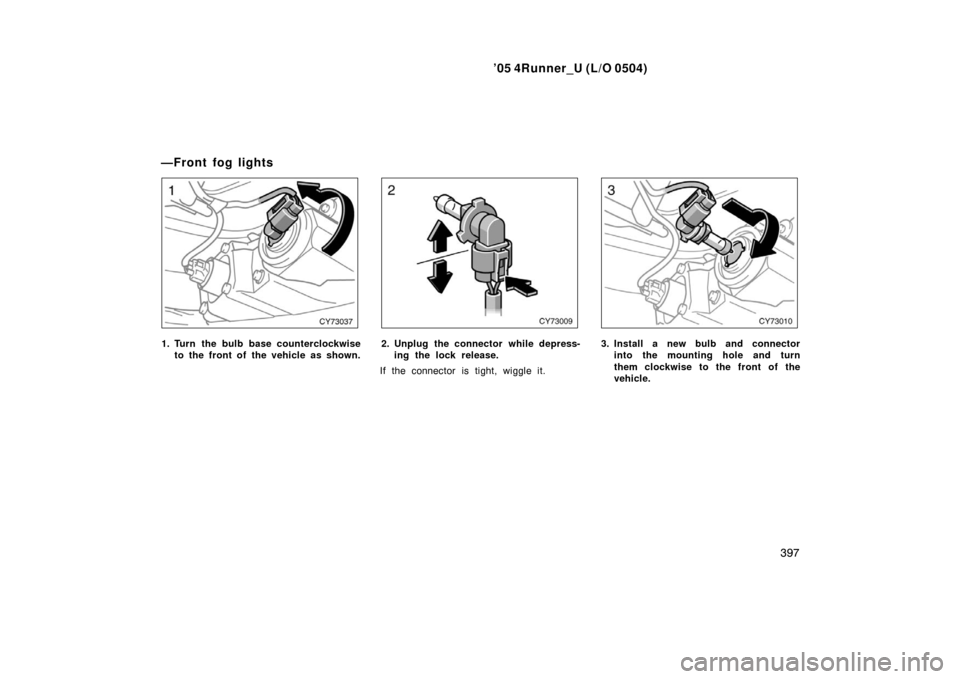
1. Turn the bulb base counterclockwise
to the front of the vehicle as shown.2. Unplug the connector while depress-ing the lock release.
If the connector is tight, wiggle it.3. Install a new bulb and connector into the mounting hole and turn
them clockwise to the front of the
vehicle.
—Front fog lights
Page 414 of 426

’05 4Runner_U (L/O 0504)
404
“Toyota Genuine Motor Oil” is used in
your Toyota vehicle. Use Toyota approved
“Toyota Genuine Motor Oil” or equivalent
to satisfy the following grade and
viscosity.
Oil grade:
API grade SL “Energy −Conserving” or
ILSAC multigrade engine oil
Recommended oil viscosity: SAE 5W −30
Outside temperature
Please contact your Toyota dealer for fur-
ther details. COOLING SYSTEM
Total capacity, L (qt., Imp. qt.):
1GR −FE engine 9.8 (10.4, 8.6)
2UZ− FE engine 12.3 (13,0, 10.8)
Coolant type:
“Toyota Super Long Life Coolant” is
used in your Toyota vehicle at factory
fill. In order to avoid technical problems,
only use “Toyota Super Long Life
Coolant” or similar high quality ethylene
glycol based non −silicate, non −amine,
non− nitrite, and non− borate coolant with
long− life hybrid organic acid technology.
(Coolant with long −life hybrid organic
acid technology is a combination of low
phosphates and organic acids.)
Do not use plain water alone.
Please contact your Toyota dealer for
further details.
BATTERY
Open voltage
∗ at 20 �C (68 �F):
12.6—12.8 V Fully charged
12.2—12.4 V Half charged
11.8—12.0 V Discharged
∗: Voltage that is checked 20 minutes af- ter the key is removed with all the
lights turned off
Charging rates: 5 A max. AUTOMATIC TRANSMISSION
Fluid capacity (drain and refill),
L (qt., Imp. qt.):
Up to 3.0 (3.2, 2.6)
Fluid type: Toyota Genuine ATF WS
Change automatic transmission fluid only
as necessary.
Generally, it is necessary to change
automatic transmission fluid only if your
vehicle is driven under one of the Special
Operating Conditions listed in your
“Scheduled Maintenance Guide” or
“Owner ’s Manual Supplement”. When
changing the automatic transmission fluid,
use only “Toyota Genuine ATF WS” (ATF
JWS3324 or NWS9638) to aid in assuring
optimum transmission performance.
Notice: Using automatic transmission
fluid other than “Toyota Genuine ATF
WS” may cause deterioration in shift
quality, locking up of your transmission
accompanied by vibration, and ultimate-
ly damage the automatic transmission
of your vehicle.
Please contact your Toyota dealer for fur-
ther details.