2005 SUBARU BAJA steering
[x] Cancel search: steeringPage 79 of 469

1-54
Seat, seatbelt and SRS airbags
avoid injuries that can result when the SRS air-
bag contacts an occupant not in proper posi-
tion such as one thrown toward the front of the
vehicle during pre-accident braking.
Do not put any objects over the steering wheel
pad and dashboard. If the SRS frontal airbag
deploys, those objects could interfere with its
proper operation and could be propelled inside
the vehicle and cause injury.
Do not attach accessories to the windshield, or
fit an extra-wide mirror over the rear view mir-
ror. If the SRS airbag deploys, those objects
could become projectiles that could seriously
injure vehicle occupants.
HS1085BA
HS1086BA
Page 81 of 469

1-56
Seat, seatbelt and SRS airbags
The SRS airbag can function only when the ignition
switch is in the “ON” position.
If the front sub sensors inside the both front fenders
and the impact sensors in the airbag control module
detect a certain predetermined amount of force during
a frontal collision, the control module sends signals to
the frontal airbag modules instructing them to inflate
the SRS frontal airbags. Then both airbag modules
produce gas, which instantly inflates driver’s and pas-
senger’s SRS frontal airbags. After the deployment,
the SRS airbags immediately start to deflate so that
the driver’s vision is not obstructed. The time required
from detecting impact to the deflation of the SRS air-
bag after deployment is shorter than the blink of aneye.
The front passenger’s SRS frontal airbag deploys to-
gether with driver’s SRS frontal airbag even when no
one occupies the front passenger’s seat.
When the SRS frontal airbags deploy, the driver’s and
front passenger’s seatbelt pretensioners operate at
the same time.
Although it is highly unlikely that the SRS airbag would
activate in a non-accident situation, should it occur,
the SRS airbag will deflate quickly, not obscuring vi-
sion and will not interfere with the driver’s ability to
maintain control of the vehicle.
When the SRS airbag deploys, a sudden, fairly loud
inflation noise will be heard and some smoke will be
released. These occurrences are normal result of the
deployment. This smoke does not indicate a fire in thevehicle.
Do not touch the SRS airbag system compo-
nents around the steering wheel and dash-
board with bare hands right after deployment.
Doing so can cause burns because the compo-
nents can be very hot as a result of deployment.
The SRS frontal airbag is designed to deploy in the
event of an accident involving a moderate to severe
frontal collision. It is basically not designed to deploy
in lesser frontal impacts because the necessary pro-
tection can be achieved by the seatbelt alone. Also, it
is basically not designed to deploy in side or rear im-
pacts or in roll-over accidents because deployment of
the SRS frontal airbag would not help the occupant in
those situations. The SRS airbag is designed to func-
tion on a one-time-only basis.
SRS airbag deployment depends on the level of force
Page 87 of 469

1-62
Seat, seatbelt and SRS airbags
low, we recommend that you have an autho-
rized SUBARU dealer perform the work. The
SRS airbag control module, impact sensors
and airbag modules are stored in these areas. y
Under the center console
y Inside each front fender
y Steering wheel and column and nearby areas
y Top of the dashboard on front passenger’s
side and nearby areas
y Inside each center pillar
In the event that the SRS airbag is deployed, re-
placement of the system should be performed
only by an authorized SUBARU dealer. When the
components of the SRS airbag system are re-
placed, use only genuine SUBARU parts.
To ensure their long-term reliability, the SRS airbags
must be inspected by a SUBARU dealer ten years af-
ter the date of manufacture, which is shown on the cer-
tification label attached to the driver’s door.
NOTE
In the following cases, contact your SUBARU deal-
er as soon as possible. y The front part of the vehicle was involved in an
accident in which the SRS frontal airbags did not deploy.y
The pad section of the steering wheel or front
passenger’s frontal airbag cover is scratched,
cracked, or otherwise damaged. „ Precautions against vehicle modifica- tion
yTo avoid accidental activation of the system
or rendering the system inoperative, which may
result in serious injury, no modifications
should be made to any components or wiring of
the SRS airbag system.
This includes following modifications:
yInstallation of custom steering wheels
y Attachment of additional trim materials to
the dashboard
y Installation of additional electrical/electronic
equipment such as a mobile two-way radio on
or near the SRS airbag system components
and/or wiring is not advisable. This could inter-
fere with proper operation of the SRS airbag
system.
Page 124 of 469

3-1
3
Instruments and controls
Ignition switch .............................................. 3-2 LOCK .................................................................. 3-2
ACC .................................................................... 3-3
ON ....................................................................... 3-3
START ................................................................ 3-4
Key reminder chime .......................................... 3-4
Ignition switch light (if equipped) .................... 3-4
Key interlock release (AT vehicles) ................. 3-4
Hazard warning flasher ................................ 3-5
Meters and gauges ....................................... 3-6 Speedometer ..................................................... 3-6
Odometer/Trip meter ........................................ 3-6
Tachometer ........................................................ 3-7
Outside temperature indicator (if equipped) .. 3-7
Fuel gauge ......................................................... 3-8
Temperature gauge ........................................... 3-8
Warning and indicator lights ....................... 3-9 Seatbelt warning light and chime .................... 3-9
SRS airbag system warning light .................... 3-10
CHECK ENGINE warning light/Malfunction indicator lamp ................................................. 3-10
Charge warning light ........................................ 3-11
Oil pressure warning light ................................ 3-12
AT OIL TEMPerature warning light (AT vehicles) ................................................... 3-12
ABS warning light ............................................. 3-12
Brake system warning light ............................. 3-13
Door ajar warning lights ................................... 3-14
Switchback door indicator light ...................... 3-14
Low fuel warning light ...................................... 3-14
All-Wheel Drive warning light (AT vehicles) ... 3-14 Security system status indicator light
(if equipped) .................................................... 3-15
Selector lever position indicator (AT vehicles) ................................................... 3-15
Gear position indicator (Turbo-AT vehicles) .. 3-16
Turn signal indicator lights .............................. 3-16
High beam indicator light ................................. 3-16
Cargo lamp indicator light ............................... 3-16
Cruise control set indicator light .................... 3-16
Clock .............................................................. 3-17
Light control switch ...................................... 3-18 Headlights ......................................................... 3-18
High/low beam change (dimmer) .................... 3-19
Headlight flasher ............................................... 3-19
Daytime running light system ......................... 3-20
Turn signal lever ........................................... 3-20
Illumination brightness control ................... 3-21
Parking light switch ...................................... 3-22
Fog light button ............................................. 3-23
Wiper and washer ......................................... 3-23 Windshield wiper and washer switches ......... 3-25
Rear window defogger button ..................... 3-26
Windshield wiper deicer (if equipped) ........ 3-27
Mirrors ............................................................ 3-28 Inside mirror ...................................................... 3-28
Outside mirrors ................................................. 3-30
Tilt steering wheel ......................................... 3-33
Horn ................................................................ 3-34
Page 125 of 469
3-2
Instruments and controls
Instruments and controlsIgnition switch
Never turn the ignition switch to “LOCK” while
the vehicle is being driven or towed because
that will lock the steering wheel, preventing
steering control. And when the engine is turned
off, it takes a much greater effort than usual to
steer.
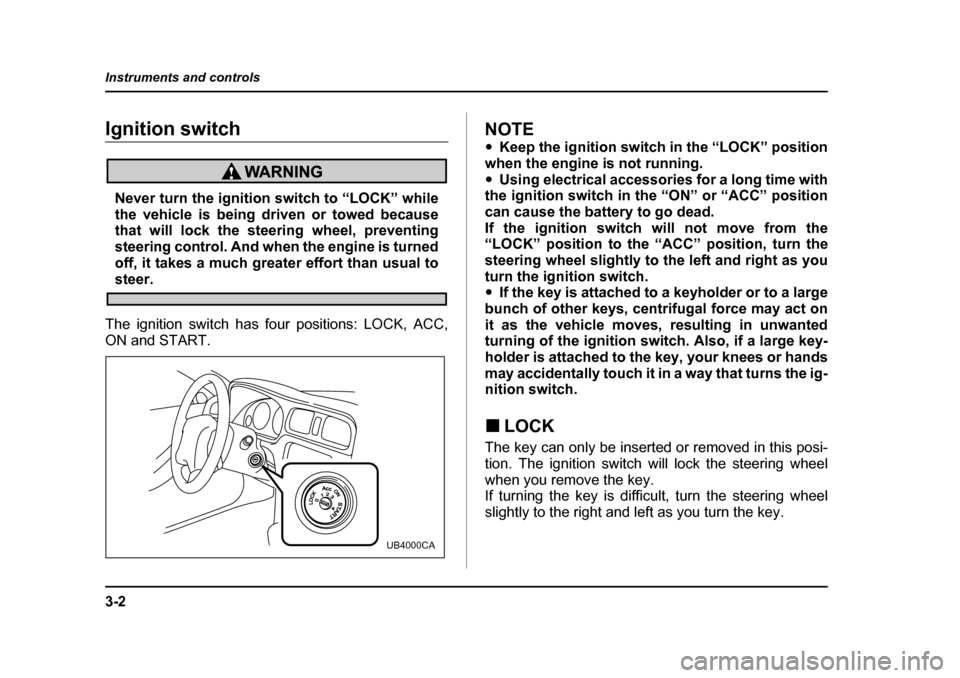
The ignition switch has four positions: LOCK, ACC,
ON and START.
NOTE y Keep the ignition switch in the “LOCK” position
when the engine is not running. y Using electrical accessories for a long time with
the ignition switch in the “ON” or “ACC” position
can cause the battery to go dead.
If the ignition switch will not move from the
“LOCK” position to the “ACC” position, turn the
steering wheel slightly to the left and right as you
turn the ignition switch. y If the key is attached to a keyholder or to a large
bunch of other keys, centrifugal force may act on
it as the vehicle moves, resulting in unwanted
turning of the ignition switch. Also, if a large key-
holder is attached to the key, your knees or hands
may accidentally touch it in a way that turns the ig-
nition switch. „ LOCK
The key can only be inserted or removed in this posi-
tion. The ignition switch will lock the steering wheel
when you remove the key.
If turning the key is difficult, turn the steering wheel
slightly to the right and left as you turn the key.
UB4000CA
Page 127 of 469
3-4
Instruments and controls
is started. „
START
Do not turn the ignition switch to the “START”position while the engine is running.
The engine is started in this position. The starter
cranks the engine to start it. When the key is released
(after the engine has started), the key automatically
returns to the “ON” position. „ Key reminder chime
The reminder chime sounds when the driver’s door
opens and the key is in the “LOCK” or “ACC” positions.
The chime stops when the key is removed from the ig-
nition switch. „ Ignition switch light (if equipped)
For easy access to the ignition switch in the dark, the
ignition switch light comes on when driver’s door is
opened. The light remains on for 10 seconds and goes
out after driver’s door is closed or if the key is turned to the “ON” position. „
Key interlock release (AT vehicles)
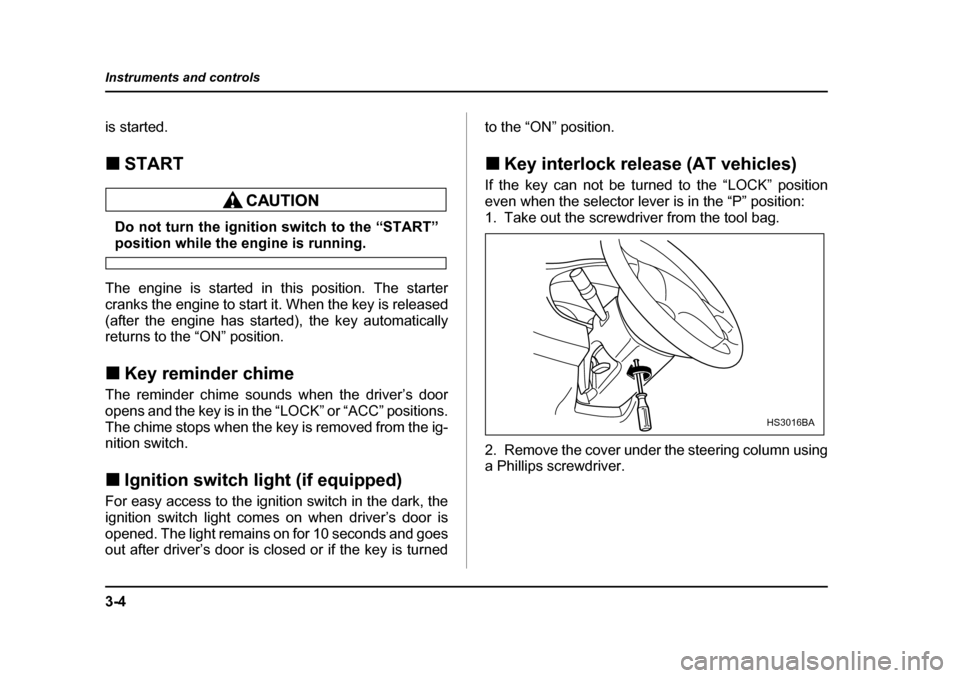
If the key can not be turned to the “LOCK” position
even when the selector lever is in the “P” position:
1. Take out the screwdriver from the tool bag.
2. Remove the cover under the steering column using
a Phillips screwdriver.
HS3016BA
Page 156 of 469
3-33
Instruments and controls
– CONTINUED –
Tilt steering wheel
Do not adjust the steering wheel tilt position
while driving. This may cause loss of vehicle
control and result in personal injury.
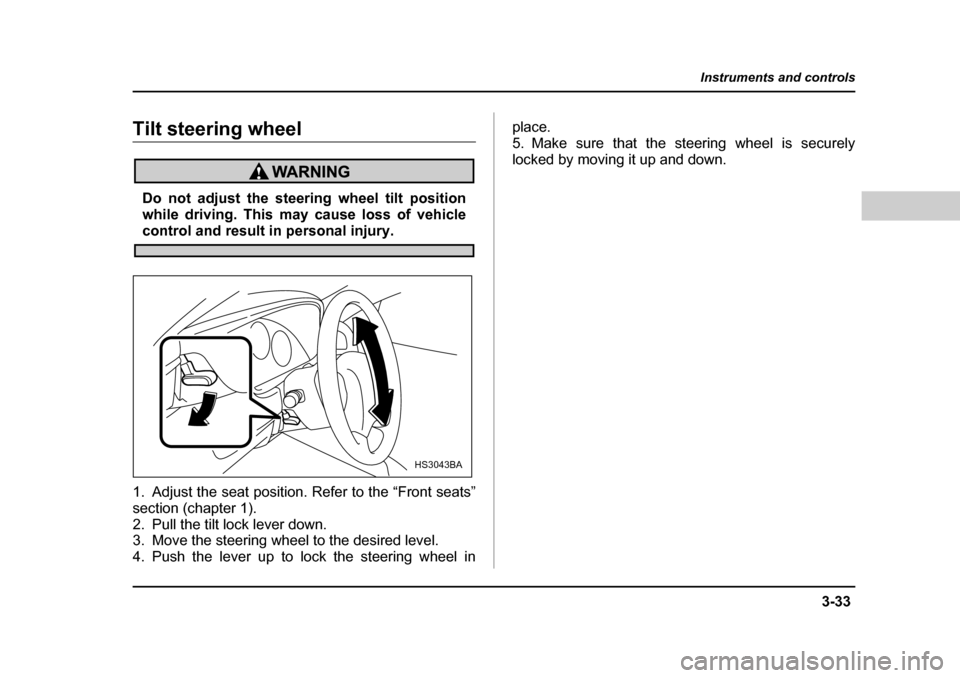
1. Adjust the seat position. Refer to the “Front seats”
section (chapter 1).
2. Pull the tilt lock lever down.
3. Move the steering wheel to the desired level.
4. Push the lever up to lock the steering wheel in place.
5. Make sure that the steering wheel is securely
locked by moving it up and down.
HS3043BA
Page 236 of 469

7-1
7
Starting and operating
Fuel ................................................................ 7-2 Fuel requirements ............................................. 7-2
Fuel filler door and cap .................................... 7-4
State emission testing (U.S. only) ............... 7-7
Preparing to drive ......................................... 7-9
Starting the engine ....................................... 7-9 Manual transmission vehicle ........................... 7-9
Automatic transmission vehicle ...................... 7-10
Stopping the engine ..................................... 7-12
Manual transmission .................................... 7-12 Shifting speeds ................................................. 7-13
Driving tips ........................................................ 7-14
Automatic transmission (Non-turbo models) ................................... 7-15Selector lever .................................................... 7-16
Driving tips ........................................................ 7-19
Shift lock release .............................................. 7-20
Automatic transmission (Turbo models) ... 7-21 Selector lever .................................................... 7-22
Selector lever reverse inhibiting function ...... 7-25
Selection of SPORTSHIFT mode (manual mode) ................................................ 7-27
Driving tips ........................................................ 7-29
Shift lock release .............................................. 7-30
Limited slip differential (LSD) ...................... 7-31
Power steering .............................................. 7-31
Braking .......................................................... 7-32 Braking tips ....................................................... 7-32
Brake system ..................................................... 7-32 Disc brake pad wear warning indicators ........ 7-33
ABS (Anti-lock Brake System) ..................... 7-33 ABS system self-check .................................... 7-34
ABS warning light ............................................. 7-34
Parking your vehicle ..................................... 7-36
Cruise control ................................................ 7-38 To set cruise control ........................................ 7-38
To temporarily cancel the cruise control ....... 7-39
To turn off the cruise control ........................... 7-40
To change the cruising speed ......................... 7-40
Cruise control set indicator light .................... 7-41