2005 SUBARU BAJA brake light
[x] Cancel search: brake lightPage 233 of 469
6-30
Interior and exterior equipments
Sport activity lights (if equipped)
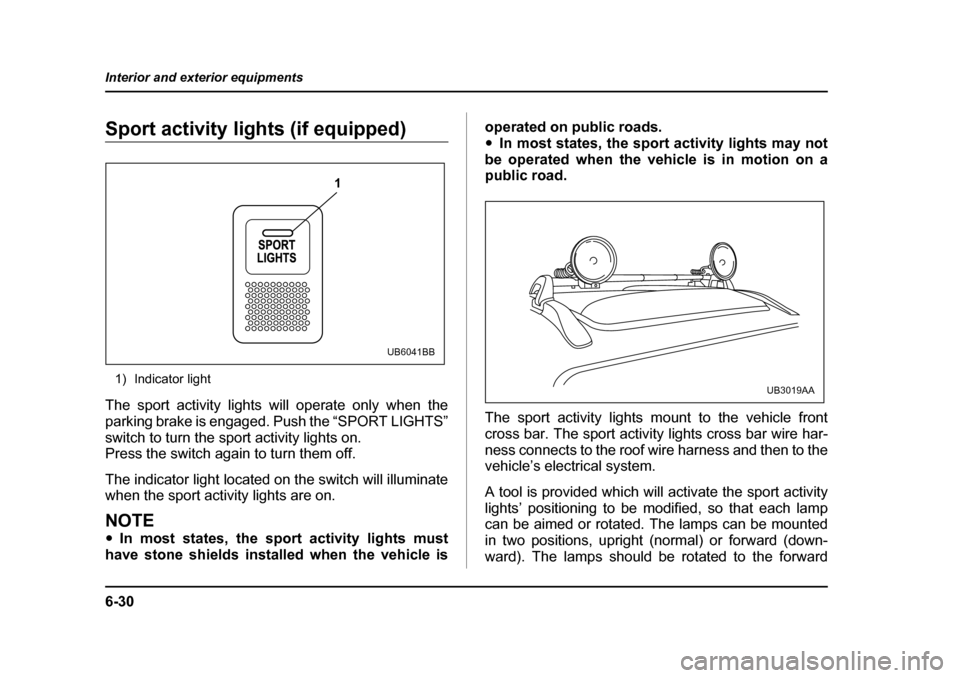
1) Indicator light
The sport activity lights will operate only when the
parking brake is engaged. Push the “SPORT LIGHTS”
switch to turn the sport activity lights on.
Press the switch again to turn them off.
The indicator light located on the switch will illuminate
when the sport activity lights are on.
NOTE y In most states, the sport activity lights must
have stone shields installed when the vehicle is operated on public roads. y
In most states, the sport activity lights may not
be operated when the vehicle is in motion on a
public road.
The sport activity lights mount to the vehicle front
cross bar. The sport activity lights cross bar wire har-
ness connects to the roof wire harness and then to the
vehicle’s electrical system.
A tool is provided which will activate the sport activity
lights’ positioning to be modified, so that each lamp
can be aimed or rotated. The lamps can be mounted
in two positions, upright (normal) or forward (down-
ward). The lamps should be rotated to the forward
1
UB6041BB
UB3019AA
Page 236 of 469

7-1
7
Starting and operating
Fuel ................................................................ 7-2 Fuel requirements ............................................. 7-2
Fuel filler door and cap .................................... 7-4
State emission testing (U.S. only) ............... 7-7
Preparing to drive ......................................... 7-9
Starting the engine ....................................... 7-9 Manual transmission vehicle ........................... 7-9
Automatic transmission vehicle ...................... 7-10
Stopping the engine ..................................... 7-12
Manual transmission .................................... 7-12 Shifting speeds ................................................. 7-13
Driving tips ........................................................ 7-14
Automatic transmission (Non-turbo models) ................................... 7-15Selector lever .................................................... 7-16
Driving tips ........................................................ 7-19
Shift lock release .............................................. 7-20
Automatic transmission (Turbo models) ... 7-21 Selector lever .................................................... 7-22
Selector lever reverse inhibiting function ...... 7-25
Selection of SPORTSHIFT mode (manual mode) ................................................ 7-27
Driving tips ........................................................ 7-29
Shift lock release .............................................. 7-30
Limited slip differential (LSD) ...................... 7-31
Power steering .............................................. 7-31
Braking .......................................................... 7-32 Braking tips ....................................................... 7-32
Brake system ..................................................... 7-32 Disc brake pad wear warning indicators ........ 7-33
ABS (Anti-lock Brake System) ..................... 7-33 ABS system self-check .................................... 7-34
ABS warning light ............................................. 7-34
Parking your vehicle ..................................... 7-36
Cruise control ................................................ 7-38 To set cruise control ........................................ 7-38
To temporarily cancel the cruise control ....... 7-39
To turn off the cruise control ........................... 7-40
To change the cruising speed ......................... 7-40
Cruise control set indicator light .................... 7-41
Page 244 of 469
7-9
Starting and operating
– CONTINUED –
Preparing to drive
You should perform the following checks and adjust-
ments every day before you start driving.
1. Check that all windows, mirrors, and lights are
clean and unobstructed.
2. Check the appearance and condition of the tires.
Also check tires for proper inflation.
3. Look under the vehicle for any sign of leaks.
4. Check that the hood is fully closed.
5. Check the adjustment of the seat.
6. Check the adjustment of the inside and outside mir-
rors.
7. Fasten your seatbelt. Check that your passengers
have fastened their seatbelts.
8. Check the operation of the warning and indicator
lights when the ignition switch is turned to the “ON” po-sition.
9. Check the gauges, indicator and warning lights af-
ter starting the engine.
NOTE
Engine oil, engine coolant, brake fluid, washer flu-
id and other fluid levels should be checked daily,
weekly or at fuel stops.
Starting the engine
Do not operate the starter motor continuously
for more than ten seconds. If the engine fails to
start after operating the starter for five to ten
seconds, wait for ten seconds or more before
trying again.
„ Manual transmission vehicle
1. Apply the parking brake.
2. Turn off unnecessary lights and accessories.
3. Press the clutch pedal to the floor and shift the shift
lever into neutral.
Hold the clutch pedal to the floor while starting the en-
gine. The starter motor will only operate when the
clutch pedal is pressed fully to the floor.
4. Turn the ignition switch to the “ON” position and
check the operation of the warning and indicator lights.
Refer to the “Warning and indicator lights” section(chapter 3).
5. Turn the ignition switch to the “START” position
without depressing the accelerator pedal. Release
the key immediately after the engine has started.
Page 245 of 469
7-10
Starting and operating
If the engine does not start, try the following:
1) Turn the ignition switch to the “OFF” position and
wait for at least 10 seconds. After checking that the
parking brake is firmly set, turn the ignition switch to
the “START” position while depressing the acceler-
ator pedal slightly (about a quarter of the full stroke).
Release the accelerator pedal as soon as the en-
gine starts.
2) If this fails to start the engine, turn the ignition
switch back to the “OFF” position and wait for at
least 10 seconds. Then fully depress the accelerator
pedal and turn the ignition switch to the “START”
position. If the engine starts, quickly release the ac-
celerator pedal.
3) If this fails to start the engine, turn the ignition
switch again to the “OFF” position. After waiting for
10 seconds or longer, turn the ignition switch to the
“START” position without depressing the accelera-
tor pedal.
4) If the engine still refuses to start, contact your
nearest SUBARU dealer for assistance.
6. Confirm that all warning and indicator lights have
gone off after the engine has started. The fuel injection
system automatically lowers the idle speed as the en-
gine warms up.
NOTE (Turbo models)
The engine may be difficult to start when the bat- tery has been disconnected and reconnected (for
maintenance or other purposes). This difficulty is
caused by the electronically controlled throttle’s
self-diagnosis function. To overcome it, keep the
ignition switch in the “ON” position for approxi-
mately 10 seconds before starting the engine. „
Automatic transmission vehicle
If you restart the engine while the vehicle is
moving, shift the selector lever into the “N” po-
sition. Do not attempt to place the selector lever
of a moving vehicle into the “P” position.
1. Apply the parking brake.
2. Turn off unnecessary lights and accessories.
3. Shift the selector lever to the “P” or “N” position
(preferably “P” position). The starter will only operate
when the select lever is at the “P” or “N” position.
4. Turn the ignition switch to the “ON” position and
check the operation of the warning and indicator lights.
Refer to the “Warning and indicator lights” section
(chapter 3).
5. Turn the ignition switch to the “START” position
Page 246 of 469
7-11
Starting and operating
– CONTINUED –
without depressing the accelerator pedal. Release
the key immediately after the engine has started.
If the engine does not start, try the following: 1) Turn the ignition switch to the “OFF” position and
wait for at least 10 seconds. After checking that the
parking brake is firmly set, turn the ignition switch to
the “START” position while depressing the acceler-
ator pedal slightly (about a quarter of the full stroke).
Release the accelerator pedal as soon as the en-
gine starts.
2) If this fails to start the engine, turn the ignition
switch back to the “OFF” position and wait for at
least 10 seconds. Then fully depress the accelerator
pedal and turn the ignition switch to the “START”
position. If the engine starts, quickly release the ac-
celerator pedal.
3) If this fails to start the engine, turn the ignition
switch again to the “OFF” position. After waiting for
10 seconds or longer, turn the ignition switch to the
“START” position without depressing the accelera-
tor pedal.
4) If the engine still refuses to start, contact your
nearest SUBARU dealer for assistance.
6. Confirm that all warning and indicator lights have
gone out after the engine has started. The fuel injec-
tion system automatically lowers the idle speed as the
engine warms up. While the engine is warming up, make sure that the
selector lever is at the “P” or “N” position and that the
parking brake is applied.
NOTE (Turbo models)
The engine may be difficult to start when the bat-
tery has been disconnected and reconnected (for
maintenance or other purposes). This difficulty is
caused by the electronically controlled throttle’s
self-diagnosis function. To overcome it, keep the
ignition switch in the “ON” position for approxi-
mately 10 seconds before starting the engine.
Page 252 of 469
7-17
Starting and operating
– CONTINUED –
A shift interlock function is employed in the automatic
transmission system to ensure safe starting of the ve-
hicle.
To shift the selector lever from the “P” to the any other
position, you have to depress the brake pedal fully
when the ignition switch is in the “ON” position. This
prevents the vehicle from lurching when it is started.
If the shift lever does not move from the “P” position
with the brake pedal depressed, refer to the “Shift lock
release” section in this chapter. TR (Reverse)
This position is for backing the vehicle.
To shift from “N” to “R” position, first stop the vehicle
completely then move the lever to “R” position. T N (Neutral)
Do not drive the vehicle with the selector lever
in the “N” (neutral) position. Engine braking
has no effect in this condition and the risk of an
accident is consequently increased.
This position is for restarting a stalled engine. In this position the wheels and transmission are not
locked. In this position, the transmission is neutral; the
vehicle will roll freely, even on the slightest incline un-
less the parking brake or foot brake is on.
Avoid coasting with the transmission neutral.
During coasting, the engine braking does not act. T
D (Drive)
This position is for normal driving.
The transmission automatically shifts into a suitable
gear from 1st to 4th according to the vehicle speed
and the acceleration you require.
When more acceleration is required in this position,
press the accelerator pedal fully to the floor and hold
that position. The transmission will automatically
downshift to 3rd, 2nd or 1st gear. When you release
the pedal, the transmission will return to the original
gear position. V While climbing a grade
When driving up a hill, undesired upshift to 4th gear is
prevented from taking place when the accelerator is
released. This minimizes the chance of subsequent
downshifting to a lower gear when accelerating again.
This prevents repeated upshifting and downshifting re-
sulting in a smoother operation of the vehicle.
Page 259 of 469
7-24
Starting and operating
T
N (Neutral)
Do not drive the vehicle with the selector lever
in the “N” (neutral) position. Engine braking
has no effect in this condition and the risk of an
accident is consequently increased.
This position is for restarting a stalled engine.
In this position the wheels and transmission are not
locked. In this position, the transmission is neutral; the
vehicle will roll freely, even on the slightest incline un-
less the parking brake or foot brake is on.
Avoid coasting with the transmission neutral.
During coasting, there is no engine braking effect.
NOTE
If the selector lever is in the “N” position when you
stop the engine for parking, you may not subse-
quently be able to move it to the “R” and “P” posi- tions. If this happens, turn the ignition switch to
the “ON” position. You will then be able to move
the selector lever to the “P” position. T D (Drive)
This position is for normal driving. The transmission automatically shifts into a suitable
gear from 1st to 4th according to the vehicle speed
and the acceleration you require.
When more acceleration is required in this position,
press the accelerator pedal fully to the floor and hold
that position. The transmission will automatically
downshift to 3rd, 2nd or 1st gear. When you release
the pedal, the transmission will return to the original
gear position.
To use the SPORTSHIFT mode, move the lever from
this position into the manual gate. V
While climbing a grade
When driving up a hill, undesired upshift to 4th gear is
prevented from taking place when the accelerator is
released. This minimizes the chance of subsequent
downshifting to a lower gear when accelerating again.
This prevents repeated upshifting and downshifting re-
sulting in a smoother operation of the vehicle.
NOTE
The transmission may downshift to 2nd or 1st
gear, depending on the way the accelerator pedal
is pressed to accelerate the vehicle again. V While going down a hill
When descending a steep hill, depressing the brake
pedal will cause the transmission to downshift to 3rd
Page 267 of 469
7-32
Starting and operating
Braking „
Braking tips
Never rest your foot on the brake pedal while
driving. This can cause dangerous overheating
of the brakes and needless wear on the brake
pads and linings.
T When the brakes get wet
When driving in rain or after washing the vehicle, the
brakes may get wet. As a result, brake stopping dis-
tance will be longer. To dry the brakes, drive the vehi-
cle at a safe speed while lightly depressing the brake
pedal to heat up the brakes. T Use of engine braking
Remember to make use of engine braking in addition
to foot braking. When descending a grade, if only the
foot brake is used, the brakes may start working im-
properly because of brake fluid overheating, caused
by overheated brake pads. To help prevent this, shift
into a lower gear to get stronger engine braking. T
Braking when a tire is punctured
Do not depress the brake pedal suddenly when a tire
is punctured. This could cause a loss of control of the
vehicle. Keep driving straight ahead while gradually
reducing speed. Then slowly pull off the road to a safe
place. „ Brake system
T Two separate circuits
Your vehicle has a dual circuit brake systems. Each
circuit works diagonally across the vehicle. If one cir-
cuit of the brake system should fail, the other half of
the system still works. If one circuit fails, the brake
pedal will go down much closer to the floor than usual
and you will need to press it down much harder. And a
much longer distance will be needed to stop the vehi- cle. T Brake booster
The brake booster uses engine manifold vacuum to
assist braking force. Do not turn off the engine while
driving because that will turn off the brake booster, re-
sulting in poor braking power.
The brakes will continue to work even when the brake
booster completely stops functioning. If this happens,
however, you will have to push the pedal much harder