2005 SKODA OCTAVIA weight
[x] Cancel search: weightPage 185 of 315

Seat belts
184
The physical principle of a frontal
collision
The physical principle of a frontal accident can be explained quite simply: Motion energy, so-called kinetic energy, is produced as soon as the
vehicle is moving, both for the vehicle and its occupants. The magnitude
of this kinetic energy depends essentially on the speed at which the
vehicle is travelling and on the weight of the vehicle and the occupants.
The greater the speed and weight increase, the greater the amount of
energy which has to be absorbed in the event of an accident.
The speed of the vehicle is, nevertheless, the most important factor.
Doubling the speed of the vehicle from 25 km/h up to 50 km/hour
increases the kinetic energy four times.
The common opinion that it is possible to support your body in a minor
accident with your hands, is incorrect. Even in a collision at only a low
speed, the forces acting on the body are such that it is no longer possible
to support your body.
Even if you only drive at a speed within the range from 30 km/hour to 50
km/hour, the forces which are produced on your body in the event of an
accident can easily exceed 10,000 N (Newton). This equals a weight of
one tonne (1 000 kg).
In the event of a frontal collision, occupants of the car not wearing a seat
belt, are thrown forward and strike in an uncontrolled way parts of the inte-
rior of the car, such as steering wheel, dash panel, windscreen,
⇒fig. 155 .
The occupants of a vehicle who have not fastened their seat belts may
even be thrown out of the vehicle. This can result in fatal injuries.
It is also important that rear seat occupants fasten their seat belts as they
will otherwise be thrown through the vehicle in an uncontrolled manner in
the event of an accident A rear seat passenger who has not fastened the
seat belt is a danger not only to himself but also for those seated at the
front ⇒fig. 156 .
Fig. 155 The driver is
thrown forward if not
wearing a belt
Fig. 156 The rear seat
occupant is thrown
forward if not wearing a
belt
s24s.book Page 184 Thursday, November 24, 2005 12:27 PM
Page 203 of 315

Transporting children safely
202
Transporting children safely
What you should know about
transporting children!
An introduction to the subject
Accident statistics have revealed that children are gener-
ally more safely transported on the rear seats than on the
front passenger seat.
Children younger than 12 years of age should normally travel on the rear
seat of the vehicle (take note of any national legal provisions which differ
from this). They should be secured there by means of a child restraint
system or by using the existing seat belts depending on their age, body
size and weight. The child seat should be mounted behind the front
passenger seat for safety reasons.
The physical principle of an accident does, of course, also apply to chil-
dren ⇒page 184, “The physical principle of a frontal collision”. They differ
from adults in that their muscles and bone structure of children are not yet
fully developed. Thus children are exposed to increased risk of injury.
Children should be transported by using special child safety seats in order
to reduce this risk of injury.
Use only child safety seats which are officially approved and are suitable
for children and which comply with the ECE-R 44 Standard, which classi-
fies child safety seats into 5 groups ⇒page 206, “Classification of child
seats into groups”. Child restraint systems which have been tested for
conformity with ECE-R 44 have a non-detachable test seal (a large E
within a circle and below this the test number) attached to the seat. We recommend that you use child safety seats from the Škoda genuine
accessories. These child seats were developed and also tested for use in
Škoda vehicles. They fulfil the standard ECE-R 44.
WARNING
Always comply with legal provisions and instructions from the
relevant child safety seat manufacturer when installing and using
the child seat
⇒ in “Important safety information on using child
safety seats”.
Note
Any varying national legal regulations take priority over the information
provided in these instructions for use, or stated in this chapter.
Important safety informat ion on using child safety
seats
Correct use of child safety seats considerably reduces the
risk of injury!
WARNING
•All the occupants of the car - in particular children - must wear
a seat belt when the car is moving.
•Children less than 1.50 m in height or younger than 12 years
must not use a normal seat belt without a child restraint system
s24s.book Page 202 Thursday, November 24, 2005 12:27 PM
Page 207 of 315

Transporting children safely
206
•Do not place any objects within the deployment area of the side
airbag - risk of injury!
Child seat
Classification of child seats into groups
Only child safety seats which have an official approval and
are suitable for the child, may be used.
ECE-R 44 standard applies to child safety seats. ECE-R means:
Economic Commission of Europe - Regulation.
Child safety seats which have been tested for conformity with ECE-R 44
have a non-detachable test seal (a large E within a circle and below this
the test number) attached to the seat.
Child safety seats are classified in 5 groups:
Children of more than 150 cm in height may use the seat belts fitted to the
vehicle without a seat bolster.
Use of child seats
An overview of the usefulness of child seats on each of the seats
according to the EG guidelines 77/541 and ECE 44 standard:
Universal category - seat is suitable for all approved types of child
safety seats.
The seat can be fitted with fixing eyes for the “ ISOFIX system*”.
GroupWeight
00 - 10 kg⇒page 207
0+up to 13 kg⇒page 207
19 - 18 kg⇒page 207
215 - 25 kg⇒page 208
322 - 36 kg⇒page 209
WARNING (continued)
Child seat
groupsFront passenger seatRear seatoutsideRear seat middle
0
0+
1
2 and 3
AUA+AUA+AU
AUA+AUA+AU
AUA+AUA+AU
AUAUAU
AU
A+
s24s.book Page 206 Thursday, November 24, 2005 12:27 PM
Page 209 of 315
Transporting children safely
208
Child seats in Group 1 are for babies and small children up to 4 years of
age with a weight of between 9 and 18 kilograms. It is best for children in
the lower range of this group, to use a child seat which allows the child to
sit with its back to the direction of travel. It is best for children in the upper
range of the Group 0+, to use a child seat which allows the child to sit
⇒ page 207, fig. 175 in the direction of travel.
Child safety seats in which the child is seated with its back facing the
direction of travel, must not be used on the front passenger seat
⇒ page 204, “Use of child safety seats on the front passenger seat”.
WARNING
•It is essential to always switch off the front passenger airbag
(airbags) when attaching in exceptional circumstances a child
safety seat on the front passenger seat where the child is seated
with its back facing in direction of travel (in some countries also
when the child is facing the direction of travel).
−in a specialist garage
− or by using the switch for the front passenger airbag*
⇒ page 200.
•In certain countries national legal provisions require that
besides the front airbag also the side or head airbags are deacti-
vated. Please comply with any di ffering national legal regulations
regarding the use of child safety seats.
•If this is not done, a child seated on the front passenger seat
may suffer severe or even fatal injuries if the front passenger
airbag or airbags are deployed.
•You should have the front passenger airbag (or airbags) reacti-
vated by your Škoda dealer just as soon as you no longer use a
child safety seat on the front passenger seat.
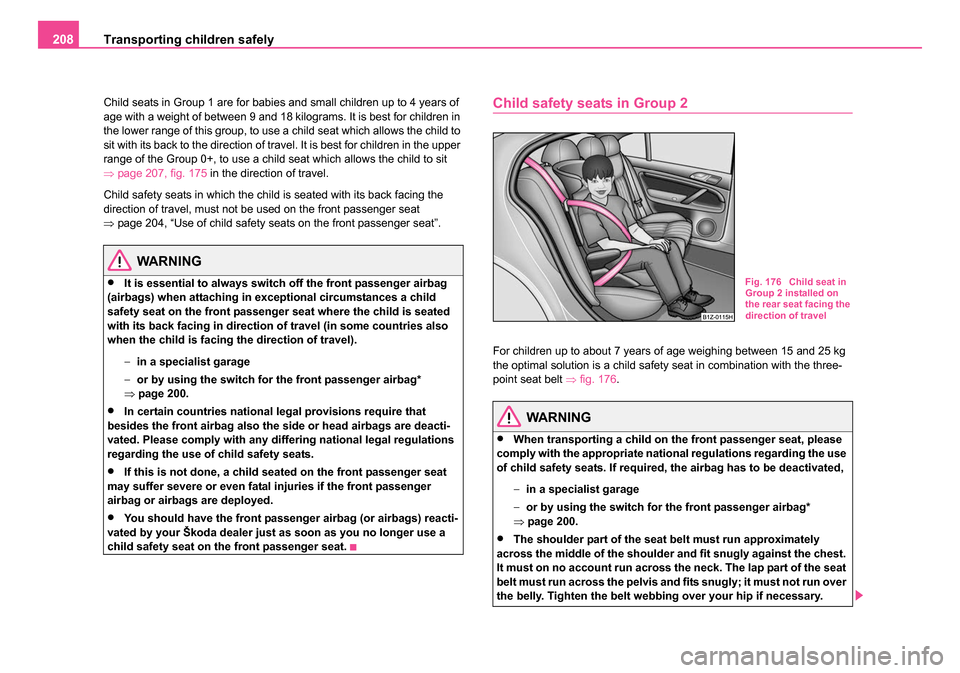
Child safety seats in Group 2
For children up to about 7 years of age weighing between 15 and 25 kg
the optimal solution is a child safety seat in combination with the three-
point seat belt ⇒fig. 176 .
WARNING
•When transporting a child on the front passenger seat, please
comply with the appropriate national regulations regarding the use
of child safety seats. If required, the airbag has to be deactivated,
−in a specialist garage
− or by using the switch for the front passenger airbag*
⇒ page 200.
•The shoulder part of the seat belt must run approximately
across the middle of the shoulder and fit snugly against the chest.
It must on no account run across the neck. The lap part of the seat
belt must run across the pelvis and fits snugly; it must not run over
the belly. Tighten the belt webbing over your hip if necessary.
Fig. 176 Child seat in
Group 2 installed on
the rear seat facing the
direction of travel
s24s.book Page 208 Thursday, November 24, 2005 12:27 PM
Page 227 of 315

Driving and the Environment
226
Avoid driving short distances
Short distances result in an above-average high fuel
consumption.
– Avoid driving a distance of no more than 4 km if the engine is
cold.
The engine and catalytic converter must first have reached their optimal
operating temperature in order to effectively reduce fuel consumption
and pollutant emissions.
The cold engine vehicle consumes approx. 15 - 20 litres/100 km of fuel
immediately after starting. Fuel consumption drops to 10 litres/100 km
after just 1 kilometre. The engine reaches its operating temperature
(outside temperature and engine dependent) only after about 4 to 10 kilo-
metres and the fuel consumption then stabilizes. You should therefore
avoid driving short distances whenever possible. An important factor in this connection is also the
ambient temperature.
The ⇒fig. 185 shows the different fuel consumptions for the same
distance, on the one hand at +20°C and on the other hand at -10°C. Your
vehicle has a higher fuel consumption in winter than in summer.
Checking tyre inflation pressures
Tyres which are correctly inflated save fuel.
Always ensure that your tyres are inflated to the correct pressure at all
times. The rolling resistance will be increased if the tyre filling pressure is
too low. This will not only increase fuel consumption but also tyre wear
and the driving behaviour will worsen.
Always check the inflation pressure of the tyres when cold.
Do not drive with winter tyres all year round for this costs about 10 %
more fuel. Winter tyres are also louder.
No unnecessary ballast
Transporting ballast costs fuel.
The fact that every kilogram of extra weight increases your fuel
consumption means that it is worth taking a look in the luggage compart-
ment to avoid transporting any unnecessary ballast.
It is particularly in town trafffic, when one is accelerating quite often, that
the vehicle weight will have a significant effect upon the fuel consumption.
A rule of thumb here is that an increase in weight of 100 kilograms will
cause an increase in fuel consumption of about 1 litre/100 kilometres.
You may frequently also leave a roof rack fitted on just out of conven-
ience, although you no longer need it. The increased aerodynamic drag of
Fig. 185 Fuel
consumption in
litres/100 km at
different temperatures
s24s.book Page 226 Thursday, November 24, 2005 12:27 PM
Page 230 of 315

Towing a trailer229
Using the systemSafetyDriving TipsGeneral MaintenanceBreakdown assistanceTechnical Data
Towing a trailer
Towing a trailer
Technical requirements
The towing device must satisfy certain technical require-
ments.
Your vehicle is designed primarily for transporting persons and luggage.
It can, however, also be used for towing a trailer - provided certain tech-
nical equipment is fitted.
If your vehicle has already been supplied with a factory-fitted towing
device then everything that is necessary for towing a trailer in technical
terms, and in terms of the law, has already been taken into account.
Your vehicle is fitted with a 13-pin power socket for the electrical connec-
tion between the vehicle and trailer. If the trailer which you wish to tow has
a 7-pin connector , you can use a suitable adapter
10) from Škoda original
accessories.
This work must be carried out in accordance with the manufacturer's
specifications if a towing device is retrofitted.
Škoda dealers are familiar with details relating to retrofitting a towing
device and for any necessary modifications to the cooling system.
WARNING
We recommend that you have the towing device from Škoda orig-
inal accessories installed by a Škoda dealer. He is familiar with all
the relevant details relating to retrofitting such equipment. There is
a risk of an accident if the towing device is not properly fitted!
General Maintenance
There are a number of points to pay attention to when
towing a trailer.
Tr a i l e r l o a d
The permissible trailer load must on no account be exceeded.
You can negotiate appropriately steeper inclines and descents if you do
not make full use of the permissible trailer load.
The trailer loads specified only apply for altitudes up to 1 000 metres
above mean sea level. The fact that the engine power output drops with
increasing height due to a lowering of air pressure and thus the ability to
climb, means that the towed weight must be reduced by 10% for every
further increase of 1 000 metres in height above sea level. The towed
weight is the weight of the (laden) vehicle and the (laden) trailer together.
One should take this into account before driving up to higher altitudes.
The trailer and drawbar load information on the type plate of the
towing device are merely test data for the towing device The data
relating to your vehicle, which is often less than this test data, can
be found in your vehicle registration documents or in the brochure -
Technical Data .
10)In some countires the adapter is supplied with the towing device.
s24s.book Page 229 Thursday, November 24, 2005 12:27 PM
Page 231 of 315

Towing a trailer
230
Distribution of the load
Distribute the load in the trailer in such a way that any heavy items are
located as close as possible to the axle. Secure the items to prevent them
slipping.
Tyre inflation pressure
Select the tyre inflation pressure on your vehicle for that of “fully laden”,
⇒ page 264. The inflation pressure of the tyres fitted to the trailer adjust in
accordance with the manufacturer's recommendation.
Exterior mirrors
You have to have additional exterior mirrors fitted if you are not able to see
the traffic behind the trailer with the standard rear-view mirrors. Both exte-
rior mirrors should be attached to folding arms. Adjust the mirrors so that
they provide you with an adequate field of view to the rear.
Headlights
Before starting off with a hitched trailer, also check the setting of the head-
lights. Alter the setting as necessary with the aid of the headlight beam
adjuster ⇒page 67.
Detachable ball head
The ball rod is detachable on vehicles which feature a factory-fitted towing
device. It is stowed together with separate fitting instructions in the spare
wheel well in the luggage compartment of the vehicle.
Further information on the towing device ⇒page 231.
Note
•We recommend that you also have your vehicle inspected between
service intervals if you tow a trailer frequently.
•The handbrake on the towing vehicle must be put on when coupling
and decoupling the trailer.
Driving Tips
Particular caution is required when towing a trailer.
– Do not, as far as possible, drive with your vehicle unladen and the trailer laden.
– Do not make full use of the legal maximum speeds. This applies in particular to downhill sections.
– Apply the brakes in good time.
– Keep a check on the coolant temperature gauge if the outside temperature is high.
Distribution of weight
The distribution of the weight is very poor if your vehicle is unladen and
the trailer is laden. Maintain a particularly low speed if you cannot avoid
driving with this combination.
Driving speed
Do not drive faster than 80 km/hour for safety reasons. This also applies
for countries in which higher speeds are allowed.
The fact that the driving stability of the vehicle + trailer combination
reduces with increasing speed means that the legally allowed speed
should not be used when there are unfavourable road, weather or wind
conditions, particularly near accident black spots.
You must always reduce your speed immediately as soon as you detect
even just the slightest swaying of the trailer. On no account attempt to
stop the trailer from “swaying” by accelerating.
Apply the brakes in good time! If the trailer is fitted with a trailer brake ,
apply the brakes gently at first, then brake firmly. This will avoid brake jolts
resulting from the trailer wheels locking. Shift down gears in good time
s24s.book Page 230 Thursday, November 24, 2005 12:27 PM