2005 Seat Ibiza 5D brake
[x] Cancel search: brakePage 92 of 252
Lights and visibility
90
For the sake of the environmentThe rear window heater should be disconnected as soon as the glass is
demisted. By saving electrical power you can also save fuel .
Note
To avoid possible damage to the battery, an automatic temporary disconnec-
tion of this function is possible, co ming back on when normal operating
conditions are reestablished.Hazard warning lights
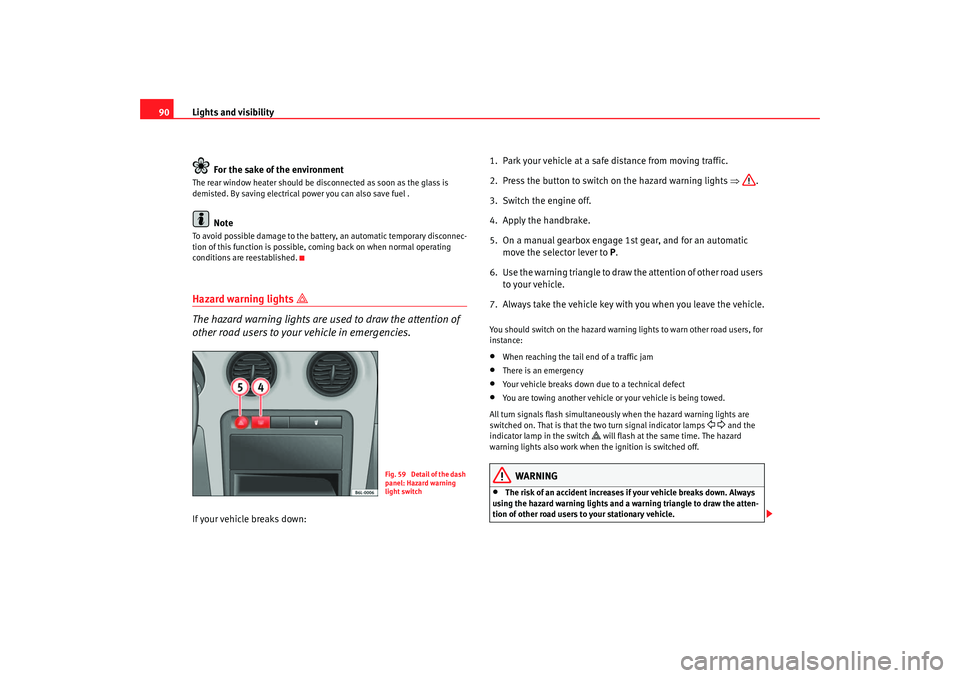
The hazard warning lights are used to draw the attention of
other road users to your vehicle in emergencies.
If your vehicle breaks down: 1. Park your vehicle at a safe distance from moving traffic.
2. Press the button to switch on the hazard warning lights ⇒
.
3. Switch the engine off.
4. Apply the handbrake.
5. On a manual gearbox engage 1st gear, and for an automatic move the selector
lever to P.
6
. Use the warning triangle to draw the attention of other road users
to your vehicle.
7. Always take the vehicle key with you when you leave the vehicle.
You should switch on the hazard warning lights to warn other road users, for
instance:•
When reaching the tail end of a traffic jam
•
There is an emergency
•
Your vehicle breaks down due to a technical defect
•
You are towing another vehicle or your vehicle is being towed.
All turn signals flash simultaneously when the hazard warning lights are
switched on. That is that the two turn signal indicator lamps
and the
indicator lamp in the switch
will flash at the same time. The hazard
warning lights also work when the ignition is switched off.
WARNING
•
The risk of an accident increases if your vehicle breaks down. Always
using the hazard warning lights and a warning triangle to draw the atten-
tion of other road users to your stationary vehicle.
Fig. 59 Detail of the dash
panel: Hazard warning
light switch
ibiza_ingles Seite 90 Mittwoch, 5. Oktober 2005 5:17 17
Page 110 of 252

Seats and stowage
108Front cup holder* To o p e n
– Press on the edge of cup holder, this opens with a spring action.
To close
– Press the cup holder until it is completely closed.
WARNING
•
Never place hot drinks in the drink holders. During normal or sudden
driving manoeuvres, sudden braking or an accident, the hot drink could be
spilled. Danger of scalding.
•
Never use rigid materials (for example, glass or ceramic), these could
cause injury in the case of an accident.
•
When travelling the drinks holder should always be closed to prevent
risk in the event of sudden breaking or accident.
Rear cup holder* On the rear part of the centre console, behind the hand brake, there is a
drinks holder installed* ⇒ fig. 80.
Fig. 79 Front cup holder
in the centre console
Fig. 80 Cupholder in the
centre console
ibiza_ingles Seite 108 Mittwoch, 5. Oktober 2005 5:17 17
Page 130 of 252

Driving
128Glow plug system for the diesel engine
To avoid unnecessary load on the battery, do not use any other major elec-
trical equipment while the glow plugs are pre-heating.
Start the engine as soon as the glow plug warning lamp ⇒page 63 goes out.
Starting the engine after the fuel tank has been completely run dry
If the fuel tank has been completely run dry, it may take longer than normal
(up to one minute) to start the engine afte r refuelling with diesel fuel. This is
because the system must eliminate air first.
WARNING
•
Never start or run the engine in un ventilated or closed rooms. The
exhaust fumes contain carbon mono xide, an odourless and colourless
poisonous gas. Risk of fatal accidents. Carbon monoxide can cause loss of
consciousness. It can also cause death.
•
Never leave the vehicle unattended if the engine is running.
•
Never use “cold start sprays”, they could explode or cause the engine
to run at high revs. Risk of injury.Caution
•
When the engine is cold, you should av oid high engine speeds, driving at
full throttle and over-loading the engine. Risk of engine damage.
•
The vehicle should not be pushed or towed for more than approximately
50 metres to start the engine. Fuel could enter the catalytic converter and
damage it.
•
Before attempting to push-start or tow a vehicle to start it, you should first
try to start it using the battery of another vehicle. Note and follow the instruc-
tions ⇒page 214, “Jump-starting”.
For the sake of the environment
Do not warm-up the engine by running th e engine with the vehicle stationary.
You should drive off as soon as you start the engine. This helps the engine
reach operating temperature faster and reduces emissions.Switching off the engine– Stopping the engine.
– Turn the ignition key to position ⇒page 125, fig. 94 .After the engine is switched off the radiator fan may run on for up to 10
minutes, even if the ignition is switched of f. It is also possible that it will turn
itself on once more if the temperature of the coolant increases due to the
elimination of built up heat in the engine compartment or if this is heated due
to prolonged exposure to the heat of the sun.
WARNING
•
Never switch off the engine until the vehicle is stationary.
•
The brake servo works only when the engine is running. You will need
more strength to brake the vehicle when the engine is switched off. As you
cannot brake in the normal manner, there is a greater risk of accidents and
serious injury.
•
The steering lock can engage immediately when the key is removed
from the ignition lock. The vehicle cannot be steered. Risk of accident.
A0
ibiza_ingles Seite 128 Mittwoch, 5. Oktober 2005 5:17 17
Page 133 of 252

Driving131
Safety First
Operating instructions
Tips and Maintenance
Te c h n i c a l D a t a
Selector lever lock functions
The selector lever lock in positi on P or N prevents gears from
being engaged inadvertently, which would cause the vehicle
to move.
The selector lever lock is released as follows:
– Switch on the ignition.
– Press and hold the brake pedal and press the selector lever lock
on the left of the selector lever at the same time.A delay device prevents the lever form blocking, on gently passing through
position N (f or example, from R to D). T
his ma
kes it possible, if the car is
stuck, to remove it “by swinging it”. Only when the lever is in position N for
more than 1 second, without pressing th e brake, does the lever block come
into operation.
At speeds of over 5 km/h the selector lever lock is automatically blocked in
posit ion N.
Selector lever positionsP - parking lock
This is the correct position for parking the vehicle. To enga ge and disengage P
press the button on the gearstick knob and depress the brake pedal, while
the car is running.
If the car is not running, it can be unlocked by pressing the knob button.
R - reverse gear
This should only be engaged when the vehicle is at a standstill and the
engine idling. Before engaging position R, starting from position P or N,
depress the brake pedal and press the button on the gearstick knob.
In position R and with the ignition on, th e reversing lights come on.
Fig. 97 Section of centre
console: selector lever on
cars with an automatic
gearboxFig. 98 Instrument panel
display: selector lever
locked in position P
ibiza_ingles Seite 131 Mittwoch, 5. Oktober 2005 5:17 17
Page 134 of 252

Driving
132N - neutral (idling)
To take the lever out of position N at speeds of below 5 km/h or when the car
is at a standstill but the ignition is switched on, depress the brake pedal and
press the lock button on the gearstick knob.
D - Drive (forwards)
The four gears automatically change up or down, depending on engine load
and vehicle speed.
In certain conditions it is preferable to place the selector lever provisionally in
one of the positions described below:
3 - Position for uneven surfaces
Gears 1st, 2nd and 3rd automatically change up or down depending on the
engine load and vehicle speed. 4th gear is blocked. This increases the engine
braking effect when decelerating.
This position is recommended when in position D and under certain driving
conditions, there are frequent changes between 3rd and 4th.
2 - Position for hilly roads
Position recommended for long slopes.
1st and 2nd gear change automatically depending on engine load and vehicle
speed. 3rd and 4th do not operate.
1 - Position for very steep slopes or manoeuvres
Recommended position for extreme slopes.
The vehicle only travels in 1st gear. 2nd, 3rd and 4th are blocked.
The cruise control* can not be used in position 1.
Caution
Never move the selector lever to R or P when driving. This could damage the
gearbox. Risk of accident!
Note
The selector lever can be pla c
ed in positions 3, 2 and 1
when the change is
made
manually, but the automatic gearbox does not change to a lower gear
until the number of rev olutions is appropriate.
Kick-down featureThis system allows maximum acceleration. When the accelerator is
depressed to full throttle, and depending on the vehicle speed and engine
speed, the lowest gear is engaged. As soon as the maximum engine speed
for that gear is reached, the next gear up is engaged.
WARNING
Remember that the drive wheels may skid if the kick-down featue is acti-
vated when driving on icy or slippery roads. Danger of skidding!Instructions for drivingStarting
The engine can only be started when the selector lever is at N or
P ⇒ page 126.
Selecting a range
When the car is at a standstill and the engine is running, always depress the
brake pedal before selecting a range.
Do not accelerate on selecting a range when the engine is at a standstill
ibiza_ingles Seite 132 Mittwoch, 5. Oktober 2005 5:17 17
Page 135 of 252

Driving133
Safety First
Operating instructions
Tips and Maintenance
Te c h n i c a l D a t a
If, while driving, the selector lever accidentally moves to position
N, first
release the accelerator pedal and wait un til the engine slows to idling before
selecting a forwards gear ⇒ .
Starting
Select a range ( R, D, 3, 2, 1). Wait until the change has taken place and the
power transmission of the drive wheels has stabilised (slight pressure is
noticeable). Then depress the accelerator.
Stopping
In the case of a temporary stop, for example at a traffic lights, it is not neces-
sary to move to position N, it is sufficent to brake using the brake pedal. The
engine should only run at idle speed.
Parking
On slopes, first pull handbrake on firmly and then connect block. This
prevents overloading the blocking mechanism, making the subsequent
disconnection easier ⇒ .
Emergency start
in vehicles fitted with an automatic gearbox the engine can not be started by
towing or pushing the vehicle ⇒page 217
If the vehicle battery is flat, a battery from another car can be used to jump-
start the car using a set of jump leads ⇒ page 126
To w i n g
If the vehicle requires towing at any time, observe the instructions of
⇒ page 217, “Towing and tow-starting”.
Back-up programme
In the event of a malfunction of the gearbox electronics, emergency
programmes are activated, according to the type of fault.
•
The gearbox continues to connect gears automatically, but the operations
are jerky. Consult the Authorised Service Centre.
•
The gearbox does not automatically engage gears.
In this case they can be changed manually. 3rd gear is only ava ilable in posi-
tions D, 3 and 2 of the selector lever.
In positions 1 and R of the selector lever 1st gear and reverse gear are availa ble
respectively as normal
As the torque converter is required to work more, especially due to the lack of
2nd gear, it is possible that the gearbox oil may overheat. In this case, consult
the Authorised Service Centre as soon as possible.
WARNING
•
In all the ranges the vehicle must always be held with the foot brake
when the engine is running. This is because an automatic gearbox still
transmits power even at idling speed, and the vehicle tends to “creep”.
•
If, when the car is at a standstill and the engine is idling, a range is
connected, take care not to accelerate accidentally (for example, when
working in the engine compartment), as the car will start to move immedi-
ately.
•
Before working on a running engine, place the selector lever in position
P and apply the handbrake.
•
To prevent the vehicle from moving out of control, the handbrake
should always be applied when the vehi cle is at a standstill. In addition
move the selector lever to position P.
ibiza_ingles Seite 133 Mittwoch, 5. Oktober 2005 5:17 17
Page 136 of 252
Driving
134HandbrakeUsing the handbrake
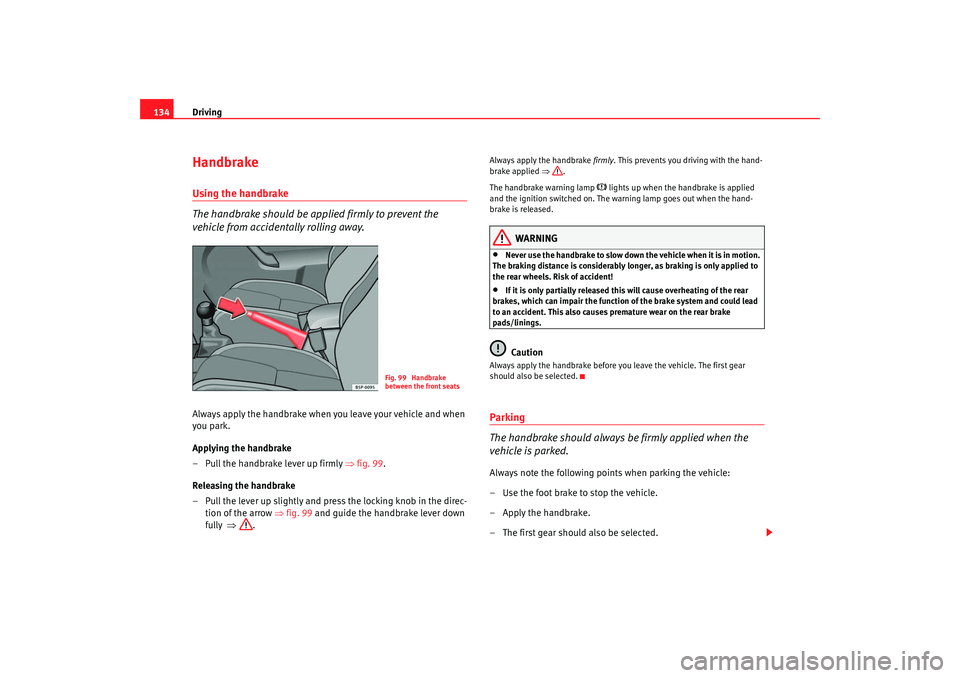
The handbrake should be applied firmly to prevent the
vehicle from accidentally rolling away.Always apply the handbrake when you leave your vehicle and when
you park.
Applying the handbrake
– Pull the handbrake lever up firmly ⇒fig. 99 .
Releasing the handbrake
– Pull the lever up slightly and press the locking knob in the direc- tion of the arrow ⇒fig. 99 and guide the handbrake lever down
fully ⇒ .
Always apply the handbrake firmly. This prevents you driving with the hand-
brake applied ⇒.
The handbrake warning lamp
lights up when the handbrake is applied
and the ignition switched on. The warning lamp goes out when the hand-
brake is released.
WARNING
•
Never use the handbrake to slow down the vehicle when it is in motion.
The braking distance is considerably longer, as braking is only applied to
the rear wheels. Risk of accident!
•
If it is only partially released this will cause overheating of the rear
brakes, which can impair the function of the brake system and could lead
to an accident. This also causes premature wear on the rear brake
pads/linings.Caution
Always apply the handbrake before you leave the vehicle. The first gear
should also be selected.Parking
The handbrake should always be firmly applied when the
vehicle is parked.Always note the following points when parking the vehicle:
– Use the foot brake to stop the vehicle.
–Apply the handbrake.
– The first gear should also be selected.
Fig. 99 Handbrake
between the front seats
ibiza_ingles Seite 134 Mittwoch, 5. Oktober 2005 5:17 17
Page 137 of 252

Driving135
Safety First
Operating instructions
Tips and Maintenance
Te c h n i c a l D a t a
– Switch off the engine and remove the key from the ignition lock.
Turn the steering wheel slightly to engage the steering lock.
– Always take you car keys with you when you leave the vehicle ⇒ .Additional notes on parking the vehicle on gradients:
Turn the steering wheel so that the vehicle would roll against the kerb if it did
start to roll.•
If the vehicle is facing downhill, turn the front wheels so that they point
towards the kerb.
•
If the vehicle is facing uphill , turn the front wheels so that they point away
from the kerb .
•
Secure the vehicle as normal by applying the handbrake firmly and
selecting first gear.
WARNING
•
Take measures to reduce the risk of injury when you leave your vehicle
unattended.
•
Never park where the hot exhaust system could ignite inflammable
materials, such as dry grass, low bushes, spilt fuel etc.
•
Never allow vehicle occupants to re main in the vehicle when it is
locked. They would be unable to open the vehicle from the inside, and
could become trapped in the vehicle in an emergency. In the event of an
emergency, locked doors will delay assistance to occupants.
•
Never leave children unsupervised in the vehicle. They could set the
vehicle in motion, for example, by releasing the handbrake or the gear
lever / selector lever.
•
Depending on weather conditions, it may become extremely hot or cold
inside the vehicle. This can be fatal.
Cruise control system (CCS)*Description
The cruise control system is able to maintain the set speed in
the range from approx. 30 km/h to 180 km/h.Once the speed setting has been saved, you may take your foot off the accel-
erator.
WARNING
It could be dangerous to use the cruise control system if it is not possible
to drive at constant speed.•
For safety reasons the cruise control system should not be used in
dense traffic, in sections with bends or where roads conditions are poor
(e.g. aquaplaning, loose chippings, slippery surfaces, snow). Risk of acci-
dent.
•
Always switch off the CCS when you have finished using it. This will
prevent you using it by mistake.
•
It is dangerous to use a set speed which is too high for the current road,
traffic or weather conditions. Risk of accident.Note
The cruise control cannot maintain a constant speed when descending gradi-
ents. The vehicle will accelerate under its own weight. Use the foot brake to
slow the vehicle.
ibiza_ingles Seite 135 Mittwoch, 5. Oktober 2005 5:17 17